| "Only dull people are brilliant at breakfast" -Oscar Wilde |
 |
"The liberal soul shall be made fat, and he that watereth, shall be watered also himself." -- Proverbs 11:25 |
"...you have a choice: be a fighting liberal or sit quietly. I know what I am, what are you?" -- Steve Gilliard, 1964 - 2007
"For straight up monster-stomping goodness, nothing makes smoke shoot out my ears like Brilliant@Breakfast" -- Tata
"...the best bleacher bum since Pete Axthelm" -- Randy K.
"I came here to chew bubblegum and kick ass. And I'm all out of bubblegum." -- "Rowdy" Roddy Piper (1954-2015), They Live
"For straight up monster-stomping goodness, nothing makes smoke shoot out my ears like Brilliant@Breakfast" -- Tata
"...the best bleacher bum since Pete Axthelm" -- Randy K.
"I came here to chew bubblegum and kick ass. And I'm all out of bubblegum." -- "Rowdy" Roddy Piper (1954-2015), They Live


Brilliant Recent Posts
There's nothing new under the sunAu revoir, y'all....
So Long and Thanks for All the Gefilte Fish
Like White on Rice
Why Did Hillary Clinton Hire a Monsanto Lobbyist t...
Virtual Book Sale
The Man Who Poisoned America
We are privileged to be alive today
The Prodigal Blogger Stops By
Good Times at Pottersville, 3/14/15
Brilliant at Searching
Brilliant Stuff to Buy
What's on my mind:
Brilliant Archives
Brilliant at Begging
Like what you read?Please consider supporting B@B with a donation: There is no gift like the present.
But gifts are nice too:


Feed Me!





Stuff You Must Read
Monday, December 03, 2012
Obama's sting operation
Krugman nails the trap that President Obama has laid for the Republicans (NYT):
Not a day goes by that I don't thank the Goddess that this country regained sufficient sanity to keep Willard Rmoney out of the White House, to put Paul Ryan back where he can do little damage in the face of other Congresscritters who can't get re-elected in two years if seniors and others turn on them, and to keep the Senate out of the hands of the Republicans.
For eight years, under George W. Bush, Republicans rubberstamped a 48.6 increase in Federal spending. Borrowed money paid for two simultaneous wars fought with little accountability at the same time that the wealthiest Americans enjoyed tax cuts. While government spending increased by 70%, revenue increased by only 25%. One would think that Republicans deliberately decided to drive the country into bankruptcy in order to end up right where we are now. Gone and forgotten is Dick Cheney's assertion that deficits don't matter. With a Democrat in the White House, Republicans decided that suddenly deficits DO matter -- especially during a recession, when austerity would be the worst thing to do to an economy in a fragile recovery. What is astonishing is that over 40% of Americans were unable to put this together during the last election and give the Republicans an even MORE serious drubbing. That kind of cynical hypocrisy should be punished more severely than it was.
That the Republican pearl-clutching about the deficit is really about protecting their billionaire masters should not be a surprise to anyone. What makes them so pathetic is that they honestly believe that their slavish devotion to the Koch brothers, Sheldon Adelson, and other less-profile people for whom no amount of money will fill the gaping hole in their souls would give them a place at the table with these men as a reward for leaving a scorched husk where a great nation used to be. They have no idea that they too will be tossed in the trash along with the detritus of the lives of those death-eaters.
The point is that when you put Republicans on the spot and demand specifics about how they’re going to make good on their posturing about spending and deficits, they come up empty. There’s no there there.
And there never was. Republicans claim to be for much smaller government, but as a political matter they have always attacked government spending in the abstract, never coming clean with voters about the reality that big cuts in government spending can happen only if we sharply curtail very popular programs. In fact, less than a month ago the Romney/Ryan campaign was attacking Mr. Obama for, yes, cutting Medicare.
Now Republicans find themselves boxed in. With taxes scheduled to rise on Jan. 1 in the absence of an agreement, they can’t play their usual game of just saying no to tax increases and pretending that they have a deficit reduction plan. And the president, by refusing to help them out by proposing G.O.P.-friendly spending cuts, has deprived them of political cover. If Republicans really want to slash popular programs, they will have to propose those cuts themselves.
So while the fiscal cliff — still a bad name for the looming austerity bomb, but I guess we’re stuck with it — is a bad thing from an economic point of view, it has had at least one salutary political effect. For it has finally laid bare the con that has always been at the core of the G.O.P.’s political strategy.
Not a day goes by that I don't thank the Goddess that this country regained sufficient sanity to keep Willard Rmoney out of the White House, to put Paul Ryan back where he can do little damage in the face of other Congresscritters who can't get re-elected in two years if seniors and others turn on them, and to keep the Senate out of the hands of the Republicans.
For eight years, under George W. Bush, Republicans rubberstamped a 48.6 increase in Federal spending. Borrowed money paid for two simultaneous wars fought with little accountability at the same time that the wealthiest Americans enjoyed tax cuts. While government spending increased by 70%, revenue increased by only 25%. One would think that Republicans deliberately decided to drive the country into bankruptcy in order to end up right where we are now. Gone and forgotten is Dick Cheney's assertion that deficits don't matter. With a Democrat in the White House, Republicans decided that suddenly deficits DO matter -- especially during a recession, when austerity would be the worst thing to do to an economy in a fragile recovery. What is astonishing is that over 40% of Americans were unable to put this together during the last election and give the Republicans an even MORE serious drubbing. That kind of cynical hypocrisy should be punished more severely than it was.
That the Republican pearl-clutching about the deficit is really about protecting their billionaire masters should not be a surprise to anyone. What makes them so pathetic is that they honestly believe that their slavish devotion to the Koch brothers, Sheldon Adelson, and other less-profile people for whom no amount of money will fill the gaping hole in their souls would give them a place at the table with these men as a reward for leaving a scorched husk where a great nation used to be. They have no idea that they too will be tossed in the trash along with the detritus of the lives of those death-eaters.
Labels: deficits, Greedy Republican Bastards, hypocrisy, spending

Monday, October 18, 2010
Let's hear how they plan to cut over a trillion dollars in spending
Paul Krugman pointed out yesterday that when you have a recession and people are out of work, government revenues drop vs. expenditures:
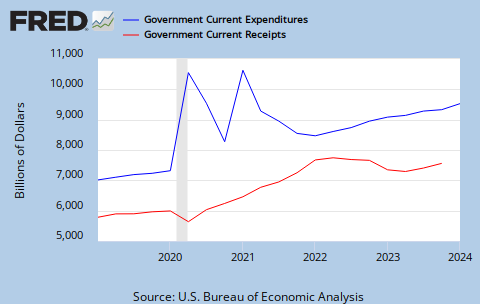
The Republicans would have you believe that if we "cut spending" and reduce tax revenue even further, the budget will be balanced. According to this graph, spending right now is about $5.3 trillion. Revenue is about $3.95 trillion. I wish someone would ask Republican candidates how they plan to cut over $1.3 trillion in spending. The Republican so-called "Pledge to America" pledges to cut spending back to 2008 levels, which still puts us at about $4.7 trillion. This pledge also comes with promises of FURTHER tax cuts, reducing revenue even more. Not even the most radical Republican plans, such as eliminating the Department of Education, will make a dent in that gap. Only dramatic cutbacks in military spending (which we never hear about, not even in the context of trying to find the billions that went missing in Iraq) AND the elimination of Social Security and Medicare (which ARE part of the Republican agenda) will.
Let's see how well candidates do who vocalize the Michele Bachmann line of setting age 60 as an arbitrary line in the sand and everyone else is shit out of luck. People like me who are 55 and have paid in for 38 years so that Republican presidents could steal the money and give it to their wealthy friends and patrons are really screwed. But even my younger co-workers aren't advocating for this.
I'm not surprised that teabag voters aren't asking their candidates where these "cuts" will come from. They really don't want to know.
The Republicans would have you believe that if we "cut spending" and reduce tax revenue even further, the budget will be balanced. According to this graph, spending right now is about $5.3 trillion. Revenue is about $3.95 trillion. I wish someone would ask Republican candidates how they plan to cut over $1.3 trillion in spending. The Republican so-called "Pledge to America" pledges to cut spending back to 2008 levels, which still puts us at about $4.7 trillion. This pledge also comes with promises of FURTHER tax cuts, reducing revenue even more. Not even the most radical Republican plans, such as eliminating the Department of Education, will make a dent in that gap. Only dramatic cutbacks in military spending (which we never hear about, not even in the context of trying to find the billions that went missing in Iraq) AND the elimination of Social Security and Medicare (which ARE part of the Republican agenda) will.
Let's see how well candidates do who vocalize the Michele Bachmann line of setting age 60 as an arbitrary line in the sand and everyone else is shit out of luck. People like me who are 55 and have paid in for 38 years so that Republican presidents could steal the money and give it to their wealthy friends and patrons are really screwed. But even my younger co-workers aren't advocating for this.
I'm not surprised that teabag voters aren't asking their candidates where these "cuts" will come from. They really don't want to know.
Labels: spending, taxes, Teabag America
Tuesday, January 26, 2010
Barack Obama's childhood baggage is worse than I thought
In Newsweek this week, Jacob Weisberg has a column on the problem Barack Obama's seeming aloofness is causing with his ability to appear to connect with Americans worried about jobs and the future. It's tempting to dismiss Weisberg out of hand, until you remember that not so long ago, thinking you might have a beer with the president was a qualification for office, and even now, thinking you might be able to FUCK the president seems to make Sarah Palin qualified for the office in the eyes of an alarming number of people.
Weisberg says that Obama's childhood made him self-sufficient to the point of seemingly not needing anyone:
There is one group that Obama seems to have a pathological need to please, and my ten-cent completely speculative and therefore worth what you paid for it psychoanalysis has to do with something he may have had to deal with during that time living with his grandparents -- winning over people who may have had to get over some of their own issues to raise their biracial grandson. The reason I keep having the sense of Obama having to ingratiate himself with people who may have had pre-existing issues is twofold: One reason is the infamous "typical white people" remark, in which he clumsily admitted that even his own grandmother had a visceral reaction to black people she didn't know -- a remark that had the chattering classes screeching for days. The other reason is the manifestation we see today of someone with a deep-seated need to ingratiate himself with people not inclined to do so, in this case, Republicans.
Because while Obama has shown himself to be willing to throw everyone otherwise inclined to have his back -- gays, working class people, the netroots, the black community -- under the bus without a second thought, the ONE group whose support he desperately wants and doesn't realize he can never have, is Republicans and those Republicans With D's After Their Names known as Blue Dogs.
And that is why, in the middle of a recession, when it's the ABSOLUTE WORST thing you can do for the economy, he's capitulating to Republicans and proposing a spending freeze on the very programs that serve the middle and working class:
Robert Reich explains why this is such a terrible idea:
Perhaps Rahm Emanuel told him this is the way for the justifiably endangered Evan Bayh to keep his Senate seat. Perhaps this is what Tim Geithner wants. But I suspect that it's deeper than that. I suspect that it's a more selective -- and more futile version of the same disease that plagues Bill Clinton -- a desperate need for approval. The difference is that at least Bill Clinton's need to be loved by everyone means that at least some of his supporters were appeased some of the time. Barack Obama only cares about the approval of those who will never, ever, as long as he lives, approve of him.
Weisberg says that Obama's childhood made him self-sufficient to the point of seemingly not needing anyone:
Obama's self-interpretation is so persuasive that it has largely preempted other interpretations. Telling his story in relation to his missing father, the son explains how in finding his identity he grew from anger and cynicism to deep social commitment. The lack of deep attachments in his life, however, is a different issue. To speculate, it may have more to do with his relationship with his mother. When Barry Obama was 10, his mother sent him from Indonesia back to live with her parents in Hawaii. She returned there after her second marriage ended, but when she went back to Indonesia a few years later, her teenage son chose to stay in Hawaii. This loving but physically distant relationship seems to have left Obama self-reliant to an unusual degree.
For a politician, emotional self-sufficiency is both asset and liability. On the positive side, it supports Obama's rationalism, his level-headedness in crisis, and his dispassionate decision making. On the negative, it can read as cold, aloof, or arrogant. It's healthy that Obama doesn't need the roar of the crowd for validation. It's a problem that the crowd seems to need more from him than he is able to provide.
There is one group that Obama seems to have a pathological need to please, and my ten-cent completely speculative and therefore worth what you paid for it psychoanalysis has to do with something he may have had to deal with during that time living with his grandparents -- winning over people who may have had to get over some of their own issues to raise their biracial grandson. The reason I keep having the sense of Obama having to ingratiate himself with people who may have had pre-existing issues is twofold: One reason is the infamous "typical white people" remark, in which he clumsily admitted that even his own grandmother had a visceral reaction to black people she didn't know -- a remark that had the chattering classes screeching for days. The other reason is the manifestation we see today of someone with a deep-seated need to ingratiate himself with people not inclined to do so, in this case, Republicans.
Because while Obama has shown himself to be willing to throw everyone otherwise inclined to have his back -- gays, working class people, the netroots, the black community -- under the bus without a second thought, the ONE group whose support he desperately wants and doesn't realize he can never have, is Republicans and those Republicans With D's After Their Names known as Blue Dogs.
And that is why, in the middle of a recession, when it's the ABSOLUTE WORST thing you can do for the economy, he's capitulating to Republicans and proposing a spending freeze on the very programs that serve the middle and working class:
President Obama will call for a three-year freeze in spending on many domestic programs, and for increases no greater than inflation after that, an initiative intended to signal his seriousness about cutting the budget deficit, administration officials said Monday.
The officials said the proposal would be a major component both of Mr. Obama’s State of the Union address on Wednesday and of the budget he will send to Congress on Monday for the fiscal year that begins in October.
The freeze would cover the agencies and programs for which Congress allocates specific budgets each year, including air traffic control, farm subsidies, education, nutrition and national parks.
But it would exempt security-related budgets for the Pentagon, foreign aid, the Veterans Administration and homeland security, as well as the entitlement programs that make up the biggest and fastest-growing part of the federal budget: Medicare, Medicaid and Social Security.
The payoff in budget savings would be small relative to the deficit: The estimated $250 billion in savings over 10 years would be less than 3 percent of the roughly $9 trillion in additional deficits the government is expected to accumulate over that time.
The initiative holds political risks as well as potential benefits. Because Mr. Obama plans to exempt military spending while leaving many popular domestic programs vulnerable, his move is certain to further anger liberals in his party and senior Democrats in Congress, who are already upset by the possible collapse of health care legislation and the troop buildup in Afghanistan, among other things.
Fiscally conservative Democrats in the House and Senate have urged Mr. Obama to support a freeze, and it would suggest to voters, Wall Street and other nations that the president is willing to make tough decisions at a time when the deficit and the national debt, in the view of many economists, have reached levels that undermine the nation’s long-term prosperity. Perceptions that government spending is out of control have contributed to Mr. Obama’s loss of support among independent voters, and concern about the government’s fiscal health could put upward pressure on the interest rates the United States has to pay to borrow money from investors and nations, especially China, that have been financing Washington’s budget deficit.
Republicans were quick to mock the freeze proposal. “Given Washington Democrats’ unprecedented spending binge, this is like announcing you’re going on a diet after winning a pie-eating contest,” said Michael Steel, a spokesman for the House Republican leader, Representative John A. Boehner of Ohio.
Robert Reich explains why this is such a terrible idea:
A spending freeze will make it even harder to get jobs back because government is the last spender around. Consumers have pulled back, investors won’t do much until they know consumers are out there, and exports are minuscule.
Jobs may be coming back a bit in the next months but the country has lost so many (not to mention all those who have entered the workforce over the last two years and still can’t land a job) that it will be many years before the middle class can relax. Furthermore, this recession isn’t like other recessions in recent memory. It has more to do with problems deep in the structure of the American economy than with the ups and downs of the business cycle.
Like Clinton’s, Obama’s package of middle-class benefits is small potatoes. They’re worthwhile but they pale relative to the size and scale of the challenge America’s middle class is now facing. Obama can no longer afford to come up with lists of nice things to do. At the least, he’s got to do two very big and important things: 1) Enact a second stimulus. It should mainly focus on bailing out state and local governments that are now cutting services and raising taxes, and squeezing the middle class. This would be the best way to reinvigorate the economy quickly. 2) Help distressed homeowners by allowing them to include their mortgage debt in personal bankruptcy -- which will give them far more bargaining leverage with mortgage lenders. (Wall Street hates this.)
Yet instead of moving in this direction, Obama is moving in the opposite one. His three-year freeze on a large portion of discretionary spending will make it impossible for him to do much of anything for the middle class that’s important.
Perhaps Rahm Emanuel told him this is the way for the justifiably endangered Evan Bayh to keep his Senate seat. Perhaps this is what Tim Geithner wants. But I suspect that it's deeper than that. I suspect that it's a more selective -- and more futile version of the same disease that plagues Bill Clinton -- a desperate need for approval. The difference is that at least Bill Clinton's need to be loved by everyone means that at least some of his supporters were appeased some of the time. Barack Obama only cares about the approval of those who will never, ever, as long as he lives, approve of him.
Labels: Barack Obama, budget, futility, nickel psychology, spending
Monday, July 02, 2007
When the president deems it meritorious, it is not pork
Libby at Newshoggers points out that when it comes to bills laden with extraneous spending, the biggest profligate is George W. Bush:
I'd call it hypocrisy. I'd also call it another example of his pathological narcissism.
A House Appropriations Committee report accompanying legislation funding the Department of the Interior shows that Bush requested 93 of the 321 earmarks in the bill. A panel report for the financial services and general government spending bill showed that Bush requested 17 special projects worth $947 million, more than any single member of Congress.
Senate appropriators have identified more than 350 earmarks in the military construction spending bill requested by the president.
Lawmakers say these lists of earmarks are inconsistent with Bush’s tough talk on earmarks this year.
During a Rose Garden speech in January, Bush called for the number of earmarks to be cut in half.
“Earmarks often divert precious funds from vital priorities like national defense,” Bush said. “And each year they cost the taxpayers billions of dollars.
“Congress needs to adopt real reform that requires full disclosure of the sponsors, the costs, the recipients, and the justifications for every earmark,” he said. “And Congress needs to cut the number and cost of earmarks next year at least in half.”
When Bush recently nominated former House Budget Committee Chairman Jim Nussle (R-Iowa) as head of the White House budget office, he reminded Congress that he would veto bills with excessive levels of spending and curb the number of earmarks.
“It would appear the administration likes earmarks from their perspective,” said Rep. Robert Aderholt (Ala.), a Republican member of the House Appropriations Committee.
“Inconsistent would be a fair way to say it,” Aderholt said when asked if Bush was being hypocritical for simultaneously requesting and criticizing earmarks.
Sen. Larry Craig (R-Idaho), the chairman of the Senate Appropriations interior subcommittee, shares Aderholt’s view.
“Hypocrisy? No, but one might call that duplicity,” said Craig.
I'd call it hypocrisy. I'd also call it another example of his pathological narcissism.
Labels: George W. Bush, narcissism, spending
Other Brilliant Bloggers
DriftglassCorrente
Hullabaloo
Hoffmania
Orcinus
Scoobie Davis
Talking Points Memo
World O'Crap
Fact-esque
Liberal Oasis
Oliver Willis
Talk Left
This Modern World
Philip Barron
Rising Hegemon
AMERICABlog
James Wolcott
Skippy the Bush Kangaroo
Dependable Renegade
The Political Carnival
Astrological Musings
Firedoglake
Spiiderweb
Words of Power
RIPCoco
Kung Fu Monkey
Empire Burlesque
WTF is it Now
Down With Tyranny
Welcome Back to Pottersvillle
Spocko's Brain
The Sideshow
The Ostroy Report
Fallenmonk
Three Wise Men
NewsHoggers
Blue Gal
Blah3
Shadow of the Hegemon
Slacktivist
ShortWoman
Echidne of the Snakes
Jesus' General
My Left Wing
Arthur Silber
Republic of T
Bitch Ph.D
The American Street
Comments from Left Field
Balloon Juice
I Can't Believe It's Not a Democracy
Scholars and Rogues
On My Mind
PhysioProf
The Vulgar Curmudgeon
Monkeyfister
Sasha Undercover
ThePoliticalCat
Fables of the Reconstruction
Talk2Action
D-Day
State of the Day
Just an Earth-Bound Misfit
Bradblog
They Gave Us a Republic
Vagabond Scholar
Seeing the Forest
The Reaction
Orcinus
SteveAudio
Princess Sparkle Pony
Paul Levinson
Politics After 50
The Jed Report
One Utah
Sam Seder
Alternet
The Political Carnival
County Fair
Mudflats
A Feather Adrift
That's Why
Disciples of Joe
No Longer Quivering
Margaret and Helen
Stand With Dr. Dean
All the Good Names Were Taken
Badtux the Snarky Penguin
My Mental Dumping Ground
Legal Schnauzer
Alicublog
Bouphonia
Konagod
The Reverse Spin
City of Angels
The Gospel According to Hate
Menopausal Stoners
Stinque
The New York Crank
BP Oil Slick
Pen-Elayne
Inside-Out the Beltway
Reclusive Leftist
Southern Beale
The Moderate Voice
The Rant
Help the 99ers
Brendan Calling
Matt Taibbi
I Was Told There Would Be Bacon
We Don't Agree, But...
ShortWoman
of mule dung and ash
Cookies in Heaven
The Hunting of the Snark
The Policy Page (Rick Ungar)
Ramona's Voices
Sardonicky
Dagblog
The Titanic Sails At Dawn
Cheese Food Nation
Donkey Mountain
Thump and Whip
Under the Lobsterscope
Addicting Info
Wifely Person
Disaffected and it Feels So Good
Reality Chex
Burnt Orange Report
Salmon Alley
The Politics Blog w/Charles Pierce
Elizabitchez
We Are The 99 Percent.
Republic of Gilead
amigoingsomeplace
Fukushima Diary
The Polygon
Degringolade
Onyx Lynx
Parsley's Pics
Mainmati
Brandflakes for Breakfast
The Economic Populist
Liberal Dan
Ex-Amish Atheist
The Poor Man's Huffington Post
Constant Commoner
Channel Surfing
Big Bad Bald Bastard
Panic in Funland (Tbogg!!!)
Weird Wally's Worldview
Brilliant Furriners
Because we all may have to live somewhere else someday.The Galloping Beaver (Canada)
Cathie from Canada
How This Old Brit Sees It ...
Stunner's Afflictions (Jamaica)
Jamaican Lifestyle
Heathers
Pulling up the ladderbehind them
Daily Kos
Atrios
Open Left


CeleBloggers
Roger EbertDispatches from the Island &
Further Dispatches
(Jorge Garcia)
Baseball Nerd
(Keith Olbermann)
FOK News Channel (ditto)
Brilliant at Tweeting
(We won't do it, but we'll follow them)Marc Maron
Sam Seder
Brendan McDonald
Johnny Weir
Melina
Lynn
Keith Olbermann
In Memoriam
(yes, we're getting tired of having to do this)

Break Room Live archives
Morning Sedition 3/04-12/05
A Brilliant Radio Show -
Morning Seditionists
Camp Butch (all the
Sedition you can eat)
Jim Earl and his
Big Page of Crap
Morning Remembrance
Steve Gilliard 1966-2007:
A Brilliant Blogger
The News Blog archive
NetSlaves article archive
Friends of Steve:
The Group News Blog
"Jon Swift" (Al Weisel) 1963-2010
Bats Left Throws Right (Doghouse Riley)
Brilliant at Disappearing
Maybe they've been raptured?Altercation
The All-Spin Zone
Baghdad Burning
Carrie's Nation
Little Country Lost
Cynical Nation
Pam's House Blend
photos1.blogger.com/blogger/397/497/320/bb_banner.1.jpg]^23004A00]coral]navy],](](]]]black],]3]8]20]1]2]3]3]1]2]3]1]1],](](]^235E3D00])])]^3Cimg^20src^3D^22)photos1.blogger.com/blogger/397/497/320/bb_banner.1.jpg^22]^22...you^20have^20a^20choice^3A^20be^20a^20fighting^20liberal^20or^20sit^20quietly.^20I^20know^20what^20I^20am^2C^20what^20are^20you^3F^22^20--^20^3Ca^20href^3D^22)stevegilliard.blogspot.com/2003/12/im-fighting-liberal-you-know-ive.html^22^20STYLE^3D^22color^3Awhite^3B^22^3ESteve^20Gilliard^2C^201966^20-^202007^3C/a^3E^3CBR^3E^22For^20straight^20up^20monster-stomping^20goodness^2C^20nothing^20makes^20smoke^20shoot^20out^20my^20ears^20like^20Brilliant@Breakfast^22^20--^20^3Ca^20href^3D^22)www.poorimpulsecontrol.net/blog^22^20STYLE^3D^22color^3Awhite^3B^22^3ETata^3C/a^3E],](],](](]black](](](]^23FDF2D7](](](]^23333](](](],]50]20],](](]^23FFF8DD])])]black]1.5]15],](](]^2398A45C])])]black]^23FFF8DD])])]^23666]30]^235E3E1A]^23622121],](](]^235E3E1A](],](]^235E3E1A]^23039]^2306C],](](]^23FFF8DD])])],](](]^23FFF8DD])])],](](]^23FFF8DD])])],](]^235E3E1A]^23666]15]3]25]20]^23808C43],](](],](],](](],](]black](](](],](](](],]^235C3E11](](](],](](]^23211104](](](](](],]^2336F]^23211104](],](]Posted^20by^20^24AUTH^20^7C^20^24TIME]20],](](]^23FFF8DD])])]^23FFF8DD])])]^23666]30]^235E3E1A]^23622121],](](]^235E3E1A](],](]^23333]^23039]^2306C]Contact]]]Home]^24HOME]First^20Page]Email^3A^3CBR^3Ebrilliantatbreakfast^20at^20gmail^20dot^20com]]]RSS]^24RSS]RSS^20Feed]Your^20Servers]]]Jill]rilliantatbreakfast.blogspot.com]]Melina])www.ripcoco.com]RIPCoco]Carrie])carriesnation.blogspot.com]Carrie^27s^20Nation]And^20occasionally...]]]jurassicpork])welcome-to-pottersville.blogspot.com]Welcome^20to^20Pottersville]Bob])bobrixon.blogspot.com]The^20Rix^20Mix]Tata])www.poorimpulsecontrol.net/blog]Poor^20Impulse^20Control]Spiiderweb])spiiderweb.blogspot.com]Spiiderweb]Other^20Brilliant^20Bloggers]]]Modern^20Fabulousity])modernfabulousity.blogspot.com]Modern^20Fabulousity]Pandagon])www.pandagon.net]Pandagon]Altercation])www.mediamatters.org/altercation]Altercation]Corrente])www.correntewire.com/]Corrente]Hullabaloo])digbysblog.blogspot.com]Hullabaloo]Hoffmania])www.hoffmania.com]Hoffmania]Orcinus])dneiwert.blogspot.com]Orcinus]Scoobie^20Davis])scoobiedavis.blogspot.com]Scoobie^20Davis]Talking^20Points^20Memo])talkingpointsmemo.com]Talking^20Points^20Memo]World^20O^27Crap])world-o-crap.com/blog]World^20O^27Crap]Fact-esque])casadelogo.typepad.com/factesque/]Fact-esque]Liberal^20Oasis])www.liberaloasis.com/]Liberal^20Oasis]Oliver^20Willis])www.oliverwillis.com/]Oliver^20Willis]Talk^20Left])www.talkleft.com/]Talk^20Left]The^20Talent^20Show])www.thetalentshow.org/]The^20Talent^20Show]Waveflux])www.waveflux.net]Waveflux]Rising^20Hegemon])rising-hegemon.blogspot.com/]Rising^20Hegemon]The^20Poor^20Man])www.thepoorman.net/]The^20Poor^20Man]AMERICABlog])www.americablog.org/]AMERICABlog]Needlenose])www.needlenose.com/]Needlenose]Brilliant^20NJ^20bloggers]]]^24ARCHIVE]^20]]Friends]]]Horm])blog.horm.org]Hallucinations^20Of^20Reabsorbed^20Mind]Phorm])p.horm.org]Another^20Phormation]Etc]]]^3Cimg^20src^3D^22)psyc.horm.org/barimg/bar_psycho.png^22^20width^3D^2280^22^20height^3D^2215^22^20alt^3D^22PsycHo^3A^20Free^20Template^20Generator^22^20style^3D^22border^3A^200px^20solid^20black^22^20/^3E]^24PSYCHO]PsycHo^3A^20Free^20Template^20Generator]^3Cimg^20src^3D^22)psyc.horm.org/barimg/bar_firefox.png^22^20width^3D^2280^22^20height^3D^2215^22^20alt^3D^22Get^20FireFox^21^22^20style^3D^22border^3A^200px^20solid^20black^22^20/^3E])www.mozilla.org/products/firefox/]Get^20Firefox^21]^3Cimg^20src^3D^22)psyc.horm.org/barimg/bar_xhtml.png^22^20width^3D^2280^22^20height^3D^2215^22^20alt^3D^22XHTML^20Validator^22^20style^3D^22border^3A^200px^20solid^20black^22^20/^3E])validator.w3.org/check/referer]XHTML^20Validator]]]]Home]^24HOME]First^20Page]Email]^24EMAIL]Mail^20me^21]RSS]^24RSS]RSS^20Feed]Archive]]]^24ARCHIVE]^20]]Friends]]]Horm])blog.horm.org]Hallucinations^20Of^20Reabsorbed^20Mind]Phorm])p.horm.org]Another^20Phormation]Etc]]]^3Cimg^20src^3D^22)psyc.horm.org/barimg/bar_psycho.png^22^20width^3D^2280^22^20height^3D^2215^22^20alt^3D^22PsycHo^3A^20Free^20Template^20Generator^22^20style^3D^22border^3A^200px^20solid^20black^22^20/^3E]^24PSYCHO]PsycHo^3A^20Free^20Template^20Generator]^3Cimg^20src^3D^22)psyc.horm.org/barimg/bar_firefox.png^22^20width^3D^2280^22^20height^3D^2215^22^20alt^3D^22Get^20FireFox^21^22^20style^3D^22border^3A^200px^20solid^20black^22^20/^3E])www.mozilla.org/products/firefox/]Get^20Firefox^21]^3Cimg^20src^3D^22)psyc.horm.org/barimg/bar_xhtml.png^22^20width^3D^2280^22^20height^3D^2215^22^20alt^3D^22XHTML^20Validator^22^20style^3D^22border^3A^200px^20solid^20black^22^20/^3E])validator.w3.org/check/referer]XHTML^20Validator^26^2361470^3BPsycHo})


