| "Only dull people are brilliant at breakfast" -Oscar Wilde |
 |
"The liberal soul shall be made fat, and he that watereth, shall be watered also himself." -- Proverbs 11:25 |
"For straight up monster-stomping goodness, nothing makes smoke shoot out my ears like Brilliant@Breakfast" -- Tata
"...the best bleacher bum since Pete Axthelm" -- Randy K.
"I came here to chew bubblegum and kick ass. And I'm all out of bubblegum." -- "Rowdy" Roddy Piper (1954-2015), They Live


Au revoir, y'all....
So Long and Thanks for All the Gefilte Fish
Like White on Rice
Why Did Hillary Clinton Hire a Monsanto Lobbyist t...
Virtual Book Sale
The Man Who Poisoned America
We are privileged to be alive today
The Prodigal Blogger Stops By
Good Times at Pottersville, 3/14/15
Please consider supporting B@B with a donation: There is no gift like the present.
But gifts are nice too:





MSM story and video link here.
Mike Stark at Daily Kos:
Today, in my capacity as field reporter for Air America and The Young Turks, I attended a political rally for George Allen. If given the opportunity, I intended to ask the Senator about his remarks concerning his opponents and his desire to "enjoy knocking their soft teeth down their whiny throats". I was wondering if that desire had anything to do with him deciding to do nothing when his campaign staff and supporters assaulted me last Tuesday.
Well, his supporters supported him again today. They really are a bunch of jock straps.
As the Senator finished his speech, I tried to ask my question. They did something that is absolutely acceptable. They shouted louder than me. "Six more years. Six more years!" Fair enough. They crowded between me and the Senator. Equally fair.
I however, saw an opening. There was no obstruction between me and the door through which the Senator had to pass in order to get to the tarmac. I made haste to establish position so that I could ask my question before the Senator left. I had just about arrived when I saw a blur out of my peripheral vision. A kid that had stood in front of me during Allen's speech (whispering things back and forth to whom I thought was his mom) just barely clipped my arm and took a dive.
There was a cop right there. "Why did you push him?" he asked as he grabbed my arms and began the process of handcuffing me. Of course, I did nothing of the sort. I knew the entire time that I was at that event that I needed to be on my best behavior. And I was.
I had been questioned hostily throughout the wait for the Senator and I answered all questions with patience, sincerity and politeness.
The beautiful part about all of this? There's video of everything that happened. Look for it soon.
In the meantime, I thought I'd help Senator Allen with his oppo research. He will certainly be putting out another press release detailing my sordid past. I want to get out in front of that and confess some stuff.
- 'tis tru that when I was in the sixth grade, I burped obnoxiously and disrupted class. For that, I was sent to the principle's office. It is a part of my permanent record.
- More than once, I've gone to bed at night without brushing my teeth.
- I sometimes sit too close to the TV
- I once grew my hair long and listened to heavy metal music.
- In my past, I engaged in pre-marital sex. Usually after drinking too much. Sometimes I regretted it.
- I'm a Darwinist. Yes, that's right, I believe in that radical thing called science ...
- I was once married to a Jewish girl. We divorced, and now I am one half of an inter-racial marraige. And we've created progeny.
Anyway, that stuff is a little juicier than the stuff in his last hit piece - that I actually engage in the electoral process and write about it on the internets

U.S. Rep. Katherine Harris, who has made past comments that raised questions about her religious sensitivity, prayed in a telephone prayer service recently that God would "bring the hearts and minds of our Jewish brothers and sisters into alignment."
A Harris spokeswoman said Friday that the Longboat Key Republican, who has advocated electing Christian officeholders, was talking about converting Jews to vote Republican, not to Christianity.
In a conference call prayer service sponsored by a religious conservative group on Oct. 3, Harris expressed the belief that Florida will lead the nation in a spiritual reawakening. She said that will include changes in government, including prayer in schools and changes in tax regulations on churches and charities.
"We just decree and declare there will be a shift for this nation, that there will be an enormous revival, even a revolution as we speak," she prayed. "Once again, we'll rejoice, rejoice with your Son and bring this nation into alignment with your government with your kingdom principles and authority."
So, Mr. Lieberman -- these are the people you're in bed with. Why not go for the whole enchilada and become one of them?
(h/t: Americablog)
(hat tip: Steve Gilliard)
Maliki, it's becoming clear, is as big a part of the problem in Iraq as al-Sadr and his gang of thugs and murderers. But President Bush is, well, staying the course with Maliki with all the obstinacy that he's displayed throughout his sojourn in Iraq.
The Iraqi prime minister threw the idea of benchmarks for progress toward disarming the Iraqi militias and standing up competent and capable Iraqi army and police units back in the administration's face last week.
Then, this week, he ordered American troops to pull down their security checkpoints around al-Sadr's power base in Baghdad's Sadr City, home to 2 million Shia.
American troops had sealed off all the routes in and out of the neighborhood in an attempt to find an Iraqi-born American soldier who's believed to have been kidnapped by the Mahdi Army militiamen.
Maliki obviously is never going to have any part of disarming the Mahdi militia, the Badr Corps or any other Shiite militia, as his nation descends into civil war. He doesn't trust the Iraqi army or police any more than anyone else does. If there's going to be a fight to the finish, Maliki wants the deck stacked in favor of the Shiites.
What Washington wants is irrelevant and immaterial to Maliki at this point. Benchmarking and videoconferences with President Bush and rush visits to Baghdad by national security adviser Stephen Hadley won't make any difference.
As we approach a December benchmark -- standing up 330,000 ill-trained, ill-equipped and unreliable Iraqi army and police units who aren't up to the job of keeping the lid from blowing off -- Defense Secretary Donald H. Rumsfeld announced that he's inclined to approve a plan to add 30,000 more Iraqi troops to that force.
That guarantees that American trainers and advisers to the Iraqi forces, as well as the other 147,000 embattled U.S. troops, will remain in Iraq for the foreseeable future unless the newly independent Maliki orders all of them to go home.
As if 30,000 more Iraqi troops, with the same hasty training, questionable leadership and ambiguous loyalties as the first bunch, might somehow make a difference.
In a war full of futile gestures, that one takes the cake, Mr. Secretary.
[snip]
The most recent polls indicate that the number of Iraqis who want us out of there is approaching 70 percent. It may be ironic that the number of Americans who want us out of there, too, is nearing the same percentage.
They want us to leave. We want us to leave.
There's nothing standing in the way of satisfying both majorities except a president, a vice president and a defense secretary who are willing to fight to the last man -- willing to drive our military to utter destruction -- before they'll admit that they were wrong, wrong, wrong from deluded beginning to wretched end.
Campaign Trail Counter-Programming
By Nicholas Confessore
They’re baaaaaaaaaack.
The pro-Joe Lieberman, anti-Ned Lamont protestors that Mr. Lamont’s supporters dubbed the “LieberKidz.”
We last saw them dogging Mr. Lamont during the heated Senate primary, and today they showed up in force at the morning kickoff of Mr. Lamont’s “Stand Up For Change” bus tour, day two, mobbing the parking lot of a Hartford residence for the elderly, and cheering “Vote for Joe” as Mr. Lamont tried to speak with some of the residents.
Mr. Lamont’s staff, somewhat outnumbered by the three dozen or so Lieberman supporters, looked annoyed.
“This is what you can do with $387,000 in petty cash,” fumed Mr. Lamont’s spokeswoman, Liz Dupont-Diehl, referring to the as-yet-unexplained, unusually large petty cash fund Mr. Lieberman maintained during the closing days of the primary.
Later, on the bus, Mr. Lamont weighed in. “I wish Senator Lieberman has showed up for the debate last night,” he said, referring to a debate held with his G.O.P. opponent, Alan Schlesinger, which Mr. Lieberman declined to attend.
TRex from Firedoglake also weighs in:
Day Two of the Big Bad Bus Tour isn't exactly off to a good start. This morning's first rally was to be outdoors at the Percival Smith Towers Senior Center. Before the event was even underway, a crowd of Lieberman supporters turned up. They have a fake voting booth set up in the bed of a Toyota 4×4 and speakers that play that insipid jingle, ("When you're in the voting booth/Watch out for the LieberYouth…") over and over and OVER. It looks like a porta-potty on wheels and the music coming out of it is akin to the smell one would expect from such an enclosure.
They started out at the street, holding signs and chanting, a clot of 25 to 30 thick-necked Young Republican types. Then they moved up the driveway to the Senior Center and blocked the bus. They formed a noisy, chanting mob around the bus door and blocked anyone from getting out. Eventually Ned and some others managed to push out through the crowd, but the noise only increased and the LieberYouth pressed tighter, chanting so that the news cameras and microphones couldn't pick up a word Ned was saying.
It was an ugly and intense little scene. The few seniors who had come outside were rushed back in by the Percival Smith staff. I did manage to ask one bright-eyed little senior lady what she thought of all this, but she just pointed at her temple and twirled her finger in the universal sign for "crazy" and then she was whisked away by a staffer.
So this is what it has come down to, Mr. Lieberman? Sending your thugs out to physically intimidate old people? Nice. Classy.
For more information and updates on the shandeh far di goyim that is Joe Lieberman and his Band of Brownshirts, check out ConnecticutBLOG.
Time for Rumsfeld to go
"So long as our government requires the backing of an aroused and informed public opinion ... it is necessary to tell the hard bruising truth."
That statement was written by Pulitzer Prize-winning war correspondent Marguerite Higgins more than a half-century ago during the Korean War.
But until recently, the "hard bruising" truth about the Iraq war has been difficult to come by from leaders in Washington. One rosy reassurance after another has been handed down by President Bush, Vice President Cheney and Defense Secretary Donald Rumsfeld: "mission accomplished," the insurgency is "in its last throes," and "back off," we know what we're doing, are a few choice examples.
Military leaders generally toed the line, although a few retired generals eventually spoke out from the safety of the sidelines, inciting criticism equally from anti-war types, who thought they should have spoken out while still in uniform, and pro-war foes, who thought the generals should have kept their critiques behind closed doors.
Now, however, a new chorus of criticism is beginning to resonate. Active-duty military leaders are starting to voice misgivings about the war's planning, execution and dimming prospects for success.
Army Gen. John Abizaid, chief of U.S. Central Command, told a Senate Armed Services Committee in September: "I believe that the sectarian violence is probably as bad as I've seen it ... and that if not stopped, it is possible that Iraq could move towards civil war."
Last week, someone leaked to The New York Times a Central Command briefing slide showing an assessment that the civil conflict in Iraq now borders on "critical" and has been sliding toward "chaos" for most of the past year. The strategy in Iraq has been to train an Iraqi army and police force that could gradually take over for U.S. troops in providing for the security of their new government and their nation.
But despite the best efforts of American trainers, the problem of molding a viciously sectarian population into anything resembling a force for national unity has become a losing proposition.
For two years, American sergeants, captains and majors training the Iraqis have told their bosses that Iraqi troops have no sense of national identity, are only in it for the money, don't show up for duty and cannot sustain themselves.
Meanwhile, colonels and generals have asked their bosses for more troops. Service chiefs have asked for more money.
And all along, Rumsfeld has assured us that things are well in hand.
Now, the president says he'll stick with Rumsfeld for the balance of his term in the White House.
This is a mistake.
It is one thing for the majority of Americans to think Rumsfeld has failed. But when the nation's current military leaders start to break publicly with their defense secretary, then it is clear that he is losing control of the institution he ostensibly leads.
These officers have been loyal public promoters of a war policy many privately feared would fail. They have kept their counsel private, adhering to more than two centuries of American tradition of subordination of the military to civilian authority.
And although that tradition, and the officers' deep sense of honor, prevent them from saying this publicly, more and more of them believe it.
Rumsfeld has lost credibility with the uniformed leadership, with the troops, with Congress and with the public at large. His strategy has failed, and his ability to lead is compromised. And although the blame for our failures in Iraq rests with the secretary, it will be the troops who bear its brunt.
This is not about the midterm elections. Regardless of which party wins Nov. 7, the time has come, Mr. President, to face the hard bruising truth:
Donald Rumsfeld must go.
(h/t: Americablog)
Safe? Keeping us safe? In a fucking pig's eye:
The recent security breach at Los Alamos National Laboratory was very serious, with sensitive materials being taken out of the facility — possibly including information on how to deactivate locks on nuclear weapons, officials tell CBS News.
Officials say there is no evidence the information taken from Los Alamos was sold or transferred to anybody else, but there is no way to be sure right now.
As CBS News correspondent Sharyl Attkisson was the first to report, secret documents apparently taken from the lab were found during a drug raid at a Los Alamos-area home last month. The FBI was called in to investigate.
Multiple sources now tell CBS News that the material includes sensitive weapons-design data.
A federal official who has been briefed on the issue said at least three USB thumb-drives were involved. Those small storage drives contained 408 separate classified documents ranging in importance from Secret National Security Information (pertaining to intelligence) to Secret Restricted Data (pertaining to nuclear weapons).
All of the information came from the classified document video media vault inside the Lab. Federal officials also found 228 pages — printed front and back — of classified documents in the drug trailer during their investigation.
Los Alamos claims to have done a careful and comprehensive analysis of the materials that it believes have been compromised as part of this matter, and has determined that "the majority of the material was classified at the lowest levels and was twenty to thirty years old."
"None of the documents in question were classified Top Secret," read a statement released by the lab. "None of the materials included any of the most sensitive nuclear weapons information."
But one federal official recently briefed on the issue says "It's devastating." If a nuclear weapon were stolen, the information "would tell the terrorists everything they need to do to get a weapon to fire."
Ah, but who cares? AFter all, John Kerry botched a joke. And that's what's really important, right? Nothing to see here, just move along.
But when this same government is posting instructions online about how to make a nuclear bomb, you really have to wonder if they know what the fuck they're doing about anything other than turning this country into a totalitarian state:
Last March, the federal government set up a Web site to make public a vast archive of Iraqi documents captured during the war. The Bush administration did so under pressure from Congressional Republicans who had said they hoped to “leverage the Internet” to find new evidence of the prewar dangers posed by Saddam Hussein.
But in recent weeks, the site has posted some documents that weapons experts say are a danger themselves: detailed accounts of Iraq’s secret nuclear research before the 1991 Persian Gulf war. The documents, the experts say, constitute a basic guide to building an atom bomb.
Last night, the government shut down the Web site after The New York Times asked about complaints from weapons experts and arms-control officials. A spokesman for the director of national intelligence said access to the site had been suspended “pending a review to ensure its content is appropriate for public viewing.”
Officials of the International Atomic Energy Agency, fearing that the information could help states like Iran develop nuclear arms, had privately protested last week to the American ambassador to the agency, according to European diplomats who spoke on condition of anonymity because of the issue’s sensitivity. One diplomat said the agency’s technical experts “were shocked” at the public disclosures.
Early this morning, a spokesman for Gregory L. Schulte, the American ambassador, denied that anyone from the agency had approached Mr. Schulte about the Web site.
The documents, roughly a dozen in number, contain charts, diagrams, equations and lengthy narratives about bomb building that nuclear experts who have viewed them say go beyond what is available elsewhere on the Internet and in other public forums. For instance, the papers give detailed information on how to build nuclear firing circuits and triggering explosives, as well as the radioactive cores of atom bombs.
“For the U.S. to toss a match into this flammable area is very irresponsible,” said A. Bryan Siebert, a former director of classification at the federal Department of Energy, which runs the nation’s nuclear arms program. “There’s a lot of things about nuclear weapons that are secret and should remain so.”
The government had received earlier warnings about the contents of the Web site. Last spring, after the site began posting old Iraqi documents about chemical weapons, United Nations arms-control officials in New York won the withdrawal of a report that gave information on how to make tabun and sarin, nerve agents that kill by causing respiratory failure.
The campaign for the online archive was mounted by conservative publications and politicians, who said that the nation’s spy agencies had failed adequately to analyze the 48,000 boxes of documents seized since the March 2003 invasion. With the public increasingly skeptical about the rationale and conduct of the war, the chairmen of the House and Senate intelligence committees argued that wide analysis and translation of the documents — most of them in Arabic — would reinvigorate the search for clues that Mr. Hussein had resumed his unconventional arms programs in the years before the invasion. American search teams never found such evidence.
In other words, conservative politicians and the gasbags in the conservative media, decided it was perfectly OK to post instructions on how to make nuclear weapons on the Web in the name of justifying the Administration's bogus Iraq policy. Think abou that for a minute: This government posted instructions on bomb-making in an effort to bail out George W. Bush.
Now you and I know perfectly well how the 101st Fighting Keyboarders are going to respond to this news -- they're going to blame the New York Times for reporting it. Because nothing will sway them from their notion that this idiot of a president is the only one who can keep them safe.
Watch for it.
The apparent fall of Ted Haggard (and this news video featuring an interview with voice analyst Rich Sanders, who handled the Oklahoma City bombing and Columbine cases, seems to bolster the claims made by prostitute Mike Jones) should, if there's any justice in the world, finally pull the curtain away from the self-righteous homophobes and sexophobes who populate the more vocal corners of the Religious Right -- and the politicians who service them.
Now we know why these people think allowing gay marriage "threatens" straight marriage. I've been married for 20 years, and my gay friends have had no effect at all. No one has tried to "recruit" me into homosexuality, no one has exhorted me to leave my marriage and live with a woman instead. So I've been left scratching my head at how they make this connection.
Now I know.
It's because if gay families are mainstreamed out where closeted gays like Ted Haggard can see them, it's possible that not even Jesus can save them from the ever-present temptation of what this glimpse of what could be if they were just honest with themselves would represent. For people like Ted Haggard, uncloseted gays DO threaten his marriage. Making statewide policy around such conflicted and self-loathing individuals is not only unjust, but also futile.
We're seeing something truly astonishing in these days leading up to the midterm election. The Republican right and its allies in the Christofascist Zombie Brigade have been able to keep a stranglehold on power partly by appealing to so-called "values voters" -- those people looking for scapegoats to explain why their kids just won't listen. Feminists, gays, MySpace, Bill Clinton -- all culprits in what they see as the downfall of American morality.
I don't know that most Americans regard our species as inherently evil -- an assumption on which Christianity as practiced today is based. The idea that man is basically a wild beast that must be tamed through organized religion is the territory of those who really are sociopaths, or in some other way so warped that THEY are unable to make the right decisions during those forks in the road that appear through life.
There are plenty of us who ARE able to distinguish between right and wrong, and make shoices based on what's the right thing to do, rather than what our impulses tell us. And those choices aren't just a question of sex vs. chastity. There are plenty of people who slept around and took drugs in their youth and then settled down into marriages of long duration, took care of themselves and their families, and served their communities. It seems to be those who refused to allow themselves to sow any kind of wild oats in their youth because of the strictures of religion who are now the ones who choke their mistresses, beat their wives, take bribes, patronize prostitutes,and exhort others about sin in the pulpit on Sundays -- or, run for office as Republicans.
Lately, even Barack Obama has made the mistake of saying that these are people the Democrats should appeal to through a greater emphasis on "faith". Note to Mr. Obama: These are people who are never going to vote for you -- not because you're black, but because you represent people who represent the apple in the Garden of Eden to them -- the forbidden fruit of which they would love to partake -- if only they didn't have so much invested in living a lie.
Naah. Now pass me the Raisinets, willya?
Can you remember a time with so many scandals involving one party at the same time? I mean, Dan Rostenkowski had to resign because of using the office postage meter, and these guys, well, they make you wonder what's next.
In case you weren't getting enough entertainment value from Don Sherwood and John Sweeney and Jim Gibbons and Ted Haggard and have I left anyone out? Well, just when you thought it was safe to send your kids to be pages, the Mark Foley page predator scandal is back:
Two senior aides to National Republican Campaign Committee Chairman Tom Reynolds participated in “damage control” conference calls concerning correspondence between Congressman Mark Foley and a former congressional page -- two days before the scandal became public, and earlier than previously reported.
NRCC Communications Director Carl Forti and Reynolds then chief-of-staff Kirk Fordham both took part in the first call the evening of Wednesday, September 27, and one call the next day, Forti and other sources familiar with the call confirmed. Forti's involvement and the NRCC's role in the run-up to the Foley scandal add another link between the disgraced former congressman and Reynolds, who has said he knew only indirectly of questionable emails, and that he reported them to his House superiors. They also reflect another moment at which House GOP leadership was aware of concerns about Foley and pages.
Foley resigned Friday, September 29, soon after ABCNews presented him with a sexually explicit instant message correspondence with a page.
But ABCNews first approached the Foley campaign that Tuesday, with more ambiguous correspondence in which Foley asked the former page for his photograph(.pdf).
The conference call, described by a Hill staffer familiar with its contents as focused on “damage control,” also included Foley’s Florida-based political consultant, Richard Johnston, and his communications director, Jason Kello, according to two people familiar with the call. The participants were unaware of the explicit instant messages that would force Foley's resignation two days later.
Foley’s aides were “seeking [Forti’s] advice and keeping him abreast of” the ABCNews inquiry, said the Hill staffer.
Forti said his participation was routine.
“The NRCC helps members all the time with things that are problems and could be problems – that’s what we do,” he said.
Think about that: The National Republican Campaign Committee's JOB is to provide damage control. That's what they do. So when your Republican friends give money to the NRCC, they're paying for hush money and spin and damage control for pedophiles and other sexual predators.
Nice. And this is the party of values.
Here's more ammunition that the more anti-gay the voice, the bigger the closet case:
A former gay male escort is going public on the eve of Colorado voting on two ballot issues relating to gay marriage, claiming a three-year sexual relationship with a prominent Colorado Springs pastor who has been an outspoken opponent of same-sex unions.
A Denver resident identifying himself as Mike Jones said he had a sexual relationship with Ted Haggard, founder of the 14,000-member New Life Church and president of the National Association of Evangelicals.
During an appearance today on the Peter Boyles show on KHOW 630 AM radio, Jones said "After sitting back and contemplating this issue, the biggest reason (for exposing it) is being a gay man all my life, I have experience with my friends, some great sadness of people that were in a relationship through the years" and were not able to enjoy the same rights and privileges as a married man and woman.
"I felt it was my responsibility to my fellow brothers and sisters, that I had to take a stand, and I cannot sit back anymore and hear (what) to me is an anti-gay message."
KUSA Channel 9 spoke to Haggard yesterday outside his Colorado Springs home, and he told a reporter Jones was lying.
"I’ve never had a gay relationship with anybody, and I’m steady with my wife. I’m faithful to my wife," said Haggard.
Jones on Thursday said that the denial is a lie.
"Yes he is (lying)," said Jones. "He had a relationship with me. We had gay sex."
Jones also said during his appearance with Boyles that he was paid money by Haggard, who made frequent trips to Denver for sexual liaisons, that he has recorded voicemails and a letter from Haggard, and that he had also witnessed Haggard use methamphetamine.
Jones offered to take a polygraph examination concerning his claim, and Boyles said that will occur Friday during his morning radio show.
More (of course) at Americablog.
Enough is enough, folks. It's time to out every last fucking one of these guys, these people who are so uncomfortable with their own sexuality that they want everyone else to deny theirs.
And this isn't limited to just homophobes. Let's out the whole sordid bunch of 'em - the closeted gay-bashers, the wife-beaters, the mistress-chokers, the sexual-assaulters -- all of them. Because the only way to get these Christofascist perverts out of positions where they can influence OUR lives is to shine the light of day on them and expose them.
But don't let it convince you to stay home next Tuesday. On the contrary -- if you have a cell phone with a camera, take that with you when you vote, and photograph your voting process. If you have problems, such as vote-flipping, and require help from a poll worker, take detailed notes on exactly what the poll worker says. If you are not permitted to vote, take detailed notes on the reason(s) they give you. The more information that's compiled about potential shenanigans, the better. There are already reports of vote-flipping out of Florida and Texas, and Ohio minority and elderly voters can count on encountering problems with required identification, minor differences in spelling of home addresses, and other shenanigans designed to keep them from voting. DO. NOT. GIVE. UP. Document everything that happens. Usually there is a central site that takes reports of voting irregularities. I will post the URL as soon as I have it.
But if you want to take George W. Bush's remarks over the last five years at face value, that "the terrorists hate our freedom", then either he's projecting quite openly, or else he's telling us that HE, and those around him like Alberto Gonzales and Sam Alito are the terrorists.
Because THEY are the ones who hated our freedom so much that now our enforcement of privacy laws ranks among the lowest in the developed world -- right down there with those bastions of freedom Russia, China, and Malaysia:
U.S. privacy protections rank among the worst in the democratic world, a London-based privacy organization said Wednesday.
Privacy International ranked 36 nations around the globe, including all European Union nations and other major democracies, and determined that in categories such as enforcement of privacy laws, the U.S. is on par with countries like China, Russia and Malaysia.
Overall, the U.S. was determined to be an "extensive surveillance society,” the second-lowest rating in the study.
The survey identified Malaysia, China and Russia as the world’s lowest-ranked countries in terms of privacy. It ranked Germany and Canada as those that best protect the privacy of their citizens.
"The rankings establish for the first time that most of the world’s most economically advanced countries have failed to protect the privacy rights of their citizens, while some of the newest and poorest democracies have become best protectors," wrote Privacy International director Simon Davies in announcing the report.
"This is damning evidence that privacy is being destroyed by the very nations that proclaim to respect our rights," he said. "It is clear that there is a systemic failure of legal mechanisms to protect us against the emerging surveillance society. Those responsible for protecting our rights have failed to do so ... Australia, Britain and the United States have not only performed abysmally but they are embracing surveillance at an alarming speed."
The rankings were based on the “Privacy and Human Rights: report, a 1,200-page survey of privacy experts conducted by Privacy International and the U.S.-based Electronic Privacy Information Center. The study has been published every year since 1997.
Mission accomplished.
Funny how they aren't having the same vapors about John Boehner blaming the generals on the ground instead of Donald Rumsfeld or about how the Bush Administration is stiffing the Army of nearly $18 billion it needs. Or about how the military has had to lower its recruitment standards so that it has enough cannon fodder to feed to Iraqi insurgents. And funny how they didn't have the vapors about this or this.
No, of course not. Of course they wouldn't be outraged about that, because they know that ONLY Mr. Bush is a patriotic American. ONLY Mr. Bush has the welfare of Americans at heart. ONLY Mr. Bush supports the troops. Except that he doesn't. Except that the evil little troll that emerges more and more every day from behind the affable mask that President Bush and his zonked-out beast of a wife present to the public is every bit as evil as any of the men he loves to shake at the American people in the hopes of scaring them. Keith Olbermann was right on the money last night. George W. Bush, and those who continue to blindly follow him, are the ones who should apologize. They should apologize for this war. They should apologize for their lies. They should apologize for advocating torture as a means of keeping Americans safe. They should apologize for using American troops -- as human shields for their own political careers.
I'm not defending John Kerry, who is either the most inept public speaker on the planet, or a mole seeking to help out his old Skull and Bones brother. His awful 2004 campaign and his timing this week were so bad I wouldn't necessarily rule out the latter.
But while there is that hard-core 28-33% who would support George W. Bush no matter what he did, no matter how heinous his actions, a majority of Americans are waking up. That hard core are the abused children who need so badly to believe that Daddy really loves them that they decide his beatings are just how he shows it. But it's quite possible that everyone else has realized that when Bush speaks, it's opposite day and that it's time to support the opposite of what he says:
A substantial majority of Americans expect Democrats to reduce or end American military involvement in Iraq if they win control of Congress next Tuesday and say Republicans will maintain or increase troop levels to try to win the war if they hold on to power on Capitol Hill, according to the final New York Times/CBS News poll before the midterm election.
The poll showed that 29 percent of Americans approve of the way President Bush is managing the war, matching the lowest mark of his presidency. Nearly 70 percent said Mr. Bush did not have a plan to end the war, and 80 percent said Mr. Bush’s latest effort to rally public support for the conflict amounted to a change in language but not policy.
Funny how exactly what Republicans are warning against is exactly what Americans WANT Democrats to do should they take control of Congress after next week's election. And even more surprisingly:
By a slight margin, more respondents said the threat of terrorism would increase under Republicans than said it would increase under Democrats.
Whether John Kerry was talking about George W. Bush the other day, or cautioning California college students that if they don't study hard, they too will be just cannon fodder to feed Dick Cheney's bloodlust, is immaterial. For it's the Republicans, including the whore John McCain, a man who ought to know better, who are the ones dissing the troops -- troops like Army Specialist Alyssa Peterson:
Army specialist Alyssa Peterson was an Arabic speaking interrogator assigned to the prison at the Tal-afar airbase in far northwestern Iraq near the Syrian border. According to the Army's investigation into her death, obtained by a KNAU reporter through the Freedom of Information Act, Peterson objected to the interrogation techniques used on prisoners. She refused to participate after only two nights working in the unit known as the cage. Army spokespersons for her unit have refused to describe the interrogation techniques Alyssa objected to. They say all records of those techniques have now been destroyed.
Instead she was assigned to the base gate, where she monitored Iraqi guards. She was sent to suicide prevention training. But on the night of September 15th, 2003, Army investigators concluded she shot and killed herself with her service rifle.
We owe it to Alyssa Peterson and the soldiers like her, who have had their trust in their leaders betrayed by venal, greedy men like Bush, Cheney, and Rumsfeld, to tell them next Tuesday, "Enough is enough."
UPDATE: A Thursday editorial in the New York Times says much the same thing, only with less passion:
But when candidates for lower office make their opponents out to be friends of Osama bin Laden, or try to turn a minor gaffe into a near felony, that’s just depressing. When the president of the United States gleefully bathes in the muck to divide Americans into those who love their country and those who don’t, it is destructive to the fabric of the nation he is supposed to be leading.
This is hardly the first time that Mr. Bush has played the politics of fear, anger and division; if he’s ever missed a chance to wave the bloody flag of 9/11, we can’t think of when. But Mr. Bush’s latest outbursts go way beyond that. They leave us wondering whether this president will ever be willing or able to make room for bipartisanship, compromise and statesmanship in the two years he has left in office.
There's no need to wonder. We already know the answer.
Fasten your seatbelts, folks. Whatever happens next Tuesday, it's going to be ugly.
Funny....when the president's name was "Bill Clinton", the mainstream media picked up on EVERYTHING the tabloids ran.
But the double standard is no longer a surprise -- what's REALLY fun is the placement of the gruesome crime story teaser -- right under the picture of Captain Codpiece (headline enlarged by me for readability):

For those who haven't seen what John Kerry said at a rally for Phil Angelides on Monday, here it is:
"I can't overstress the importance of a great education. Do you know where you end up if you don't study, if you aren't smart, if you're intellectually lazy? You end up getting us stuck in a war in Iraq."
The problem is that while the transcription of what Kerry said is clear, when viewed on video (linked here), the words "us" and "stuck" can be perceived to blur together so it sounds like "You end up getting stuck in a war in Iraq."
And yes, that does sound like Kerry is saying that if you're intellectually lazy and don't study hard, you end up stuck in Iraq.
The problem is threefold.
First of all, even the misinterpretation of what Kerry said is true -- that if you for whatever reason don't have access to a great education, either because you're poor, or come from a nightmarish home, or have an undiagnosed learning disability, or if you're just struggling to get through adolescence, you may find yourself with no other opportunities in a shrinking job market than to join the military, and if you join the military these days, you're going to end up getting stuck in Iraq. However, this is not the fault of those kids who have no other choice, it's the fault of the way the Bush Administration has managed not just the war but the overall economic situation in the U.S.
The second problem is that it opens the door to the Mighty Wurlitzer to do its thing -- and as we know, a well-coordinated noise machine tends to make the meme stick. Even my own mother, who's well-informed, thought Kerry had said something stupid.
The third problem is that the whole flapdoodle is a distraction -- a distraction from Laura Bush's jump on board Rush Limbaugh's Throw the Sick Guy Down the Well bandwagon on Saturday that Michael J. Fox is "manipulating people's feelings" about stem cell research. The Thorazine Queen is largely seen as the "human" face of the Bush Administration, the "nice lady" whose popularity far exceeds that of her husband. I wonder just how popular she would be if more people saw her coldbloodedly brand a man as "manipulative" whose condition has clearly deteriorated since the LAST time she attacked him in the name of supporting her husband's pointless and idiotic policy.
And while there are those who are lauding John Kerry to the skies for standing up to the ridiculous charges that he somehow dissed the troops, I'm less than impressed. Where the hell was this guy two years ago, when it mattered? In 2004, we still had a chance to save this country from the clutches of a madman. Now a Republican Congress, with the help of certain spineless Democrats (*cough* Bob Menendez *cough*)have given this lunatic complete and unfettered power to apprehend indefinitely anyone HE decides is an "enemy combatant." So frankly, I'm really not interested in what John Kerry has to say, because he's a day late and a dollar short. Especially when his remarks are distracting from a story that would reveal that behind Laura Bush's Stepford Wife mask is a woman every bit as cold-hearted as her mother-in-law.
UPDATE: When even John Derbyshire, a man so wingnutty that he has called for the murder of Chelsea Clinton lest she reproduce, is saying that it was obvious that the intellectually lazy person John Kerry was talking about was George Bush, those who are still having the vapors (*cough* Barry *cough* -- you know, I really hope I get over this cold soon...) about Kerry's lame-ass and bungled "joke" look pretty damn silly:
John Kerry is awful, and anything we can do further to degrade his political prospects is worth doing. But really, I saw a clip of him making the much-deplored remark, and it was obvious that the dimwit in Iraq that he referred to was George W. Bush, not the American soldier. It was a dumb joke badly delivered, but his meaning was plain. My pleasure in watching JK squirm is just as great as any other conservative's, but something is owed to honesty. There's a lot of fake outrage going round here.
(Thanks to John Cole for pointing this out.)
Stark asked an inflammatory question, to be sure, but well within the standards set in the 1990's, when the media decided that asking a president about marks on his penis was fair game. The reason Stark asked the question is that there is speculation that the allegation appears in the divorce papers from Allen's first marrriage. Yes, first marriage. Given that Allen is presenting himself as a champion of family values and marriage, a question about whether he spit on his first wife -- and the accompanying revelation that Mr. Sanctity-of-Marriage has himself been divorced -- is germane to the image he's trying to present.
Judge for yourself. The video is linked here, because for some reason, YouTube videos aren't loading for me -- are they for you?
And Mike Stark quite correctly responds:
Letter from Mike Stark
Richmond Times-Dispatch
Oct 31, 2006
The following is a letter to NBC29 from Mike Stark, the man who was tackled for a comment he made at Senator Allen's campaign stop in Charlottesville on Tuesday.
My name is Mike Stark. I am a law student at the University of Virginia, a marine, and a citizen journalist. Earlier today at a public event, I was attempting to ask Senator Allen a question about his sealed divorce record and his arrest in the 1970s, both of which are in the public domain. His people assaulted me, put me in a headlock, and wrestled me to the ground. Video footage is available here, from an NBC affiliate.
I demand that Senator Allen fire the staffers who beat up a constituent attempting to use his constitutional right to petition his government. I also want to know why Senator Allen would want his staffers to assault someone asking questions about matters of public record in the heat of a political campaign. Why are his divorce records sealed? Why was he arrested in the 1970s? And why did his campaign batter me when I asked him about these questions.
George Allen defends his support of the Iraq war by saying that our troops are defending the ideals America stands for. Indeed, he says our troops are defending our very freedom. What kind of country is it when a Senator's constituent is assaulted for asking difficult and uncomfortable questions? What freedoms do we have left? Maybe we need to bring the troops home so that they can fight for freedom at George Allen's campaign events. Demanding accountability should not be an offense worthy of assault.
I will be pressing charges against George Allen and his surrogates later today. George Allen, at any time, could have stopped the fray. All he had to do was say, "This is not how my campaign is run. Take your hands off that man." He could have ignored my questions. Instead he and his thugs chose violence. I spent four years in the Marine Corps. I'll be damned if I'll let my country be taken from me by thugs that are afraid of taking responsibility for themselves.
It just isn't the America I know and love. Somebody needs to take a stand against those that would bully and intimidate their fellow citizens. That stand begins right here, right now.
W. Michael Stark
Republicans have been screaming about the way we draw parallels between Republicans and Nazis. Up until now, it's been hyperbole. But when we have a situation where the Federal government is building what it calls "temporary detention facilities", the President of the United States is claiming that Democrats are more dangerous than terrorists and his strategists are referring to the possibility that he might have to deal with Democrats as "a cataclysmic fight to the death", the parallels are no longer hyperbole. And watching Allen's goons rough up a citizen yesterday just made the parallels that much more vivid.
It has been reported that George W. Bush has recently purchased a 98,842 acre farm in Northern Paraguay. What on earth does the President of the United States need a 98,000+ acre farm in Northern Paraguay for?
On the surface it looks all very innocent, but lets add the very quiet trip that Jenna Bush made to the country earlier this month in which she met Paraguayan President Nicanor Duarte and his family at their official residence. She also met with U.S. Ambassador James Cason. Could it be that our little drunken Jenna is all grown up and playing diplomacy?
This all still seems very innocent on the surface, but now lets add the five hundred U.S. troops that arrived in Paraguay with planes, weapons and ammunition in July 2005, shortly after the Paraguayan Senate granted U.S. troops immunity from national and International Criminal Court (ICC) jurisdiction. Neighboring countries and human rights organizations are concerned the massive air base at Mariscal Estigarribia, Paraguay is potential real estate for the U.S. military.
Does Bush plan on being charged with something in the future? Does Bush foresee a collapse of the United States and feels a strong need to have a place to cut and run to, or does Bush just need a nice secret little place other than Gitmo where he can send people he doesn’t like?
Sounds like someone's afraid of being carted off to the Hague, and he's getting ready to head south -- just like the Nazis his grandfather financed.
Fox was interviewed by David Gregory today in a segment shown on Countdown. It is absolutely heartbreaking to watch him, because damn it if he still LOOKS like Marty McFly. He's hardly aged a day since his mid-20's, and to see him so impaired, and to imagine how much it hurts to be the punching bag of a bunch of hate-filled right-wingers who don't give a rat's ass about human life or babies or anything else other than retaining Republican grasp on power is just heartbreaking. And yes, Laura Bush, I'm talking to you, you heartless, cold bitch.
The minute this election is over and I no longer need to donate to candidates, I am writing a nice fat check to the Michael J. Fox Foundation.
Who's with me?
The federal government's "no sex without marriage" message isn't just for kids anymore.
Now the government is targeting unmarried adults up to age 29 as part of its abstinence-only programs, which include millions of dollars in federal money that will be available to the states under revised federal grant guidelines for 2007.
The government says the change is a clarification. But critics say it's a clear signal of a more directed policy targeting the sexual behavior of adults.
"They've stepped over the line of common sense," said James Wagoner, president of Advocates for Youth, a Washington, D.C.-based non-profit that supports sex education. "To be preaching abstinence when 90% of people are having sex is in essence to lose touch with reality. It's an ideological campaign. It has nothing to do with public health."
Abstinence education programs, which have focused on preteens and teens, teach that abstaining from sex is the only effective or acceptable method to prevent pregnancy or disease. They give no instruction on birth control or safe sex.
The National Center for Health Statistics says well over 90% of adults ages 20-29 have had sexual intercourse.
But Wade Horn, assistant secretary for children and families at the Department of Health and Human Services, said the revision is aimed at 19- to 29-year-olds because more unmarried women in that age group are having children.
"The message is 'It's better to wait until you're married to bear or father children,' " Horn said. "The only 100% effective way of getting there is abstinence."
The revised guidelines specify that states seeking grants are "to identify groups ... most likely to bear children out-of-wedlock, targeting adolescents and/or adults within the 12- through 29-year-old age range." Previous guidelines didn't mention targeting of an age group.
"We wanted to remind states they could use these funds not only to target adolescents," Horn said. "It's a reminder."
This is what happens when you let sexually-repressed fundamentalist Christians make policy. Who needs the Taliban? Who needs "Islamic fascism", when you have the same old kind of religious fear and loathing right here in the good old U. S. and A.?
You think they'll stop with "guidelines"? Wait till they get hold of Griswold v. Connecticut.
Let's not have any more talk about "Democratic hate speech" from the likes of Lynne Cheney and Ann Coulter and the rest of them, not when THEIR followers are saying things like this:
As with Cindy Sheehan the best thing that could happen to you would be seeing some WONDERFUL activist sticking an AK-47 up your Glory Holes and sending you into eternity.
Nice. And what's with the right-wing obsession with sticking things into people's anuses? Huh?
Larry Johnson has more, including speculation on the letter-writer's sexual issues. And Brad Friedman digs up some more deathless prose from this moron.
Election officials are claiming that the problem is that the "hot spot" touch area is too small. Didn't anyone at ES&S do any user testing to see how real-life users might be using these things? Or is the hot spot set to be too small for a reason?
I continue to be amazed at the sloppy design and coding practices used by these companies in making these voting machines. If you go to your bank's ATM, how often, when you touch "$60 Fastcash from Checking" do you get $100? Never? That's what I thought. So why is it that when these same companies create voting machine software, they can't achieve similar accuracy?
And isn't it interesting that EVERY DAMN REPORT OF VOTE-FLIPPING involves a flip from Democratic to Republican candidates?
Brad Friedman reports on vote flipping in states where Republican losses will be highly embarrassing to the party:
So far, the reports have all involved Democratic (or Green) votes flipping to, or otherwise benefitting, Republican candidates. In South Florida, St. Louis County, Missouri, Virginia, Arkansas, Dallas, and now San Antonio, Texas.
Primatologists like Frans de Waal have long argued that the roots of human morality are evident in social animals like apes and monkeys. The animals’ feelings of empathy and expectations of reciprocity are essential behaviors for mammalian group living and can be regarded as a counterpart of human morality.
Marc D. Hauser, a Harvard biologist, has built on this idea to propose that people are born with a moral grammar wired into their neural circuits by evolution. In a new book, “Moral Minds” (HarperCollins 2006), he argues that the grammar generates instant moral judgments which, in part because of the quick decisions that must be made in life-or-death situations, are inaccessible to the conscious mind.
People are generally unaware of this process because the mind is adept at coming up with plausible rationalizations for why it arrived at a decision generated subconsciously.
Dr. Hauser presents his argument as a hypothesis to be proved, not as an established fact. But it is an idea that he roots in solid ground, including his own and others’ work with primates and in empirical results derived by moral philosophers.
The proposal, if true, would have far-reaching consequences. It implies that parents and teachers are not teaching children the rules of correct behavior from scratch but are, at best, giving shape to an innate behavior. And it suggests that religions are not the source of moral codes but, rather, social enforcers of instinctive moral behavior.
Both atheists and people belonging to a wide range of faiths make the same moral judgments, Dr. Hauser writes, implying “that the system that unconsciously generates moral judgments is immune to religious doctrine.” Dr. Hauser argues that the moral grammar operates in much the same way as the universal grammar proposed by the linguist Noam Chomsky as the innate neural machinery for language. The universal grammar is a system of rules for generating syntax and vocabulary but does not specify any particular language. That is supplied by the culture in which a child grows up.
The moral grammar too, in Dr. Hauser’s view, is a system for generating moral behavior and not a list of specific rules. It constrains human behavior so tightly that many rules are in fact the same or very similar in every society — do as you would be done by; care for children and the weak; don’t kill; avoid adultery and incest; don’t cheat, steal or lie.
[snip]
Dr. Hauser believes that the moral grammar may have evolved through the evolutionary mechanism known as group selection. A group bound by altruism toward its members and rigorous discouragement of cheaters would be more likely to prevail over a less cohesive society, so genes for moral grammar would become more common.
Many evolutionary biologists frown on the idea of group selection, noting that genes cannot become more frequent unless they benefit the individual who carries them, and a person who contributes altruistically to people not related to him will reduce his own fitness and leave fewer offspring.
But though group selection has not been proved to occur in animals, Dr. Hauser believes that it may have operated in people because of their greater social conformity and willingness to punish or ostracize those who disobey moral codes.
“That permits strong group cohesion you don’t see in other animals, which may make for group selection,” he said.
...which of course would mean that the 10 Commandments are less a function of the Word of God and more one of a book's author putting to paper in a succinct form the vague but ever-present precepts he saw around him.
Of course a hypothesis isn't fact, but if there are some universal moral behaviors that most people adhere to, it tends to debunk the idea advanced by many Christians that humans, left to their own devices, are savages who need religion to keep them on the straight and narrow. And given the preponderance of strict Christianity among the most corrupt people we see in Washington, perhaps it's time to examine those who seem to be lacking that innate moral code and find out why -- and what's missing from THEIR biology.
At least two dozen federal judges appointed by President Bush since 2001 made political contributions to key Republicans or to the president himself while under consideration for their judgeships, government records show. A four-month investigation of Bush-appointed judges by the Center for Investigative Reporting reveals that six appellate court judges and 18 district court judges contributed a total of more than $44,000 to politicians who were influential in their appointments. Some gave money directly to Bush after he officially nominated them. Other judges contributed to Republican campaign committees while they were under consideration for a judgeship.
Republicans who received money from judges en route to the bench include Sens. Arlen Specter and Rick Santorum of Pennsylvania, Sens. George Voinovich and Mike DeWine of Ohio, and Gov. George Pataki of New York
[snip]
The CIR investigation analyzed the campaign contribution records of 249 judges appointed by Bush nationwide since 2001. The money trail leading from Bush judges to influential politicians runs particularly deep through the political battleground states of Ohio and Pennsylvania.
[snip]
Political giving while serving on the federal bench is a violation of the official Code of Conduct for U.S. Judges. The code says that "A judge should not ... solicit funds for or pay an assessment or make a contribution to a political organization or candidate."
More here.
Legislating from the bench? Bad. Well, unless it's legislating for greater executive power? Buying your seat on the court? A-OK, where this bunch is concerned.
That media whores like Wolf Blitzer, who have been such good little propagandists for the Bush Administration, should be surprised to just now discover who they're dealing with, is just a wee tad disingenuous, don't you think? Blind loyalty is the hallmark of this Administration, and if you don't toe the line at all times, they will cut you -- badly.
So spare me your righteous indignation, Mr. Blitzer. I knew what these people were. Why didn't you?
UPDATE: The vote-rigging in Florida has already begun:
After a week of early voting, a handful of glitches with electronic voting machines have drawn the ire of voters, reassurances from elections supervisors -- and a caution against the careless casting of ballots.
Several South Florida voters say the choices they touched on the electronic screens were not the ones that appeared on the review screen -- the final voting step.
Election officials say they aren't aware of any serious voting issues. But in Broward County, for example, they don't know how widespread the machine problems are because there's no process for poll workers to quickly report minor issues and no central database of machine problems.
In Miami-Dade, incidents are logged and reported daily and recorded in a central database. Problem machines are shut down.
''In the past, Miami-Dade County would send someone to correct the machine on site,'' said Lester Sola, county supervisor of elections. Now, he said, ``We close the machine down and put a seal on it.''
Debra A. Reed voted with her boss on Wednesday at African-American Research Library and Cultural Center near Fort Lauderdale. Her vote went smoothly, but boss Gary Rudolf called her over to look at what was happening on his machine. He touched the screen for gubernatorial candidate Jim Davis, a Democrat, but the review screen repeatedly registered the Republican, Charlie Crist.
Funny how these so-called "glitches" ALWAYS, ALWAYS, ALWAYS work to favor Republicans, isn't it?
Nope. Nothing to see here. Just move along. Nothing going on. Just get out of here and go home.
The American military has not properly tracked hundreds of thousands of weapons intended for Iraqi security forces and has failed to provide spare parts, maintenance personnel or even repair manuals for most of the weapons given to the Iraqis, a federal report released Sunday has concluded.
The report was undertaken at the request of Senator John W. Warner, the Virginia Republican who is the chairman of the Senate Armed Services Committee and who recently expressed an assessment far darker than the Bush administration’s on the situation in Iraq.
Mr. Warner sent his request in May to a federal oversight agency, the Special Inspector General for Iraq Reconstruction. He also asked the inspector general to examine whether Iraqi security forces were developing a logistics operation capable of sustaining the hundreds of thousands of troops and police officers the American military says it has trained.
The answers came Sunday from the inspector general’s office, which found major discrepancies in American military records on where thousands of 9-millimeter pistols and hundreds of assault rifles and other weapons have ended up. The American military did not even take the elementary step of recording the serial numbers of nearly half a million weapons provided to Iraqis, the inspector general found, making it impossible to track or identify any that might be in the wrong hands.
Exactly where untracked weapons could end up — and whether some have been used against American soldiers — were not examined in the report, although black-market arms dealers thrive on the streets of Baghdad, and official Iraq Army and police uniforms can easily be purchased as well, presumably because government shipments are intercepted or otherwise corrupted.
Can we please stop them before they "succeed" again?
But just ten days after the much anticipated opening of Borat: Cultural Learnings of America for Make Benefit Glorious Nation of Kazakhstan opens, the work of the forbears of Sacha Baron Cohen is being re-released in the form of a new CD, Jewface.
The New York Times explains:
But probably few of those shocked by the movie realize that long before Mr. Cohen shed his Ali G persona for Borat’s ill-fitting suit — in fact, long before the 1929 stock market crash — Berlin, the songwriter behind “White Christmas” and “God Bless America,” was reeling off satirical songs about Jews that might seem dodgy on the “Borat” soundtrack. One such Berlin number, “Cohen Owes Me Ninety-Seven Dollars,” from 1916, concerns a businessman on his deathbed who cannot stop fretting over his unrepaid i.o.u.’s.
This song and others by long-dead Tin Pan Alley songwriters are featured on a new compact disc, “Jewface,” which is aimed not at the History Channel crowd, but at a hipper audience. The album, to be released Nov. 14, contains 16 songs salvaged from wax cylinder recordings and scratchy 78s, from a century-old genre that is essentially Jewish minstrelsy. Often known as Jewish dialect music, it was performed in vaudeville houses by singers in hooked putty noses, oversize derbies and tattered overcoats. Highly popular, if controversial, in its day, it has been largely lost to history — perhaps justifiably.
“It’s like Hitler’s playlist, but it’s not, because it was actually Fanny Brice’s playlist,” said Jody Rosen, 37, a music critic for the online magazine Slate, who has spent more than a decade researching the genre. (Brice was the Ziegfeld-era singer and comedian played by Barbra Streisand in “Funny Girl.”) “It’s a more complicated and nuanced vision of Jewish history than what you absorb at Hebrew school.”
Mr. Holt pointed out that such dialect music was usually performed by Jews and was popular among Jewish as well as non-Jewish audiences when it was released. For many immigrants, laughing at even newer arrivals from the Old World was a way to make themselves feel more at home in their adopted country.
But even after a century, the music carries the potential to shock. “My Yiddisha Mammy,” a 1922 riff on Al Jolson’s “Mammy,” written by Eddie Cantor and others, may offend contemporary Jews and African-Americans equally with lyrics like these:
I’ve got a mammy,
But she don’t come from Alabammy.
Her heart is filled with love and real sentiment,
Her cabin door is in a Bronx tenement.
The “Jewface” project, however, does have historical as well as musical value, said Jeffrey Magee, an associate professor of musicology at the University of Illinois at Urbana-Champaign.
“This album is a big step in repossessing this stuff that has been muted for a century,” said Dr. Magee, who explained that this music was generally ignored, except in academic works, by earlier generations of American Jews, who were trying to assimilate and wanted to run from painful stereotypes, not explore them. (Other groups, like the Irish and Italians, had their own vaudeville self-parodies.)
“Some generations had to come and go,” Dr. Magee said, “before younger people could listen with fresh ears, say: ‘Hey, let’s listen to this. It’s not us, but it’s our predecessors.’ ”
Many Jews in the vaudeville era ran from this music. In 1909, Mr. Rosen writes in the album liner notes, a prominent Reform rabbi said that such Hebrew comedy was “the cause of greater prejudice against the Jews as a class than all other causes combined,” and that same year it was denounced by the Central Conference of American Rabbis.
Kenneth Jacobsen, the deputy national director of the Anti-Defamation League, said that a project like this “gets very complicated.” It is on the one hand comedy, and that it was usually performed by Jews softens its impact. Still, he said, “our experience in this kind of thing is that inevitably somebody will probably use this for not such good purposes.”
Forget the shandeh far di goyim factor. I for one can't wait.
The federal government is investigating the takeover last year of a leading American manufacturer of electronic voting systems by a small software company that has been linked to the leftist Venezuelan government of President Hugo Chávez.
The inquiry is focusing on the Venezuelan owners of the software company, the Smartmatic Corporation, and is trying to determine whether the government in Caracas has any control or influence over the firm’s operations, government officials and others familiar with the investigation said.
The inquiry on the eve of the midterm elections is being conducted by the Committee on Foreign Investment in the United States, or Cfius, the same panel of 12 government agencies that reviewed the abortive attempt by a company in Dubai to take over operations at six American ports earlier this year.
The committee’s formal inquiry into Smartmatic and its subsidiary, Sequoia Voting Systems of Oakland, Calif., was first reported Saturday in The Miami Herald.
Officials of both Smartmatic and the Venezuelan government strongly denied yesterday that President Chávez’s administration, which has been bitterly at odds with Washington, has any role in Smartmatic.
“The government of Venezuela doesn’t have anything to do with the company aside from contracting it for our electoral process,” the Venezuelan ambassador in Washington, Bernardo Alvarez, said last night.
Now if you believe this, I have a bridge to sell you. But on the other hand, the sudden concern on the Republican side about Sequoia voting machines, after six years of complete unconcern about the Diebold and ES&S machines that are easily rigged, is kind of interesting. When the lack of security in a voting machine doesn't stand to benefit Republicans, now it's a problem.
The Carter Center only monitors elections in foreign countries. But maybe it's time for it to monitor this election just over a week from now. Because the U.S. has become about as foreign to what it's supposed to stand for as it's possible to be.
Josh Marshall asks: What's Bob Corker's deal with Harold Ford's sex life?"
I believe I can answer that, having seen a few Douglas Sirk movies in my time.
Bob Corker is gay. He may not know it yet, he may never know it, he may go to his sarcophagus wrapped in denial, but his fascination with Ford's prowess and good looks gives him away, as does his political affiliation. All Republican political figures are gay, especially the men. When President Bush insists on kissing one bald head after another, the psychosexual symbolism speaks for itself. He's planting his lips on big uncircumcised Kojak peckers. When Rush Limbaugh packs his Viagra and jets off on a tropical jaunt with the guys, it's assumed there are saucy wenches awaiting him under the sultry palms, but I wonder--I wonder if it's cabana boys making the hammock sway under the moonlight. Republican women--those masochistic saints--are more like Joan Allen playing Pat Nixon under layers of frosting, their rigid smiles forged by years of living a lie with a man infatuated with other men and too timid to take out a subscription to Details magazine, lest he be exposed. The closet in which he dwells doubles as a panic room with a convenient minibar, so that if he ever stumbles or strays, he can blame it on the creme de menthe, not the burning yearning of his heart. Perhaps Corker has a special thing for black men, and can't get enough of that smooth and creamy Blair Underwood. There's no shame in that. Many a significant look has been exchanged in the locker room at half-time.
The only shame is that Harold Ford can't run for office without his Republican opponent, Karl Rove, and Ken Mehlman leching on him and taking turns at the keyhole. The South has made such progress, yet in affairs of the groin, it still has so far to go.
Fortunately, Showtime, which I'd boycotted after they ran the historically revisionist propaganda piece DC 9/11: Time of Crisis, redeemed themselves by running the Reagan miniseries out of which CBS had chickened out, so when Dish Network offered us Starz AND Showtime for fifteen bucks a month in perpetuity, I snapped it up, largely so that I could watch Dexter. And so, four weeks into the season, I've finally caught up with Dexter Morgan.
I don't think I've ever been as involved in a series as I was in Six Feet Under. Not even The Sopranos has felt so real and so organic; nor have its characters felt like people we know. That Alan Ball understood this and provided us with closure when the series ended hasn't stopped me from wishing that the Fishers could come visit us every now and then, much the way I wish that the departed in my own life could come visit every now and then. But perhaps the most organic Fisher of all was David, whose journey out of the closet and into parenthood provided the most compelling storyline in the entire series.
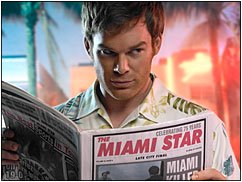 David Fisher was such a complex and memorable character that it's hard to imagine Michael C. Hall in any other role. But any ghosts of David Fisher were banished about eight minutes into the first episode of Dexter.
Dexter feels like one of those British crime dramas where the protagonist is so deeply flawed as to be interesting. For my money, the British Cracker was one of the best series ever shown on television. With drunken, loutish Fitz (Robbie Coltrane) at its center, Cracker built an entirely credible universe around its so-unlikeable-he's-likeable antihero, and held it together with fine supporting actors, directors like Michael Winterbottom, and tight, clever scripts.
If Dexter doesn't quite reach the literate heights of the British series to which it so obviously owes a debt, it's certainly not the fault of Michael C. Hall. As David Fisher, Hall exuded a kind of buttoned-up irony combined with a desperate need to be loved. As the serial killer who only dispatches those who deserve it, Hall is completely transformed. His blandly handsome choirboy face effortlessly moves from detachment to irony to dementedness without missing a beat. Painfully aware of his own nature and how it interferes with his ability to live a normal life, Hall's performance turns Dexter into a twisted version of a comic book superhero. He's the sick and twisted big brother to Tobey Maguire's Peter Parker.
Hall has a few excellent actors around him, and where these people are on the screen, the show is as good as anything the U.K. ever put out. Of particular note are Lauren Velez as police Lt. Maria LaGuerta, a woman clearly insecure in her position as boss of a largely male staff of police officers; and Julie Benz as Dexter's sort-of girlfriend Rita. Rita is as damaged as Dexter, though in a very different way, and Benz plays her with an interestingly ditzy vulnerability. The ease with which Dexter interacts with Rita's two young children seem to make him a kind of single mother dream guy, and while the sheer normality of the interaction might serve as a sledgehammer driving home the duality of Dexter's personality, they never play as forced.
Alas, the preposterous flashbacks, in which we learn how Dexter's adoptive father seeks to channel his son's homicidal nature in a positive, vigilante direction, play as if written by someone else, with huge hulking chunks of dialogue plopping off the screen and laying in a fetid heap on the floor. Part of the problem is that James Remar, last seen as Samantha's rich boss/boyfrined on Sex and the City, is a perfectly ghastly actor, but he's given clunky lines to deliver. Under the best of circumstances, you would have to suspend huge amounts of disbelief when confronted with a by-the-books cop who enables homicidal behavior in his son, whatever kind of twisted moral code lies behind it. But in Dexter, these scenes seem to have walked in by mistake from another series entirely.
For those of us who don't really unwind from the workweek to the point of being ready for a weekend until Sunday night, and as a result have trouble sleeping, unsettling series like Six Feet Under and The Sopranos haven't helped matters any. Dexter fills that weirdness gap very nicely, thank you very much.
The ship of state is on a disastrous course, and will founder on the reefs of economic disaster if nothing is done to correct it.
There's a good reason politicians don't like to talk about the nation's long-term fiscal prospects. The subject is short on political theatrics and long on complicated economics, scary graphs and very big numbers. It reveals serious problems and offers no easy solutions. Anybody who wanted to deal with it seriously would have to talk about raising taxes and cutting benefits, nasty nostrums that might doom any candidate who prescribed them.
[snip]
Polls suggest that Americans have only a vague sense of their government's long-term fiscal prospects. When pollsters ask Americans to name the most important problem facing America today -- as a CBS News/New York Times poll of 1,131 Americans did in September -- issues such as the war in Iraq, terrorism, jobs and the economy are most frequently mentioned. The deficit doesn't even crack the top 10.
Yet on the rare occasions that pollsters ask directly about the deficit, at least some people appear to recognize it as a problem. In a survey of 807 Americans last year by the Pew Center for the People and the Press, 42 percent of respondents said reducing the deficit should be a top priority; another 38 percent said it was important but a lower priority.
So the majority of the public appears to agree with Walker that the deficit is a serious problem, but only when they're made to think about it. Walker's challenge is to get people not just to think about it, but to pressure politicians to make the hard choices that are needed to keep the situation from spiraling out of control.
To show that the looming fiscal crisis is not a partisan issue, he brings along economists and budget analysts from across the political spectrum. In Austin, he's accompanied by Diane Lim Rogers, a liberal economist from the Brookings Institution, and Alison Acosta Fraser, director of the Roe Institute for Economic Policy Studies at the Heritage Foundation, a conservative think tank.
''We all agree on what the choices are and what the numbers are,'' Fraser says.
Their basic message is this: If the United States government conducts business as usual over the next few decades, a national debt that is already $8.5 trillion could reach $46 trillion or more, adjusted for inflation. That's almost as much as the total net worth of every person in America -- Bill Gates, Warren Buffett and those Google guys included.
A hole that big could paralyze the U.S. economy; according to some projections, just the interest payments on a debt that big would be as much as all the taxes the government collects today.
And every year that nothing is done about it, Walker says, the problem grows by $2 trillion to $3 trillion.
[snip]
Economists Jagadeesh Gokhale of the American Enterprise Institute and Kent Smetters of the University of Pennsylvania have an even scarier way of looking at Medicare. Their method calculates the program's long-term fiscal shortfall -- the annual difference between its dedicated revenues and costs -- over time.
By 2030 they calculate Medicare will be about $5 trillion in the hole, measured in 2004 dollars. By 2080, the fiscal imbalance will have risen to $25 trillion. And when you project the gap out to an infinite time horizon, it reaches $60 trillion.
Medicare so dominates the nation's fiscal future that some economists believe health care reform, rather than budget measures, is the best way to attack the problem.
''Obviously health care is a mess,'' says Dean Baker, a liberal economist at the Center for Economic and Policy Research, a Washington think tank. ''No one's been willing to touch it, but that's what I see as front and center.''
Social Security is a much less serious problem. The program currently pays for itself with a 12.4 percent payroll tax, and even produces a surplus that the government raids every year to pay other bills. But Social Security will begin to run deficits during the next century, and ultimately would need an infusion of $8 trillion if the government planned to keep its promises to every beneficiary.
Calculations by Boston University economist Lawrence Kotlikoff indicate that closing those gaps -- $8 trillion for Social Security, many times that for Medicare -- and paying off the existing deficit would require either an immediate doubling of personal and corporate income taxes, a two-thirds cut in Social Security and Medicare benefits, or some combination of the two.
Why is America so fiscally unprepared for the next century? Like many of its citizens, the United States has spent the last few years racking up debt instead of saving for the future. Foreign lenders -- primarily the central banks of China, Japan and other big U.S. trading partners -- have been eager to lend the government money at low interest rates, making the current $8.5-trillion deficit about as painful as a big balance on a zero-percent credit card.
Despite the propensity of Gen-Xers and the others who are girding their loins to blame baby-boomers for all of the upcoming financial mess, most of my baby-boom compatriots have been well aware of the coming crisis. In fact, most of us have worked under the assumption, fed by more than two decades of predominantly Republican rule, that neither Social Security nor Medicare will be there for us.
But it's not as if "no one could have anticipated" the coming burden on the national senior safety net. It's not as if we've exactly been quiet, as we make our way through this God-forsaken level of reality like an elephant passing through a snake. The Social Security surplus that was bandied about so much during the 2000 election no longer exists, having been looted to pay for other government expenditures. Believe me, we are well aware of this, and we are also well aware of the coming generational warfare as more Americans fight over an ever-diminishing pie.
George W. Bush came to office with a $400 billion surplus, and he has now spent us into oblivion by cutting taxes for his friends and embarking on a pointless war that has shoveled billions of our tax dollars that could have paid for education, investment in technology and infrastructure, health care, and shoring up our safety net programs. And we have nothing to show for it, other than an insurmountable debt, a war that we have no idea how to end, a health care system on the verge of collapse, a diminishing job base, and a bleak future for the very children this Administration professes to protect -- until they're born, anyway.
Perhaps the worst failure of Congressional Democrats over the last six years has been their failure to point out that it is Republicans who are the big debt spenders. In the post-WWII era, when Democrats control the White House increases in debt spendinig have been far less than under Republican presidents:
Since 1946 the Democratic Presidents increased the national debt an average of only 3.7% per year when they were in office. The Republican Presidents stay at an average increase of 9.3% per year. Over the last 59 years Republican Presidents have out borrowed Democratic Presidents by almost a three to one ratio. That is, for every dollar a Democratic President has raised the national debt in the past 59 years Republican Presidents have raised the debt by $2.87.
With the terrorism fear card not working for the Republicans this time, and the "Scary Oversexed Negroes" card not working, and the "Scary Oversexed Homosexuals who want to get married" not really working, it's only a matter of time before the "Democrats want to raise your taxes" card becomes the drumbeat in the days before the midterm election.
There was a Mark Alan Stamaty Washingtoon that appeared in the Village Voice during the 1988 campaign. Alas, it can't be found anywhere on the Web, but it depicts a hysterical George Bush Sr. jumping up and down and screaming "Killer negroes are coming to get you! Liberals want to take all your money! Read my lips! Read my lips!"
Like father, like son. We can't say we weren't warned. So you might want to ask your friends who voted for the son to start thinking about how they're going to tell their children why they let it happen.
Corrente
Hullabaloo
Hoffmania
Orcinus
Scoobie Davis
Talking Points Memo
World O'Crap
Fact-esque
Liberal Oasis
Oliver Willis
Talk Left
This Modern World
Philip Barron
Rising Hegemon
AMERICABlog
James Wolcott
Skippy the Bush Kangaroo
Dependable Renegade
The Political Carnival
Astrological Musings
Firedoglake
Spiiderweb
Words of Power
RIPCoco
Kung Fu Monkey
Empire Burlesque
WTF is it Now
Down With Tyranny
Welcome Back to Pottersvillle
Spocko's Brain
The Sideshow
The Ostroy Report
Fallenmonk
Three Wise Men
NewsHoggers
Blue Gal
Blah3
Shadow of the Hegemon
Slacktivist
ShortWoman
Echidne of the Snakes
Jesus' General
My Left Wing
Arthur Silber
Republic of T
Bitch Ph.D
The American Street
Comments from Left Field
Balloon Juice
I Can't Believe It's Not a Democracy
Scholars and Rogues
On My Mind
PhysioProf
The Vulgar Curmudgeon
Monkeyfister
Sasha Undercover
ThePoliticalCat
Fables of the Reconstruction
Talk2Action
D-Day
State of the Day
Just an Earth-Bound Misfit
Bradblog
They Gave Us a Republic
Vagabond Scholar
Seeing the Forest
The Reaction
Orcinus
SteveAudio
Princess Sparkle Pony
Paul Levinson
Politics After 50
The Jed Report
One Utah
Sam Seder
Alternet
The Political Carnival
County Fair
Mudflats
A Feather Adrift
That's Why
Disciples of Joe
No Longer Quivering
Margaret and Helen
Stand With Dr. Dean
All the Good Names Were Taken
Badtux the Snarky Penguin
My Mental Dumping Ground
Legal Schnauzer
Alicublog
Bouphonia
Konagod
The Reverse Spin
City of Angels
The Gospel According to Hate
Menopausal Stoners
Stinque
The New York Crank
BP Oil Slick
Pen-Elayne
Inside-Out the Beltway
Reclusive Leftist
Southern Beale
The Moderate Voice
The Rant
Help the 99ers
Brendan Calling
Matt Taibbi
I Was Told There Would Be Bacon
We Don't Agree, But...
ShortWoman
of mule dung and ash
Cookies in Heaven
The Hunting of the Snark
The Policy Page (Rick Ungar)
Ramona's Voices
Sardonicky
Dagblog
The Titanic Sails At Dawn
Cheese Food Nation
Donkey Mountain
Thump and Whip
Under the Lobsterscope
Addicting Info
Wifely Person
Disaffected and it Feels So Good
Reality Chex
Burnt Orange Report
Salmon Alley
The Politics Blog w/Charles Pierce
Elizabitchez
We Are The 99 Percent.
Republic of Gilead
amigoingsomeplace
Fukushima Diary
The Polygon
Degringolade
Onyx Lynx
Parsley's Pics
Mainmati
Brandflakes for Breakfast
The Economic Populist
Liberal Dan
Ex-Amish Atheist
The Poor Man's Huffington Post
Constant Commoner
Channel Surfing
Big Bad Bald Bastard
Panic in Funland (Tbogg!!!)
Weird Wally's Worldview
The Galloping Beaver (Canada)
Cathie from Canada
How This Old Brit Sees It ...
Stunner's Afflictions (Jamaica)
Jamaican Lifestyle
behind them
Daily Kos
Atrios
Open Left


Dispatches from the Island &
Further Dispatches
(Jorge Garcia)
Baseball Nerd
(Keith Olbermann)
FOK News Channel (ditto)
Marc Maron
Sam Seder
Brendan McDonald
Johnny Weir
Melina
Lynn
Keith Olbermann

Break Room Live archives
Morning Sedition 3/04-12/05
A Brilliant Radio Show -
Morning Seditionists
Camp Butch (all the
Sedition you can eat)
Jim Earl and his
Big Page of Crap
Morning Remembrance
Steve Gilliard 1966-2007:
A Brilliant Blogger
The News Blog archive
NetSlaves article archive
Friends of Steve:
The Group News Blog
"Jon Swift" (Al Weisel) 1963-2010
Bats Left Throws Right (Doghouse Riley)
Altercation
The All-Spin Zone
Baghdad Burning
Carrie's Nation
Little Country Lost
Cynical Nation
Pam's House Blend
photos1.blogger.com/blogger/397/497/320/bb_banner.1.jpg]^23004A00]coral]navy],](](]]]black],]3]8]20]1]2]3]3]1]2]3]1]1],](](]^235E3D00])])]^3Cimg^20src^3D^22)photos1.blogger.com/blogger/397/497/320/bb_banner.1.jpg^22]^22...you^20have^20a^20choice^3A^20be^20a^20fighting^20liberal^20or^20sit^20quietly.^20I^20know^20what^20I^20am^2C^20what^20are^20you^3F^22^20--^20^3Ca^20href^3D^22)stevegilliard.blogspot.com/2003/12/im-fighting-liberal-you-know-ive.html^22^20STYLE^3D^22color^3Awhite^3B^22^3ESteve^20Gilliard^2C^201966^20-^202007^3C/a^3E^3CBR^3E^22For^20straight^20up^20monster-stomping^20goodness^2C^20nothing^20makes^20smoke^20shoot^20out^20my^20ears^20like^20Brilliant@Breakfast^22^20--^20^3Ca^20href^3D^22)www.poorimpulsecontrol.net/blog^22^20STYLE^3D^22color^3Awhite^3B^22^3ETata^3C/a^3E],](],](](]black](](](]^23FDF2D7](](](]^23333](](](],]50]20],](](]^23FFF8DD])])]black]1.5]15],](](]^2398A45C])])]black]^23FFF8DD])])]^23666]30]^235E3E1A]^23622121],](](]^235E3E1A](],](]^235E3E1A]^23039]^2306C],](](]^23FFF8DD])])],](](]^23FFF8DD])])],](](]^23FFF8DD])])],](]^235E3E1A]^23666]15]3]25]20]^23808C43],](](],](],](](],](]black](](](],](](](],]^235C3E11](](](],](](]^23211104](](](](](],]^2336F]^23211104](],](]Posted^20by^20^24AUTH^20^7C^20^24TIME]20],](](]^23FFF8DD])])]^23FFF8DD])])]^23666]30]^235E3E1A]^23622121],](](]^235E3E1A](],](]^23333]^23039]^2306C]Contact]]]Home]^24HOME]First^20Page]Email^3A^3CBR^3Ebrilliantatbreakfast^20at^20gmail^20dot^20com]]]RSS]^24RSS]RSS^20Feed]Your^20Servers]]]Jill]rilliantatbreakfast.blogspot.com]]Melina])www.ripcoco.com]RIPCoco]Carrie])carriesnation.blogspot.com]Carrie^27s^20Nation]And^20occasionally...]]]jurassicpork])welcome-to-pottersville.blogspot.com]Welcome^20to^20Pottersville]Bob])bobrixon.blogspot.com]The^20Rix^20Mix]Tata])www.poorimpulsecontrol.net/blog]Poor^20Impulse^20Control]Spiiderweb])spiiderweb.blogspot.com]Spiiderweb]Other^20Brilliant^20Bloggers]]]Modern^20Fabulousity])modernfabulousity.blogspot.com]Modern^20Fabulousity]Pandagon])www.pandagon.net]Pandagon]Altercation])www.mediamatters.org/altercation]Altercation]Corrente])www.correntewire.com/]Corrente]Hullabaloo])digbysblog.blogspot.com]Hullabaloo]Hoffmania])www.hoffmania.com]Hoffmania]Orcinus])dneiwert.blogspot.com]Orcinus]Scoobie^20Davis])scoobiedavis.blogspot.com]Scoobie^20Davis]Talking^20Points^20Memo])talkingpointsmemo.com]Talking^20Points^20Memo]World^20O^27Crap])world-o-crap.com/blog]World^20O^27Crap]Fact-esque])casadelogo.typepad.com/factesque/]Fact-esque]Liberal^20Oasis])www.liberaloasis.com/]Liberal^20Oasis]Oliver^20Willis])www.oliverwillis.com/]Oliver^20Willis]Talk^20Left])www.talkleft.com/]Talk^20Left]The^20Talent^20Show])www.thetalentshow.org/]The^20Talent^20Show]Waveflux])www.waveflux.net]Waveflux]Rising^20Hegemon])rising-hegemon.blogspot.com/]Rising^20Hegemon]The^20Poor^20Man])www.thepoorman.net/]The^20Poor^20Man]AMERICABlog])www.americablog.org/]AMERICABlog]Needlenose])www.needlenose.com/]Needlenose]Brilliant^20NJ^20bloggers]]]^24ARCHIVE]^20]]Friends]]]Horm])blog.horm.org]Hallucinations^20Of^20Reabsorbed^20Mind]Phorm])p.horm.org]Another^20Phormation]Etc]]]^3Cimg^20src^3D^22)psyc.horm.org/barimg/bar_psycho.png^22^20width^3D^2280^22^20height^3D^2215^22^20alt^3D^22PsycHo^3A^20Free^20Template^20Generator^22^20style^3D^22border^3A^200px^20solid^20black^22^20/^3E]^24PSYCHO]PsycHo^3A^20Free^20Template^20Generator]^3Cimg^20src^3D^22)psyc.horm.org/barimg/bar_firefox.png^22^20width^3D^2280^22^20height^3D^2215^22^20alt^3D^22Get^20FireFox^21^22^20style^3D^22border^3A^200px^20solid^20black^22^20/^3E])www.mozilla.org/products/firefox/]Get^20Firefox^21]^3Cimg^20src^3D^22)psyc.horm.org/barimg/bar_xhtml.png^22^20width^3D^2280^22^20height^3D^2215^22^20alt^3D^22XHTML^20Validator^22^20style^3D^22border^3A^200px^20solid^20black^22^20/^3E])validator.w3.org/check/referer]XHTML^20Validator]]]]Home]^24HOME]First^20Page]Email]^24EMAIL]Mail^20me^21]RSS]^24RSS]RSS^20Feed]Archive]]]^24ARCHIVE]^20]]Friends]]]Horm])blog.horm.org]Hallucinations^20Of^20Reabsorbed^20Mind]Phorm])p.horm.org]Another^20Phormation]Etc]]]^3Cimg^20src^3D^22)psyc.horm.org/barimg/bar_psycho.png^22^20width^3D^2280^22^20height^3D^2215^22^20alt^3D^22PsycHo^3A^20Free^20Template^20Generator^22^20style^3D^22border^3A^200px^20solid^20black^22^20/^3E]^24PSYCHO]PsycHo^3A^20Free^20Template^20Generator]^3Cimg^20src^3D^22)psyc.horm.org/barimg/bar_firefox.png^22^20width^3D^2280^22^20height^3D^2215^22^20alt^3D^22Get^20FireFox^21^22^20style^3D^22border^3A^200px^20solid^20black^22^20/^3E])www.mozilla.org/products/firefox/]Get^20Firefox^21]^3Cimg^20src^3D^22)psyc.horm.org/barimg/bar_xhtml.png^22^20width^3D^2280^22^20height^3D^2215^22^20alt^3D^22XHTML^20Validator^22^20style^3D^22border^3A^200px^20solid^20black^22^20/^3E])validator.w3.org/check/referer]XHTML^20Validator^26^2361470^3BPsycHo})


