| "Only dull people are brilliant at breakfast" -Oscar Wilde |
 |
"The liberal soul shall be made fat, and he that watereth, shall be watered also himself." -- Proverbs 11:25 |
"...you have a choice: be a fighting liberal or sit quietly. I know what I am, what are you?" -- Steve Gilliard, 1964 - 2007
"For straight up monster-stomping goodness, nothing makes smoke shoot out my ears like Brilliant@Breakfast" -- Tata
"...the best bleacher bum since Pete Axthelm" -- Randy K.
"I came here to chew bubblegum and kick ass. And I'm all out of bubblegum." -- "Rowdy" Roddy Piper (1954-2015), They Live
"For straight up monster-stomping goodness, nothing makes smoke shoot out my ears like Brilliant@Breakfast" -- Tata
"...the best bleacher bum since Pete Axthelm" -- Randy K.
"I came here to chew bubblegum and kick ass. And I'm all out of bubblegum." -- "Rowdy" Roddy Piper (1954-2015), They Live


Brilliant Recent Posts
There's nothing new under the sunAu revoir, y'all....
So Long and Thanks for All the Gefilte Fish
Like White on Rice
Why Did Hillary Clinton Hire a Monsanto Lobbyist t...
Virtual Book Sale
The Man Who Poisoned America
We are privileged to be alive today
The Prodigal Blogger Stops By
Good Times at Pottersville, 3/14/15
Brilliant at Searching
Brilliant Stuff to Buy
What's on my mind:
Brilliant Archives
Brilliant at Begging
Like what you read?Please consider supporting B@B with a donation: There is no gift like the present.
But gifts are nice too:


Feed Me!





Stuff You Must Read
Saturday, April 15, 2006
Sunday Cat Blogging, or Molly Your Fifteen Minutes Have Begun

Those of you who aren't animal people have probably been scratching your head for the last two weeks as the saga of Molly the Cat Trapped in the Wall has begun to rival Missing And Feared Dead Pretty White Girls in terms of cable news time. Well, for those of us who have cats, even those of us who haven't had a good night's sleep at home in five years because we have a cat that thinks she's an infant and wants to be draped over our necks ALL DAMN NIGHT LONG EVERY NIGHT DAMMIT, the Saga of Molly has been our worst nightmare of the dire things we think about when Maggie has puked up her dinner for the third night in a row because she wants baby food.
Well, at 10:15 last night, Molly became just another mouser again -- or will be after she makes the inevitable round of talk shows. For Molly, whose plaintive cries tugged at the hearts of ailurophiles for the last two weeks, is now free after a two-week vigil that turned a building on Hudson Street in New York into a form of street theatre:
Molly's distressed meows _ audible from the sidewalk outside the building _ became international news, and rescuers worked almost around the clock for her safe retrieval.
The activity began after the cat wandered into a narrow space between walls and got lost in the building's complex network of beams and pipes.
Those involved in the rescue effort drilled and hammered out bricks in the cellar of the 157-year-old edifice, trying everything from special cameras to traps to locate her and get her out. Kittens were used as bait to appeal to Molly's maternal side. A pet psychic and self-described "cat therapist" even stopped by to offer a hand.
But in the end, it was good old-fashioned elbow grease that got the job done.
Rescuers drilled a hole in the wall from inside the store, cutting through layers of brick to get to Molly, said Mike Pastore, field director for Animal Care & Control of New York City, a private organization with a city contract to handle lost, injured and unwanted animals.
Animal Care & Control will set up a link on its Web site for people to donate to help with repairs at the deli.
Molly was finally retrieved by Kevin Clifford, a tunnel worker at a project nearby who had been volunteering for the rescue effort.
"I gave what they needed, and lent a hand to it," he said.
The animal didn't come easily at first, said Pastore.
"It was twisting and turning, paws were flying everywhere," he said. "It took a little struggle to put her back in a cage."
Molly's first meal? Nibbles of roasted pork, sardines in oil and water, Myers said. Hearty fare, but perhaps not surprising for a feline who spends her time in Myers of Keswick, a deli specializing in meat pies, clotted cream and other British food specialties.
"I'm amazed at how well she looks," Myers said. "She always was a fit cat, otherwise she wouldn't have survived 14 days in that hole."
Rita Cosby may now return to covering the disappearance of Natalee Holloway, or the family mauled by bears in Tennessee.
And let's hope Molly is smarter than my cat Maggie and doesn't decide to take a trip inside the wall again.

The sinking of the Titanic — 94 years on
It was 94 years ago today that the Titanic sank in the north Atlantic.
Today, when we have cruise ships that dwarf the infamous White Star liner and when such disasters unfold in our own homes in real time, it seems almost quaint that this particular sea disaster still captures the imaginations of so many people. I think it's because the Titanic sinking embodies so many broad themes and archetypes that resonate across time -- the hubris of men who believed that technology could conquer nature, the doomed immigrants seeking only a better life, the wealthy whose millions couldn't protect them against a rush of sea water, the Monday morning quarterbacking used by showboating politicians.
At the beginning of last year, I used to say "If you liked 1905, you'll love 2005." But the parallels between the Gilded Age backdrop against which the Titanic sinking took place and the polarized environment in which we now find ourselves are astonishing.
Economic conditions
1912 was a presidential election year, in which the pressing issues were very similar to those important to Americans today. While inflation today in general isn't the hot topic it was in the 1970's, increasing fuel prices are rippling across the country increasing the cost of everything. ThinkProgress is reporting that in 2005, Exxon's CEO raked in a cool $190,000/day. In the 1910 midterm elections, Democrats had gained a majority in Congressby focusing on voters' frustration with the cost of living and their perception that greedy speculators were robbing the country blind while average workers could barely keep up:


Labor
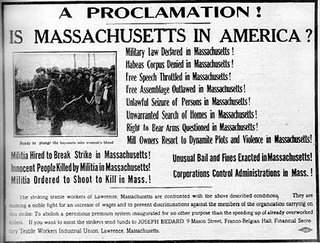
Today's Republicans have been successful in convincing American voters that shoveling more and more cash into the pockets of the wealthy "creates jobs" while at the same time pointing their attention at illegal immigrants, convincing Americans that the Brown Hordes are their problem, not the guy with the $6000 shower curtain picking their pockets from behind. In 1912, organized labor was coming into full flower, and the Lawrence, Massachusetts textile workers' strike that year in response to mill owners' reducing wages in the aftermath of a law requiring a shorter work week resulted in a victory for workers. The Lawrence textile mills, with their output-based pay and alienation between workers and management were the Wal-Marts of their day.Today, workers faced with globalization submit meekly when corporate executives like those at Delphi receive huge bonuses while worker pensions and medical benefits are short-changed and workers are asked to take pay cuts. What little manufacturing is left in this country is rapidly devolving into the kind of conditions workers endured prior to the early 20th century labor movement.
Conservation and the environment
It's interesting that George W. Bush, who has presided over the gutting of most environmental regulations on business, likes to identify with Theodore Roosevelt. 1912 was the year Roosevelt ran on the Progressive Party ticket on a conservation platform, during a time when the realization that the land was a valuable resource that must be tended was gaining traction. Today, fish is full of mercury, much of the coast is likely to be under water in less than 100 years, and the Bush Administration gives nothing but lip service to addressing the environmental problems we face. In the area of the environment and conservation, the American people are more in synch with their 1912 brethren than with the contemporary robber barons that this president has admitted is his primary constituency.
Direct democracy
After the presidential election debacles of 2000 and 2004, the move to eliminate the Electoral College and have direct elections for president has once again gained traction. Fairvote.org has a number of editorials from after the 2000 election calling for Electoral College reform. At the same time, right-wingers have clamored for judicial recall, citing decisions by "activist judges" (read: judges who are not wingnuts) as a reason. Interestingly, it was Teddy Roosevelt calling for judicial recall in his speech at the Ohio nominating convention of 1912, showing that the adult version of the "do-over" knows no ideology. Those who know me are aware that I am involved in the campaign of Camille Abate for the Democratic nomination for the 5th Congressional District of New Jersey. Camille is running against a Clintonista who was brought into the district by the party apparatchiks, seemingly to be a sacrificial lamb to run against the incumbent Republican. In terms of everything from fundraising to ballot position, the candidate not endorsed by the party machine has an uphill battle, relying mostly on guts, energy, and moxie, to fight the machine politics that dominate the nominating process. The irony of the impact of machine politics in the primary process is underscored by looking at history, because it was again Roosevelt who advocated direct elections of party nominees via a primary process, to reduce the influence of professional politicians.
After September 11, 2001, there was much talk about whether the attacks of that day were the Titanic sinking of our time. It could be argued that the collapse of two giant skyscrapers, theoretically caused by ten guys with boxcutters on airplanes, had the same dramatic and fatal impact of a piece of ice floating in the North Atlantic, punching a series of dots in the hull of a supposedly unsinkable ocean liner. Just as the watertight bulkheads proved ineffective against this particular iceberg collision, so did the insulation and other construction safeguards prove ineffective against the impact of two airplanes. Both show the pitfalls of human hubris in thinking that size somehow means invincibility -- a misconception made by the builders of the Titanic, the builders of the World Trade Center, and the architects of the Iraq War.
The Titanic sinking, occurring as it did in the context of an ascendant labor movement, marked an unofficial end to the age of the Robber Barons. Alas, the 9/11 attacks, which frightened Americans into blind acquiescence to the worst instincts of the President, his administration, Congressional Republicans, and their corporate funders, seem to be heralding a new, meaner Gilded Age, one once again characterized by a preposterously wealthy plutocracy amassing more and more wealth, with the rest of us scrambling in modern-day sweatshops for the scraps.
(HUGE hat tip to the Graduate School of Ohio State University, whose 1912: Competing Visions for America provided much of the information for this blog entry.)
(cross-posted at Spiiderweb.)
Today, when we have cruise ships that dwarf the infamous White Star liner and when such disasters unfold in our own homes in real time, it seems almost quaint that this particular sea disaster still captures the imaginations of so many people. I think it's because the Titanic sinking embodies so many broad themes and archetypes that resonate across time -- the hubris of men who believed that technology could conquer nature, the doomed immigrants seeking only a better life, the wealthy whose millions couldn't protect them against a rush of sea water, the Monday morning quarterbacking used by showboating politicians.
At the beginning of last year, I used to say "If you liked 1905, you'll love 2005." But the parallels between the Gilded Age backdrop against which the Titanic sinking took place and the polarized environment in which we now find ourselves are astonishing.
Economic conditions
1912 was a presidential election year, in which the pressing issues were very similar to those important to Americans today. While inflation today in general isn't the hot topic it was in the 1970's, increasing fuel prices are rippling across the country increasing the cost of everything. ThinkProgress is reporting that in 2005, Exxon's CEO raked in a cool $190,000/day. In the 1910 midterm elections, Democrats had gained a majority in Congressby focusing on voters' frustration with the cost of living and their perception that greedy speculators were robbing the country blind while average workers could barely keep up:


Labor
Today's Republicans have been successful in convincing American voters that shoveling more and more cash into the pockets of the wealthy "creates jobs" while at the same time pointing their attention at illegal immigrants, convincing Americans that the Brown Hordes are their problem, not the guy with the $6000 shower curtain picking their pockets from behind. In 1912, organized labor was coming into full flower, and the Lawrence, Massachusetts textile workers' strike that year in response to mill owners' reducing wages in the aftermath of a law requiring a shorter work week resulted in a victory for workers. The Lawrence textile mills, with their output-based pay and alienation between workers and management were the Wal-Marts of their day.Today, workers faced with globalization submit meekly when corporate executives like those at Delphi receive huge bonuses while worker pensions and medical benefits are short-changed and workers are asked to take pay cuts. What little manufacturing is left in this country is rapidly devolving into the kind of conditions workers endured prior to the early 20th century labor movement.

Conservation and the environment
It's interesting that George W. Bush, who has presided over the gutting of most environmental regulations on business, likes to identify with Theodore Roosevelt. 1912 was the year Roosevelt ran on the Progressive Party ticket on a conservation platform, during a time when the realization that the land was a valuable resource that must be tended was gaining traction. Today, fish is full of mercury, much of the coast is likely to be under water in less than 100 years, and the Bush Administration gives nothing but lip service to addressing the environmental problems we face. In the area of the environment and conservation, the American people are more in synch with their 1912 brethren than with the contemporary robber barons that this president has admitted is his primary constituency.
Direct democracy
After the presidential election debacles of 2000 and 2004, the move to eliminate the Electoral College and have direct elections for president has once again gained traction. Fairvote.org has a number of editorials from after the 2000 election calling for Electoral College reform. At the same time, right-wingers have clamored for judicial recall, citing decisions by "activist judges" (read: judges who are not wingnuts) as a reason. Interestingly, it was Teddy Roosevelt calling for judicial recall in his speech at the Ohio nominating convention of 1912, showing that the adult version of the "do-over" knows no ideology. Those who know me are aware that I am involved in the campaign of Camille Abate for the Democratic nomination for the 5th Congressional District of New Jersey. Camille is running against a Clintonista who was brought into the district by the party apparatchiks, seemingly to be a sacrificial lamb to run against the incumbent Republican. In terms of everything from fundraising to ballot position, the candidate not endorsed by the party machine has an uphill battle, relying mostly on guts, energy, and moxie, to fight the machine politics that dominate the nominating process. The irony of the impact of machine politics in the primary process is underscored by looking at history, because it was again Roosevelt who advocated direct elections of party nominees via a primary process, to reduce the influence of professional politicians.
After September 11, 2001, there was much talk about whether the attacks of that day were the Titanic sinking of our time. It could be argued that the collapse of two giant skyscrapers, theoretically caused by ten guys with boxcutters on airplanes, had the same dramatic and fatal impact of a piece of ice floating in the North Atlantic, punching a series of dots in the hull of a supposedly unsinkable ocean liner. Just as the watertight bulkheads proved ineffective against this particular iceberg collision, so did the insulation and other construction safeguards prove ineffective against the impact of two airplanes. Both show the pitfalls of human hubris in thinking that size somehow means invincibility -- a misconception made by the builders of the Titanic, the builders of the World Trade Center, and the architects of the Iraq War.
The Titanic sinking, occurring as it did in the context of an ascendant labor movement, marked an unofficial end to the age of the Robber Barons. Alas, the 9/11 attacks, which frightened Americans into blind acquiescence to the worst instincts of the President, his administration, Congressional Republicans, and their corporate funders, seem to be heralding a new, meaner Gilded Age, one once again characterized by a preposterously wealthy plutocracy amassing more and more wealth, with the rest of us scrambling in modern-day sweatshops for the scraps.
(HUGE hat tip to the Graduate School of Ohio State University, whose 1912: Competing Visions for America provided much of the information for this blog entry.)
(cross-posted at Spiiderweb.)
Friday, April 14, 2006
At this rate, by Sunday they'll be telling us that Iranian nukes are on their way here
Arthur Silber:
The nuking of Iran is a foregone conclusion, no matter how the Administration tries to spin it otherwise. All this talk from the State Department about Iran being 16 days away from being able to build a nuclear bomb is designed to soften us up for the inevitable. The 16 intelligence agencies (16 being suddenly a Significant Number in terms of war planning, as if castaway John Locke had been brought in from the hatch on Lost to determine war policy) remain steadfast in their view that Iran is at least several years away from being able to produce enough enriched uranium to build a bomb -- a timeframe which allows us to take the time to come up with a solution other than turning that country into a glass wasteland just because Rummy has an itchy button-finger.
Bush apologists will be tempted to claim that the intelligence agencies botched their job so badly that the 9/11 attacks happened, but we now know that the intelligence was there, but the president was too busy clearing brush in Crawford to take any of it seriously. Bush apologists will also claim that the intelligence agencies botched the Iraq weapons of mass destruction issue, but we now know that the Administration would only heed intelligence which met its preconceived notions.
Iran may not be a serious threat this minute, but the country presents a problem that requires a U.S. response built by competent, thoughtful people -- not a bunch of arrogant cowboys with sexual issues who think the entire world is their own private little video game arcade and who have played on American fears for five years in their efforts to turn this country into Stalinist Russia.
A crucial part of the Iran propaganda campaign has been to steadily reduce the relevant time horizon, as I noted in this essay. The administration began with estimates of approximately a decade before Iran could have nuclear weapons -- which then got reduced to five years -- which then was further shrunk to a year or two -- then to a few months -- and now they are offering ludicrous stories about Iran having nukes within 16 days. Let me repeat the critical point: this is all propaganda. It doesn't matter in the least that they say this is what the intelligence indicates. Even if it were accurate, which almost all of it is not, the intelligence is not the foundation of the administration's foreign policy, with regard to Iran or more broadly.
In fact, I have thought for a few years that the decision to attack to Iran was made some time ago. I am more convinced of that now than I ever was before. The constant stream of scare stories about Iran is designed only to terrify the American public sufficiently, so that when Bush holds a press conference to announce air strikes against Iran that have already begun, enough people will believe that the strikes were necessary -- since Iran was about to launch nuclear weapons against us momentarily.
As with Iraq, all the major points will be lies. All of it will be war propaganda. And given our cowardly, inept, and fatally incompetent media and the lack of any significant political opposition -- which opposition, if it existed, ought to be making itself known now and not after the press conference -- and provided enough people are scared to the required degree, it will work. Again.
The nuking of Iran is a foregone conclusion, no matter how the Administration tries to spin it otherwise. All this talk from the State Department about Iran being 16 days away from being able to build a nuclear bomb is designed to soften us up for the inevitable. The 16 intelligence agencies (16 being suddenly a Significant Number in terms of war planning, as if castaway John Locke had been brought in from the hatch on Lost to determine war policy) remain steadfast in their view that Iran is at least several years away from being able to produce enough enriched uranium to build a bomb -- a timeframe which allows us to take the time to come up with a solution other than turning that country into a glass wasteland just because Rummy has an itchy button-finger.
Bush apologists will be tempted to claim that the intelligence agencies botched their job so badly that the 9/11 attacks happened, but we now know that the intelligence was there, but the president was too busy clearing brush in Crawford to take any of it seriously. Bush apologists will also claim that the intelligence agencies botched the Iraq weapons of mass destruction issue, but we now know that the Administration would only heed intelligence which met its preconceived notions.
Iran may not be a serious threat this minute, but the country presents a problem that requires a U.S. response built by competent, thoughtful people -- not a bunch of arrogant cowboys with sexual issues who think the entire world is their own private little video game arcade and who have played on American fears for five years in their efforts to turn this country into Stalinist Russia.
Secrets! Red Hot Secrets! Getcher Red-Hot Military Secrets Here! Too much? So make an offer...
Can this bunch possibly get any more incompetent? How dumb do you have to be to think that flash drives don't have any actual information on them?
For the one or two people who read this who might not be technically inclined, a flash drive is a little device about the size of the average thumb, that plugs into a USB port on your PC and becomes another drive -- like a floppy drive or writable CD. It's a great way to move files back and forth between home and work or between PCs.
Apparently a bunch of these drives were either improperly discarded or stolen from a U.S. military base in Afghanistan, and were found readily available to buy at Afghan markets.
Various news media, including MSNBC, have snapped these up like original Bettie Page photos:
Uh....yeah.
The level of ignorance about basic modern computer technology that pervades the government is unbelievable. I still remember the days when wingnut Congressmen would pontificate on the halls of Congress about Communists hacking the V-chip to threaten our national security, and not much has changed. More recently, we've had $170 million blown on the failed FBI Virtual Case File system and the agency's inability to even manage to handle Google, which any PC bought at Wal-Mart and a dial-up connection can handle.
This is of course is also how companies like Diebold and ES&S manage to sell voting machines that crash in the middle of an election, necessitating techs to come in and "change the smart cards" -- which ought to decertify the machine right then and there.
It seems that if it's not technology that Blows Stuff Up, government officials still insist on being willfully ignorant about the implications of technology equipment used by your average school child. But the dangers of this ignorance can't be underestimated, as evidenced by flash drives with classified information being available at Afghan schmatte markets.
For the one or two people who read this who might not be technically inclined, a flash drive is a little device about the size of the average thumb, that plugs into a USB port on your PC and becomes another drive -- like a floppy drive or writable CD. It's a great way to move files back and forth between home and work or between PCs.
Apparently a bunch of these drives were either improperly discarded or stolen from a U.S. military base in Afghanistan, and were found readily available to buy at Afghan markets.
Various news media, including MSNBC, have snapped these up like original Bettie Page photos:
This week, an NBC News producer, using a hidden camera, visited the bazaar and bought a half dozen of the memory drives the size of a thumb known as flash drives. On them, NBC News found highly sensitive military information, some which NBC will not reveal.
“This isn't just a loss of sensitive information,” says Lt. Col. Rick Francona (ret.), an NBC News military analyst. “This is putting U.S. troops at risk. This is a violation of operational security.”
Some of the data would be valuable to the enemy, including:
- Names and personal information for dozens of DOD interrogators;
- Documents on an “interrogation support cell” and interrogation methods;
- IDs and photos of U.S. troops.
With information like this, “You could cripple our U.S. intelligence collection capability in Afghanistan,” says Francona.
Among the photos of Americans are pictures of individuals who appear to have been tortured and killed, most too graphic to show. NBC News does not know who caused their injuries. The Pentagon would not comment on the photos.
The tiny computer memories are believed to have been smuggled off base by Afghan employees and sold to shopkeepers. Whoever buys one can simply plug it into another computer, and in a couple of minutes, see thousands of files.
Other reporters have bought drives at the bazaar containing classified information, including names and photos of Afghans spying for the U.S. and maps revealing locations of radar used to foil mortar attacks.
“This is simply appalling,” says Col. Ken Allard (ret.), an NBC News military analyst. “You've got a situation in which the U.S. is going to be forced to change an awful lot of its operational techniques.”
Uh....yeah.
The level of ignorance about basic modern computer technology that pervades the government is unbelievable. I still remember the days when wingnut Congressmen would pontificate on the halls of Congress about Communists hacking the V-chip to threaten our national security, and not much has changed. More recently, we've had $170 million blown on the failed FBI Virtual Case File system and the agency's inability to even manage to handle Google, which any PC bought at Wal-Mart and a dial-up connection can handle.
This is of course is also how companies like Diebold and ES&S manage to sell voting machines that crash in the middle of an election, necessitating techs to come in and "change the smart cards" -- which ought to decertify the machine right then and there.
It seems that if it's not technology that Blows Stuff Up, government officials still insist on being willfully ignorant about the implications of technology equipment used by your average school child. But the dangers of this ignorance can't be underestimated, as evidenced by flash drives with classified information being available at Afghan schmatte markets.
Thursday, April 13, 2006
Pastor Niemoller looks more correct every day
First they came for the emergency contraception, but I did not need emergency contraception, so I was not concerned....
Then they came for birth control pills, but I do not use birth control pills, so I was not concerned....
Now lunatic pharmacists are refusing to fill prescriptions for antibiotics and vitamins:
Cedar River Clinics, a women's health and abortion provider with facilities in Renton, Tacoma, and Yakima, filed a complaint with the Washington State Department of Health this week alleging three instances where pharmacists raising moral objections refused to fill prescriptions for Cedar River clients. The complaint includes one incident at the Swedish Medical Center outpatient pharmacy in Seattle. According to the complaint, someone at the Swedish pharmacy said she was "morally unable" to fill a Cedar River patient's prescription for abortion-related antibiotics. Cedar River's complaint quotes its Renton clinic manager's May 17, 2005, e-mail account: "Today, one of our clients asked us to call in her prescription... to Swedish outpatient pharmacy. [We] called the prescription in... and spoke with an efficient staff person who took down the prescription. A few minutes later, this pharmacy person called us back and told us she had found out who we were and she morally was unable to fill the prescription." (Cedar River thinks their client eventually got her prescription filled.)
[snip]
The complaint also includes an incident from November 2005 in Yakima, in which a pharmacist at a Safeway reportedly refused to fill a Cedar River patient's prescription for pregnancy-related vitamins. The pharmacist reportedly asked the customer why she had gone to Cedar River Clinics and then told the patient she "didn't need them if she wasn't pregnant."
[snip]
"Pharmacists should not be able to elevate their personal beliefs over the needs of the patient," says Amy Luftig, deputy director of public policy at Planned Parenthood Network of Washington. Luftig offered several anecdotes of refusal stories—including one of a young couple seeking emergency contraception in the Central District who were lectured by the pharmacist about sex—but says most women are too embarrassed or stigmatized to go public with a complaint like the one Cedar River filed on behalf of its clients.
This is not even remotely about the sanctity of human life and about pharmacists not wanting to fill prescriptions for drugs they believe kill human beings (though even that should not be their decision to make). This is about pharmacists deciding they can punish women who have abortions by denying them antibiotics they need after the procedure, or even vitamins that pregnant women who utilize abortion providers for routine prenatal care may need.
And this is the kind of lunacy that happens when you allow religious fanatics into the government. By this logic, Christian Scientist pharmacists can refuse to fill prescriptions for ANY medications at all. Catholic pharmacists can refuse to give women diaphragms. Scientologist pharmacists can refuse to fill prescriptions for antidepressants.
If you can't fill prescriptions, don't be a pharmacist. It's very simple.
(Hat tip: Radical Russ at Pam's House Blend).
Bush gets away with anything BECAUSE he's so unspeakably awful
The Bush Administration seems to have uncovered the secret to getting away with anything: overload your administration with so many scandals and so much corruption that the public simply can't -- or won't -- fathom just how bad it is. And now with Bush believing himself to be a dictator (or "unitary executive, to use the Administration's preferred term), having delusions that he is God's Chosen Architect of the Rapture, and just itching to drop nukes on Iran, we can no longer pretend that things are OK....because they aren't.
Digby:
Digby:
For the life of me, I failed to see then, and fail to see now, why the fact that Bush lied about the trailers wasn't headline news in June, 2003. The country wasn't ready for the truth? Of course it wasn't, because the press had stopped doing its job in November, 2000, when the election was stolen. And that just walks the question back. Why wasn't the country ready for the truth in November, 2000? Because the press covered the 2000 election campaign in an utterly incompetent fashion. And, herdlike, everyone in the press - Krugman the only serious exception - chose to ignore what was staring them in the face. It was too uncomfortable to believe that a major presidential candidate would blatantly lie about his economic program, or that that same candidate actually would steal an American election. It was too painful to imagine that as president, that same incompetent liar would neglect the most dangerous threats to America, an incompetence so spectacular that a bunch of ignorant fanatics could pull off a still unbelievably horrible series of terrorist attacks. It was simply beyond the pale to imagine that this same unspeakable bastard would then lie the United States into a bogus war, causing the deaths of thousands upon thousands of people, American and Iraqi alike, and mind-boggling anarchy.
[snip]
And that brings me to my point from yesterday. Man, I hate to be a prick about this, but let's get serious here. We are talking about the very real possibility of Bush launching a first-strike nuclear war. Dammit, we should be pricks about it.
[snip]
The fact that Bush is seriously planning to start a nuclear war must not be permitted to drop out of sight. If it is ignored, chances are we will learn that the first 21st Century nuclear war - but not the last - will have started when we weren't looking. Bush isn't going to ask for authorization to use nuclear weapons. He isn't even going to ask authorization to attack Iran. It is going to happen and if they are very nice, they'll boast about it afterwards to the right reporters. The use of nukes will ooze out, contributing to the anomie and "whatever" attitude that Bush has cultivated towards news about his behavior.
Unless the press holds Bush's feet to the fire and refuse to let this story suffer the same fate as the story about the trailers, we will slouch into Armageddon. It is sheer moral cowardice to ignore this, or minimize its importance. Hersh may be wrong - he's been wrong before. But as far as I know, he's never been wrong about the dangers of the Bush administration. The press must press the question: Does Bush plan to start a nuclear war?
They ate rabbit at the Last Supper? Who knew?
Funny how when Bill O'Reilly and the other Lunatics of the Right now talk about the "War on Easter" the symbol they use is the Easter Bunny, NOT Jesus on the cross, just as they used Santa Claus rather than the manger as the symbol for Christmas?
Christmas and Easter are both Christian appropriations of pagan celebrations. The Easter Bunny? Eggs? Little baby chickens? Fertility symbols, anyone? For that matter, the word "Easter"? Sounds like "Oestrus" (menstrual cycle), doesn't it? For that matter, it sounds like "Ishtar", a Babylonian goddess. How non-Christian can you get?
Yes, folks, we non-Christians really ARE at war with the Easter Bunny. Especially people who have gardens.
The Science Exodus
A side effect of the takeover of the U.S. government by the Christofascist Zombie Brigade is an exodus of top American scientists to other countries not in thrall to people who believe in killing massive numbers of people in war, but saving the stem cells.
Singapore is a top destination for American scientists:
Does anyone believe that these Asian countries are stupid? Unfettered by the lunatics of the Christian right, these countries are able to invest in the scientific community ini a way the U.S. government, with its Jeebofascist leanings and its feverish plans to bring about Armaggedon, refuses to do.
I'm sure that there are many Americans who believe the book of Revelation to be real, and who believe that George W. Bush is God's Own Anointed Architect of the Rapture. But I can't imagine that this is where most Americans want to go. Most Americans believe that their children will live in a world much like the current one, but if the current thrall to religious extremists among the political elites is allowed to continue, the U.S. will be in for a future as medieval as the present we love to deride in Islamic countries -- while the rest of the developed world leaves us in the dust, still waiting for a Rapture that never comes.
Singapore is a top destination for American scientists:
Singapore's siren song is growing increasingly more irresistible for scientists, especially stem cell researchers who feel stifled by the U.S. government's restrictions on their field.
Two prominent California scientists are the latest to defect to the Asian city-state, announcing earlier this month that they, too, had fallen for its glittering acres of new laboratories outfitted with the latest gizmos.
They weren't the first defections, and Singapore officials at the Biotechnology Organization's annual convention in Chicago this week promise they won't be the last.
Other Asian countries, including Japan, South Korea and even China, are also here touting their burgeoning biotechnology spending to the 20,000 scientists and biotechnology executives attending the conference.
But what sets Singapore apart is the shear size of its effort to become the "Boston of the east" along with its promise to limit government meddling.
The 250-square-mile island nation known to some as the place that canes miscreants and has issues with chewing gum has already spent $4 billion on biotechnology and has committed another $8 billion through 2010 in a bid to give the United States a run for biomedical supremacy.
"I am absolutely amazed at what they have. It's just knock-dead gorgeous," said Dr. Judith Swain, a University of California, San Diego, heart researcher who will decamp to Singapore in September to run the country's new Singapore Institute for Clinical Sciences at a state-funded research wonderland called Biopolis.
Does anyone believe that these Asian countries are stupid? Unfettered by the lunatics of the Christian right, these countries are able to invest in the scientific community ini a way the U.S. government, with its Jeebofascist leanings and its feverish plans to bring about Armaggedon, refuses to do.
I'm sure that there are many Americans who believe the book of Revelation to be real, and who believe that George W. Bush is God's Own Anointed Architect of the Rapture. But I can't imagine that this is where most Americans want to go. Most Americans believe that their children will live in a world much like the current one, but if the current thrall to religious extremists among the political elites is allowed to continue, the U.S. will be in for a future as medieval as the present we love to deride in Islamic countries -- while the rest of the developed world leaves us in the dust, still waiting for a Rapture that never comes.
Saint John McCain shows his inner lizard
Saint John is starting to show some of the unfortunate "How Dare You Question Me" characteristics of the current occupant of the White House:
When Jean Diamond asked Sen. John McCain a polite but tough question about federal spending last weekend, McCain turned churlish.
"I'm not getting anything I really need and my grandchildren are getting saddled with $9 trillion in debt," said Diamond, a Keene retiree. "Why should I vote Republican?"
Because, McCain replied, Democrats have also voted to increase federal spending.
"Maybe," the Arizona Republican suggested, "you should vote for the vegetarians."
Diamond was not amused by McCain's sarcasm. "Republicans are in charge of three Houses," she snapped back. "You have no excuse."
McCain shook his head. "Yes, ma'am," he said, peering at the 500 people gathered at the town meeting. "I knew we should have cut this thing off."
This exchange is very revealing about the so-called "Straight Talk Express", for it shows that McCain exhibits all of the traits of the modern Republican leader:
1) Refusal to answer a question
2) Anger at having his record questioned
3) Blaming Democrats
4) Willingness to only speak to a friendly audience
5) A belief that dissenters should not be able to speak to him.
All this may make him the perfect successor to George W. "Easier if I were the Dictator" Bush, but if there's anyone out there who still believes in the "Straight Talk Express", this should put an end to any such delusions.
David Brooks has to resort to myth to envision a bright future for Iraq
David Brooks' deep-seated NEED to believe that the Bush Administration hasn't destroyed the situation in Iraq beyond repair is so strong that he takes to the Old Testament today in order to try to make sense out of it.
Good Lord, this man is an idiot:
Mr. Past: Your big problem is you don't understand the limits of what governments can achieve. Before this whole Iraq thing, you should have read Elie Kedourie's essay on the British occupation in the 1920's. This isn't history repeating itself, it's the same unbroken pattern.
Kedourie shows the whole history of Iraq is a story of "bloodshed, treason and rapine." He shows how Iraqi politics have always been marked by "murderous currents," "demonic hatreds," "grisly spectacles," Sunni violence and Shiite fanaticism. He shows naïve Westerners who thought they could change all this. He even quotes a memo from a British officer saying Britain should threaten to withdraw because then the Iraqis will be forced to behave responsibly. It's all the same!
The central lesson of the past three years is that societies are not that malleable. Evils do not grow out of manageable defects in the environment that can be neatly fixed. We need to change our mentality, scale back to more realistic expectations.
Mr. Future: Actually, I did read Kedourie, but last night I also reread the Exodus story. The Exodus story reminds us that human beings can transform themselves and their situations. It reminds us that people who embark on generational journeys are the realistic ones, because they are the ones who see all the possibilities the future contains.
The finest things humans have done have been achieved in an Exodus frame of mind. This country was settled and founded by people who adopted the Exodus mentality. The civil rights movement was also led by such people.
Martin Luther King learned from Exodus that it is not enough to sit back and let history slowly evolve. It's sometimes necessary to venture into the hazardous wilderness.
There are times amid the journey when the Promised Land can seem a long way off, when the words "next year in Jerusalem" seem unrealistic. But those are the times when the words mean the most. So of all the lessons to learn from the past three years, the worst would be to settle back into your cold-hearted acceptance of the status quo.
So OK, a book written by people in a primitive time to explain the inexplicable is the last bastion of hope for Iraq? I've long said that there is no limit to the hoops Bush supporters will jump through in order to delude themselves that their guy isn't a complete screwup, but that the Grey Lady is paying Brooks to write this kind of stuff still amazes me.
What the Democrats should do about Iran
John has come up with a very detailed and credible plan for how the Democrats should address the Bush Administration's lust for dropping nukes on Iran as we head into the 2006 elections. It's worth your time to read it.
Sometimes I think he's wasting his time and mind as a blogger. We need him making policy.
Wednesday, April 12, 2006
How can we trust this Administration on Iran?
We now know that the Bush Administration didn't just act on "bad intelligence", but outright lied in order to start the war in Iraq that Bush had wanted as far back as 1999, when he was a candidate for president.
The latest evidence of this lying comes from the infamous "trailers" which the Administration told us were bioweapons labs -- while they knew perfectly well that they weren't.
MoDo weighs in:
It takes only one lie to destroy a president's credibility. Republicans wrung their hands in the 1990's because a president lied about sex. Now, Bush's apologists would tell us to trust the president on Iran because he's the president -- even when he has a track record of lying that has caused the deaths of tens of thousands of people and has destroyed our moral authority in the world.
If Iran now has enriched uranium (as Iranian President Mahmoud Ahmadinejad now claims), that country now counts as a Serious and Legitimate Problem. In the short term, the immediate problem is a potential nuclear strike on Israel to "wipe it off the map." Whether most Americans want George W. Bush, with his known messianic delusions, to be the one to make the decision as to whether Israel is worth a worldwide conflagration remains to be seen. The Christofascists will have no problem with it, as they have already decided that Bush is God's Own Anointed Architect of Armageddon, but I don't believe that those who are NOT religious crazies are going to go for it.
I don't have any answers as to what to do. But watching the President, the Vice President, and their senile Secretary of Defense rubbing their figurative hands together in anticipation of using nuclear bunker-busters in Iran, like the Mythbusters about to blow something up real good, doesn't exactly make me confident that these guys have any motivation to, or any idea how to, resolve this conflict without destroying the entire world in the process.
The latest evidence of this lying comes from the infamous "trailers" which the Administration told us were bioweapons labs -- while they knew perfectly well that they weren't.
MoDo weighs in:
Talk about a fearful symmetry.
Iran was whipping up real uranium while America was whipped up by fake uranium.
Obsessed with going to war against a Middle East country that had no nuclear weapon, the Bush administration lost focus on and leverage over a Middle East country hurtling toward a nuclear weapon.
That's after the Bush crew lost focus on and leverage over an Asian country that says it has now produced a whole bunch of nuclear weapons.
To paraphrase Raymond Chandler, if brains were elastic, these guys wouldn't have enough to make suspenders for a parakeet.
[snip]
The nuclear doves announcement was embarrassing for Mr. Bush, who had said on Monday that he was determined to prevent Iran from getting the know-how to enrich uranium. But the Persian logic cannot be faulted. If you pretend to have W.M.D., the U.S. may come and get you. Ask Saddam. If you really have W.M.D., you're bulletproof. Ask Kim Jong Il.
I'm sure the mad-as-cheese Mr. Ahmadinejad cannot believe his luck. The down-the-rabbit-hole Bush administration is tied up in Iraq, helping to create a theocracy friendly to Iran while leaving Iran to do whatever it wants on W.M.D.
In this week's New Yorker, Seymour Hersh writes about the Pentagon planning for a possible strike against the nutty "apocalyptic Shiites," as the former C.I.A. agent Robert Baer calls the Holocaust-denying Ahmadinejad and his chorus line of clerics.
Mr. Hersh quotes a source close to the Pentagon saying that Mr. Bush believes "that saving Iran is going to be his legacy." Which makes sense, in a wag-the-camel way, since saving Iraq is not going to be his legacy.
The Bush hawks, who have already proven themselves cultural cretins in Iraq, seem to still be a long way from that humble foreign policy they promised. A former defense official told Mr. Hersh that the plan was based on an administration belief that "a sustained bombing campaign in Iran will humiliate the religious leadership and lead the public to rise up and overthrow the government." The official's reaction: "What are they smoking?"
Just as Rummy dismissed questions back in August 2002 about a possible invasion of Iraq as a media "frenzy" — even as plans were well under way — the defense chief shrugged off The New Yorker story as "Henny Penny, the sky is falling."
Noting that the president is "on a diplomatic track," He Who Should Be Fired said that while W. was obviously concerned about Iran as a country that supports terrorists and wants W.M.D., "it is just simply not useful to get into fantasy land."
Yes, the reality-based community of journalists should stay out of fantasy land, which is already overcrowded with hallucinatory Bushies.
It takes only one lie to destroy a president's credibility. Republicans wrung their hands in the 1990's because a president lied about sex. Now, Bush's apologists would tell us to trust the president on Iran because he's the president -- even when he has a track record of lying that has caused the deaths of tens of thousands of people and has destroyed our moral authority in the world.
If Iran now has enriched uranium (as Iranian President Mahmoud Ahmadinejad now claims), that country now counts as a Serious and Legitimate Problem. In the short term, the immediate problem is a potential nuclear strike on Israel to "wipe it off the map." Whether most Americans want George W. Bush, with his known messianic delusions, to be the one to make the decision as to whether Israel is worth a worldwide conflagration remains to be seen. The Christofascists will have no problem with it, as they have already decided that Bush is God's Own Anointed Architect of Armageddon, but I don't believe that those who are NOT religious crazies are going to go for it.
I don't have any answers as to what to do. But watching the President, the Vice President, and their senile Secretary of Defense rubbing their figurative hands together in anticipation of using nuclear bunker-busters in Iran, like the Mythbusters about to blow something up real good, doesn't exactly make me confident that these guys have any motivation to, or any idea how to, resolve this conflict without destroying the entire world in the process.
Tuesday, April 11, 2006
Now even the fast food jobs are being outsourced
The latest in sweatshop jobs:
Like many American teenagers, Julissa Vargas, 17, has a minimum-wage job in the fast-food industry — but hers has an unusual geographic reach.
"Would you like your Coke and orange juice medium or large?" Ms. Vargas said into her headset to an unseen woman who was ordering breakfast from a drive-through line. She did not neglect the small details —"You Must Ask for Condiments," a sign next to her computer terminal instructs — and wished the woman a wonderful day.
What made the $12.08 transaction remarkable was that the customer was not just outside Ms. Vargas's workplace here on California's central coast. She was at a McDonald's in Honolulu. And within a two-minute span Ms. Vargas had also taken orders from drive-through windows in Gulfport, Miss., and Gillette, Wyo.
Ms. Vargas works not in a restaurant but in a busy call center in this town, 150 miles from Los Angeles. She and as many as 35 others take orders remotely from 40 McDonald's outlets around the country. The orders are then sent back to the restaurants by Internet, to be filled a few yards from where they were placed.
The people behind this setup expect it to save just a few seconds on each order. But that can add up to extra sales over the course of a busy day at the drive-through.
Ms. Vargas seems unfazed by her job, even though it involves being subjected to constant electronic scrutiny. Software tracks her productivity and speed, and every so often a red box pops up on her screen to test whether she is paying attention. She is expected to click on it within 1.75 seconds. In the break room, a computer screen lets employees know just how many minutes have elapsed since they left their workstations.
The pay may be the same, but this is a long way from flipping burgers.
"Their job is to be fast on the mouse — that's their job," said Douglas King, chief executive of Bronco Communications, which operates the call center.
[snip]
The remote order-takers at Bronco earn the minimum wage ($6.75 an hour in California), do not get health benefits and do not wear uniforms. Ms. Vargas, who recently finished high school, wore jeans and a baggy white sweatshirt as she took orders last week.
The call-center system allows employees to be monitored and tracked much more closely than would be possible if they were in restaurants. Mr. King's computer screen gives him constant updates as to which workers are not meeting standards. "You've got to measure everything," he said. "When fractions of seconds count, the environment needs to be controlled."
Now this call center is in the U.S., but there is no reason it can't be in any country in which one can teach "unaccented" English to prospective employees, pay them peanuts, monitor their every move, and pay them by the keystroke.
In a country in which executive pay is once again out of control, and CEOs receive massive payouts when they run a company into the ground -- packages negotiated when they come on board, there is on the other end a push to make the ever-diminishing experience of work for the rank-and-file as pressured and dehumanizing as possible in the name of shoving ever more cash into those who control the pursestrings.
Monday, April 10, 2006
They'll stop at nothing to retain power
They did it in the 2002 midterm elections, and they'll do it this year -- if Democrats let them:
Key figures in a phone-jamming scheme designed to keep New Hampshire Democrats from voting in 2002 had regular contact with the White House and Republican Party as the plan was unfolding, phone records introduced in criminal court show.
The records show that Bush campaign operative James Tobin, who recently was convicted in the case, made two dozen calls to the White House within a three-day period around Election Day 2002 — as the phone jamming operation was finalized, carried out and then abruptly shut down.
The national Republican Party, which paid millions in legal bills to defend Tobin, says the contacts involved routine election business and that it was "preposterous" to suggest the calls involved phone jamming.
The Justice Department has secured three convictions in the case but hasn't accused any White House or national Republican officials of wrongdoing, nor made any allegations suggesting party officials outside New Hampshire were involved. The phone records of calls to the White House were exhibits in Tobin's trial but prosecutors did not make them part of their case.
Democrats plan to ask a federal judge Tuesday to order GOP and White House officials to answer questions about the phone jamming in a civil lawsuit alleging voter fraud.
Repeated hang-up calls that jammed telephone lines at a Democratic get-out-the-vote center occurred in a Senate race in which Republican John Sununu defeated Democrat Jeanne Shaheen, 51 percent to 46 percent, on Nov. 5, 2002.
Besides the conviction of Tobin, the Republicans' New England regional director, prosecutors negotiated two plea bargains: one with a New Hampshire Republican Party official and another with the owner of a telemarketing firm involved in the scheme. The owner of the subcontractor firm whose employees made the hang-up calls is under indictment.
The phone records show that most calls to the White House were from Tobin, who became President Bush's presidential campaign chairman for the New England region in 2004. Other calls from New Hampshire senatorial campaign offices to the White House could have been made by a number of people.
A GOP campaign consultant in 2002, Jayne Millerick, made a 17-minute call to the White House on Election Day, but said in an interview she did not recall the subject. Millerick, who later became the New Hampshire GOP chairwoman, said in an interview she did not learn of the jamming until after the election.
A Democratic analysis of phone records introduced at Tobin's criminal trial show he made 115 outgoing calls — mostly to the same number in the White House political affairs office — between Sept. 17 and Nov. 22, 2002. Two dozen of the calls were made from 9:28 a.m. the day before the election through 2:17 a.m. the night after the voting.
There also were other calls between Republican officials during the period that the scheme was hatched and canceled.
Prosecutors did not need the White House calls to convict Tobin and negotiate the two guilty pleas.
Whatever the reason for not using the White House records, prosecutors "tried a very narrow case," said Paul Twomey, who represented the Democratic Party in the criminal and civil cases. The Justice Department did not say why the White House records were not used.
The Democrats said in their civil case motion that they were entitled to know the purpose of the calls to government offices "at the time of the planning and implementation of the phone-jamming conspiracy ... and the timing of the phone calls made by Mr. Tobin on Election Day."
While national Republican officials have said they deplore such operations, the Republican National Committee said it paid for Tobin's defense because he is a longtime supporter and told officials he had committed no crime.
By Nov. 4, 2002, the Monday before the election, an Idaho firm was hired to make the hang-up calls. The Republican state chairman at the time, John Dowd, said in an interview he learned of the scheme that day and tried to stop it.
Dowd, who blamed an aide for devising the scheme without his knowledge, contended that the jamming began on Election Day despite his efforts. A police report confirmed the Manchester Professional Fire Fighters Association reported the hang-up calls began about 7:15 a.m. and continued for about two hours. The association was offering rides to the polls.
Virtually all the calls to the White House went to the same number, which currently rings inside the political affairs office. In 2002, White House political affairs was led by now-RNC chairman Ken Mehlman. The White House declined to say which staffer was assigned that phone number in 2002.
The Republicans will jam phone banks, swap out smart cards in DRE voting machines, arrange for breakdowns at polling places in precincts that vote Democratic, or reduce the number of polling places in those precincts.
Whatever it takes to win, they'll do. And the sooner the Democrats realize that, the better.
Sy Hersh: Bush really IS batshit crazy
If your hair wasn't standing on end already about Bush's Iran plans, Sy Hersh's findings, as he articulated to Wolf Blitzer yesterday, will do the trick:
And there, my friends, is the problem. We have a president who really does believe that God wants him to bomb the bejeezus out of Iran, who sees this big conflagration in the Middle East as his administration's redemption -- and we have a Congress that refuses to do a damn thing to stop him.
This country has been obsessed with madmen for generations. In my lifetime alone, we had Krushchev banging his shoe on the table. We had Ho Chi Minh. We had the Ayatollah Khomeni. We had Saddam Hussein. We've had Osama Bin Laden. And we've had Abu Musab Al-Zarqawi, whose importance the military ADMITS it's exaggerating for propaganda purposes.
But no amount of putting our heads in the sand, or thinking "He wouldn't do that" or self-delusion will change the fact that the most dangerous madman in the world right now is sitting in the White House. And Americans not only put him there, but didn't vote him out when they had the chance.
(Video of the Hersh interview at Crooks and Liars.)
BLITZER: Here's, among other things, what you write in the article: "A government consultant with close ties to the civilian leadership in the Pentagon said that Bush was 'absolutely convinced that Iran is going to get the bomb' if it is not stopped. He said that the president believes that he must do 'what no Democrat or Republican, if elected in the future, would have the courage to do,' and that 'saving Iran is going to be his legacy.' " So what's your bottom line? Do you believe, based on the reporting you did for this article, that the president of the United States is now aggressively plotting military action, a preemptive strike against Iran?
HERSH: The word I hear is messianic. He thinks, as I wrote, that he's the only one now who will have the courage to do it. He's politically free. I don't think he's overwhelmingly concerned about the '06 elections, congressional elections. I think he really thinks he has a chance, and this is going to be his mission.
[snip]
BLITZER: Here's the most explosive item in your new article in The New Yorker magazine. And I'll read it: "The lack of reliable intelligence leaves military planners, given the goal of totally destroying the sites," the nuclear sites in Iran, "little choice but to consider the use of tactical nuclear weapons. 'Every other option, in the view of the nuclear weaponeers, would leave a gap,' the former senior intelligence official said. 'Decisive' is the key word of the Air Force's planning. It's a tough decision, but we made it in Japan."
Now, this is an explosive charge, an explosive revelation, if true, that the United States is seriously considering using a tactical nuclear bomb or bombs to destroy Iran's nuclear capabilities.
HERSH: What you just read says this. If you're giving the White House a series of options, and the option is to get rid of an underground facility -- the facility I'm talking about is Natanz, 75 feet under hard rock -- if you want to tell the White House one sure way of getting it in a range of options is nuclear, what happened in this case is they gave that option, the JCS, the joint chiefs.
And then, of course, nobody in their right mind would want to use a nuclear weapon in the Middle East, because it would be, my God, totally chaotic. When the JCS, the joint chiefs, and the planners wanted to walk back that option, what happened is about three or four weeks ago, the White House, people in the White House, in the Oval Office, the vice president's office, said, no, let's keep it in the plan.
That doesn't mean it's going to happen. They refuse to take it out. And what I'm writing here is that if this isn't removed -- and I say this very seriously. I've been around this town for 40 years -- some senior officers are prepared to resign. They're that upset about the fact that this plan is kept in. Again, let me make the point, you're giving a range of options early in the planning. To be sure of getting rid of it, you give that option.
[snip]
HERSH: What I write about is this, and, you know, it's a 7,000- word article, so it's easy to -- it's hard to summarize in a sentence. We learned in the, three decades ago during the Cold War that we saw a lot of digging outside of Russia.
We didn't know what it was. It turned out to be an underground contingency of government facilities, 75 feet underground, hard rock.
And at that time, our planners -- if you want to have an all-out war with the Russians and decapitate, destroy the leadership, the only sure way, they said, 30 years ago, was nukes.
So when they looked at the underground facility in Iran -- as I said, this place, the main place is 75 hard feet underground, the only way you can tell the White House for sure, folks, you have to use a tac nuke.
But that isn't what they were -- they were just giving the range. But it's the fact that the White House wouldn't let it go that has got the JCS in an uproar.
BLITZER: And you're saying that some senior military officers are prepared to resign?
HERSH: I'm saying that, if this isn't walked back and if the president isn't told that you cannot do it -- and once the chairman of the joint chiefs or some senior members of the military say to the president, let's get this nuclear option off the table, it will be taken off. He will not defy the military in a formal report. Unless something specific is told to the White House that you've got to drop this dream of a nuclear option -- and that's exactly the issue I'm talking about -- people have said to me that they would resign.
BLITZER: Do you want to name names?
HERSH: Are you kidding?
BLITZER: I'm giving you the opportunity.
HERSH: No. You know why? Because this is a punitive government right now. This is a government that pretty much has its back against the wall, as you've been saying all morning, in Iraq.
And in the military -- you know, one thing about our military is they're very loyal to the president, but they're getting to the edge. They're getting to the edge with not only Rumsfeld but also with Cheney and the president.
[snip]
Here's the real, critical point. The critical point, it seems to me, is that we're not talking. This president is not talking to the Iranians. They are trying very hard to make contact, I can assure you of that, in many different forms.
And he's not talking. And there's no public pressure on the White House to start bilateral talks. And that's what amazes everybody.
When I was in Vienna, seeing officials of the International Atomic Energy Agency, the one thing they all said is everybody knows Iran is trying to do something. They're cheating. They're not near. There's plenty of time. And instead of talking about bombing, let's talk about talking.
Let's see if we can do something to begin a bilateral conversation. And it's amazing to me, not only that the president doesn't but there's no pressure on him from Congress or anybody else.
And there, my friends, is the problem. We have a president who really does believe that God wants him to bomb the bejeezus out of Iran, who sees this big conflagration in the Middle East as his administration's redemption -- and we have a Congress that refuses to do a damn thing to stop him.
This country has been obsessed with madmen for generations. In my lifetime alone, we had Krushchev banging his shoe on the table. We had Ho Chi Minh. We had the Ayatollah Khomeni. We had Saddam Hussein. We've had Osama Bin Laden. And we've had Abu Musab Al-Zarqawi, whose importance the military ADMITS it's exaggerating for propaganda purposes.
But no amount of putting our heads in the sand, or thinking "He wouldn't do that" or self-delusion will change the fact that the most dangerous madman in the world right now is sitting in the White House. And Americans not only put him there, but didn't vote him out when they had the chance.
(Video of the Hersh interview at Crooks and Liars.)
I guess if her religion called for slaveownership, she'd sue for that too
Funny how when it comes to crap like this, Christofascist zombies have no trouble with trial lawyers:
So what Scarborough is saying is that to be Christian is to be loudly judgmental of others and to infringe on THEIR rights to be who they are.
Well, at least that's now out in the open -- that conservative Christians really ARE judgmental, narrow-minded, hatemongering assholes.
Now maybe we can stop the charade that they are somehow about God or morality and deal with them in the very gutter in which they reside.
Ruth Malhotra went to court last month for the right to be intolerant.
Malhotra says her Christian faith compels her to speak out against homosexuality. But the Georgia Institute of Technology, where she's a senior, bans speech that puts down others because of their sexual orientation.
Malhotra sees that as an unacceptable infringement on her right to religious expression. So she's demanding that Georgia Tech revoke its tolerance policy.
With her lawsuit, the 22-year-old student joins a growing campaign to force public schools, state colleges and private workplaces to eliminate policies protecting gays and lesbians from harassment. The religious right aims to overturn a broad range of common tolerance programs: diversity training that promotes acceptance of gays and lesbians, speech codes that ban harsh words against homosexuality, anti-discrimination policies that require college clubs to open their membership to all.
The Rev. Rick Scarborough, a leading evangelical, frames the movement as the civil rights struggle of the 21st century. "Christians," he said, "are going to have to take a stand for the right to be Christian."
So what Scarborough is saying is that to be Christian is to be loudly judgmental of others and to infringe on THEIR rights to be who they are.
Well, at least that's now out in the open -- that conservative Christians really ARE judgmental, narrow-minded, hatemongering assholes.
Now maybe we can stop the charade that they are somehow about God or morality and deal with them in the very gutter in which they reside.
"But he wouldn't do that"
Very early on in the Bush Administration, I opined that Bush sees himself as divinely anointed by God Himself to architect the battle of Armageddon. Among my less politically-inclined peers, my dark musings on what stinks about the official explanations of what happened on 9/11/01 and my predictions about the consequences of pre-emptive war, bankrupting the country, about Bush's dictatorial aspirations, about turning the United States into a fundamentalist Christian theocracy, have all been met by the same comment: "But he wouldn't do that."
And this is what the Bush Administration has always banked on, and why these people are so unconcerned about the ever-increasing scandals enveloping the Administration: Because there is a line beyond which people are unwilling to look at their government. Americans have a deep-seated need to believe that their government means well, that it means to do good, and that on balance, our government would never do anything willfully to hurt this country.
That might have been a legitimate assumption, until the administration of George W. Bush. Because where this president, who has more psychological and family issues than any president since Richard Nixon, surrounded by some of the most greedy, ruthless, evil men ever to sit in the corridors of power in this country, is concerned, all bets are off.
Krugman:
"But he wouldn't do that," say people who think they're being sensible. Given what we now know about the origins of the Iraq war, however, discounting the possibility that Mr. Bush will start another ill-conceived and unnecessary war isn't sensible. It's wishful thinking.
[snip]
Now there are rumors of plans to attack Iran. Most strategic analysts think that a bombing campaign would be a disastrous mistake. But that doesn't mean it won't happen: Mr. Bush ignored similar warnings, including those of his own father, about the risks involved in invading Iraq.
As Joseph Cirincione of the Carnegie Endowment for International Peace recently pointed out, the administration seems to be following exactly the same script on Iran that it used on Iraq: "The vice president of the United States gives a major speech focused on the threat from an oil-rich nation in the Middle East. The U.S. secretary of state tells Congress that the same nation is our most serious global challenge. The secretary of defense calls that nation the leading supporter of global terrorism. The president blames it for attacks on U.S. troops."
Why might Mr. Bush want another war? For one thing, Mr. Bush, whose presidency is increasingly defined by the quagmire in Iraq, may believe that he can redeem himself with a new Mission Accomplished moment.
[snip]
And it's not just Mr. Bush's legacy that's at risk. Current polls suggest that the Democrats could take one or both houses of Congress this November, acquiring the ability to launch investigations backed by subpoena power. This could blow the lid off multiple Bush administration scandals. Political analysts openly suggest that an attack on Iran offers Mr. Bush a way to head off this danger, that an appropriately timed military strike could change the domestic political dynamics.
Does this sound far-fetched? It shouldn't. Given the combination of recklessness and dishonesty Mr. Bush displayed in launching the Iraq war, why should we assume that he wouldn't do it again?
Where Bush is concerned, it's all about him -- his legacy, his messianic delusions, his money, his power. That what he intends to do will ruin our standing in the rest of the world, as well as plunge the entire Middle East into war not just against each other, but against us, in perpetuity, never occurs to him. As long as he's the dictator.
Extraordinary
Not even when there were calls for Robert McNamara to resign during the Vietnam era has there been this kind of increasing chorus for a defense secretary's resignation from those in a position to know.
If the chorus of retired officers against their own boss while they were on active duty escalates, things are going to get very interesting indeed:
The three-star Marine Corps general who was the military's top operations officer before the invasion of Iraq expressed regret, in an essay published Sunday, that he did not more energetically question those who had ordered the nation to war. He also urged active-duty officers to speak out now if they had doubts about the war.
Lt. Gen. Gregory Newbold, who retired in late 2002, also called for replacing Defense Secretary Donald H. Rumsfeld and "many others unwilling to fundamentally change their approach." He is the third retired senior officer in recent weeks to demand that Mr. Rumsfeld step down.
In the essay, in this week's issue of Time magazine, General Newbold wrote, "I now regret that I did not more openly challenge those who were determined to invade a country whose actions were peripheral to the real threat — Al Qaeda."
The decision to invade Iraq, he wrote, "was done with a casualness and swagger that are the special province of those who have never had to execute these missions — or bury the results."
Though some active-duty officers will say in private that they disagree with Mr. Rumsfeld's handling of Iraq, none have spoken out publicly. They attribute their silence to respect for civilian control of the military, as set in the Constitution — but some also say they know it would be professional suicide to speak up.
"The officer corps is willing to sacrifice their lives for their country, but not their careers," said one combat veteran who says the Pentagon's civilian leadership made serious mistakes in Iraq, but has declined to voice his concerns for attribution.
Many officers who served in Iraq also say privately that regardless of flawed war planning or early mistakes by civilian and military officers, the American public would hold the current officer corps responsible for failure in Iraq. These officers do not want to discuss doubts about the mission publicly now. General Newbold acknowledged these issues, saying he decided to go public only after "the encouragement of some still in positions of military leadership" and in order to "offer a challenge to those still in uniform."
A leader's responsibility "is to give voice to those who can't — or don't have the opportunity to — speak," General Newbold wrote. "Enlisted members of the armed forces swear their oath to those appointed over them; an officer swears an oath not to a person but to the Constitution. The distinction is important."
Newbold's entire essay can be found here.
Imagine that: fealty to the Constitution over party loyalty; fealty to the Constitution over an idiot with a 36% approval rating dressed up in a military uniform. What a concept.
How anyone can still take Rumsfeld seriously is beyond me, after his appearance on Meet the Press three years ago claiming that they knew exactly where the weapons of mass destruction were stored. The question is whether Rummy is crazy, delusional, or senile. I vote for the latter.
Other Brilliant Bloggers
DriftglassCorrente
Hullabaloo
Hoffmania
Orcinus
Scoobie Davis
Talking Points Memo
World O'Crap
Fact-esque
Liberal Oasis
Oliver Willis
Talk Left
This Modern World
Philip Barron
Rising Hegemon
AMERICABlog
James Wolcott
Skippy the Bush Kangaroo
Dependable Renegade
The Political Carnival
Astrological Musings
Firedoglake
Spiiderweb
Words of Power
RIPCoco
Kung Fu Monkey
Empire Burlesque
WTF is it Now
Down With Tyranny
Welcome Back to Pottersvillle
Spocko's Brain
The Sideshow
The Ostroy Report
Fallenmonk
Three Wise Men
NewsHoggers
Blue Gal
Blah3
Shadow of the Hegemon
Slacktivist
ShortWoman
Echidne of the Snakes
Jesus' General
My Left Wing
Arthur Silber
Republic of T
Bitch Ph.D
The American Street
Comments from Left Field
Balloon Juice
I Can't Believe It's Not a Democracy
Scholars and Rogues
On My Mind
PhysioProf
The Vulgar Curmudgeon
Monkeyfister
Sasha Undercover
ThePoliticalCat
Fables of the Reconstruction
Talk2Action
D-Day
State of the Day
Just an Earth-Bound Misfit
Bradblog
They Gave Us a Republic
Vagabond Scholar
Seeing the Forest
The Reaction
Orcinus
SteveAudio
Princess Sparkle Pony
Paul Levinson
Politics After 50
The Jed Report
One Utah
Sam Seder
Alternet
The Political Carnival
County Fair
Mudflats
A Feather Adrift
That's Why
Disciples of Joe
No Longer Quivering
Margaret and Helen
Stand With Dr. Dean
All the Good Names Were Taken
Badtux the Snarky Penguin
My Mental Dumping Ground
Legal Schnauzer
Alicublog
Bouphonia
Konagod
The Reverse Spin
City of Angels
The Gospel According to Hate
Menopausal Stoners
Stinque
The New York Crank
BP Oil Slick
Pen-Elayne
Inside-Out the Beltway
Reclusive Leftist
Southern Beale
The Moderate Voice
The Rant
Help the 99ers
Brendan Calling
Matt Taibbi
I Was Told There Would Be Bacon
We Don't Agree, But...
ShortWoman
of mule dung and ash
Cookies in Heaven
The Hunting of the Snark
The Policy Page (Rick Ungar)
Ramona's Voices
Sardonicky
Dagblog
The Titanic Sails At Dawn
Cheese Food Nation
Donkey Mountain
Thump and Whip
Under the Lobsterscope
Addicting Info
Wifely Person
Disaffected and it Feels So Good
Reality Chex
Burnt Orange Report
Salmon Alley
The Politics Blog w/Charles Pierce
Elizabitchez
We Are The 99 Percent.
Republic of Gilead
amigoingsomeplace
Fukushima Diary
The Polygon
Degringolade
Onyx Lynx
Parsley's Pics
Mainmati
Brandflakes for Breakfast
The Economic Populist
Liberal Dan
Ex-Amish Atheist
The Poor Man's Huffington Post
Constant Commoner
Channel Surfing
Big Bad Bald Bastard
Panic in Funland (Tbogg!!!)
Weird Wally's Worldview
Brilliant Furriners
Because we all may have to live somewhere else someday.The Galloping Beaver (Canada)
Cathie from Canada
How This Old Brit Sees It ...
Stunner's Afflictions (Jamaica)
Jamaican Lifestyle
Heathers
Pulling up the ladderbehind them
Daily Kos
Atrios
Open Left


CeleBloggers
Roger EbertDispatches from the Island &
Further Dispatches
(Jorge Garcia)
Baseball Nerd
(Keith Olbermann)
FOK News Channel (ditto)
Brilliant at Tweeting
(We won't do it, but we'll follow them)Marc Maron
Sam Seder
Brendan McDonald
Johnny Weir
Melina
Lynn
Keith Olbermann
In Memoriam
(yes, we're getting tired of having to do this)

Break Room Live archives
Morning Sedition 3/04-12/05
A Brilliant Radio Show -
Morning Seditionists
Camp Butch (all the
Sedition you can eat)
Jim Earl and his
Big Page of Crap
Morning Remembrance
Steve Gilliard 1966-2007:
A Brilliant Blogger
The News Blog archive
NetSlaves article archive
Friends of Steve:
The Group News Blog
"Jon Swift" (Al Weisel) 1963-2010
Bats Left Throws Right (Doghouse Riley)
Brilliant at Disappearing
Maybe they've been raptured?Altercation
The All-Spin Zone
Baghdad Burning
Carrie's Nation
Little Country Lost
Cynical Nation
Pam's House Blend
photos1.blogger.com/blogger/397/497/320/bb_banner.1.jpg]^23004A00]coral]navy],](](]]]black],]3]8]20]1]2]3]3]1]2]3]1]1],](](]^235E3D00])])]^3Cimg^20src^3D^22)photos1.blogger.com/blogger/397/497/320/bb_banner.1.jpg^22]^22...you^20have^20a^20choice^3A^20be^20a^20fighting^20liberal^20or^20sit^20quietly.^20I^20know^20what^20I^20am^2C^20what^20are^20you^3F^22^20--^20^3Ca^20href^3D^22)stevegilliard.blogspot.com/2003/12/im-fighting-liberal-you-know-ive.html^22^20STYLE^3D^22color^3Awhite^3B^22^3ESteve^20Gilliard^2C^201966^20-^202007^3C/a^3E^3CBR^3E^22For^20straight^20up^20monster-stomping^20goodness^2C^20nothing^20makes^20smoke^20shoot^20out^20my^20ears^20like^20Brilliant@Breakfast^22^20--^20^3Ca^20href^3D^22)www.poorimpulsecontrol.net/blog^22^20STYLE^3D^22color^3Awhite^3B^22^3ETata^3C/a^3E],](],](](]black](](](]^23FDF2D7](](](]^23333](](](],]50]20],](](]^23FFF8DD])])]black]1.5]15],](](]^2398A45C])])]black]^23FFF8DD])])]^23666]30]^235E3E1A]^23622121],](](]^235E3E1A](],](]^235E3E1A]^23039]^2306C],](](]^23FFF8DD])])],](](]^23FFF8DD])])],](](]^23FFF8DD])])],](]^235E3E1A]^23666]15]3]25]20]^23808C43],](](],](],](](],](]black](](](],](](](],]^235C3E11](](](],](](]^23211104](](](](](],]^2336F]^23211104](],](]Posted^20by^20^24AUTH^20^7C^20^24TIME]20],](](]^23FFF8DD])])]^23FFF8DD])])]^23666]30]^235E3E1A]^23622121],](](]^235E3E1A](],](]^23333]^23039]^2306C]Contact]]]Home]^24HOME]First^20Page]Email^3A^3CBR^3Ebrilliantatbreakfast^20at^20gmail^20dot^20com]]]RSS]^24RSS]RSS^20Feed]Your^20Servers]]]Jill]rilliantatbreakfast.blogspot.com]]Melina])www.ripcoco.com]RIPCoco]Carrie])carriesnation.blogspot.com]Carrie^27s^20Nation]And^20occasionally...]]]jurassicpork])welcome-to-pottersville.blogspot.com]Welcome^20to^20Pottersville]Bob])bobrixon.blogspot.com]The^20Rix^20Mix]Tata])www.poorimpulsecontrol.net/blog]Poor^20Impulse^20Control]Spiiderweb])spiiderweb.blogspot.com]Spiiderweb]Other^20Brilliant^20Bloggers]]]Modern^20Fabulousity])modernfabulousity.blogspot.com]Modern^20Fabulousity]Pandagon])www.pandagon.net]Pandagon]Altercation])www.mediamatters.org/altercation]Altercation]Corrente])www.correntewire.com/]Corrente]Hullabaloo])digbysblog.blogspot.com]Hullabaloo]Hoffmania])www.hoffmania.com]Hoffmania]Orcinus])dneiwert.blogspot.com]Orcinus]Scoobie^20Davis])scoobiedavis.blogspot.com]Scoobie^20Davis]Talking^20Points^20Memo])talkingpointsmemo.com]Talking^20Points^20Memo]World^20O^27Crap])world-o-crap.com/blog]World^20O^27Crap]Fact-esque])casadelogo.typepad.com/factesque/]Fact-esque]Liberal^20Oasis])www.liberaloasis.com/]Liberal^20Oasis]Oliver^20Willis])www.oliverwillis.com/]Oliver^20Willis]Talk^20Left])www.talkleft.com/]Talk^20Left]The^20Talent^20Show])www.thetalentshow.org/]The^20Talent^20Show]Waveflux])www.waveflux.net]Waveflux]Rising^20Hegemon])rising-hegemon.blogspot.com/]Rising^20Hegemon]The^20Poor^20Man])www.thepoorman.net/]The^20Poor^20Man]AMERICABlog])www.americablog.org/]AMERICABlog]Needlenose])www.needlenose.com/]Needlenose]Brilliant^20NJ^20bloggers]]]^24ARCHIVE]^20]]Friends]]]Horm])blog.horm.org]Hallucinations^20Of^20Reabsorbed^20Mind]Phorm])p.horm.org]Another^20Phormation]Etc]]]^3Cimg^20src^3D^22)psyc.horm.org/barimg/bar_psycho.png^22^20width^3D^2280^22^20height^3D^2215^22^20alt^3D^22PsycHo^3A^20Free^20Template^20Generator^22^20style^3D^22border^3A^200px^20solid^20black^22^20/^3E]^24PSYCHO]PsycHo^3A^20Free^20Template^20Generator]^3Cimg^20src^3D^22)psyc.horm.org/barimg/bar_firefox.png^22^20width^3D^2280^22^20height^3D^2215^22^20alt^3D^22Get^20FireFox^21^22^20style^3D^22border^3A^200px^20solid^20black^22^20/^3E])www.mozilla.org/products/firefox/]Get^20Firefox^21]^3Cimg^20src^3D^22)psyc.horm.org/barimg/bar_xhtml.png^22^20width^3D^2280^22^20height^3D^2215^22^20alt^3D^22XHTML^20Validator^22^20style^3D^22border^3A^200px^20solid^20black^22^20/^3E])validator.w3.org/check/referer]XHTML^20Validator]]]]Home]^24HOME]First^20Page]Email]^24EMAIL]Mail^20me^21]RSS]^24RSS]RSS^20Feed]Archive]]]^24ARCHIVE]^20]]Friends]]]Horm])blog.horm.org]Hallucinations^20Of^20Reabsorbed^20Mind]Phorm])p.horm.org]Another^20Phormation]Etc]]]^3Cimg^20src^3D^22)psyc.horm.org/barimg/bar_psycho.png^22^20width^3D^2280^22^20height^3D^2215^22^20alt^3D^22PsycHo^3A^20Free^20Template^20Generator^22^20style^3D^22border^3A^200px^20solid^20black^22^20/^3E]^24PSYCHO]PsycHo^3A^20Free^20Template^20Generator]^3Cimg^20src^3D^22)psyc.horm.org/barimg/bar_firefox.png^22^20width^3D^2280^22^20height^3D^2215^22^20alt^3D^22Get^20FireFox^21^22^20style^3D^22border^3A^200px^20solid^20black^22^20/^3E])www.mozilla.org/products/firefox/]Get^20Firefox^21]^3Cimg^20src^3D^22)psyc.horm.org/barimg/bar_xhtml.png^22^20width^3D^2280^22^20height^3D^2215^22^20alt^3D^22XHTML^20Validator^22^20style^3D^22border^3A^200px^20solid^20black^22^20/^3E])validator.w3.org/check/referer]XHTML^20Validator^26^2361470^3BPsycHo})


