| "Only dull people are brilliant at breakfast" -Oscar Wilde |
 |
"The liberal soul shall be made fat, and he that watereth, shall be watered also himself." -- Proverbs 11:25 |
"For straight up monster-stomping goodness, nothing makes smoke shoot out my ears like Brilliant@Breakfast" -- Tata
"...the best bleacher bum since Pete Axthelm" -- Randy K.
"I came here to chew bubblegum and kick ass. And I'm all out of bubblegum." -- "Rowdy" Roddy Piper (1954-2015), They Live


Au revoir, y'all....
So Long and Thanks for All the Gefilte Fish
Like White on Rice
Why Did Hillary Clinton Hire a Monsanto Lobbyist t...
Virtual Book Sale
The Man Who Poisoned America
We are privileged to be alive today
The Prodigal Blogger Stops By
Good Times at Pottersville, 3/14/15
Please consider supporting B@B with a donation: There is no gift like the present.
But gifts are nice too:





Do you honestly believe that if we were talking about sections where wealthy white people lived, this would still be going on:
So far, the city has collected only $117 million to start the repair work in what has been billed as the largest urban restoration in U.S. history.
For every repair project, city officials must follow a lengthy application process — and spend their own money — before getting a dime of federal aid to fix at least 833 projects such as police stations, courtrooms, baseball fields or auditoriums.
Residents don't care much what the cause is. They're just tired of crater-like potholes, sudden drops in water pressure and debris-clogged storm drains.
"We're not asking for a lot. At this point, we're just looking for basic services: power, gas, water. Sewer that doesn't back up into your house would be nice too," said Jeb Bruneau, president of the neighborhood association in the Lakeview area. "Whatever the snafu was, the result is Joe Blow Citizen isn't seeing the effect of that federal money."
Louisiana eventually expects to get at least $25 billion in federal money for rebuilding projects, including everything from levee repairs to homeowner assistance. Of that money, $6 billion to $8 billion will be doled out statewide to repair broken roads, schools, water pipes and countless other problems.
But to get the money, the city — and other agencies such as the Sewerage and Water Board, the Regional Transit Authority and Orleans Parish School Board — must fill out worksheets for every construction project.
The worksheets are submitted to FEMA, which determines whether the project is eligible for federal aid. If approved, the federal government releases the approved money to the state, but the local government fronts the money to have the work done. After that, the local government can submit receipts for reimbursement.
The process takes months and can be further complicated if costs surpass the original request — a particular concern in New Orleans because of shortages of materials and construction workers.
It also requires the city have cash to pay upfront, forcing money to be diverted from other parts of the budget.
Bush says the rebuilding will "take time." The problem is, it has to START for it to "take time."
And just as an aside, Ned Lamont reminded us on Thursday just who it was who was highly instrumental in folding FEMA into the Department of Homeland Security:
In 2002, against the advice of experts like Clinton FEMA chief James Lee Witt and Brookings Institute senior fellow Ivo Daalder Sen. Lieberman plowed ahead folding FEMA into his shiny new Department of Homeland Security. Here's a warning from Ivo Daalder against putting FEMA in a giant bureaucracy from 6/25/02:
Daalder: Take FEMA. This is one of the best run federal government agencies. It has excellent record, gained through years of responding to natural disasters, of dealing with state and local government entities and first responders. In its FY2003 budget, the Bush administration proposed that FEMA take central control of all training and grant programs for first responders, providing state and local authorities with the kind of one-stop shopping and integrated training program they have long demanded. Why, then, tear an agency with such a successful record from its roots and integrate into a much larger bureaucracy, with new command and control lines? Much of its day-to-day responsibility has nothing to do with terrorism--and whatever responsibility it does have for this area is fundamentally different from the preventive and protective counter-terrorism functions of other parts of the proposed department. No one proposes to merge the diplomatic functions of the State Department with the military functions of the Pentagon, even though both have a role in national security policy--including in countering terrorism. Might it not be better, then, to leave FEMA be, and coordinate its counter-terrorism role as part of a well-functioning interagency process?
Lieberman ignored the advice of many Democratic experts and pushed ahead with his own vision for DHS. People of good will can disagree but shouldn't the Chairman of the Senate Homeland Security Committe and later Ranking Member do some kind of operational oversight to ensure his vision was actually being fulfilled? Sen. Lieberman did no such thing. Just a week before Daalder's prescient testimony Sen. Lieberman confirmed Michael Brown as Deputy Director of FEMA in a 42-minute rubber stamp abomination of a hearing.
6/19/02: PREPARED OPENING STATEMENT OF SENATOR LIEBERMAN (PDF)
Good morning. Welcome to you, Mr. Brown, and also to your wife, Tamara. We are here this morning for the nomination hearing of Michael Brown to become Deputy Director of the Federal Emergency Management Agency--a government agency under much discussion these days, as we begin to reorganize government to better protect our citizens from terrorist attacks here at home. If, and I hope when, the Department of Homeland Security comes into existence, FEMA will be folded into the Department; we must ensure that the agency is equipped to function at the highest level today, and equipped to make the transition into the new department without losing a step tomorrow. Responding to terrorist attacks, of course, is just one piece of FEMA's mission. Re- cent floods in Minnesota and crippling forest fires in Colorado have reminded us of FEMA's critical, often life-saving role in helping Americans protect themselves from and recover from natural disasters....But because, by creating the Department of Homeland Security, we are in the throes of making such an important decision that will affect FEMA's historic and future responsibilities, I'd like to focus today on the agency's role as the lead federal agency responding to terrorist attacks.
Does Lieberman focus on terrorism at the expense of natural disaster readiness? More...
Based on a series of hearings on homeland security the Governmental Affairs Committee held last fall, it is crystal clear to me that effective coordination among and between layers of government is the crux of all quick and effective terror response. Therefore, FEMA must be an absolutely de- pendable link in that communications chain. It must ensure that the Federal Gov- ernment's entire emergency response network is a well-honed machine, and then that the Federal, state and local governments are just as well coordinated with one another. This is an immense challenge that FEMA has yet to meet. I am glad the President has nominated someone already familiar with FEMA's mission to become Deputy Director. Mr. Brown is currently General Counsel and Chief Operating Officer of the agency, a position he has held since February of 2001. Before joining the Bush Administration, I note from his resume, he served as execu- tive director of the Independent Electrical Contractors in Denver. In the early 1980s, Mr. Brown served as staff director of the Oklahoma Senate's Finance Com- mittee, while serving on the Edmund, Oklahoma, City Council. He ran for Congress in the sixth district, and, in what I think is particularly useful experience, early in his career, was assistant city manager in Edmond, with responsibility for police, fire and emergency services.
The advise and consent role of the Senate in confirming appointments is well-established. A good friend tells you when you have mustard on your chin, spinach in your teeth, or Michael Brown as a nominee. Joe Lieberman did none of these things for his friend President Bush. Instead he acted as a toady DC insider and just rubber stamped the nomination. This without making a single phone call as Chairman of the committee to verify the references of Michael Brown.
[snip]
Now on to Lieberman's remarks at the Brown hearing.Chairman LIEBERMAN . Mr. Brown, I thank you very much. I will certainly support your nomination. I will do my best to move it through the Committee as soon as possible so we can have you fully and legally at work in your new position. In the meantime, I thank you very much. I thank your family for their support of you, and at this point, we will adjourn the hearing.
You can view the hearing video at this link. Scroll down to find the appropriate Senate hearing.
Am I being too hard on Senator Lieberman and his uber bipartisan twin Sen. Susan Collins of Maine? In a word, NO. In the 2 years and 7 months from the time of Gov. Tom Ridge's confirmation hearing as first Secretary of Homeland Security in Jan '03 to the time Katrina made landfall in the Gulf of Mexico Lieberman and Collins held exactly ZERO hearings on FEMA's operational readiness. ZERO. Z-E-R-O. Lieberman and Collins as Ranking Member and Chairman did hold one hearing on FEMA cash payouts in May 2005. I'll let Sen. Lieberman's words characterize that meeting for the record.
Sen. Lieberman(PDF): FEMA's mission of responding to natural disasters and of providing financial assistance to those harmed by them is an absolutely critical one - and one I completely support. That's not what this hearing is about.
In the same 2 years and 7 months Lieberman's committee found the time to confirm David Safavian, a man since convicted of 4 felony counts of obstruction as a Bush appointee. And the Liebeman/Collins vaudeville act found time for 7 separate hearings on Postal reform and 2 separate hearings on diploma mills. How effective can Lieberman/Collins be on stopping bogus degrees when they can't be bothered to check Michael Brown's resume references the same as a junior manager at McDonald's checking a new fry cook?
I'm ranting at this point but I just wanted to reinforce Ned Lamont's criticisms of Joe Lieberman on Homeland Security and FEMA specifically. Lieberman is all talk, no action.
That so little progress has been made in even cleanup, let alone rebuilding, is a disgrace. If you saw even a little of Spike Lee's documentary this week on HBO, it showed an American shame, an American disgrace -- the kind of abandonment of a group of people solely because they do not donate to campaigns. And this is what we're telling the rest of the world to emulate?

1... Things that scare me
Death
Old Age
The Christofascist Zombie Brigade
2...People who make me laugh
Mr. Brilliant
Marc Maron
Tata
3...Things I hate the most
Knee-jerk Republicans
People who try to shove their religion down my throat
Beer commercials
4...Things I don't understand
The Three Stooges
Bigotry
IP subnetting
5...Things I'm doing right now
Blogging
Listening to Peter Werbe subbing for Sam Seder
Preparing to set the DVR to record Bill Maher tonight
Trying to remember the manufacturer of the surprisingly nice-looking wood plank-look sheet vinyl I saw at Lowe's tonight.
6...Things I want to do before I die
Lost 40 pounds but NOT by being sick
Be healthy the whole time
Take a Greek Islands cruise
7... Things I can do
Light home repairs and improvements
Develop web sites
Write essays and fiction
8... Things I can't do
Keep my weight down
Play music
Reach the top shelf of the cabinets
10...Things I think you should listen to
The alarms that go off in your head telling you when you shouldn't do someting
Me
The Brandenberg Concertos
11...Things you should never listen to
The friend whose own life is fucked up
Rush Limbaugh
12...Things I'd like to learn
Unix/PHP/CivicSpace
Carpentry
How to nicely join two different color yarns together in knitting
13...Favorite foods
Anything Middle Eastern
Chicken
Mild fish fillets with panko breadcrumb crust
14...Beverages I drink regularly
Coffee
Bentley's Ginger Peach White Tea
Tropicana light lemonade
Water
15...Shows I watched as a kid
Ed Sullivan
Dr. Kildare
The Defenders
The Twilight Zone
The Outer Limits
OK, tagging:
Tami
Tata
ModFabLynn

I've purchased the makings of the special veneer-cutting board described in Herrick Kimball's Refacing Cabinets: Making an Old Kitchen New, and I'm ready to take the plunge and start veneering.
As those who have been following this saga know, the soffits have been painted Benjamin Moore Peale Green,

and the walls in the dining area painted "Rich Cream".

I'm leaning towards this Kronotex laminate for the flooring (and still haven't decided whether to let a professional do this or if I'm nutty enough to try it as a DIY job):

As anyone who's either done this kind of work him/herself or had contractors in can tell you, any kind of home improvement has a habit of escalating. So I've been looking ahead to the day when I can have that oven wall bump-out taken out and my cooktop replaced with a real range that can hold 4 cookie sheets at once or a turkey AND the scallopped potatoes.
The problem is that I will lose four cabinets in the process.
The kitchen is 9'6" by 17', with an L-shaped work area along two walls, a door and the damn bump-out along one long wall, and a dining area that has a blank wall the full 9'6" on one end that's perfect for adding storage.
At one time, I had thought of installing additional kitchen cabinets there, but since base cabinets are 24" deep and I only have 18" of clearance before hitting the doorway to the living room, that's out. So I've been investigating alternatives.
These fabulous modular cabinets appeared in the Home Depot Direct summer catalog. They would fit perfectly in the space with only about 3" extra on both sides. They are 16" deep (bottom cabinets) and 18" (top), so they won't block the doorway.

The center unit is a desk, which would give me a place to put catalogs and related clutter:

This is "real furniture", which will require taking time off work for delivery. It's also about $1000 more than the alternative, which is these lovelies from the Home Decorators catalog:


Of these, the light oak probably is closer to the existing cabinets, but the dark oak is much nicer. And closer to this table, which I am considering buying once the old budget recovers:

In case you're wondering where Mr. Brilliant comes into play here, his feeling is that anything not involving pink, lavender, or lace curtains is fine.
So take this dreary day, a Friday in the waning days of summer, and join me in taking a day off from the cares of the world, pour a cup of coffee and join me in my kitchen ruminations.
So leave it to reality show mogul Mark Burnett to seize on a zeitgeist when he sees one and tear the benign veneer off of the jewel in the crown, Survivor.
For twelve seasons, Burnett has given us an assortment of walking minority stereotypes and slurs. With bean-sneak Clarence Black in Survivor: Africa, Christian nutcase and immunity-idol-o-phobe Joanna Ward in Survivor: Amazon, preposterously fit Osten Taylor being the first person to quit the game for no good reason in Survivor: Pearl Islands, the oversexed stereotyping of Ted Rogers being accused of sexual assault by psychotic Ghandia Johnson in Survivor: Thailand, black Americans have not exactly been treated well by Burnett's editors. Even the snarkalicious Cirie Fields last season, no matter how funny and clever and game she may have been with her improbable fourth-place finish, was presented in confessional as the archetypal bobbing-head, fat, sassy black mama.
The rare Asians on the show haven't fared much better. Shii-Ann Huang was the too-smart-for-her-own-good calculating bitch. Daniel Lue, defying the stereotype of the skinny Asian male with his pumped-up musculature, was a first boot. And last season, 57-year-old karate black belt Bruce Kanegai was edited as the funny old guy doing karate chops and spending entirely too much time building a zen garden on the beach, who had to leave the game due to an impacted bowel that was described to the viewing audience in exquisite detail. That he was a talented artist and black belt hardly registered on the radar.
So with a tin ear worthy of George W. Bush, Burnett decided that the way to deal with the criticism of the lack of diversity on the show was to create a bigger cast and divide it into four tribes by what he calls "race" (which is actually "ethnicity", but why quibble when we're painting people with a broad brush?):
When the stunning news broke early yesterday that CBS would divide contestants on the next "Survivor" into four tribes based on race, we anxiously watched the traditional unveiling of the contestants on the network's "Early Show" because we had money riding on how fast "Survivor" host Jeff Probst would work the phrase "social experiment" into the interview.
"Survivor" executive producer Mark Burnett has been able to keep the reality series afloat for six years with stunts like pitting an all-male team against an all-female team. But a ratings plunge like the one the show suffered this past spring in its 12th edition -- fumbling nearly one-quarter of its audience compared with just two springs back -- called for something far more incendiary. Something that would whip the press into a frenzy amounting to millions of dollars worth of free publicity. Something "The Real Beverly Hillbillies" big -- something "Amish in the City" big.
So yesterday, on CBS's morning infotainment program, the network announced that for "Survivor: Cook Islands," which debuts next month, 20 contestants would be divided into the White Tribe, the African American Tribe, the Asian American Tribe and the Hispanic Tribe.
We'll pause here to give you time to re-hinge your jaw.
"The Early Show" was the perfect venue for a discussion about the "Survivor" cast's racial divide -- on-air talent for the CBS News program having been carefully selected nearly four years ago when "Early Show" was relaunched to include White Guy Father Figure Harry Smith, African American Chick Rene Syler, Asian American Chick Julie Chen and White Chick Hannah Storm.
About 15 minutes before the interview, "The Early Show's" ethnically diverse On-Air Gang took it outside the studio to see what the Common Folk thought of the shocking development:
"Now I'm just going to take this out into the crowd for a second because, the big twist . . . they're going to divide the tribes into race this time," Smith told the ethnically diverse gathering of Common Folk. Smith sought out one member of the Common Folk to speak for the crowd. He zoomed in on -- a white guy.
"What's your reaction to that?" Smith asked White Guy.
"Should be pretty interesting," White Guy responded.
So would feeding Christians to the lions be "pretty interesting", but should it be televised? Well, if we're talking about James Dobson and Randall Terry and their ilk, maybe. But I digress
Is this the worst television idea you've heard since Anna Nicole Smith got her own reality show, or what? Sure, let's take a high-ratings show and pit five white people against the marauding hordes. That'll foster a feeling of "out of many, one people", right? And given Burnett's history, I don't expect the editing to be significantly different from what we've seen for the last 12 seasons. Merge or no merge, this could get ugly.

But Bush is trapped in a self-generated dynamic that eerily recalls the centrifugal forces that spun apart his father's presidency. George H.W. Bush, a World War II fighter pilot, was unfairly said by the media to suffer from "the wimp factor," "emasculated by the office of vice president," according to a notorious Newsweek cover story in 1987. (George W., acting as enforcer, his then favorite role, cut Newsweek's reporters off from further access.) It was not until the Gulf War that the public became convinced that the elder Bush was a strong leader and not the wimp he was stereotypically depicted as. But then almost immediately afterward came a recession. Bush's feeble response was not seen as merely an expression of typical Republican policy but as a profound character flaw. If Bush was strong, why didn't he solve the problem? The public concluded he was indifferent, and its view of him curdled into anger. Outdoing the father by subduing "the wimp factor," the son has not grasped that it was the father's presumed strength and not his weakness that undid him in the end.
President Bush's staggering mismanagement of the Iraqi occupation, making the old colonial "savage wars of peace" appear by comparison as case studies for modern business schools of benign competence, has until recently served his purpose of seeming to defy the elements of chaos he himself has aroused. By stringing every threat together into an immense plot that justifies a global war on terrorism, however, he has ultimately made himself hostage to any part of the convoluted story line that goes haywire.
Because Bush has told the public that Iraq is central to the war on terror, the worse things go in Iraq, the more the public thinks the war on terror is going badly. Asked at his press conference what invading Iraq had to do with Sept. 11, Bush seemed so dumbfounded that at first he answered directly. "Nothing," he said, before sliding into a falsely aggrieved self-defense -- "except for it's part of -- and nobody has ever suggested in this administration that Saddam Hussein ordered the attack."
Asked about sectarian violence in Iraq, Bush's voice suddenly went passive. "You know, I hear a lot of talk about civil war." Indeed, he might have heard it from his top generals, John Abizaid and Peter Pace, who testified before the Senate on Aug. 3, seriously off-message from Bush's P.R. campaign of relentlessly stressing "victory." As Abizaid said, "Sectarian violence is probably as bad as I have seen it."
All the stopgap strategies have failed to halt it -- eliminating Abu Musab al-Zarqawi, mobilizing the civil action teams, building up the police, concentrating forces in Baghdad. Asked three times what his strategy is, or whether he has a new one, Bush tried to fend off the question with words like "dreams" and "democratic society." "That's the strategy," he said. Then Bush confused having a strategy with being in Iraq. "Now, if you say, are you going to change your strategic objective," he struggled to explain, "it means you're leaving before the mission is complete." Finally, as always, he asserted that if the United States withdrew, "the enemy would follow us here," forgetting that London is "here." Or is it? "Here" dissolved into abstraction, too.
Bush is now reduced to just making it up as he goes along. Yesterday, he likened terrorists to a lost puppy:
"Leaving before we complete our mission would create a terrorist state in the heart of the Middle East, a country with huge oil reserves that the terrorist network would be willing to use to extract economic pain from those of us who believe in freedom," Bush said Wednesday.
"If we leave before the mission is complete, if we withdraw, the enemy will follow us home,"
Guess what, George. Your mission has already created a terrorist state in the heart of the Middle East, a country with huge oil reserves that the terrorist network would be willing to use to extract economic pain from us. It's too late. Face it, George. You fucked up. Big-time. And all the petulant news conferences in the world won't change that.
Some senior Bush administration officials and top Republican lawmakers are voicing anger that American spy agencies have not issued more ominous warnings about the threats that they say Iran presents to the United States.
Some policy makers have accused intelligence agencies of playing down Iran’s role in Hezbollah’s recent attacks against Israel and overestimating the time it would take for Iran to build a nuclear weapon.
The complaints, expressed privately in recent weeks, surfaced in a Congressional report about Iran released Wednesday. They echo the tensions that divided the administration and the Central Intelligence Agency during the prelude to the war in Iraq.
The criticisms reflect the views of some officials inside the White House and the Pentagon who advocated going to war with Iraq and now are pressing for confronting Iran directly over its nuclear program and ties to terrorism, say officials with knowledge of the debate.
The dissonance is surfacing just as the intelligence agencies are overhauling their procedures to prevent a repeat of the 2002 National Intelligence Estimate — the faulty assessment that in part set the United States on the path to war with Iraq.
The new report, from the House Intelligence Committee, led by Representative Peter Hoekstra, Republican of Michigan, portrayed Iran as a growing threat and criticized American spy agencies for cautious assessments about Iran’s weapons programs. “Intelligence community managers and analysts must provide their best analytical judgments about Iranian W.M.D. programs and not shy away from provocative conclusions or bury disagreements in consensus assessments,” the report said, using the abbreviation for weapons of mass destruction like nuclear arms.
Some policy makers also said they were displeased that American spy agencies were playing down intelligence reports — including some from the Israeli government — of extensive contacts recently between Hezbollah and members of Iran’s Revolutionary Guard. “The people in the community are unwilling to make judgment calls and don’t know how to link anything together,” one senior United States official said.
“We’re not in a court of law,” he said. “When they say there is ‘no evidence,’ you have to ask them what they mean, what is the meaning of the term ‘evidence’?”
The criticisms do not appear to be focused on any particular agency, like the C.I.A., the Defense Intelligence Agency or the State Department’s intelligence bureau, which sometimes differ in their views.
Officials from across the government — including from within the Bush administration, Congress and American intelligence agencies — spoke for this article on condition of anonymity because they were discussing a debate over classified intelligence information. Some officials said that given all that had happened over the last four years, it was only appropriate that the intelligence agencies took care to avoid going down the same path that led the United States to war with Iraq.
I don't claim to know for certain that Iran isn't a bigger threat than intelligence estimates indicate. But the Administration chose to blow its credibility on Iraq, and right now it has absolutely none to convince me that this isn't just the next chapter in the neocon dream world.
As you already know, I have a serious problem with the Democratic candidate for our Congressional seat -- not because he's a bad guy, but because he's weak. He has absolutely no "presence" whatsoever, no connection with people when he speaks, no ability to think on his feat, no willingness to give a straight answer to a question, and seemingly, no desire to win.
I live in the kind of Republican district that used to be called "Rockefeller Republican." Marge Roukema, who probably wouldn't be allowed in the Republican Party anymore, served this district in Congress for 25 years. I suspect that many people here, too busy with shlepping their kids back and forth, aren't even aware that when Marge retired, they elected the most foul kind of Christofascist Zombie.
Scott Garrett is awful, but the candidacy of Paul Aronsohn insults my intelligence. It insults my intelligence because I am supposed to believe that this corporatist namedropper, whose web site is chockablock of him shaking hands with politicians, is going to represent my interests in Congress. When asked whether he'll represent Pfizer, his former employer, or constituents in Congress, he won't give an answer. When confronted about net neutrality in the context of having the telecom industry's leading lobbyist as a campaign advisor, he goes on the attack. Aronsohn's theme is "We have to move past pointing fingers."
At least I KNOW that Scott Garrett is going to screw me over. Aronsohn is going to talk nicely, reassure me that he's on my team, and then when my back is turned, he'll pocket the corporate cash and THEN screw me over.
I recognize how important it is to take the House this year. I recognize the argument for being a "good soldier." But that acknowledged, I vowed in November 2004, after John Kerry left Ohio with $14 million in leftover campaign cash and votes still uncounted, and went home, that I would never, ever, ever again be a "good soldier" and vote for a pussy-ass candidate who DOES NOT WANT TO WIN.
And I see nothing from Paul Aronsohn indicating that he has the fire in the belly to run against Republicans.
If he gets flustered and angry when I ask him tough questions, what on earth is this guy going to do when Scott Garrett gets hold of him?
I WANT Aronsohn to not be the cigar store Indian that I think he is. I WANT to be able to vote for him. But so far, there's just no there there. So it's against this dilemma that I went to this candidates' forum.
The panel consisted of 12th District Rep. Rush Holt, 9th District Rep. Steve Rothman, and Aronsohn.
Holt favors a phased withdrawal from Iraq beginning immediately. Rothman favors a phased withdrawal beginning in November. Aronsohn favors a phased withdrawal "beginning by the end of the year."
Of the three of these nimrods, Holt was the least offensive. The man is no speaker, but he gets points from me for at least trying to address the voting machine issue. And he was at least prepared with an impressive breakdown of what the money being spent every day in Iraq could pay for.
After you get past Holt, all bets are off. This was a testy, restive, angry crowd of about 100 people. With the exception of a few well-placed Aronsohn shills sprinkled through the crowd, this was a group tired of sellout Democrats, tired of war without end, tired of having no representation. This was a group that wants Action-With-A-Capital-A, not promises. This was a group that wants a plan, not bullshit. And this was a group that didn't get what it was looking for.
The standard line about Democratic ineffectiveness is "What can they do? They're out of power." This line is parrotted by everyone from Randi Rhodes to, well, Steve Rothman. Rothman, becoming angrier and more sarcastic with every question, repreated this mantra over and over and over again: "With a Democratic majority, we'll do x, y, and z." That's an awfully big leap of faith to ask us, when so many Democrats have just rolled over for this Administration for the last five years. The message from this party is, "When you can't win, don't try." Once you get past John Conyers, who bravely soldiers on, holding his basement hearings, guys like Steve Rothman are biding their time, waiting till they are guaranteed a win to do what's right.
And we're supposed to elect representatives who get their motivational philosophy from Homer Simpson:
Kids, you tried your best and you failed miserably. The lesson is, never try.
Trying is the first step towards failure.
I want to share something with you -- the three sentences that will get you through life. Number one, "Cover for me." Number two, "Oh, good idea, boss." Number three, "It was like that when I got here."
Kids, you tried your best and you failed miserably. The lesson is, never try.
By this logic, the Mets should only show up to play when the Pittsburgh Pirates are in town sitting all their regulars and playing a team full of Triple-A callups.
Now THAT'S the kind of strategy that makes you want to go out and make phone calls, doesn't it?
If you're wondering why I haven't said much about the candidate for my own district, it's that there's nothing much to say. Paul Aronsohn sat between Holt and Rothman looking as if he'd rather be anywhere else. Aside from nodding like a bobblehead doll whenever support for Israel was mentioned, he used every opportunity to magnanimously hand the microphone off to Holt or Rothman. The one direct question he answered was one about Airbus receiving Katrina reconstruction money to build a plant in Louisiana to build fighter jets for the Iraq war. And his answer was stock Aronsohn: "I don't know about that."
At that point, I put my hands to my head to keep it from exploding and muttered, "I'm really trying here, guy, but you gotta help me out...you gotta give me something to work with."
Paul Aronsohn is exactly the reason why Rothman's call of "Just make us a majority and we'll do you proud" rings hollow. Aronsohn is clearly already looking to his next government position. It seems he can't be bothered running a real campaign. He can't be bothered coming up with positions on the issues that are tenable. The Aronsohn boilerplate consists of two concepts: "Let's move on and not point fingers" and "I don't kknow about that."
The attendees at this forum want accountability as well as repairs to the mess the Bush Administration and their Congressional lackeys have made of this country. We are currently being represented by a bunch of guys who don't even TRY -- and now they've given me yet another one are they're telling me he's my only hope.
If that's the case, then hope is already gone.
You know, it started back in 2004. I wrote a book called "Rome Wasn't Burnt in a Day," which three people read, because when you write books now you either have to be on the left calling the president a liar or be on the right calling people treasonous. I actually took Republicans and Democrats to task and was harshly critical of the president and my Republican colleagues for being so hypocritical ... No tough choices are being made in Washington. You want to have a war? OK, we'll pay for it. You want tax cuts? OK, we'll pay for it. You want a $7 trillion Medicare drug benefit plan? OK, we'll pay for it...
Here's the kicker -- since 2004, I have been attacked by Republicans, by conservatives, well, actually, more by Republican loyalists than conservatives, by basically the Republican establishment in Washington, for saying the exact same thing that we were all saying in 1995, '96, '97, '98, '99. We were always attacking Bill Clinton's spending levels. Dick Armey called him a Marxist, called Hillary Clinton a Marxist. As I point out in speeches these days, government spending grew by 3.4 percent annually under Bill Clinton the Marxist. Spending has grown by 10.5 percent under George Bush the fiscal conservative. I always say: Give me that choice, I'll take the Marxist at 3.4 percent any day of the week. And so I started in 2004, and when you talk about NSA wiretapping, when you talk about the bank records, my criticisms -- I'm saying the exact same thing now that Bob Barr and David Vitter and myself were saying on the Judiciary Committee in 1999 and in 2000, when Janet Reno was trying to get roving wiretaps without coming to Congress first.
Somebody sent me an e-mail yesterday saying they couldn't believe how much I've changed. That's laughable. I'm saying the exact same thing now that I was saying in 1999, when I was on the Judiciary Committee, that I was saying in 1995 during the Contract with America, that I was saying in 1994 when I was campaigning to be a part of a fiscally conservative Congress. The libertarian strain of Republicanism that was on the rise in the 1990s has been snuffed out by the Bush administration and by Republicans who suddenly adore big government, whether big government in the Justice Department or big government in the Oval Office when they put budgets together. I'm not the one whose convictions have changed. It's the Bush administration and Republican leaders on the Hill whose positions have changed radically since 2001.
[snip]
It is unfortunate for the Republican Party that loyalty to conservative causes has been linked with George W. Bush. I have a friend, an evangelical pastor, who says it's much worse in churches, where a year or two ago, if he ever questioned what George Bush did, his faith in God was questioned!
It goes back to hypocrisy. We Republicans, during impeachment, were so outraged that Democrats would bitch and moan behind the scenes and talk about what a disgrace Bill Clinton was, but then when they went on the House floor and the Senate floor, would fiercely defend him ... We would all scratch our heads and say, 'How could they do that? How could they go out and circle the wagons and say something they didn't believe?'
And yet here we have a Republican administration and a Republican Congress doing basically the exact same thing, where staying in power is more important than staying true to the values that put you in power in the first place. Again, there are more and more conservatives behind the scenes that are voicing concerns, but most of them are afraid to say anything publicly, because they know if they do they'll be branded as traitors to the cause.
Despite the fact that the above makes sense, Don't count me among the fans of Joe Scarborough. He's still a "drown the government in a bathtub" conservative. But that said, I'll give him credit for understanding that what the Bush Administration and the current crop of Congressional Republicans represent has nothing to do with conservative principles. Scarborough is at this point more of a Goldwater Republican, and it's indicative of just how far off the mark "conservatism" has gone that to this blogger, who grew up in a household where Adlai Stevenson was practically worshipped as a god and Barry Goldwater was Satan incarnate, I sometimes find myself longing for Goldwater Republicans to step up to the plate.
The poll found that 51 percent of those surveyed saw no link between the war in Iraq and the broader antiterror effort, a jump of 10 percentage points since June. That increase comes despite the regular insistence of Mr. Bush and Congressional Republicans that the two are intertwined and should be seen as complementary elements of a strategy to prevent domestic terrorism.
[snip]
Public sentiment about the war remains negative, threatening to erode a Republican advantage on national security. Fifty-three percent said going to war was a mistake, up from 48 percent in July; 62 percent said events were going “somewhat or very badly” in the effort to bring order and stability to Iraq.
Mr. Bush recorded a gain of four percentage points in how the public views his handling of terrorism, rising to 55 percent approval from 51 percent a week earlier. This was his highest approval rating on the issue since last summer and followed the arrests in Britain in a suspected terror plot to blow up airliners.
Mr. Bush’s overall standing was nevertheless unchanged from the previous week, with 57 percent disapproving and 36 percent approving, far below the level Republicans in Congress would like to see as they prepare for elections in November.
These numbers just don't make sense, unless they reflect the deep-seated NNED that Americans have to not face the reality of just what the man who has been running the country for the last five years and has another 2-1/2 years left to go is.
While the Administration claims credit for the arrests of British air terrorism suspects, it simultaneous cuts funding for developing and deploying new liquid explosives detection technology. Meanwhile, this supposed threat that has an additional 5-10% of Americans running back to Big Daddy Bush may be, just as so many other so-called terrorist plots on which the news media reported to breathlessly and urgently, simply thoughtcrimes. Supposedly Rashid Rauf had "obtained some of the materials for the explosive", but hadn't prepared or mixed it. Well, given that airport security isn't allowing people to take simple cosmetic chemicals and soft drinks on planes, any of us could be arrested for "obtaining materials for explosive" every time we buy a Diet Coke -- especially if we buy a tube of Mentos at the same time.
Last week I was listening to an old Morning Sedition podcast from August 2004, in which Marc Maron drew parallels between the way the Bush Administration uses fear to foster a sense among Americans that only he can protect them -- and abusive domestic relationships. I've pulled that excerpt from the show into an mp3 and will post it tonight, so check back later. It's worth a listen.
2) The Arizona Diamondbacks trade premier outfielder Shawn Green to the Mets for a batboy, a box of balls, and a Kit Kat bar. Well, not quite. The Mets get Green and cash in exchange for a minor-league pitcher not named "Mike Pelfrey" or "Oliver Perez".
3) Cleveland trades Guillermo Mota to the Mets for a player to be named later. Mota is the guy who beaned Mike Piazza in spring training in 2002 AND 2003. Mota is assigned Piazza's old locker. Meanwhile, Mike Piazza has gone 24 at-bats without a hit since hitting two home runs off Pedro Martinez in his return to Shea August 9th.
4) Tom Glavine does NOT have a season- or worse, career-ending blood clot in his shoulder requiring "David Cone Surgery." He'll miss one start to heal from the angiogram and take baby aspirin to break up a small clot in his finger.
Sometimes the stars align in just the right way. But I still think they should have kept the 1986 uniforms for the rest of the season.
The Bush administration has begun designating as secret some information that the government long provided even to its enemy the former Soviet Union: the numbers of strategic weapons in the U.S. nuclear arsenal during the Cold War.
The Pentagon and the Department of Energy are treating as national security secrets the historical totals of Minuteman, Titan II and other missiles, blacking out the information on previously public documents, according to a new report by the National Security Archive. The archive is a nonprofit research library housed at George Washington University.
"It would be difficult to find more dramatic examples of unjustifiable secrecy than these decisions to classify the numbers of U.S. strategic weapons," wrote William Burr, a senior analyst at the archive who compiled the report. " . . . The Pentagon is now trying to keep secret numbers of strategic weapons that have never been classified before."
File that one away under "closing the barn door..."
Not impressed? Think this is just two bored teenaged dorks? Wait....there's more.
THE PRESIDENT: I square it because, imagine a world in which you had Saddam Hussein who had the capacity to make a weapon of mass destruction, who was paying suiciders to kill innocent life, who would -- who had relations with Zarqawi. Imagine what the world would be like with him in power. The idea is to try to help change the Middle East.
Now, look, part of the reason we went into Iraq was -- the main reason we went into Iraq at the time was we thought he had weapons of mass destruction. It turns out he didn't, but he had the capacity to make weapons of mass destruction. But I also talked about the human suffering in Iraq, and I also talked the need to advance a freedom agenda. And so my question -- my answer to your question is, is that, imagine a world in which Saddam Hussein was there, stirring up even more trouble in a part of the world that had so much resentment and so much hatred that people came and killed 3,000 of our citizens.
You know, I've heard this theory about everything was just fine until we arrived, and kind of "we're going to stir up the hornet's nest" theory. It just doesn't hold water, as far as I'm concerned. The terrorists attacked us and killed 3,000 of our citizens before we started the freedom agenda in the Middle East.
Q What did Iraq have to do with that?
THE PRESIDENT: What did Iraq have to do with what?
Q The attack on the World Trade Center?
THE PRESIDENT: Nothing, except for it's part of -- and nobody has ever suggested in this administration that Saddam Hussein ordered the attack. Iraq was a -- the lesson of September the 11th is, take threats before they fully materialize, Ken. Nobody has ever suggested that the attacks of September the 11th were ordered by Iraq. I have suggested, however, that resentment and the lack of hope create the breeding grounds for terrorists who are willing to use suiciders to kill to achieve an objective. I have made that case.
And one way to defeat that -- defeat resentment is with hope. And the best way to do hope is through a form of government. Now, I said going into Iraq that we've got to take these threats seriously before they fully materialize. I saw a threat. I fully believe it was the right decision to remove Saddam Hussein, and I fully believe the world is better off without him. Now, the question is how do we succeed in Iraq? And you don't succeed by leaving before the mission is complete, like some in this political process are suggesting.
Talk about parsing the definition of "is." Bush claims no one in the administration ever claimed that Saddam Hussein ordered the attacks, and maybe the LETTER is so, but certainly not the SPIRIT of how the White House handled the prewar spin. If you use the terms "Saddam" and "9/11" in the same context over and over and over again, people will make the connection. And it's disingenuous for this bozo to now point to his own chest and say, "Moi?"
Bush on March 6, 2003:
Saddam Hussein has a long history of reckless aggression and terrible crimes. He possesses weapons of terror. He provides funding and training and safe haven to terrorists -- terrorists who would willingly use weapons of mass destruction against America and other peace-loving countries. Saddam Hussein and his weapons are a direct threat to this country, to our people, and to all free people.
If the world fails to confront the threat posed by the Iraqi regime, refusing to use force, even as a last resort, free nations would assume immense and unacceptable risks. The attacks of September the 11th, 2001 showed what the enemies of America did with four airplanes. We will not wait to see what terrorists or terrorist states could do with weapons of mass destruction.
Cheney talks to CNBC reporter Gloria Borger on June 18, 2004:
Blaming what he called "lazy" reporters for blurring the distinction, Vice President Dick Cheney said that while "overwhelming" evidence shows a past relationship between Saddam Hussein and al-Qaida, the Bush administration never accused Saddam of helping with the Sept. 11 attacks.
"We have never been able to prove that there was a connection there on 9/11," he said in the CNBC interview that aired on NBC's "Today" show Friday.
Cheney was echoing comments by President Bush on Thursday, and they followed a report by the bipartisan Sept. 11 commission that found no "collaborative relationship" between the former Iraqi leader and Osama bin Laden's al-Qaida network.
Cheney, however, insisted the case was not closed into whether there was an Iraq connection to the Sept. 11 attacks. "We don't know."
The vice president noted a disputed report about an alleged meeting between an Iraqi intelligence official and lead hijacker Mohamed Atta in the Czech Republic in April 2001. "We've never been able to confirm or to knock it down," Cheney said.
The 9/11 commission, however, said in one of three reports issued this week that "based on the evidence available — including investigation by Czech and U.S. authorities plus detainee reporting — we do not believe that such a meeting occurred."
Cheney responded that, for his part, the findings remained inconclusive. "It doesn't add anything from my perspective. I mean, I still am a skeptic."
Wolf Blitzer interviews Condoleeza Rice, October 3, 2004:
BLITZER: Now, here's another controversial statement that the president made at the news conference, and you can explain to our viewers what he meant. Listen to this.
(BEGIN VIDEO CLIPS)
BUSH: First, listen, of course I know Osama bin Laden attacked us. I know that.
RICHARD CHENEY, VICE PRESIDENT OF THE UNITED STATES: Saddam's regime also had long-established ties with al Qaeda. These ties included senior-level contacts going back a decade.
(END VIDEO CLIPS)
BLITZER: That was the vice president, speaking earlier, on July 1st...
RICE: Yes.
BLITZER: ... making the connection between Saddam Hussein and al Qaeda.
But on the specific issue of 9/11, the 9/11 Commission said, in terms of operational collaboration, there's no evidence that Saddam Hussein was involved in 9/11.
RICE: Wolf, no one has ever said that Saddam Hussein operationally planned 9/11 or maybe even knew about 9/11, but nobody's tried to make that link.
BLITZER: Well, there are people who have made that link.
RICE: The administration has not made that link. And I think the president has said, I have said, Colin Powell has said, there's no evidence of Saddam Hussein with a direct link to 9/11.
But that's a rather narrow notion of what caused the 9/11. What caused 9/11, of course, was the organization that did 9/11, and they're being wrapped up, people like Khalid Sheik Mohammed.
But what also caused 9/11 was a Middle East that is roiling, that has dictatorships throughout it that are not allowing the free aspirations of their people to come out, and so it's being channeled in these very virulent ways; a Middle East that was unstable, thanks to people like Saddam Hussein who were friends of terrorism. And he was on the state sponsor of terrorism list for a reason.
So, in that sense...
BLITZER: But on the specific -- because a lot of Americans still believe that Saddam Hussein had some role in planning 9/11.
RICE: Wolf, I've just said, Saddam Hussein didn't plan 9/11. But if you look at what caused 9/11, and you look at the circumstances in the Middle East, you also have to change those circumstances in the Middle East. And dealing with Saddam Hussein is an important part of changing those circumstances in the Middle East.
They are good, you have to give them that much. They may never have said outright that Saddam Hussein planned 9/11, but every point person in the Administration has made very clear, in dealings with the media, to speak of Saddam Hussein in the context of the 9/11 attacks, thereby blurring the two in people's minds.
What makes yesterday's admission startling, however, is that for once, at yesterday's news conference there was no such parsing. Bush was backed into a corner, his arrogance and petulance on full display, clearly becoming unhinged, and was unable to stay on message -- that message being to always indirectly tie Iraq to the 9/11 attacks.
I hope the press continues to keep him in that corner. I can't wait to hear what else he has to say as he becomes angrier and angrier as he watches the legacy he thought about even before he was elected turn to dust in his hands.
Video here. Note especially how this so-called "conservative", less-government president says the best way to create hope is through a form of government.
When I heard John "I love you, George" McCain say on Press the Meat yesterday that the American people don't favor a timetable for withdrawal, I thought my head would explode -- because that's a flat-out lie.
Atrios has done the research for us:
CNN poll:
"Which comes closer to your view about U.S. troops in Iraq? The U.S. should set a timetable for withdrawal by announcing that it will remove all of its troops from Iraq by a certain date. The U.S. should keep troops in Iraq as long as necessary without setting any timetable for withdrawal." Options rotated. Half sample, MoE ± 4.5.
8/2-3/06 Timetable 57 No timetable 40 Unsure 4
CBS poll:
"Do you think the United States should or should not set a timetable for the withdrawal of U.S. troops from Iraq?"
Should 56 Should not 40 Unsure 4
USA Today Gallup:
"Here are four different plans the U.S. could follow in dealing with the war in Iraq. Which ONE do you prefer? Withdraw all troops from Iraq immediately. Withdraw all troops by August 2007, that is, in 12 months' time. Withdraw troops, but take as many years to do this as are needed to turn control over to the Iraqis. OR, Send more troops to Iraq." Options rotated.
Withdraw immediately 19% Withdraw by August 2007 33% Takes as Long as Needed 38% Send More Troops 7% Unsure 2%
Fox News Poll:
Pull out by year-end 27% Pull out all over the next year 31% After Iraqis capable 33% send more 4%
John McCain may have been a maverick at one time, but now he's just another pathetic Bush sycophant, going on the Sabbath Gasbags to dutifully spout Idiot-Boy's propaganda because he desperately wants to be president.
It would be sad if he didn't potentially have our futures in his craven little hands.
As the New York Times reported yesterday:
If you owe back taxes to the federal government, the next call asking you to pay may come not from an Internal Revenue Service officer, but from a private debt collector.
Within two weeks, the I.R.S. will turn over data on 12,500 taxpayers — each of whom owes $25,000 or less in back taxes — to three collection agencies. Larger debtors will continue to be pursued by I.R.S. officers.
The move, an initiative of the Bush administration, represents the first step in a broader plan to outsource the collection of smaller tax debts to private companies over time. Although I.R.S. officials acknowledge that this will be much more expensive than doing it internally, they say that Congress has forced their hand by refusing to let them hire more revenue officers, who could pull in a lot of easy-to-collect money.
[snip]
Critics of the privatization plan point not only to the higher cost but also to what they say is a greater potential for abuse. With private companies in the mix, they say, debtors could more easily be tricked into paying money to scam artists using spoof Web sites or other schemes, a problem the I.R.S. alerted taxpayers to in April. Brady R. Bennett, collections director for the I.R.S., said that by 2008, about 350,000 past-due tax records will be distributed among about 10 private debt-collection agencies. To guard against fraud, he said, the agencies will contact taxpayers only by telephone or mail — not the Internet — and will instruct them to send all payments directly to the United States Treasury, not the private collection agency.
And of course there's the stellar record private companies have of late with keeping personal data secure....
Krugman today:
Privatizing tax collection will cost far more than hiring additional I.R.S. agents, raise less revenue and pose obvious risks of abuse. But what’s really amazing is the extent to which this plan is a retreat from modern principles of government. I used to say that conservatives want to take us back to the 1920’s, but the Bush administration seemingly wants to go back to the 16th century.
And privatized tax collection is only part of the great march backward.
In the bad old days, government was a haphazard affair. There was no bureaucracy to collect taxes, so the king subcontracted the job to private “tax farmers,” who often engaged in extortion. There was no regular army, so the king hired mercenaries, who tended to wander off and pillage the nearest village. There was no regular system of administration, so the king assigned the task to favored courtiers, who tended to be corrupt, incompetent or both.
Modern governments solved these problems by creating a professional revenue department to collect taxes, a professional officer corps to enforce military discipline, and a professional civil service. But President Bush apparently doesn’t like these innovations, preferring to govern as if he were King Louis XII.
So the tax farmers are coming back, and the mercenaries already have. There are about 20,000 armed “security contractors” in Iraq, and they have been assigned critical tasks, from guarding top officials to training the Iraqi Army.
Like the mercenaries of old, today’s corporate mercenaries have discipline problems. “They shoot people, and someone else has to deal with the aftermath,” declared a U.S. officer last year.
[snip]
Tax farmers, mercenaries and viceroys: why does the Bush administration want to run a modern superpower as if it were a 16th-century monarchy? Maybe people who’ve spent their political careers denouncing government as the root of all evil can’t grasp the idea of governing well. Or maybe it’s cynical politics: privatization provides both an opportunity to evade accountability and a vast source of patronage.
Before the 2004 election, I used to say "If you liked 1905, you'll love 2005 under a second Bush term." But I was mistaken. Bush policies aren't even returning us to the age of the robber barons, they're returning us to the Middle Ages.
Mission accomplished.
But behind the jokes lies a serious issue, that that is net neutrality. This issue has been quiet for the summer, but it hasn't gone away.
Call your Senator today and urge him or her to support net neutrality. Tell your Senator that YOU, not Comcast or Cablevision or Verizon or SBC should decide what you see on the internet. Tell your Senator that YOU paid for the development of the internet with YOUR tax dollars, and you don't want it privatized. Remind your Senator that he/she represents YOU, not giant corporations from which he/she's received campaign donations.
And if you live in New Jersey, call Sen. Bob Menendez' office(202-224-4744
) and remind him that he's in a close election race, and you'll be watching.
The Nation explains the issues here.
But there's no getting around the fact that twenty years is a long time. It's the difference between an infant and a young adult. And it's the difference between young adulthood and middle-age. And for professional athletes, it's a lifetime.
In 1986, Mr. Brilliant and I were still living in the shitty Hackensack apartment we'd moved into in those tentative early days when we wanted a place either of us could afford alone, if it came to that. And the Mets were playing out the string in a season in which they won the division by more than 20 games, winning 108 games in the regular season.
And then there was the playoffs.
We tend to measure our lives by where we were when certain things happened. For my generation, those things tend to be assassinations and scandals -- the two Kennedy assassinations. The murder of Rev. Dr. Martin Luther King. Watergate.
But then there's game six of the 1986 NLCS.
I will never forget that game. We were listening to it at work in New York, and it looked bad for the Mets, who entered the ninth inning trailing 3-0. So this dispirited Mets fan headed home. I was working in lower Manhattan at the time, commuting via PATH and commuter train. I vividly remember losing the radio signal on my Walkman when I entered the World Trade Center, and a few minutes later, hearing a roar wafting through the corridors as I reached the top of the long escalators that led down to the PATH trains. The Mets had tied the game in the 9th.
I got to Hoboken and ducked into a bar to watch the 12th inning. I got on the train and listened to the 13th and 14th innings. I stopped in a video store in Hackensack to watch the top of the 15th before heading home. And I arrived home in time to see the Mets win in 16 innings.
Because no matter who the players are, that's the kind of games the Mets play -- when they're not stinking up the joint.
I also remember the infamous July 4, 1985 game in which they took 19 innings and over six hours to beat the Atlanta Braves on Fireworks night in Atlanta. We had gone to the Macy's fireworks that night, gone home, and fallen asleep with the game on. I remember waking up around 3 AM with the game still going on and and hearing Mets broadcaster Steve Zabriskie say "If you're just tuning in, write and tell us why." The thing I remember most about that game was Braves relief pitcher Rick Camp hitting a home run off of Mets sidearm reliever Terry Leach in the 18th inning and Danny Heep watching it go over the fence and clasping his hands on top of his head in disbelief. Keith Hernandez later wrote about that home run in his book If at First, describing the call Terry Leach answered the next day from a fan who just said, "Rick Camp? You gotta be shitting me!" -- and hung up.
The 1986 World Series and the infamous Bill Buckner Bobble were almost anticlimactic by comparison to Game Six of the 1986 NLCS, which for my money is the greatest baseball game played in my lifetime.
It's hard to describe what it was like to be a Mets fan that year.
So watching the 20th anniversary celebration of the most colorful group of players in the team's history was a bittersweet reminder than none of us are as young as we used to be -- except Rick Aguilera, Tim Teufel, and Danny Heep; all of whom look as if they could still play and are practically unchanged in 20 years, save for Danny Heep, who was a horsey-faced young ball player who has turned into a preposterously good-looking middle-aged man.
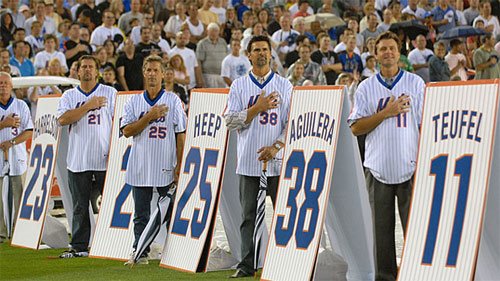
Time has been kinder to some players than others. Ed Hearn, he of the infamous Ed-Hearn-and-Rick-Anderson-For-David-Cone swindle of 1987, looks like Ed Hearn's dad. Kevin Elster is unrecognizable, as is Wally Backman, who looks far older than his 46 years. Darryl Strawberry looks surprisingly youthful given the problems he's had, from jail to colon cancer to two failed marriages. Darryl was always a paradox, with a sweet smile that could never quite hide the strange, sad, dead look in his eyes, eyes that are even more sorrowful now. And of course Darryl's presence, due to a last-minute change of heart on his part to put aside a financial disupte with the organization, served to underscore who was NOT present -- his buddy Dwight Gooden, now doing time in a Florida prison.
Then there's Lenny Dykstra, the little engine that could, who at 23, with his trademark tobacco chaw, was the most exciting player on a team that boasted Keith Hernandez and Darryl Strawberry.
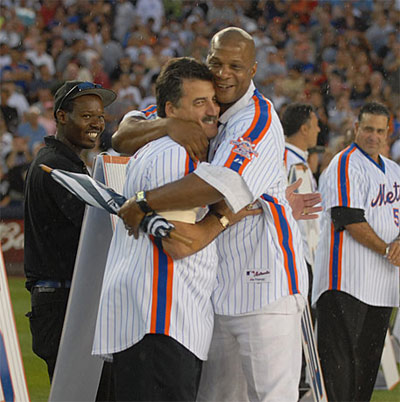
Dykstra is the guy you went to high school with who you figured would be either in a wheelchair or dead by the time he was 40. Although he never admitted it, Dykstra's pumped-up physique after he was traded to the Phillies, as well as the back problems that plague him today, are pretty clear indicators of steroid use. But who would have believed that Nails, of all people, who never gave the impression of being the sharpest knife in the drawer, would turn out to be not just a successful entrepreneur, but also a savvy investor and financial writer?
You don't believe me? Believe it, baby.
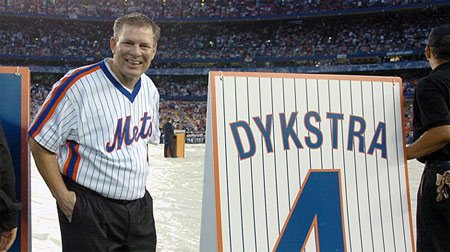
I'm glad that after years of distancing the organization from its most famous and most fun team ever, the Mets organization has decided to embrace its own best past. Keith Hernandez and Ron Darling are now TV broadcasters. Howard Johnson and Randy Niemann are coaches with the Norfolk Tides. Gary Carter manages the St. Lucie Mets, replacing Tim Teufel. It's far better to embrace that team, with its rally caps and hotfoots and swagger and all its warts, than to remember what happened in subsequent years, when the organization tried to build a team around supposed phenom Gregg Jeffries, trading everyone from the 1986 team that didn't get along with Gregg Jeffries before realizing that it was Jeffries himself who was the problem.
But last night, with a sellout crowd at Shea, and the once again dominant Mets sporting 1986 uniforms, it was almost possible to delude myself for a short time that I was still 31 insteaf of 51, and that nothing really has changed.
(Photos from NY Mets Official Site)
Corrente
Hullabaloo
Hoffmania
Orcinus
Scoobie Davis
Talking Points Memo
World O'Crap
Fact-esque
Liberal Oasis
Oliver Willis
Talk Left
This Modern World
Philip Barron
Rising Hegemon
AMERICABlog
James Wolcott
Skippy the Bush Kangaroo
Dependable Renegade
The Political Carnival
Astrological Musings
Firedoglake
Spiiderweb
Words of Power
RIPCoco
Kung Fu Monkey
Empire Burlesque
WTF is it Now
Down With Tyranny
Welcome Back to Pottersvillle
Spocko's Brain
The Sideshow
The Ostroy Report
Fallenmonk
Three Wise Men
NewsHoggers
Blue Gal
Blah3
Shadow of the Hegemon
Slacktivist
ShortWoman
Echidne of the Snakes
Jesus' General
My Left Wing
Arthur Silber
Republic of T
Bitch Ph.D
The American Street
Comments from Left Field
Balloon Juice
I Can't Believe It's Not a Democracy
Scholars and Rogues
On My Mind
PhysioProf
The Vulgar Curmudgeon
Monkeyfister
Sasha Undercover
ThePoliticalCat
Fables of the Reconstruction
Talk2Action
D-Day
State of the Day
Just an Earth-Bound Misfit
Bradblog
They Gave Us a Republic
Vagabond Scholar
Seeing the Forest
The Reaction
Orcinus
SteveAudio
Princess Sparkle Pony
Paul Levinson
Politics After 50
The Jed Report
One Utah
Sam Seder
Alternet
The Political Carnival
County Fair
Mudflats
A Feather Adrift
That's Why
Disciples of Joe
No Longer Quivering
Margaret and Helen
Stand With Dr. Dean
All the Good Names Were Taken
Badtux the Snarky Penguin
My Mental Dumping Ground
Legal Schnauzer
Alicublog
Bouphonia
Konagod
The Reverse Spin
City of Angels
The Gospel According to Hate
Menopausal Stoners
Stinque
The New York Crank
BP Oil Slick
Pen-Elayne
Inside-Out the Beltway
Reclusive Leftist
Southern Beale
The Moderate Voice
The Rant
Help the 99ers
Brendan Calling
Matt Taibbi
I Was Told There Would Be Bacon
We Don't Agree, But...
ShortWoman
of mule dung and ash
Cookies in Heaven
The Hunting of the Snark
The Policy Page (Rick Ungar)
Ramona's Voices
Sardonicky
Dagblog
The Titanic Sails At Dawn
Cheese Food Nation
Donkey Mountain
Thump and Whip
Under the Lobsterscope
Addicting Info
Wifely Person
Disaffected and it Feels So Good
Reality Chex
Burnt Orange Report
Salmon Alley
The Politics Blog w/Charles Pierce
Elizabitchez
We Are The 99 Percent.
Republic of Gilead
amigoingsomeplace
Fukushima Diary
The Polygon
Degringolade
Onyx Lynx
Parsley's Pics
Mainmati
Brandflakes for Breakfast
The Economic Populist
Liberal Dan
Ex-Amish Atheist
The Poor Man's Huffington Post
Constant Commoner
Channel Surfing
Big Bad Bald Bastard
Panic in Funland (Tbogg!!!)
Weird Wally's Worldview
The Galloping Beaver (Canada)
Cathie from Canada
How This Old Brit Sees It ...
Stunner's Afflictions (Jamaica)
Jamaican Lifestyle
behind them
Daily Kos
Atrios
Open Left


Dispatches from the Island &
Further Dispatches
(Jorge Garcia)
Baseball Nerd
(Keith Olbermann)
FOK News Channel (ditto)
Marc Maron
Sam Seder
Brendan McDonald
Johnny Weir
Melina
Lynn
Keith Olbermann

Break Room Live archives
Morning Sedition 3/04-12/05
A Brilliant Radio Show -
Morning Seditionists
Camp Butch (all the
Sedition you can eat)
Jim Earl and his
Big Page of Crap
Morning Remembrance
Steve Gilliard 1966-2007:
A Brilliant Blogger
The News Blog archive
NetSlaves article archive
Friends of Steve:
The Group News Blog
"Jon Swift" (Al Weisel) 1963-2010
Bats Left Throws Right (Doghouse Riley)
Altercation
The All-Spin Zone
Baghdad Burning
Carrie's Nation
Little Country Lost
Cynical Nation
Pam's House Blend
photos1.blogger.com/blogger/397/497/320/bb_banner.1.jpg]^23004A00]coral]navy],](](]]]black],]3]8]20]1]2]3]3]1]2]3]1]1],](](]^235E3D00])])]^3Cimg^20src^3D^22)photos1.blogger.com/blogger/397/497/320/bb_banner.1.jpg^22]^22...you^20have^20a^20choice^3A^20be^20a^20fighting^20liberal^20or^20sit^20quietly.^20I^20know^20what^20I^20am^2C^20what^20are^20you^3F^22^20--^20^3Ca^20href^3D^22)stevegilliard.blogspot.com/2003/12/im-fighting-liberal-you-know-ive.html^22^20STYLE^3D^22color^3Awhite^3B^22^3ESteve^20Gilliard^2C^201966^20-^202007^3C/a^3E^3CBR^3E^22For^20straight^20up^20monster-stomping^20goodness^2C^20nothing^20makes^20smoke^20shoot^20out^20my^20ears^20like^20Brilliant@Breakfast^22^20--^20^3Ca^20href^3D^22)www.poorimpulsecontrol.net/blog^22^20STYLE^3D^22color^3Awhite^3B^22^3ETata^3C/a^3E],](],](](]black](](](]^23FDF2D7](](](]^23333](](](],]50]20],](](]^23FFF8DD])])]black]1.5]15],](](]^2398A45C])])]black]^23FFF8DD])])]^23666]30]^235E3E1A]^23622121],](](]^235E3E1A](],](]^235E3E1A]^23039]^2306C],](](]^23FFF8DD])])],](](]^23FFF8DD])])],](](]^23FFF8DD])])],](]^235E3E1A]^23666]15]3]25]20]^23808C43],](](],](],](](],](]black](](](],](](](],]^235C3E11](](](],](](]^23211104](](](](](],]^2336F]^23211104](],](]Posted^20by^20^24AUTH^20^7C^20^24TIME]20],](](]^23FFF8DD])])]^23FFF8DD])])]^23666]30]^235E3E1A]^23622121],](](]^235E3E1A](],](]^23333]^23039]^2306C]Contact]]]Home]^24HOME]First^20Page]Email^3A^3CBR^3Ebrilliantatbreakfast^20at^20gmail^20dot^20com]]]RSS]^24RSS]RSS^20Feed]Your^20Servers]]]Jill]rilliantatbreakfast.blogspot.com]]Melina])www.ripcoco.com]RIPCoco]Carrie])carriesnation.blogspot.com]Carrie^27s^20Nation]And^20occasionally...]]]jurassicpork])welcome-to-pottersville.blogspot.com]Welcome^20to^20Pottersville]Bob])bobrixon.blogspot.com]The^20Rix^20Mix]Tata])www.poorimpulsecontrol.net/blog]Poor^20Impulse^20Control]Spiiderweb])spiiderweb.blogspot.com]Spiiderweb]Other^20Brilliant^20Bloggers]]]Modern^20Fabulousity])modernfabulousity.blogspot.com]Modern^20Fabulousity]Pandagon])www.pandagon.net]Pandagon]Altercation])www.mediamatters.org/altercation]Altercation]Corrente])www.correntewire.com/]Corrente]Hullabaloo])digbysblog.blogspot.com]Hullabaloo]Hoffmania])www.hoffmania.com]Hoffmania]Orcinus])dneiwert.blogspot.com]Orcinus]Scoobie^20Davis])scoobiedavis.blogspot.com]Scoobie^20Davis]Talking^20Points^20Memo])talkingpointsmemo.com]Talking^20Points^20Memo]World^20O^27Crap])world-o-crap.com/blog]World^20O^27Crap]Fact-esque])casadelogo.typepad.com/factesque/]Fact-esque]Liberal^20Oasis])www.liberaloasis.com/]Liberal^20Oasis]Oliver^20Willis])www.oliverwillis.com/]Oliver^20Willis]Talk^20Left])www.talkleft.com/]Talk^20Left]The^20Talent^20Show])www.thetalentshow.org/]The^20Talent^20Show]Waveflux])www.waveflux.net]Waveflux]Rising^20Hegemon])rising-hegemon.blogspot.com/]Rising^20Hegemon]The^20Poor^20Man])www.thepoorman.net/]The^20Poor^20Man]AMERICABlog])www.americablog.org/]AMERICABlog]Needlenose])www.needlenose.com/]Needlenose]Brilliant^20NJ^20bloggers]]]^24ARCHIVE]^20]]Friends]]]Horm])blog.horm.org]Hallucinations^20Of^20Reabsorbed^20Mind]Phorm])p.horm.org]Another^20Phormation]Etc]]]^3Cimg^20src^3D^22)psyc.horm.org/barimg/bar_psycho.png^22^20width^3D^2280^22^20height^3D^2215^22^20alt^3D^22PsycHo^3A^20Free^20Template^20Generator^22^20style^3D^22border^3A^200px^20solid^20black^22^20/^3E]^24PSYCHO]PsycHo^3A^20Free^20Template^20Generator]^3Cimg^20src^3D^22)psyc.horm.org/barimg/bar_firefox.png^22^20width^3D^2280^22^20height^3D^2215^22^20alt^3D^22Get^20FireFox^21^22^20style^3D^22border^3A^200px^20solid^20black^22^20/^3E])www.mozilla.org/products/firefox/]Get^20Firefox^21]^3Cimg^20src^3D^22)psyc.horm.org/barimg/bar_xhtml.png^22^20width^3D^2280^22^20height^3D^2215^22^20alt^3D^22XHTML^20Validator^22^20style^3D^22border^3A^200px^20solid^20black^22^20/^3E])validator.w3.org/check/referer]XHTML^20Validator]]]]Home]^24HOME]First^20Page]Email]^24EMAIL]Mail^20me^21]RSS]^24RSS]RSS^20Feed]Archive]]]^24ARCHIVE]^20]]Friends]]]Horm])blog.horm.org]Hallucinations^20Of^20Reabsorbed^20Mind]Phorm])p.horm.org]Another^20Phormation]Etc]]]^3Cimg^20src^3D^22)psyc.horm.org/barimg/bar_psycho.png^22^20width^3D^2280^22^20height^3D^2215^22^20alt^3D^22PsycHo^3A^20Free^20Template^20Generator^22^20style^3D^22border^3A^200px^20solid^20black^22^20/^3E]^24PSYCHO]PsycHo^3A^20Free^20Template^20Generator]^3Cimg^20src^3D^22)psyc.horm.org/barimg/bar_firefox.png^22^20width^3D^2280^22^20height^3D^2215^22^20alt^3D^22Get^20FireFox^21^22^20style^3D^22border^3A^200px^20solid^20black^22^20/^3E])www.mozilla.org/products/firefox/]Get^20Firefox^21]^3Cimg^20src^3D^22)psyc.horm.org/barimg/bar_xhtml.png^22^20width^3D^2280^22^20height^3D^2215^22^20alt^3D^22XHTML^20Validator^22^20style^3D^22border^3A^200px^20solid^20black^22^20/^3E])validator.w3.org/check/referer]XHTML^20Validator^26^2361470^3BPsycHo})


