| "Only dull people are brilliant at breakfast" -Oscar Wilde |
 |
"The liberal soul shall be made fat, and he that watereth, shall be watered also himself." -- Proverbs 11:25 |
"...you have a choice: be a fighting liberal or sit quietly. I know what I am, what are you?" -- Steve Gilliard, 1964 - 2007
"For straight up monster-stomping goodness, nothing makes smoke shoot out my ears like Brilliant@Breakfast" -- Tata
"...the best bleacher bum since Pete Axthelm" -- Randy K.
"I came here to chew bubblegum and kick ass. And I'm all out of bubblegum." -- "Rowdy" Roddy Piper (1954-2015), They Live
"For straight up monster-stomping goodness, nothing makes smoke shoot out my ears like Brilliant@Breakfast" -- Tata
"...the best bleacher bum since Pete Axthelm" -- Randy K.
"I came here to chew bubblegum and kick ass. And I'm all out of bubblegum." -- "Rowdy" Roddy Piper (1954-2015), They Live


Brilliant Recent Posts
There's nothing new under the sunAu revoir, y'all....
So Long and Thanks for All the Gefilte Fish
Like White on Rice
Why Did Hillary Clinton Hire a Monsanto Lobbyist t...
Virtual Book Sale
The Man Who Poisoned America
We are privileged to be alive today
The Prodigal Blogger Stops By
Good Times at Pottersville, 3/14/15
Brilliant at Searching
Brilliant Stuff to Buy
What's on my mind:
Brilliant Archives
Brilliant at Begging
Like what you read?Please consider supporting B@B with a donation: There is no gift like the present.
But gifts are nice too:


Feed Me!





Stuff You Must Read
Saturday, June 24, 2006
Convert THIS, bitchez!!
Ah, the sweet smell of Schädenfreude after a summer rainstorm.....
And they thought the Jews were buying all their outreach bullshit! Hah! The wages of Christofascism is spyware. I like the ring of that.
(hat tip: Steve Gilliard)
Watchers of right-wing Christian groups in the States say a new apocalyptic videogame released by cultish Revelations-based fiction series Left Behind is riddled with spyware.
Developers have incorporated software from an Israeli firm called Double Fusion. It incorporates video advertising and product placement into the game, and reportedly records players' behaviour, location, and other data to be uploaded to Left Behind's Bible-powered marketing machine.
Aimed at 13 to 34-year-old males, Left Behind: Eternal Forces casts the player as a director of God's Earthly militia, left behind in the Rapture to roam the streets of New York, battling Satan's minions and shooting unbelievers.
[snip]
In an interview on the series' website Greg Bauman of Left Behind Games explains: "Left Behind: Eternal Forces will help readers get a sense of the conflict and chaos of the time period portrayed in Left Behind and live out how they would defend themselves and their faith from the Antichrist and his Global Peace Keeping Forces." The United Nations, already organ of satanic machinations for many on the Christian far-right, features strongly in the game. Goat-footed demons reportedly emerge from UN peacekeeping humvees.
One reviewer noted: "The only way to accomplish anything positive in the game is to 'convert' nonbelievers into faithful believers, and the only alternative to this is outright killing them."®
And they thought the Jews were buying all their outreach bullshit! Hah! The wages of Christofascism is spyware. I like the ring of that.
(hat tip: Steve Gilliard)

The Advantages of Being Ignored by the Alpha Dogs of Blogtopia
No one call you Markos Moulitsas' lapdog or smears you in the pages of the Joe Lieberman of so-called liberal publications, The New Republic.
Now the day that I get ignored by ModFab and Jay and Spiidey and Tami and Skippy (even though Skip is kind of an "alpha minus" blogger) and Tata and Jeff and their ilk, THAT'S when I'll be upset.
Now the day that I get ignored by ModFab and Jay and Spiidey and Tami and Skippy (even though Skip is kind of an "alpha minus" blogger) and Tata and Jeff and their ilk, THAT'S when I'll be upset.
Best quote on the "Hey Kids Let's Put On an Attack" Gang that couldn't organize straight
Via ShakesSis, I bring you George at I'm Not One to Blog:
The more I hear about these guys, the more they sound like a particularly nasty bunch of totally inept little boys playing at being badass.
I think it's hilarious that the Bushistas and their acolytes are portraying this as some kind of huge success in the War on Terror, never mind the fact that they want to have it both ways with these guys. I mean, if the war in Iraq is "fighting them there so we don't have to fight them here", then if these guys are Big Bad Al Qaeda wannabes, we're fighting them here anyway, right?
And if the "terrorists here" are as dumb as this bunch is supposed to be, then don't you think that all this nonsense with vast data banks in AT&T secret rooms and amassing bank records is just a wee bit of overkill?
I mean, look at what he have here: Nineteen guys with baseball cutters, taking orders from a 6'4" guy on dialysis in Afghanistan manage to topple the World Trade Center and damage a third of the Pentagon. Some Latino guy (Jose Padilla) talks about dirty bombs without having any means of acting in his talk and ends up being disappared into a military prison, probably for life. Now these guys. This isn't exactly high-tech stuff, folks. This hardly makes "the enemy" that Bush talks about all the time sound worthy of being the focus of so much hysteria. In fact, the boogeymen that this Administration, with the help of the media flaying these stories until their flesh fragments, sound more like the Keystone Kops than the kind of threat for which Americans should be willing to give up their freedoms.
If this country is really that much threatened by every nut with delusions of destructions, then perhaps we need a serious gut-check.
Josh Marshall has more:
I mean, hell, if running around talking like a religious nut means you're a terrorist, then we might as well arrest most of the Republicans in Congress right now.
The Miami group arrested as terrorists, which called itself the "Seas of David," evidently hoping that people might just think they're the latest Royal Caribbean line super ship, were cooking up a plot that was "more aspirational than operational," according to FBI deputy director John Pistole. Sort of like that old Catholic notion that if you think of the sin, you've already committed it. Or, to paraphrase Tom Edison, "Terrorism is 99% aspiration, and 1% perspiration."
The more I hear about these guys, the more they sound like a particularly nasty bunch of totally inept little boys playing at being badass.
I think it's hilarious that the Bushistas and their acolytes are portraying this as some kind of huge success in the War on Terror, never mind the fact that they want to have it both ways with these guys. I mean, if the war in Iraq is "fighting them there so we don't have to fight them here", then if these guys are Big Bad Al Qaeda wannabes, we're fighting them here anyway, right?
And if the "terrorists here" are as dumb as this bunch is supposed to be, then don't you think that all this nonsense with vast data banks in AT&T secret rooms and amassing bank records is just a wee bit of overkill?
I mean, look at what he have here: Nineteen guys with baseball cutters, taking orders from a 6'4" guy on dialysis in Afghanistan manage to topple the World Trade Center and damage a third of the Pentagon. Some Latino guy (Jose Padilla) talks about dirty bombs without having any means of acting in his talk and ends up being disappared into a military prison, probably for life. Now these guys. This isn't exactly high-tech stuff, folks. This hardly makes "the enemy" that Bush talks about all the time sound worthy of being the focus of so much hysteria. In fact, the boogeymen that this Administration, with the help of the media flaying these stories until their flesh fragments, sound more like the Keystone Kops than the kind of threat for which Americans should be willing to give up their freedoms.
If this country is really that much threatened by every nut with delusions of destructions, then perhaps we need a serious gut-check.
Josh Marshall has more:
It seems the new terrorist cell rolled up near Miami was in such preliminary stages of launching their jihad that they hadn't yet set aside time to become Muslims.
From the NYT: "Neighbors said at least some of the men were in a religious group called the Seas of David that appeared to mix Christian and Muslim beliefs. The group wore uniforms bearing a Star of David and met for Bible study, prayer and martial arts in a one-story warehouse in the heart of the predominantly Haitian section of the impoverished Liberty City area."
From CNN: "The sister of Lyglenson Lemorin, or "Brother Levi," one of the men arrested Thursday on charges of concocting a terrorist plot, said her brother was involved with the group of men to study religion. Gina Lemorin, who had just returned from her college graduation in Atlanta, Georgia, when she learned of the charges, said he had been with the group in Miami doing construction work. But when the group began practicing "witchcraft," she said, Lemorin left and moved to Atlanta about four months ago ...The family of Phanor, who according to the indictment calls himself "Brother Sunni," told reporters in Miami he was innocent of all charges and was a practicing Roman Catholic, not a Muslim. "They all call themselves brothers and they well-mannered," said his older sister, Marlene Phanor. "All they was trying to do was clean up the community. We are Catholic. He's Catholic." She said the family attends St. Mary's Catholic Church in Miami. Sylvain Plantin, a cousin of Phanor's, said he was involved in a religious group called "Mores," which met to read the Bible."
From KR: "The group apparently did little to inspire fear in the Liberty City neighborhood where they took up residence. A close family friend and a distance cousin of Stanley Grant Phanor described the leader of the group, Narseal Batiste, as a "Moses-like figure" who would roam the streets in a cape or bathrobe, toting a crooked wooden cane and looking for young men to join his group. Sylvain Plantin, 30, said Batiste was a martial arts expert who preached an obscure religion."
I mean, hell, if running around talking like a religious nut means you're a terrorist, then we might as well arrest most of the Republicans in Congress right now.
Friday, June 23, 2006
"...a pathetic Hail Mary pass"
So sayeth Jonathan Alter on Countdown last night, in a scathing piece by Sir Keith that should pretty much put the final nail in Rick Santorum's electoral coffin, given that Man-on-Dog is 18 points down in the polls.
This isn't to say that a few voting machines won't be bedded down the night before the election at poll workers' houses as they were in the California Busby/Bilbray election this month, or that a few smartcards won't be replaced to change the outcome, which will then be attributed to "a last-minute surge by Evangelical voters" -- but on the off chance that we get a serious election conducted by serious people, Little Ricky will be history.
This isn't to say that a few voting machines won't be bedded down the night before the election at poll workers' houses as they were in the California Busby/Bilbray election this month, or that a few smartcards won't be replaced to change the outcome, which will then be attributed to "a last-minute surge by Evangelical voters" -- but on the off chance that we get a serious election conducted by serious people, Little Ricky will be history.
Something to think about while CNN is whipping you into a frenzy of fear over a bunch of guys in Florida
I was in a doctor's office this afternoon (nothing serious, just a consult before some middle-aged medical procedures that shall remain nameless) and the TV set therein was blasting CNN's frenetic coverage of the Florida arrests.
For some strange reason, I'm linked to today by none other than Pajamas Media (welcome, wingnuts!), the denizens of which seem to think that we liberals just can't give the Bush Administration credit for anything, that by arresting these guys, the Administration has just prevented a 9/11 attack from happening, even though there were no plans or equipment in place for such an attack, and even though this is yet another "thwarted attack" trumpeted from the rooftops at a time Bush and the Republicans in Congress who just voted to feed American kids into the meatgrinder that is Iraq in perpetuity need it most.
But those who continue to cling to the Bush is the Big Protective Daddy meme ought perhaps to take a look inside Ron Suskind's new book, The One Percent Doctrine. Gary Kamiya did, and found a few interesting things about He Who Claims To Be The Only One Who Can Keep Us Safe:
Once again, I ask you to think about the expression on Bush's face as he was told about the 9/11 attacks. Spiidey has it, in case you need to refresh your memory. Then think about the man in that photo dismissing a CIA analyst warning Bush -- IN PERSON -- that Bin Laden was planning to strike in the U.S. with "All right, you've covered your ass now."
I've always assumed that because of the Bush family connection with the Bin Laden family, Bush knew damn well what was going to happen and let it play out because he and his cronies stood to benefit hugely -- and certainly his conduct since then has backed me up. But what if it's more insidious than that -- what if Bush decides to know only what he wants to know -- and having tuned out the August 2001 warnings, 2900 people paid the price for his willful ignorance?
Kamiya again:
Now the charitable view towards the Administration would be that Bush has learned from his mistakes in August 2001 and is determined to do a better job this time -- and that's why we're seeing this drumbeat about seven guys in Florida. But since we've seen little from this president in the way of contrition, and even less willingness to admit that his Iraq war was a misbegotten adventure that is damaged beyond repair, I'm skeptical that this spate of "We stopped a terrorist attack" media blasts is anything more than yet another attempt to salvage what's left of a credibiilty that this man never should have been granted in the first place. This administration is all about the politics, and always has been. It has never been about leadership. Bill Clinton's administration stopped a number of New Year's Eve 1999 attacks and never uttered a peep about it. This bunch claims to thwart attacks every time their numbers are in the toilet and a swarthy guy with a bottle of iced tea gets on the F train.
Fool me once, shame on....shame on you. Fool me .........can't get fooled again.
For some strange reason, I'm linked to today by none other than Pajamas Media (welcome, wingnuts!), the denizens of which seem to think that we liberals just can't give the Bush Administration credit for anything, that by arresting these guys, the Administration has just prevented a 9/11 attack from happening, even though there were no plans or equipment in place for such an attack, and even though this is yet another "thwarted attack" trumpeted from the rooftops at a time Bush and the Republicans in Congress who just voted to feed American kids into the meatgrinder that is Iraq in perpetuity need it most.
But those who continue to cling to the Bush is the Big Protective Daddy meme ought perhaps to take a look inside Ron Suskind's new book, The One Percent Doctrine. Gary Kamiya did, and found a few interesting things about He Who Claims To Be The Only One Who Can Keep Us Safe:
Cheney, Bush, Rumsfeld, Rice and Rove pulled off a much more sophisticated job: a bureaucratic coup d'état. Without firing a shot, they silenced critics, squelched unwanted facts, and created their own false but salable reality. As a result, they were able to launch a war justified by lies and driven by nothing more than Bush's ignorant whim. It is, truly, the heist of the century.
[snip]
Suskind opens the book with a damning scene in which a CIA analyst warns Bush in August 2001 that bin Laden was planning to strike the U.S. Bush's response: "All right. You've covered your ass, now." That dismissive reply displayed not just Bush's frat-boy boorishness but his poor judgment. And after the terrorist attacks came, all constraints on Bush -- and Cheney -- vanished. Suskind depicts Bush as unbound, liberated by 9/11: While before the attacks senior staff worried that he wasn't thinking things through, now improvisation, not rational thought, was called for. This let Bush be Bush. "Left unfettered, and unchallenged, were his instincts, his 'gut,' as he often says, and an unwieldy aggressiveness that he'd long been cautioned to contain."
Once again, I ask you to think about the expression on Bush's face as he was told about the 9/11 attacks. Spiidey has it, in case you need to refresh your memory. Then think about the man in that photo dismissing a CIA analyst warning Bush -- IN PERSON -- that Bin Laden was planning to strike in the U.S. with "All right, you've covered your ass now."
I've always assumed that because of the Bush family connection with the Bin Laden family, Bush knew damn well what was going to happen and let it play out because he and his cronies stood to benefit hugely -- and certainly his conduct since then has backed me up. But what if it's more insidious than that -- what if Bush decides to know only what he wants to know -- and having tuned out the August 2001 warnings, 2900 people paid the price for his willful ignorance?
Kamiya again:
Suskind all but comes out and says what many have suspected: that Bush, although a man of deep faith -- he reads Scripture or a religious tract every morning -- is grossly intellectually unqualified to be president. Again and again, Suskind describes scenes that display his disengagement, his lack of curiosity, his ignorance of the most rudimentary facts. His inner circle knew his weaknesses, and assiduously prevented them from being known. "He is very good at some things that presidents are prized for, and startlingly deficient in others. No one in his innermost circle trusts that those imbalances would be well received by a knowledgeable public, especially at a time of crisis. So they are protective of him -- astonishingly so -- and forgiving."
[snip]
Cheney and Rumsfeld, Suskind writes, viewed Bush as an inferior, the child of their contemporaries. A master at bureaucratic stealth, Cheney quietly orchestrated the war, which was "about the only matter on which all three agreed ... So, as America officially moved to a detailed action plan for the overthrow of Hussein, only three men would be in the know: Bush, Cheney and Rumsfeld."
[snip]
But Bush, in Suskind's portrayal, was hardly putty in Cheney's hands (although Suskind reports that inside the CIA Cheney was nicknamed "Edgar," after the ventriloquist Edgar Bergen, whose famous dummy was Charlie McCarthy). Bush played along with the game. He didn't want to know any more than Cheney wanted him to know. "No one would dare say that the President made it clear to his most trusted lieutenants he did not want to be informed, especially when the information might undercut the confidence he has in certain sweeping convictions."
Now the charitable view towards the Administration would be that Bush has learned from his mistakes in August 2001 and is determined to do a better job this time -- and that's why we're seeing this drumbeat about seven guys in Florida. But since we've seen little from this president in the way of contrition, and even less willingness to admit that his Iraq war was a misbegotten adventure that is damaged beyond repair, I'm skeptical that this spate of "We stopped a terrorist attack" media blasts is anything more than yet another attempt to salvage what's left of a credibiilty that this man never should have been granted in the first place. This administration is all about the politics, and always has been. It has never been about leadership. Bill Clinton's administration stopped a number of New Year's Eve 1999 attacks and never uttered a peep about it. This bunch claims to thwart attacks every time their numbers are in the toilet and a swarthy guy with a bottle of iced tea gets on the F train.
Fool me once, shame on....shame on you. Fool me .........can't get fooled again.
Isn't it funny how terror plots are only planned when the Bush Administration is in trouble?
Funny how there have been no terror threats while Karl Rove was on the back burner, and now that he's back in the driver's seat, the "Run for the hills! The terrorists are coming!" message is back in full force:
Look at what now constitutes the kind of behavior that gets people suspicious:
- men exercising....at night....in Florida, where the temperature is up over 90 during the day.
- claims of having given one's life over to a deity
- "recruiting" kids for a karate class
Well, let's see: Sometimes I work out at night in the summertime because it's cooler.
And gee....when I see fundamentalist Christians who say they've given their lives to Christ, I think the same thing. The difference is that I don't report them to the FBI as potential terrorists. Though when you think about people like Paul Hill and Eric Rudolph, maybe we should.
And there are any number of martial arts schools in my area that "recruit" kids into studying martial arts. And parents take their kids there by the hundreds.
Sorry, folks, but something about this stinks to high heaven. It's interesting that the rest of the story will come out as part of the Friday News Dump -- which undoubtedly means that there's no there there, but it was necessary to push the fear button yesterday.
Seven people were arrested Thursday in connection with the early stages of a plot to attack Chicago's Sears Tower and other buildings in the U.S., including the FBI office here, a federal law enforcement official said.
As part of the raids related to the arrests, FBI agents swarmed a warehouse in Miami's Liberty City area, using a blowtorch to take off a metal door. A neighbor said the suspects had been sleeping in the warehouse while running what seemed to be a "military boot camp."
The official told The Associated Press the alleged plotters were mainly Americans with no apparent ties to al-Qaida or other foreign terrorist organizations. He spoke on condition of anonymity so as not to pre-empt news conferences planned for Friday in Washington and Miami.
Miami U.S. Attorney R. Alexander Acosta said in a statement that the investigation was an ongoing operation and that more details would be released Friday.
"There is no imminent threat to Miami or any other area because of these operations," said Richard Kolko, spokesman for FBI headquarters in Washington. He declined further comment.
FBI Director Robert Mueller, questioned about the case during an appearance on CNN's "Larry King Live," said he couldn't offer many details because "it's an ongoing operation."
"We are conducting a number of arrests and searches" in Miami, Mueller said, which were expected to be wrapped up Friday morning.
Residents living near the warehouse said the men taken into custody described themselves as Muslims and had tried to recruit young people to join their group, which seemed militaristic.
The residents said FBI agents spent several hours in the neighborhood showing photos of the suspects and seeking information. They said the men had lived in the area about a year.
The men slept in the warehouse, said Tashawn Rose, 29. "They would come out late at night and exercise. It seemed like a military boot camp that they were working on there. They would come out and stand guard."
She talked to one of the men about a month ago: "They seemed brainwashed. They said they had given their lives to Allah."
Look at what now constitutes the kind of behavior that gets people suspicious:
- men exercising....at night....in Florida, where the temperature is up over 90 during the day.
- claims of having given one's life over to a deity
- "recruiting" kids for a karate class
Well, let's see: Sometimes I work out at night in the summertime because it's cooler.
And gee....when I see fundamentalist Christians who say they've given their lives to Christ, I think the same thing. The difference is that I don't report them to the FBI as potential terrorists. Though when you think about people like Paul Hill and Eric Rudolph, maybe we should.
And there are any number of martial arts schools in my area that "recruit" kids into studying martial arts. And parents take their kids there by the hundreds.
Sorry, folks, but something about this stinks to high heaven. It's interesting that the rest of the story will come out as part of the Friday News Dump -- which undoubtedly means that there's no there there, but it was necessary to push the fear button yesterday.
This is what the Bush Administration regards as progress in Iraq
FUBAR:
This is the course that Senate Republicans have just resolved to stay. Hey, guys, how's that working for ya? Of course we'll see in November, but I wonder how all these Good Christian Men sleep at night knowing that they are trading the lives a generation of American kids for their own Congressional perqs.
The Iraqi government declared a state of emergency and imposed a curfew Friday after insurgent gunmen set up roadblocks in central Baghdad and opened fire on U.S. and Iraqi troops just north of the heavily fortified Green Zone.
With just two hours notice, the prime minister ordered everyone off the streets of the capital from 2 p.m. Friday until 6 a.m. Saturday. U.S. and Iraqi forces also were engaged in firefights with insurgents in the dangerous Dora neighborhood in south Baghdad.
As the state of emergency was announced in the capital, a car bomb ripped through a market and nearby gas station in the increasingly volatile southern city of Basra Friday, killing at least five people and wounding 18, including two policemen, police said.
At least 19 other deaths were reported in Baghdad.
Throughout the morning Friday, Iraqi and U.S. military forces clashed with attackers who were armed with rocket-propelled grenades, hand grenades and rifles in busy Haifa Street that runs into the Green Zone, site of the U.S. and British embassies and the Iraqi government.
Two Iraqi soldiers and a policeman were wounded in the fighting, said police Lt. Maitham Abdul Razzaq said.
The region was sealed and Iraqi and U.S. forces conducted house-to-house searches.
Gunmen also attacked a group of worshippers marching from Sadr City, the Shiite slum in eastern Baghdad, to the Buratha mosque on the other side of the city to protest a suicide attack a week ago on the revered Shiite shrine. At least one marcher was killed and four were wounded, Lt. Ahmed Mohammed Ali said.
The U.S. military on Friday said a Marine had died in combat and a soldier was killed in an unspecified non-hostile incident three days earlier. Their deaths raise to at least 2,514 members of the U.S. military who have died since the Iraq war started in March 2003, according to an Associated Press count.
This is the course that Senate Republicans have just resolved to stay. Hey, guys, how's that working for ya? Of course we'll see in November, but I wonder how all these Good Christian Men sleep at night knowing that they are trading the lives a generation of American kids for their own Congressional perqs.
The problem with "clean slate" Christianity
Most of the people in my life aren't terribly religious. I do know a number of people who define themselves as "spiritual", but don't adhere to a particular religious doctrine. One trait that all these people have in common is this notion that one should try to live a "good life." This "good life" has little to do with money or amassing fortunes, and much to do with being kind to others. Some of these people are Christians, particularly Catholics, who think that good deeds are what you're judged on when you take the dirt nap, to determine if you go to the place with the harps and halos, or if you're condemned to an eternity of the worst hotflashes you've ever experienced, listening to the song stylings of Celine Dion for all eternity.
The problem is that Christians who think that good deeds mean anything are completely misinterpreting their doctrine.
Roman Catholicism at least provides a structure in which one has to face one's sins by confessing them to another person. It still has this "do whatever the hell you want as long as you confess" aspect to it, but one would hope that the humiliation factor of having to tell a priest that you stole your best friend's diamond earrings, or that you backed your car into a parked car and didn't leave a note on the windshield, or that you hit a baseball through a house's window and then ran away, or that you fucked the secretary after the office Christmas party, would serve as a deterrent against future transgressions.
We are all flawed to one degree or another, but I believe that part of life, and part of our journey towards -- whatever -- enlightenment, heaven, or whatever awaits us -- is to try to do the best we can to "do what thou wilt, harm none."
My beef with the brand of Christianity practiced by today's right-wing "family values" politicians and those on their side of the fence is the "clean slate" it seems to offer in exchange for saying, "Yup. He was the son of God and died on the cross for my sins." That's all you have to do, and you can do whatever the hell you want without even TRYING to live a virtuous life, because this kind of Christianity is about faith, not deeds.
This is how you end up with the parade of Republican adulterers out on the stump telling the rest of us how to live. Right now the very same people who would love to see Bill Clinton stoned to death for HIS adultery are twisting themselves into pretzels trying to find a way to support the adulterers John McCain or Rudy Giuliani for the presidency.
The latest entry in this "I found Jesus so it's OK" band of hypocrites is Florida gubernatorial candidate Tom Gallagher:
I would be interested in knowing what kinds of acts of contrition he may have made towards his first wife in the aftermath of "finding Jesus." My hunch is that there aren't any.
I am no great fan of Bill Clinton, but he is at least a guy who admitted that he'd fucked up, acknowledged the pain he'd caused his family, and has tried to make amends to that family, not a weasel who seems to think that simple belief that a Jew getting nailed to a tree two thousand years ago means they can do whatever the fuck they want and it doesn't count -- and the collateral damage left behind can be forgotten.
UPDATE: No less an "authority" than The World's Most Self-Loathing Hermaphrodite holds forth on "clean slate Christianity about a third of the way through this interview. Listen to the whole thing, and note the inconsistency between her idea that salvation isn't about what you do, and her contention that conservatives deal with crime by making criminals take their punishment and "get right with God." But if you can do whatever you want as long as you believe Jesus died for your sins, what of the religious Christian who molests his daughter (i.e. Susan Smith's father) or the one who kills abortion doctors (Paul Hill, Eric Rudolph) or the one who kills his family and then goes on the lam for 18 years (John List)?
The problem is that Christians who think that good deeds mean anything are completely misinterpreting their doctrine.
Roman Catholicism at least provides a structure in which one has to face one's sins by confessing them to another person. It still has this "do whatever the hell you want as long as you confess" aspect to it, but one would hope that the humiliation factor of having to tell a priest that you stole your best friend's diamond earrings, or that you backed your car into a parked car and didn't leave a note on the windshield, or that you hit a baseball through a house's window and then ran away, or that you fucked the secretary after the office Christmas party, would serve as a deterrent against future transgressions.
We are all flawed to one degree or another, but I believe that part of life, and part of our journey towards -- whatever -- enlightenment, heaven, or whatever awaits us -- is to try to do the best we can to "do what thou wilt, harm none."
My beef with the brand of Christianity practiced by today's right-wing "family values" politicians and those on their side of the fence is the "clean slate" it seems to offer in exchange for saying, "Yup. He was the son of God and died on the cross for my sins." That's all you have to do, and you can do whatever the hell you want without even TRYING to live a virtuous life, because this kind of Christianity is about faith, not deeds.
This is how you end up with the parade of Republican adulterers out on the stump telling the rest of us how to live. Right now the very same people who would love to see Bill Clinton stoned to death for HIS adultery are twisting themselves into pretzels trying to find a way to support the adulterers John McCain or Rudy Giuliani for the presidency.
The latest entry in this "I found Jesus so it's OK" band of hypocrites is Florida gubernatorial candidate Tom Gallagher:
Tom Gallagher, the Republican state chief financial officer running for governor on a platform of family values, admitted Monday that he had an extramarital affair that led to his 1979 divorce and said he used marijuana before he was elected to public office ''many, many'' years ago.
Gallagher, 62, conducted an impromptu news conference with his wife, Laura, after The Tampa Tribune asked him about 26 pages excerpted from his 27-year-old divorce file, expunged from Miami-Dade court files years ago in a routine purging of dated records.
The revelations come as Gallagher courts religious conservatives, who have embraced him, in part, because he is married and has a 7-year-old son. They see him as more of a committed family man than his GOP primary opponent, Attorney General Charlie Crist, who remains single after a divorce in 1980 following seven months of marriage.
The divorce documents, as well as additional court records obtained by The Miami Herald, show that Gallagher's ex-wife, Ann Louise, kicked him out of their Miami home in 1979 when she discovered he had been having a yearlong affair with a Tallahassee legislative aide.
At the time, Gallagher was a state representative from Coconut Grove and owned a Tallahassee condominium, leased by his then-girlfriend, Stephanie W. McBee.
After Ann Louise filed for divorce in 1979, an allegedly intoxicated Gallagher returned to their home and tore a screen off the house, the court documents say. The next day, he returned and took the dog. Ann Louise Gallagher asked a judge for a restraining order.
The apparently sympathetic judge, Milton Rubin, told Tom Gallagher: ``You're a public figure. You don't need any adverse publicity.''
The judge then agreed not to ''embarrass'' him with a restraining order as long as Gallagher agreed to stay away from the home until the divorce was final.
GIRLFRIEND TESTIFIES
In a copy of a September 1979 deposition of McBee obtained by The Miami Herald, the former girlfriend testified that during 1978 and 1979, she traveled with Gallagher to Atlanta, Texas, California, Miami, Orlando, West Virginia, Washington, D.C., Delaware and Nassau in the Bahamas. She stayed at his Miami home for three days when his wife was in Michigan, and he gave her gifts.
McBee testified that in 1979, she spent three days with Gallagher in Nassau, where they ``went to dinner, saw a show, swam, laid on the beach and read.''
[snip]
A contrite Tom Gallagher said on Monday he does not regret that the documents have become public, and that he takes full responsibility for his past. "Divorces are messy, but I take full responsibility for what led to mine," he said. "It was totally my fault."
A DIFFERENT MAN
But Gallagher emphasized that he is not the same man who first sought the Republican nomination for governor in 1982, when he had a reputation in Tallahassee as a bon vivant and ladies' man.
"I know that many of you have been somewhat skeptical about some of the changes that have taken place in my life -- that it's some kind of a campaign strategy,'' Gallagher said. ``But I'm here to tell you, Christ does change lives, and I'm a different person because of it."
I would be interested in knowing what kinds of acts of contrition he may have made towards his first wife in the aftermath of "finding Jesus." My hunch is that there aren't any.
I am no great fan of Bill Clinton, but he is at least a guy who admitted that he'd fucked up, acknowledged the pain he'd caused his family, and has tried to make amends to that family, not a weasel who seems to think that simple belief that a Jew getting nailed to a tree two thousand years ago means they can do whatever the fuck they want and it doesn't count -- and the collateral damage left behind can be forgotten.
UPDATE: No less an "authority" than The World's Most Self-Loathing Hermaphrodite holds forth on "clean slate Christianity about a third of the way through this interview. Listen to the whole thing, and note the inconsistency between her idea that salvation isn't about what you do, and her contention that conservatives deal with crime by making criminals take their punishment and "get right with God." But if you can do whatever you want as long as you believe Jesus died for your sins, what of the religious Christian who molests his daughter (i.e. Susan Smith's father) or the one who kills abortion doctors (Paul Hill, Eric Rudolph) or the one who kills his family and then goes on the lam for 18 years (John List)?
Thursday, June 22, 2006
It's not just your phone records they're spying on
It's your bank transactions too. Do YOU believe this Administration when they say they are ONLY monitoring bank records of suspected terrorists, especially after we find out that AT&T is running secret surveillance rooms for them?
I don't.
More:
So now the government claims the right to examine, in minute detail, every aspect of your life at any time. And they have the nerve to call us a free society?
The terrorists, if indeed it was foreign terrorists behind the 9/11 attacks, which every time the Bush Administration pulls another stunt like this because less and less believable, have succeeded beyond their wildest dreams. It was never about "they hate our freedom" -- unless by "they" you're referring to the Bush Administration, not the shadowy Arabs they've used as boogeymen to gain the totalitarian, centralized, all-powerful dictatorship for which they've lusted for a generation.
In other news, AT&T has now updated its privacy policy. You have none. They now say YOUR data is THEIRS to do with as they wish -- sell it to brokers, give it to the government, use it against you in any way they like.
Back in the 1960's, there was a movie called The President's Analyst. James Coburn starred as the eponymous shrink, and the plot, via Wikipedia, is as follows:
The climactic scene features a creepily affable Pat Harrington, later to go on to "Schneider" fame on the sitcom One Day at a Time, explaining the phone company conspiracy with a bland, Ralph Reed-type smile. It's a film that didn't do well outside of psycniatry nerds like most of my family, and fans of James Coburn from the Flint movies. But while it's as dated as most 1960's paranoid spy movies, its relevance to today is quite shocking.
There are films like Dr. Strangelove that are classic social satires, but since the deliciously-named director Theodore J. Flicker is probably not a household name and spent much of his career directing Barney Miller, this film has been largely forgotten outside of spy movie cultists. But if you have Netflix, give it a look. You'll find that old Ted Flicker was on to something back in 1967.
I don't.
More:
The program, however, is a significant departure from typical practice in how the government acquires Americans' financial records. Treasury officials did not seek individual court-approved warrants or subpoenas to examine specific transactions, instead relying on broad administrative subpoenas for millions of records from the cooperative, known as Swift.
That access to large amounts of sensitive data was highly unusual, several officials said, and stirred concerns inside the administration about legal and privacy issues.
"The capability here is awesome or, depending on where you're sitting, troubling," said one former senior counterterrorism official who considers the program valuable. While tight controls are in place, the official added, "The potential for abuse is enormous."
The program is separate from the National Security Agency's efforts to eavesdrop without warrants and collect domestic phone records, operations that have provoked fierce public debate and spurred lawsuits against the government and telecommunications companies. But all the programs grew out of the Bush administration's desire to exploit technological tools to prevent another terrorist strike, and all reflect attempts to break down longstanding legal or institutional barriers to the government's access to private information about Americans and others inside the United States.
Officials described the Swift program as the biggest and most far-reaching of several secret efforts to trace terrorist financing. Much more limited agreements with other companies have provided access to A.T.M. transactions, credit card purchases and Western Union wire payments, the officials said.
Nearly 20 current and former government officials and industry executives discussed aspects of the Swift operation with The New York Times on condition of anonymity because the program remains classified. Some of those officials expressed reservations about the program, saying that what they viewed as an urgent, temporary measure had become permanent nearly five years later without specific Congressional approval or formal authorization.
Data from the Brussels-based banking consortium, formally known as the Society for Worldwide Interbank Financial Telecommunication, has allowed officials from the C.I.A., the Federal Bureau of Investigation and other agencies to examine "tens of thousands" of financial transactions, Mr. Levey said.
While many of those transactions have occurred entirely on foreign soil, officials have also been keenly interested in international transfers of money by individuals, businesses, charities and other organizations under suspicion inside the United States, officials said. A small fraction of Swift's records involve transactions entirely within this country, but Treasury officials said they were uncertain whether any had been examined.
So now the government claims the right to examine, in minute detail, every aspect of your life at any time. And they have the nerve to call us a free society?
The terrorists, if indeed it was foreign terrorists behind the 9/11 attacks, which every time the Bush Administration pulls another stunt like this because less and less believable, have succeeded beyond their wildest dreams. It was never about "they hate our freedom" -- unless by "they" you're referring to the Bush Administration, not the shadowy Arabs they've used as boogeymen to gain the totalitarian, centralized, all-powerful dictatorship for which they've lusted for a generation.
In other news, AT&T has now updated its privacy policy. You have none. They now say YOUR data is THEIRS to do with as they wish -- sell it to brokers, give it to the government, use it against you in any way they like.
Back in the 1960's, there was a movie called The President's Analyst. James Coburn starred as the eponymous shrink, and the plot, via Wikipedia, is as follows:
Dr. Sidney Schaefer (James Coburn), a psychologist, is chosen by the U.S. Government to act as the President’s personal analyst. He is constantly telephoned at any/all hours to go to the White House and listen to his client’s daily problems, and quickly becomes overwhelmed by stress. Schaefer begins to feel that he is being watched everywhere and his paranoia grows to an almost insane degree; he even suspects his sweet girlfriend (Joan Delaney) of spying on him. Eventually, he goes on the lam and manages to narrowly avoid several assassination attempts by tiny agents from the “FBR”, who are trying to kill him due to his having been pegged as a risk to national security. At the same time, spies from every corner of the world attempt to kidnap him because of all the secret information the President has provided to him. Two of Schaefer’s previous clients, a “CEA” assassin (Godfrey Cambridge) and a Russian spy (Severn Darden), come to his aid and help him expose a major conspiracy involving The Phone Company and world domination.
The climactic scene features a creepily affable Pat Harrington, later to go on to "Schneider" fame on the sitcom One Day at a Time, explaining the phone company conspiracy with a bland, Ralph Reed-type smile. It's a film that didn't do well outside of psycniatry nerds like most of my family, and fans of James Coburn from the Flint movies. But while it's as dated as most 1960's paranoid spy movies, its relevance to today is quite shocking.
There are films like Dr. Strangelove that are classic social satires, but since the deliciously-named director Theodore J. Flicker is probably not a household name and spent much of his career directing Barney Miller, this film has been largely forgotten outside of spy movie cultists. But if you have Netflix, give it a look. You'll find that old Ted Flicker was on to something back in 1967.
Net Neutrality Is Imperative
Do you want your website to get prioritized? Do you want to pay your ISP to ensure hits? Yeah, I thought not. But internet access and freedom are being challenged unmercifully.
They'll vote on Friday. Check the right sidebar of this site under "USEFUL LINKS" to contact your Congress critter. All contact info is linked except for the "omnibus" phone number.
(read more)
Originally posted at SPIIDERWEB™
If you're unsure about how the Net Neutrality goes, here's the down & dirty talking point. The big Telcos (AT&T, Bell South, Verizon, etc.) claim that unless they can run the internet their way, innovation is dead, and the internet will suck forever. The big Telcos are calling Net Neutrality "regulating the internet".
What a crock of shit. What the big Telcos want to do is create a monopoly for themselves, rake in money on services that are currently free (by setting up "toll booths" for those services - such as blogging, video streaming, etc.) and potentially determine which content will be provided to users. In order to argue this, McCurry and the Telcos have resorted to outright lies, claiming that Net Neutrality is an issue advocated by the far left and that if the Net Neutrality amendment passes, traffic on the internet will bog down in an increasingly overwhelmed network.
They'll vote on Friday. Check the right sidebar of this site under "USEFUL LINKS" to contact your Congress critter. All contact info is linked except for the "omnibus" phone number.
(read more)
Originally posted at SPIIDERWEB™
OK, Mr. President, now say it without the smirk
Delusional quote of the day:
(Hat tip: Spiidey)
"We'll defend ourselves, but at the same time we're actively working with our partners to spread peace and democracy,"
(Hat tip: Spiidey)
"If a woman in India marries a snake, gay people should have to justify it"
So sayeth Stephen Colbert. ShakesSis delivers the video.
Republicans have nothing else to run on
There must be TONS of dirt on Congressional Republicans that they don't want to get out, because it looks like the Corleone Administration has succeeded in getting their minions in Congress to fall into line on the Iraq War:
Message to Republicans: It's too late. Thousands of troops HAVE died for nothing, and feeding more of them into this meat grinder isn't going to redeem this war without end, this war without strategy, this war without purpose, this war without a plan. This war, which let's not forget was a war of choice, not necessity, HAS given extremists the launching pad they needed,. This war IS the most humiliating American defeat since Vietnam. That's reality, and all the gaseous rhetoric spewing from Capitol Hill doesn't change that.
I might be willing to go along with the notion of fighting it as best we can if we had any indication at all that the Administration had anything resembling a clue as to what it was doing. But instead, we are foundering in Iraq. Kidnappings and torture deaths of American soldiers. Soldiers being killed by the very Iraqi military they are training. Soldiers being killed by IEDs. Bill Clinton was vilified after inheriting the Somalia mess from the current president's father and presiding over the dragging of the corpse of an American soldier through the streets. Yet over 2000 American soldiers have been killed since Captain Codpiece pretended to fly an airplane onto an aircraft carrier and crowed that "Major combat operations have ended" in front of a sign reading "Mission Accomplished" -- and not only don't Republicans utter a peep, but want to send MORE kids to be killed in a occupation without a plan.
Here's what's happened in Iraq just today as of 8:30 AM GMT -- and the day has just begun:
This is not a war on anything. It is an occupation of a country that never attacked us. It is a war that serves the geopolitical interests of a small cadre of corporatist ideologues. It is a war that has already cost us almost $300 billion at a time when the American middle class is being systematically eliminated. It is a war that is shoveling huge amounts of taxpayer cash -- with no accountability at all -- into the pockets of Halliburton, which has enjoyed an increase of 600% in federal contracts granted it during the Bush/Cheney years.
And Republicans want it to go on and on indefinitely, asking more American families to bury their children, while not one of them is making any kind of sacrifice at all.
If the Democrats had any guts at all, they'd be able to kick this kind of crap aside like an errant pebble on the sidewalk. Endless, pointless, bankrupting, botched war would hardly seem like a winning campaign issue. We'll see over the next few months if it is.
That emerging Republican approach reflects, at least for now, the success of a White House effort to bring a skittish party behind Mr. Bush on the war after months of political ambivalence in some vocal quarters. As President Bush offered another defense of his Iraq policy during a visit to Vienna on Wednesday, Republicans acknowledged that it was a strategy of necessity, an effort to turn what some party leaders had feared could become the party's greatest liability into an advantage in the midterm elections.
The approach might yet be upended by more problems in Iraq, as Republicans were reminded this week with reports about two American servicemen who were abducted, tortured and apparently killed. Some polls show a majority of Americans continue to think that entering Iraq was a mistake, and pollsters say independent voters are particularly open to the idea of setting some sort of timetable for withdrawal, the very policy Democrats have embraced and Republicans are now fighting.
But people who attended a series of high-level meetings this month between White House and Congressional officials say President Bush's aides argued that it could be a politically fatal mistake for Republicans to walk away from the war in an election year.
White House officials including the national security adviser, Stephen J. Hadley, outlined ways in which Republican lawmakers could speak more forcefully about the war. Participants also included Mr. Bush's top political and communications advisers: his deputy chief of staff, Karl Rove; his political director, Sara Taylor; and the White House counselor, Dan Bartlett. Mr. Rove is newly freed from the threat of indictment in the C.I.A. leak case, and leaders of both parties see his reinvigorated hand in the strategy.
The meetings were followed by the distribution of a 74-page briefing book to Congressional offices from the Pentagon to provide ammunition for what White House officials say will be a central line of attack against Democrats from now through the midterm elections: that the withdrawal being advocated by Democrats would mean thousands of troops would have died for nothing, would give extremists a launching pad from which to build an Islamo-fascist empire and would hand the United States its must humiliating defeat since Vietnam.
[snip]
A senior adviser to Mr. Bush said the White House had concluded that it was better to plunge aggressively into the debate on Iraq than to let Democrats play upon clear, public misgivings about the war. "This is going to be a big issue in this election," said the adviser, who was granted anonymity in exchange for agreeing to describe strategic considerations about the war. "Better to shape and fight it — as good and strongly as you can — than to try to run away from it."
Message to Republicans: It's too late. Thousands of troops HAVE died for nothing, and feeding more of them into this meat grinder isn't going to redeem this war without end, this war without strategy, this war without purpose, this war without a plan. This war, which let's not forget was a war of choice, not necessity, HAS given extremists the launching pad they needed,. This war IS the most humiliating American defeat since Vietnam. That's reality, and all the gaseous rhetoric spewing from Capitol Hill doesn't change that.
I might be willing to go along with the notion of fighting it as best we can if we had any indication at all that the Administration had anything resembling a clue as to what it was doing. But instead, we are foundering in Iraq. Kidnappings and torture deaths of American soldiers. Soldiers being killed by the very Iraqi military they are training. Soldiers being killed by IEDs. Bill Clinton was vilified after inheriting the Somalia mess from the current president's father and presiding over the dragging of the corpse of an American soldier through the streets. Yet over 2000 American soldiers have been killed since Captain Codpiece pretended to fly an airplane onto an aircraft carrier and crowed that "Major combat operations have ended" in front of a sign reading "Mission Accomplished" -- and not only don't Republicans utter a peep, but want to send MORE kids to be killed in a occupation without a plan.
Here's what's happened in Iraq just today as of 8:30 AM GMT -- and the day has just begun:
The new Shi'ite-led government of Prime Minister Nuri al- Maliki has vowed to rein in insurgent and sectarian violence that has killed tens of thousands of people since U.S. forces invaded Iraq in 2003.
ANBAR PROVINCE - Four U.S. soldiers were killed on Tuesday in two separate attacks in Iraq's western Anbar province, the U.S. military said.
DHULUIYA - Gunmen killed an Iraqi soldier in his home in Dhuluiya, 40 km (25 miles) north of Baghdad, police said.
BAGHDAD - A U.S. soldier was killed by a roadside bomb south of Baghdad on Wednesday, the U.S. military said.
HAWIJA - Gunmen killed a carpenter on Wednesday in Hawija, 70 km (43 miles) southwest of Kirkuk, police said.
KIRKUK - Iraqi soldiers killed a gunman and arrested two on Wednesday after coming under attack in the northern oil city of Kirkuk, police said.
This is not a war on anything. It is an occupation of a country that never attacked us. It is a war that serves the geopolitical interests of a small cadre of corporatist ideologues. It is a war that has already cost us almost $300 billion at a time when the American middle class is being systematically eliminated. It is a war that is shoveling huge amounts of taxpayer cash -- with no accountability at all -- into the pockets of Halliburton, which has enjoyed an increase of 600% in federal contracts granted it during the Bush/Cheney years.
And Republicans want it to go on and on indefinitely, asking more American families to bury their children, while not one of them is making any kind of sacrifice at all.
If the Democrats had any guts at all, they'd be able to kick this kind of crap aside like an errant pebble on the sidewalk. Endless, pointless, bankrupting, botched war would hardly seem like a winning campaign issue. We'll see over the next few months if it is.
Wednesday, June 21, 2006
Will NASA never learn?
I can't believe they're going to do it again:
As Tbogg so succinctly puts it:
"Looking at our options" once the crew is in orbit is sort of like looking to bolster the World Trade Center's fireproofing while you're standing on Lispenard Street watching it collapse.
What's happened to NASA is a tragedy. I can remember when space flight was exciting and glamorous. Watching all those geeky guys in their short-sleeved white shirts and thick-rimmed black glasses in the 1960's, working all those "machines that go 'ping!'" while jaunty guys in spacesuits waved on grainy video footage made it seem as if there was nothing Americans couldn't do; that good old American know-how meant that the sky was the limit for knowledge, for discovery, for science.
Now they're reduced to launching 25-year-old shuttles using what one article once called "big dumb rockets" that have at least an even shot at destroying what they're launching. And instead of discovery and wonder, we now can't bear to watch.
NASA managers have rejected last-ditch pleas from their top safety officer and chief engineer to scrap next month's shuttle launch, saying that they will press ahead despite potentially catastrophic risks.
[snip]
During a weekend meeting at NASA's Kennedy Space Centre at Cape Canaveral, Florida, Dr Griffin gave the final nod for next month's mission, despite what he called an "intensive and spirited exchange" with senior colleagues who recommended a "no-go". "We have elected to take the risk," he said.
If the mission ends in disaster, NASA's multi-billion dollar shuttle programme will be scrapped, leaving construction of the International Space Station unfinished and marking the end of an era in human spaceflight.
"If we were to lose another vehicle ... I would be moving to figure out a way to shut the programme down," Dr Griffin admitted.
Engineers have addressed the foam-shedding problem suffered during last year's mission by removing a stretch of insulating material from the shuttle's external fuel tank.
But smaller pieces could be shed from 34 aerodynamic structures known as ice-frost ramps, which protect the tank's fuel lines from ice build-up.
If a big enough slab hit a certain part of the shuttle, "the results would be catastrophic," said John Chapman, project manager for the external tank.
Former astronaut Bryan O'Connor, now NASA's safety chief, and chief engineer Christopher Scolese have recommended that the next mission should be postponed until the ice-frost ramps can be redesigned.
Dr Griffin said that if the shuttle's thermal tiles are damaged by debris during launch, the vehicle would still make it safely into space. The danger, he said, would come during re-entry.
The astronauts could make minor repairs before coming down or take refuge in the International Space Station and await a rescue mission by a second shuttle, Atlantis.
Dr Griffin said: "I do not see the situation we're in as being a crew-loss situation. If we are unlucky and we have a debris event on ascent, it will not impede the ascent. The crew will arrive safely in orbit, and then we will begin to look at our options."
As Tbogg so succinctly puts it:
"crew-loss situation" = death
"debris event" = shit happening + death
Houston, we have a moron.
"Looking at our options" once the crew is in orbit is sort of like looking to bolster the World Trade Center's fireproofing while you're standing on Lispenard Street watching it collapse.
What's happened to NASA is a tragedy. I can remember when space flight was exciting and glamorous. Watching all those geeky guys in their short-sleeved white shirts and thick-rimmed black glasses in the 1960's, working all those "machines that go 'ping!'" while jaunty guys in spacesuits waved on grainy video footage made it seem as if there was nothing Americans couldn't do; that good old American know-how meant that the sky was the limit for knowledge, for discovery, for science.
Now they're reduced to launching 25-year-old shuttles using what one article once called "big dumb rockets" that have at least an even shot at destroying what they're launching. And instead of discovery and wonder, we now can't bear to watch.
Which Avenue Q character are you?
It only took me three years to get to Avenue Q, which was far too long. Forget the fact that it's like Sesame Street with puppet sex and curse words, it's got the must singable, hummable score this side of Frank Loesser.
So since every day for the last week and a half I've awakened with a song from the show in my head (Today's selection is "Schädenfreude"), it's only fitting to reveal who I am on Avenue Q:
So since every day for the last week and a half I've awakened with a song from the show in my head (Today's selection is "Schädenfreude"), it's only fitting to reveal who I am on Avenue Q:
You live on Avenue Q!
You are Trekkie Monster
(you pervert)
Perhaps you should get out more often and step away from the computer. There is, after all, life outside your apartment!
Take this quiz!


Slow News Day
On a day which has seen 85 Iraqi workers kidnapped from the factory in which they work, THIS is the most compelling story MSNBC could come up with?

I guess they want to do advance work for Rita Cosby's coverage of the thousands of missing bosomy young starlets that will undoubtedly be among the casualties.

I guess they want to do advance work for Rita Cosby's coverage of the thousands of missing bosomy young starlets that will undoubtedly be among the casualties.
Bill of Rights? We don' need no es-teenking Bill of Rights
Hot on the heels yesterday of the news that federal and local law enforcement agencies are bypassing warrants and subpoenas by buying background information on Americans from data brokers of still-questionable legality comes the news that the NSA is operating a secret operation of internet traffic data mining out of an AT&T facility in St. Louis:
The Bush Administration has given a lot of lip service to toughness and steadfastness in the age of terror, stating that "they hate our freedom". Well, when a government in a free society utilizes private businesses to conduct dragnet surveillance of Americans even when there is no suspcion of wrongdoing, it is the government, not the Americans, who have allowed the terrorists to win. It is the government that hates our freedom. It is the government that wants us to be afraid all the time, because only by playing on Americans' fears of being attacked again can Republicans continue to eviscerate the middle class, eliminate programs that help the poor, shovel ever-increasing amounts of taxpayer cash into the pockets of the already preposterously wealthy, sustain an ever-spiraling military machine, and embark on wars of choice.
Remember when Zacarias Moussaoui was "the 20th hijacker"? How many 20th hijackers have there been? I'd say it's about as many as there were Columbian druglords "responsible for 80% of the cocaine coming into this country" during the Reagan years: as many as was necessary to keep people afraid and keep them willing to sacrifice their civil liberties.
Now all of a sudden we have ANOTHER 20th hijacker in what is being sold as yet another Al Qaeda video. Isn't it funny how every time the Bush Administration is on the ropes, we hear about another terrorist threat they didn't tell us about, or another reminder of the 9/11 attacks? If you needed further proof that Rove has returned from exile, here it is. Whatever else we can say about Karl Rove, the man knows how to play to the reptilian brain.
It's ironic that the very people who support the bellicose rhetoric of this Administration and its bullying tactics, not just against Iraq, but against its own people, are the ones who are the most frightened of being attacked again. These so-called "patriots" are the ones who want to sell everything this country stands for down the river just so they can delude themselves that they are safe.
There's a word for this: It's called cowardice.
In interviews with Salon, the former AT&T workers said that only government officials or AT&T employees with top-secret security clearance are admitted to the room, located inside AT&T's facility in Bridgeton. The room's tight security includes a biometric "mantrap" or highly sophisticated double door, secured with retinal and fingerprint scanners. The former workers say company supervisors told them that employees working inside the room were "monitoring network traffic" and that the room was being used by "a government agency."
The details provided by the two former workers about the Bridgeton room bear the distinctive earmarks of an operation run by the National Security Agency, according to two intelligence experts with extensive knowledge of the NSA and its operations. In addition to the room's high-tech security, those intelligence experts told Salon, the exhaustive vetting process AT&T workers were put through before being granted top-secret security clearance points to the NSA, an agency known as much for its intense secrecy as its technological sophistication.
"It was very hush-hush," said one of the former AT&T workers. "We were told there was going to be some government personnel working in that room. We were told, 'Do not try to speak to them. Do not hamper their work. Do not impede anything that they're doing.'"
The importance of the Bridgeton facility is its role in managing the "common backbone" for all of AT&T's Internet operations. According to one of the former workers, Bridgeton serves as the technical command center from which the company manages all the routers and circuits carrying the company's domestic and international Internet traffic. Therefore, Bridgeton could be instrumental for conducting surveillance or collecting data.
If the NSA is using the secret room, it would appear to bolster recent allegations that the agency has been conducting broad and possibly illegal domestic surveillance and data collection operations authorized by the Bush administration after the terrorist attacks of Sept. 11, 2001. AT&T's Bridgeton location would give the NSA potential access to an enormous amount of Internet data -- currently, the telecom giant controls approximately one-third of all bandwidth carrying Internet traffic to homes and businesses across the United States.
The nature of the government operation using the Bridgeton room remains unknown, and could be legal. Aside from surveillance or data collection, the room could conceivably house a federal law enforcement operation, a classified research project, or some other unknown government operation.
The former workers, both of whom were approached by and spoke separately to Salon, asked to remain anonymous because they still work in the telecommunications industry. They both left the company in good standing. Neither worked inside the secured room or has access to classified information. One worked in AT&T's broadband division until 2003. The other asked to be identified only as a network technician, and worked at Bridgeton for about three years.
The disclosure of the room in Bridgeton follows assertions made earlier this year by a former AT&T worker in California, Mark Klein, who revealed that the company had installed a secret room in a San Francisco facility and reconfigured its circuits, allegedly to help collect data for use by the government. In detailed documents he provided to the Electronic Frontier Foundation, Klein also alleged there were other secret rooms at AT&T facilities in other U.S. cities.
The Bush Administration has given a lot of lip service to toughness and steadfastness in the age of terror, stating that "they hate our freedom". Well, when a government in a free society utilizes private businesses to conduct dragnet surveillance of Americans even when there is no suspcion of wrongdoing, it is the government, not the Americans, who have allowed the terrorists to win. It is the government that hates our freedom. It is the government that wants us to be afraid all the time, because only by playing on Americans' fears of being attacked again can Republicans continue to eviscerate the middle class, eliminate programs that help the poor, shovel ever-increasing amounts of taxpayer cash into the pockets of the already preposterously wealthy, sustain an ever-spiraling military machine, and embark on wars of choice.
Remember when Zacarias Moussaoui was "the 20th hijacker"? How many 20th hijackers have there been? I'd say it's about as many as there were Columbian druglords "responsible for 80% of the cocaine coming into this country" during the Reagan years: as many as was necessary to keep people afraid and keep them willing to sacrifice their civil liberties.
Now all of a sudden we have ANOTHER 20th hijacker in what is being sold as yet another Al Qaeda video. Isn't it funny how every time the Bush Administration is on the ropes, we hear about another terrorist threat they didn't tell us about, or another reminder of the 9/11 attacks? If you needed further proof that Rove has returned from exile, here it is. Whatever else we can say about Karl Rove, the man knows how to play to the reptilian brain.
It's ironic that the very people who support the bellicose rhetoric of this Administration and its bullying tactics, not just against Iraq, but against its own people, are the ones who are the most frightened of being attacked again. These so-called "patriots" are the ones who want to sell everything this country stands for down the river just so they can delude themselves that they are safe.
There's a word for this: It's called cowardice.
Tuesday, June 20, 2006
Conventional Wisdom is Neither
The conventional Democratic Party wisdom is still touting a Hillary Clinton candidacy, with perhaps Barack Obama in the #2 spot, thus giving Republicans enough affirmative action jokes to carry them right through the next 27 months.
More recently, Mrs. Clinton has received a less-than-enthusiastic response in public appearances, and now the glow is beginning to fade from Barack Obama's star as he continues to sound more and more like a typical "talk the talk but don't walk the walk" Democrat.
In fairness, I don't think Obama saw himself as any kind of Great African-American hope. Yes, he can work a crowd when he has to, but I knew very early on -- when he refused to stand up for not certifying the Ohio vote, that this was a guy who was very much going to adhere to Freshman Senator protocol, and did NOT represent any kind of change.
Today, Matt Stoller at MyDD dares to blaspheme this Democratic messiah manqué -- and most of the commenters agree.
More recently, Mrs. Clinton has received a less-than-enthusiastic response in public appearances, and now the glow is beginning to fade from Barack Obama's star as he continues to sound more and more like a typical "talk the talk but don't walk the walk" Democrat.
In fairness, I don't think Obama saw himself as any kind of Great African-American hope. Yes, he can work a crowd when he has to, but I knew very early on -- when he refused to stand up for not certifying the Ohio vote, that this was a guy who was very much going to adhere to Freshman Senator protocol, and did NOT represent any kind of change.
Today, Matt Stoller at MyDD dares to blaspheme this Democratic messiah manqué -- and most of the commenters agree.
Wow....that didn't take long, now, did it?
While I was reading about the response of Pfc. Kristian Menchaca's uncle to the private's death in Iraq at lunchtime today, I wondered how long it would take for the denizens of Outer Wingnuttia to brand him a traitor.
Turns out it didn't take long.
Ken MacKenzie said:
And faster than you can say "Ann Coulter", John Hinderaker is on the case:
"No shame," he says. No shame? How about slamming a grieving relative before the body is even cold for no shame? I really wish someone would explain this erotomania that guys like Assrocket and Joe Klein and Chris Matthews have for Captain Codpiece. Because it's causing them to not be able to see straight.
(Hat tip: Paul the Spud at ShakesSis)
UPDATE: Assrocket and all the others who are going to go all Ann Coulter on these families' asses should read every damn word of this. Then comment to me how you can continue to support these bums.
Brian Hart, the father profiled in the article, has a blog. If you have a blog, please add it to your blogroll, as I just have.
(WaPo article via this must-read post at Firedoglake)
Turns out it didn't take long.
Ken MacKenzie said:
"Because the U.S. government did not have a plan in place, my nephew has paid for it with his life...I think the U.S. government was too slow to react to this."
And faster than you can say "Ann Coulter", John Hinderaker is on the case:
In a sick coda, Menchaca's uncle, Ken MacKenzie, appeared on the Today show and recited weirdly inapplicable Democratic Party talking points in relation to his own nephew's death...
"No shame," he says. No shame? How about slamming a grieving relative before the body is even cold for no shame? I really wish someone would explain this erotomania that guys like Assrocket and Joe Klein and Chris Matthews have for Captain Codpiece. Because it's causing them to not be able to see straight.
(Hat tip: Paul the Spud at ShakesSis)
UPDATE: Assrocket and all the others who are going to go all Ann Coulter on these families' asses should read every damn word of this. Then comment to me how you can continue to support these bums.
Brian Hart, the father profiled in the article, has a blog. If you have a blog, please add it to your blogroll, as I just have.
(WaPo article via this must-read post at Firedoglake)
Two of Tony Snow's "numbers"
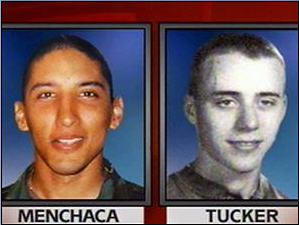
Take a good look at these young Americans.
This is Pfc. Kristian Menchaca, 23, of Houston, Texas and Pfc. Thomas L. Tucker, 25, of Madras, Oregon. These are the two soldiers who were kidnapped by the Iraqi insurgency, tortured, and killed. These are two more soldiers that George W. Bush's press secretary and former Fox flack Tony Snow referred to the other day as "numbers."
These are two more soldiers who are being treated as political footballs by the men surrounding their own Commander-in-Chief in a desperate attempt to save his political fortunes.
Enough is enough. This Administration has no plan for victory. They have no plan for rebuilding. They have no plan that goes any farther than keeping control of Washington in November 2006 and 2008.
I have a friend whose young adult daughter passed away suddenly earlier this year. I've seen how the death of a child can damage a family. Every death of every kid that dies in this war damages another American family. Sometimes that sacrifice is necessary. In the case of this war, that sacrifice has never been necessary. And there is no need for any more American families to suffer this grief because the president is unable and unwilling to say "I made a mistake."
Enough.
It's not about right and left anymore, it's about right and wrong
...and those who continue to defend the Administration out of blind loyalty, or out of an inability or unwillingness to admit that our government could fuck up this badly, are on the WRONG side. There are plenty of issues on which the left and the right still disagree, but there are some violations of all human decency; the kind of decency for which the United States is supposed to stand, that cannot be defended -- even if they're by your own team.
Rep. John J. Duncan Jr., a Republican from Tennessee, is on the right side. June 16, 2006:
(via Spiidey)
Rep. John J. Duncan Jr., a Republican from Tennessee, is on the right side. June 16, 2006:
Mr. Speaker, I requested this Special Order to read a statement that I earlier placed in the Record during the debate on the Iraq war resolution.
I did not request time during the debate because it was obvious that the chairmen controlling the time, all good friends of mine, wanted only speakers who support the war, and I did not want to place them in an uncomfortable position.
I did not request time from the Democrats because many of my colleagues in the minority were using this debate in a bitterly partisan way. Surely, war should be the last thing that should become partisan.
Yet 80 percent of the House Republicans, including me, voted against the bombings in Bosnia and Kosovo when President Clinton was in the White House. I believe 80 percent of Republicans would have opposed the war in Iraq if it had been started by President Clinton or Gore, and probably almost all the Democrats would have then been supporting it, as they did the bombings in Bosnia and Kosovo.
Much of the resolution that was just passed by this House contains language that everyone supports, especially the praise for our troops. Our troops do a great job everywhere they are sent. And it is certainly no criticism of them to criticize this war.
In August of 2002, two months before Congress voted for the war in Iraq, Dick Armey, then our Republican majority leader, in a speech in Iowa said, "I don't believe America will justifiably make an unprovoked attack on another nation. It would not be consistent with what we have been as a nation."
Jack Kemp wrote before the war, "What is the evidence that should cause us to fear Iraq more than Pakistan or Iran? Do we reserve the right to launch a preemptive war exclusively for ourselves, or might other nations such as India, Pakistan, or China be justified in taking similar action on the basis of fears of other nations?"
Mr. Kemp said, based on the evidence he had seen, there was not "a compelling case for the invasion and occupation of Iraq."
William F. Buckley wrote that if he had known in 2002 what he knew then in 2004, he would have been against the war. Last year, he wrote another column against the war, saying, "A point is reached when tenacity conveys not steadfastness of purpose, but misapplication of pride."
The very popular conservative columnist Charley Reese wrote that this war was "against a country that was not attacking us, did not have the means to attack us, and had never expressed any intention of attacking us. … [A]nd for whatever real reason we attacked Iraq, it was not to save America from any danger, imminent or otherwise."
Many years ago, Sen. Robert Taft expressed a traditional conservative position: "No foreign policy can be justified except a policy devoted to the protection of the American people, with war only as the last resort and only to preserve that liberty."
Millions of conservatives across this nation believe this war was unconstitutional, unaffordable, and worst of all, unnecessary. It was waged against an evil man, but one who had a total military budget only two-tenths of 1 percent of ours.
We are not going to be able to pay all our military pensions, civil service pensions, Social Security, Medicare, and all the other things we have promised if we are going to turn the Department of Defense into the Department of Foreign Aid and attempt to be the policeman of the world.
This is contrary to every traditional conservative position on defense and on huge deficit spending. The conservative columnist Georgie Ann Geyer wrote, "Critics of the war against Iraq have said since the beginning of the conflict that Americans, still strangely complacent about overseas wars being waged by a minority in their name, will inevitably come to a point where they will see they have to have a government that provides services at home, or one that seeks empire across the globe."
(via Spiidey)
"Last throes"
In the aftermath of the National Press Club interview yesterday in which Dick Cheney rewrote history to erase his "last throes" comment from a year ago, and reiterated that the insurgency is in its last throes, the only thing in its last throes was the lives of the two GIs who had been kidnapped by insurgency:
How much more American blood has to be spilled in Iraq before Dick Cheney gets his fill?
Two missing U.S. soldiers in Iraq have been killed and their bodies were found, the spokesman for Iraq's Defense Ministry said today.
"The two soldiers were killed and they were found in Yusufiya near an electricity plant," Major General Abdul Aziz Mohammed told a news conference in Baghdad.
He did not say when the soldiers were killed or when their bodies were found.
How much more American blood has to be spilled in Iraq before Dick Cheney gets his fill?
""I don't think anybody anticipated..." - the Bush Admininstration in a nutshell
Condoleeza Rice, May 16, 2002:
January 30, 2006, NYT reports:
George W. Bush, September 1, 2005:
Dick Cheney, June 19, 2006, as part of a response on whether the U.S. is winning the "war on terror:
They never anticipate. They don't plan. They spend the lives of young Americans in their little fantasy world, and never look back. The word "competence" has been tainted by its use by Michael Dukakis eighteen years ago, but perhaps it's time to bring it back, becuase this bunch hasn't got a clue -- and then uses the "no one could have anticipated..." excuse every time they fuck up.
Steve, I don't think anybody could have predicted that these people would take an airplane and slam it into the World Trade Center, take another one and slam it into the Pentagon; that they would try to use an airplane as a missile, a hijacked airplane as a missile. All of this reporting about hijacking was about traditional hijacking. You take a plane -- people were worried they might blow one up, but they were mostly worried that they might try to take a plane and use it for release of the blind Sheikh or some of their own people.
January 30, 2006, NYT reports:
Secretary of State Condoleezza Rice acknowledged Sunday that the United States had failed to understand the depth of hostility among Palestinians toward their longtime leaders. The hostility led to an election victory by the militant group Hamas that has reduced to tatters crucial assumptions underlying American policies and hopes in the Middle East.
"I've asked why nobody saw it coming," Ms. Rice said, speaking of her own staff. "It does say something about us not having a good enough pulse."
[snip]
Ms. Rice pointed out that the election results surprised just about everyone. "I don't know anyone who wasn't caught off guard by Hamas's strong showing," she said on her way to London for meetings on the Middle East, Iran and other matters.
George W. Bush, September 1, 2005:
"I don't think anybody anticipated the breach of the levees."
Dick Cheney, June 19, 2006, as part of a response on whether the U.S. is winning the "war on terror:
"I don't think anybody anticipated the level of violence that we've encountered,"
They never anticipate. They don't plan. They spend the lives of young Americans in their little fantasy world, and never look back. The word "competence" has been tainted by its use by Michael Dukakis eighteen years ago, but perhaps it's time to bring it back, becuase this bunch hasn't got a clue -- and then uses the "no one could have anticipated..." excuse every time they fuck up.
"You can't trust Republicans to defend the country"
Note to Democrats running for office: Memorize the above. Recite it with your sun salutations in the morning, chant it before going to bed at night.
Monday, June 19, 2006
Why, when they don't suck, the Mets are the most fun team in baseball
It's the Goofy Factor, and it all started with Banner Day, back in the early 1960's. But while being a Mets fan can often feel like being trapped in an abusive marriage, when the team is playing well and has interesting characters on the team, there is no more fun to be had in baseball. No one bonds with their favorite players the way Mets fans do, and no one comes up with goofier ways to do it.
Dwight Gooden's fans' K Korner has since been appropriated by fans of other teams, though few with the panache of the current crop of "K-dro" fans. And somehow the Coneheads just didn't work as well in Yankee Stadium as they did at Shea, for all that David Cone was a more consistent and mature pitcher by the time he donned the Enemy Uniform.
But now, in these heady days of 9-1/2 game leads and 47-year-old utility players (Julio Franco) making diving catches and stealing bases, and castoffs (Eli Marrero) traded in exchange for other castoffs (Kaz Matsui) exercising balletics in the field, the goofiness is back, in the form of fans of the latest Mets rookie phenom, a kid with Snoop Dogg-style cornrows, a checkered past as a bit of a bad boy, and talent and charisma to spare, who goes by the inimitable moniker of Lastings Milledge.
So what name has HIS particular contingent appropriated?
What else? "The Milledge People."
Now THIS ought to be good.
Dwight Gooden's fans' K Korner has since been appropriated by fans of other teams, though few with the panache of the current crop of "K-dro" fans. And somehow the Coneheads just didn't work as well in Yankee Stadium as they did at Shea, for all that David Cone was a more consistent and mature pitcher by the time he donned the Enemy Uniform.
But now, in these heady days of 9-1/2 game leads and 47-year-old utility players (Julio Franco) making diving catches and stealing bases, and castoffs (Eli Marrero) traded in exchange for other castoffs (Kaz Matsui) exercising balletics in the field, the goofiness is back, in the form of fans of the latest Mets rookie phenom, a kid with Snoop Dogg-style cornrows, a checkered past as a bit of a bad boy, and talent and charisma to spare, who goes by the inimitable moniker of Lastings Milledge.
So what name has HIS particular contingent appropriated?
What else? "The Milledge People."
Now THIS ought to be good.
Meanwhile, in a country that's a REAL threat....
...tests of intercontinental ballistic missiles are in the immediate future:
Captain Codpiece once drew an Axis of Evil consisting of Iraq, Iran, and North Korea. Of those three, the immediate threat was North Korea. So of course he invaded Iraq instead. Now he has busted the budget pouring money into THAT pointless and useless war and occupation, allowing North Korea the luxury of time to get its missile program in gear.
Heck of a job, Georgie.
North Korea appears to have completed fueling a long-range ballistic missile, American officials said Sunday, a move that greatly increases the probability that it will go ahead with its first important test launching in eight years.
A senior American official said that intelligence from satellite photographs suggested that booster rockets had been loaded onto a launching pad, and liquid-fuel tanks fitted to a missile at a site on North Korea's remote east coast.
While there have been steady reports in recent days about preparations for a test, fueling is regarded as a critical step as well as a probable bellwether of North Korea's intentions. Siphoning the liquid fuel out of a missile is a complex undertaking.
"Yes, looks like all systems are 'go' and fueling appears to be done," said the official who discussed the matter only after being promised anonymity because he was addressing delicate diplomatic and intelligence issues. A second senior official, who declined to speak on the record for similar reasons, also indicated that the United States believed the missile had been fueled.
A launching would be a milestone in the North's missile capacity and effectively scrap a moratorium on such tests declared by the North Koreans after their last test in 1998. Moreover, a launching would have enormous importance for American security because it would be North Korea's first flight test of a new long-range missile that might eventually have the capacity to strike the United States.
Captain Codpiece once drew an Axis of Evil consisting of Iraq, Iran, and North Korea. Of those three, the immediate threat was North Korea. So of course he invaded Iraq instead. Now he has busted the budget pouring money into THAT pointless and useless war and occupation, allowing North Korea the luxury of time to get its missile program in gear.
Heck of a job, Georgie.
The REAL "no-spin zone" in Iraq
This weekend I wrote TWO letters to my wingnut Congressman, E. Scott Garrett, inquiring how he reconciled his glowing report of the situation in Iraq with the reality as set forth in a cable from the U.S. Embassy in Iraq, reprinted in the Washington Post.
E&P:
The actual PDF of the cable is here.
When and if I get a response from Garrett, I'll post it. This should be good. Last time I got a response from this guy, he said that he absolutely agreed with Karl Rove that liberals hate America, citing the usual suspects -- Michael Moore and the ad submitted to MoveOn.org that likened Bush to Hitler -- an ad that MoveOn gave NO preference to over other submissions, and which the organization pulled after the outcry began.
Given that the Democratic hack candidate, Paul Aronsohn, who seems to appear nowhere that doesn't involve people writing checks in exchange for the privilege of shaking his hand, has ZERO chance of taking this seat, I plan to spend the next two years, or however long he's in office, hounding Scott Garrett.
Read the cable, and then check what YOUR Congressperson says about the situation in Iraq. Every time these guys paint a rosy picture, hit 'em over the head with this. It may not change their minds, but it'll at least be fun to see what kind of B.S. they send back to you. Then e-mail me with what you find out.
E&P:
As a footnote in one of the 23 sections, the embassy relates, "An Arab newspaper editor told us he is preparing an extensive survey of ethnic cleansing, which he said is taking place in almost every Iraqi province, as political parties and their militiast are seemingly engaged in tit-for-tat reprisals all over Iraq."
Among the other troubling reports:
- "Personal safety depends on good relations with the 'neighborhood' governments, who barricade streets and ward off outsiders. The central government, our staff says, is not relevant; even local mukhtars have been displaced or coopted by militias. People no longer trust most neighbors."
- One embassy employee had a brother-in-law kidnapped. Another received a death threat, and then fled the country with her family.
- Iraqi staff at the embassy, beginning in March and picking up in May, report "pervasive" harassment from Islamist and/or militia groups. Cuts in power and rising fuel prices "have diminished the quality of life." Conditions vary but even upscale neighborhoods "have visibly deteriorated" and one of them is now described as a "ghost town."
- Two of the three female Iraqis in the public affairs office reported stepped-up harassment since mid-May...."some groups are pushing women to cover even their face, a step not taken in Iran even at its most conservative." One of the women is now wearing a full abaya after receiving direct threats.
- It has also become "dangerous" for men to wear shorts in public and "they no longer allow their children to play outside in shorts." People who wear jeans in public have also come under attack.
- Embassy employees are held in such low esteem their work must remain a secret and they live with constant fear that their cover will be blown. Of nine staffers, only four have told their families where they work. They all plan for their possible abductions. No one takes home their cell phones as this gives them away. One employee said criticism of the U.S. had grown so severe that most of her family believes the U.S. "is punishing populations as Saddam did."
- Since April, the "demeanor" of guards in the Green Zone has changed, becoming more "militia-like," and some are now "taunting" embassy personnel or holding up their credentials and saying loudly that they work in the embassy: "Such information is a death sentence if overheard by the wrong people." For this reason, some have asked for press instead of embassy credentials.
- "For at least six months, we have not been able to use any local staff members for translation at on-camera press events....We cannot call employees in on weekends or holidays without blowing their 'cover.'"
- "More recently, we have begun shredding documents printed out that show local staff surnames. In March, a few staff members approached us to ask what provisions would we make for them if we evacuate."
- The overall environment is one of "frayed social networks," with frequent actual or perceived insults. None of this is helped by lack of electricity. "One colleague told us he feels 'defeated' by circumstances, citing his example of being unable to help his two-year-old son who has asthma and cannot sleep in stifling heat," which is now reaching 115 degrees.
- "Another employee tell us that life outside the Green Zone has become 'emotionally draining.' He lives in a mostly Shiite area and claims to attend a funeral 'every evening.'"
- Fuel lines have grown so long that one staffer spent 12 hours in line on his day off. "Employees all confirm that by the last week of May, they were getting one hour of power for every six hours without.....One staff member reported that a friend lives in a building that houses a new minister; within 24 hours of his appointment, her building had city power 24 hours a day."
- The cable concludes that employees' "personal fears are reinforcing divisive sectarian or ethnic channels, despite talk of reconciliation by officials."
The actual PDF of the cable is here.
When and if I get a response from Garrett, I'll post it. This should be good. Last time I got a response from this guy, he said that he absolutely agreed with Karl Rove that liberals hate America, citing the usual suspects -- Michael Moore and the ad submitted to MoveOn.org that likened Bush to Hitler -- an ad that MoveOn gave NO preference to over other submissions, and which the organization pulled after the outcry began.
Given that the Democratic hack candidate, Paul Aronsohn, who seems to appear nowhere that doesn't involve people writing checks in exchange for the privilege of shaking his hand, has ZERO chance of taking this seat, I plan to spend the next two years, or however long he's in office, hounding Scott Garrett.
Read the cable, and then check what YOUR Congressperson says about the situation in Iraq. Every time these guys paint a rosy picture, hit 'em over the head with this. It may not change their minds, but it'll at least be fun to see what kind of B.S. they send back to you. Then e-mail me with what you find out.
Sunday, June 18, 2006
Note to rest of Democratic Party: This is how it's done
While the rest of the Democratic Party is curled up into even tighter positions in the corner, looking more and more like a cuddle party of cowards, because Mean Ol' Karl is back in the driver's seat, Jack Murtha, the meanest mofo in the Democratic Party, comes out swinging:
And what are Karl Rove's military credentials? Here you go:
Now, at this point I really don't care what Karl Rove did to avoid the draft 40 years ago, though the idea that he opposed the Vietnam War because it was "a political skirmish that was not being properly administered" is pretty damn hilarious, don't you think, in view of his unwavering support for an endless meatgrinder without a plan in Iraq?
The larger point is that Karl Rove is the Head 101st Fighting Keyboarder -- yet another chickenshit conservative weasel who is all too willing to send other men to die and other people's children to die, but when it was his time, he thought his own sorry ass was too important to put at risk.
So why should anyone put any credence in what he has to say?
This is what Murtha understands, and Russ Feingold understands, and a few others understand -- and the rest of the sorry bunch of cowards and their overpaid consultants that pass for the remnants of the formerly-proud Democratic Party refuse to understand.
He's in New Hampshire. He's making a political speech. He’s sitting in his air-conditioned office on his big, fat backside-saying stay the course. That’s not a plan! We've got to change direction. You can't sit there in the air-conditioned office and tell troops carrying seventy pounds on their backs, inside these armored vessels-hit with IED's every day-seeing their friends blown up-their buddies blown up-and he says stay the course? Easy to say that from Washington, DC.
And what are Karl Rove's military credentials? Here you go:
Rove's Selective Service records are sparse, but they show a seemingly typical path for many male Utah high school seniors in 1969.
Like most, he registered with the Selective Service while he was a senior at Olympus High School, and he was assigned identification number 42-24-50-1691. Rove was first classified as 1S-H, ineligible to be drafted because he was a high school student.
Gustavson and Rove became friends over their shared distaste for the war in Vietnam. Both high school debate team members, they once were thrown out of a pizza parlor after a heated argument over the war. Another time, they trekked downtown together to protest Democratic presidential candidate Hubert Humphrey's speech at the LDS Church Tabernacle.
Far from being a conscientious objector, Gustavson recalls, Rove's opposition to the war was political. He considered the conflict a "political skirmish that was not being properly administered."
"I never heard Karl say, 'I hope I don't get drafted,' " Gustavson says. "Everyone went and registered. No matter how we felt about the war, we understood our legal duty. I don't remember Karl saying he would get married or get a student deferment or do anything that would have earned one a deferment."
But Rove got one anyway. Rove graduated from high school in the spring of 1969 and in June was reclassified 1-A, available to be drafted.
Rove enrolled that fall in the University of Utah. In December the Selective Service System held its first lottery drawing in which numbers were assigned to potential draftees based on their birth dates. The lower the number, the more likely it was the young man would be drafted.
Rove received number 84, or within the top one-fourth of the 365 numbers. It would turn out that the highest lottery number drafted from this group was 195, according the Selective Service, putting Rove's number deep within those that could be drafted.
On Jan. 19, 1970, less than two months after the lottery, Rove underwent a required Armed Forces Physical Examination and was found to be fit for military service.
About a month later, on Feb. 17, 1970, Rove was again reclassified, this time as 2-S, a deferment from the draft because of his enrollment at the University of Utah.
During his two years at the university, Rove studied politics. Beloved professor emeritus J.D. Williams, a staunch Democrat, was his mentor. Rove has said he served an internship through the Hinckley Institute of Politics. And in 1970, he worked on former XRepublican Sen. Wallace F. Bennett's successful campaign to defeat incumbent Democratic U.S. Sen. Frank Moss.
At the time, a full-time student at the university would have had to take 12 hours a quarter. University records show Rove went to school full-time for four of those quarters. But in the autumn and spring quarters of 1971, Rove was a part-time student, registered for between six and 12 credit hours.
Despite the apparent lapse in his full-time status, Rove maintained his deferment.
At the end of the school year in 1971, Rove told Gustavson he was going to Washington to work for the Republican National Committee as executive director of the College Republicans - a job Bennett reportedly helped him secure.
Bush-Cheney campaign spokesman Steve Schmidt says Rove enrolled that fall at the University of Maryland in College Park. But a letter he prepared to notify the local draft board in Murray of his transfer never made it to Utah.
"To this day, it is unclear to Mr. Rove what happened to the letter," Schmidt says. "He turned it in to the university. But whether it was lost in the mail or arrived late, the draft board did not get it in time and the deferment was not renewed."
Now, at this point I really don't care what Karl Rove did to avoid the draft 40 years ago, though the idea that he opposed the Vietnam War because it was "a political skirmish that was not being properly administered" is pretty damn hilarious, don't you think, in view of his unwavering support for an endless meatgrinder without a plan in Iraq?
The larger point is that Karl Rove is the Head 101st Fighting Keyboarder -- yet another chickenshit conservative weasel who is all too willing to send other men to die and other people's children to die, but when it was his time, he thought his own sorry ass was too important to put at risk.
So why should anyone put any credence in what he has to say?
This is what Murtha understands, and Russ Feingold understands, and a few others understand -- and the rest of the sorry bunch of cowards and their overpaid consultants that pass for the remnants of the formerly-proud Democratic Party refuse to understand.
Greedstock Nation
Now Playing at the Hell On Earth Music Festival:
(via ShakesSis)
President Bush greets a guest as White House Chief of Staff Josh Bolten
plays bass guitar with his band 'The Compassionates' at the White House
Congressional Picnic on the South Lawn of the White House, June 15, 2006.
(Joshua Roberts/Reuters)
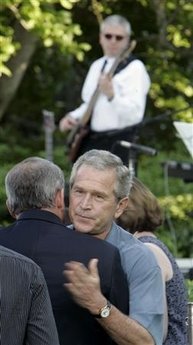
(via ShakesSis)
The Accountability Administration
Ah, for the days when Republicans believed that those who commit crimes should be apprehended, tried and punished. Of course, it was always thus that they only believed this should apply to themselves and their friends.
The talk of pardoning Scooter Libby rather than allowing him to sing has begun:
My guess is that they'll wait till the next season of American Idol, when no one will be paying attention.
The talk of pardoning Scooter Libby rather than allowing him to sing has begun:
Now that top White House aide Karl Rove is off the hook in the CIA leak probe, President George W. Bush must weigh whether to pardon former vice presidential aide I. Lewis "Scooter" Libby, the only one indicted in the three-year investigation.
Speculation about a pardon began in late October, soon after Special Counsel Patrick Fitzgerald unsealed the perjury indictment of Libby, and it continued last week after Fitzgerald chose not to charge Rove.
"I think ultimately, of course, there are going to be pardons," said Joseph diGenova, a former prosecutor and an old Washington hand who shares that view with many pundits.
"These are the kinds of cases in which historically presidents have given pardons," said the veteran Republican attorney.
The White House remains mum on the president's intentions. Spokeswoman Dana Perino declined to comment Friday.
Bush has powerful incentives to pardon Libby, however. They range from rewarding past loyalty to ending the awkward revelations emerging from pretrial motions, a flow that could worsen in his trial next year.
[snip]
By demanding sensitive, sometimes embarrassing materials, some say, Libby appears to be goading the White House into issuing a pardon. Libby's spokeswoman did not respond to questions about a pardon.
One attorney familiar with the Plame case said Bush might find that it is in his interest to pardon Libby sooner rather than later.
A pardon before the trial could could cut off the disclosures and spare Vice President Dick Cheney from testifying as Fitzgerald's witness about Libby, his former chief of staff.
But the timing of a pardon, the attorney suggested, likely would depend on the outcome of the midterm elections.
If Republicans retain control of Congress, Bush could act swiftly. But if Democrats win control of the House or Senate, Bush might wait, and use Libby's trial as an excuse not to cooperate with any congressional investigations into the leak.
My guess is that they'll wait till the next season of American Idol, when no one will be paying attention.
The Inadequate Corporate Security Accountability Inoculation Act of 2006
So let's see....first you had personal information on 26.5 million American servicepeople stolen because a Department of Defense worker somehow managed to take a database of this size home. Then you had 930,000 AIG customers having THEIR data stolen because allegedly "a burglar" got into their computer room and stole a file server -- a theft not reported for three months. Now the personal data on 13,000 D.C. workers, including their Social Security numbers, has been stolen from a laptop belonging to an ING Financial Services employee that was neither password-protected nor was the data encrypted.
First of all, why are employees like this permitted to offload this amount of data onto flash sticks or their laptops to take home? Haven't these companies heard of Virtual Private Networks?
Second of all, it's clear that the cavalier way in which corporations are treating this data isn't unique, and indeed may be even more widespread than what we've heard.
It's a serious problem, right? So what is our Republican Congress doing? Are they trying to set up laws to require protection of this data? No, they're trying to prevent you from putting a freeze on your credit unless you can prove that you have ALREADY BEEN THE VICTIM OF IDENTITY THEFT.
Getting out from under even suspected identity theft complications is a huge and time-consuming task. To wait until you KNOW that your identity has been stolen opens you up to not just a ruined credit rating, but even possible arrest, if the person who has stolen your identity commits a crime.
Once again, Congressional Republicans are putting the interests of their corporate donors not just first, but first to the exclusion of any kind of demonstration of interest in resolving the problem of corporate data being carried about in an employee's pocket.
First of all, why are employees like this permitted to offload this amount of data onto flash sticks or their laptops to take home? Haven't these companies heard of Virtual Private Networks?
Second of all, it's clear that the cavalier way in which corporations are treating this data isn't unique, and indeed may be even more widespread than what we've heard.
It's a serious problem, right? So what is our Republican Congress doing? Are they trying to set up laws to require protection of this data? No, they're trying to prevent you from putting a freeze on your credit unless you can prove that you have ALREADY BEEN THE VICTIM OF IDENTITY THEFT.
Getting out from under even suspected identity theft complications is a huge and time-consuming task. To wait until you KNOW that your identity has been stolen opens you up to not just a ruined credit rating, but even possible arrest, if the person who has stolen your identity commits a crime.
Once again, Congressional Republicans are putting the interests of their corporate donors not just first, but first to the exclusion of any kind of demonstration of interest in resolving the problem of corporate data being carried about in an employee's pocket.
Other Brilliant Bloggers
DriftglassCorrente
Hullabaloo
Hoffmania
Orcinus
Scoobie Davis
Talking Points Memo
World O'Crap
Fact-esque
Liberal Oasis
Oliver Willis
Talk Left
This Modern World
Philip Barron
Rising Hegemon
AMERICABlog
James Wolcott
Skippy the Bush Kangaroo
Dependable Renegade
The Political Carnival
Astrological Musings
Firedoglake
Spiiderweb
Words of Power
RIPCoco
Kung Fu Monkey
Empire Burlesque
WTF is it Now
Down With Tyranny
Welcome Back to Pottersvillle
Spocko's Brain
The Sideshow
The Ostroy Report
Fallenmonk
Three Wise Men
NewsHoggers
Blue Gal
Blah3
Shadow of the Hegemon
Slacktivist
ShortWoman
Echidne of the Snakes
Jesus' General
My Left Wing
Arthur Silber
Republic of T
Bitch Ph.D
The American Street
Comments from Left Field
Balloon Juice
I Can't Believe It's Not a Democracy
Scholars and Rogues
On My Mind
PhysioProf
The Vulgar Curmudgeon
Monkeyfister
Sasha Undercover
ThePoliticalCat
Fables of the Reconstruction
Talk2Action
D-Day
State of the Day
Just an Earth-Bound Misfit
Bradblog
They Gave Us a Republic
Vagabond Scholar
Seeing the Forest
The Reaction
Orcinus
SteveAudio
Princess Sparkle Pony
Paul Levinson
Politics After 50
The Jed Report
One Utah
Sam Seder
Alternet
The Political Carnival
County Fair
Mudflats
A Feather Adrift
That's Why
Disciples of Joe
No Longer Quivering
Margaret and Helen
Stand With Dr. Dean
All the Good Names Were Taken
Badtux the Snarky Penguin
My Mental Dumping Ground
Legal Schnauzer
Alicublog
Bouphonia
Konagod
The Reverse Spin
City of Angels
The Gospel According to Hate
Menopausal Stoners
Stinque
The New York Crank
BP Oil Slick
Pen-Elayne
Inside-Out the Beltway
Reclusive Leftist
Southern Beale
The Moderate Voice
The Rant
Help the 99ers
Brendan Calling
Matt Taibbi
I Was Told There Would Be Bacon
We Don't Agree, But...
ShortWoman
of mule dung and ash
Cookies in Heaven
The Hunting of the Snark
The Policy Page (Rick Ungar)
Ramona's Voices
Sardonicky
Dagblog
The Titanic Sails At Dawn
Cheese Food Nation
Donkey Mountain
Thump and Whip
Under the Lobsterscope
Addicting Info
Wifely Person
Disaffected and it Feels So Good
Reality Chex
Burnt Orange Report
Salmon Alley
The Politics Blog w/Charles Pierce
Elizabitchez
We Are The 99 Percent.
Republic of Gilead
amigoingsomeplace
Fukushima Diary
The Polygon
Degringolade
Onyx Lynx
Parsley's Pics
Mainmati
Brandflakes for Breakfast
The Economic Populist
Liberal Dan
Ex-Amish Atheist
The Poor Man's Huffington Post
Constant Commoner
Channel Surfing
Big Bad Bald Bastard
Panic in Funland (Tbogg!!!)
Weird Wally's Worldview
Brilliant Furriners
Because we all may have to live somewhere else someday.The Galloping Beaver (Canada)
Cathie from Canada
How This Old Brit Sees It ...
Stunner's Afflictions (Jamaica)
Jamaican Lifestyle
Heathers
Pulling up the ladderbehind them
Daily Kos
Atrios
Open Left


CeleBloggers
Roger EbertDispatches from the Island &
Further Dispatches
(Jorge Garcia)
Baseball Nerd
(Keith Olbermann)
FOK News Channel (ditto)
Brilliant at Tweeting
(We won't do it, but we'll follow them)Marc Maron
Sam Seder
Brendan McDonald
Johnny Weir
Melina
Lynn
Keith Olbermann
In Memoriam
(yes, we're getting tired of having to do this)

Break Room Live archives
Morning Sedition 3/04-12/05
A Brilliant Radio Show -
Morning Seditionists
Camp Butch (all the
Sedition you can eat)
Jim Earl and his
Big Page of Crap
Morning Remembrance
Steve Gilliard 1966-2007:
A Brilliant Blogger
The News Blog archive
NetSlaves article archive
Friends of Steve:
The Group News Blog
"Jon Swift" (Al Weisel) 1963-2010
Bats Left Throws Right (Doghouse Riley)
Brilliant at Disappearing
Maybe they've been raptured?Altercation
The All-Spin Zone
Baghdad Burning
Carrie's Nation
Little Country Lost
Cynical Nation
Pam's House Blend
photos1.blogger.com/blogger/397/497/320/bb_banner.1.jpg]^23004A00]coral]navy],](](]]]black],]3]8]20]1]2]3]3]1]2]3]1]1],](](]^235E3D00])])]^3Cimg^20src^3D^22)photos1.blogger.com/blogger/397/497/320/bb_banner.1.jpg^22]^22...you^20have^20a^20choice^3A^20be^20a^20fighting^20liberal^20or^20sit^20quietly.^20I^20know^20what^20I^20am^2C^20what^20are^20you^3F^22^20--^20^3Ca^20href^3D^22)stevegilliard.blogspot.com/2003/12/im-fighting-liberal-you-know-ive.html^22^20STYLE^3D^22color^3Awhite^3B^22^3ESteve^20Gilliard^2C^201966^20-^202007^3C/a^3E^3CBR^3E^22For^20straight^20up^20monster-stomping^20goodness^2C^20nothing^20makes^20smoke^20shoot^20out^20my^20ears^20like^20Brilliant@Breakfast^22^20--^20^3Ca^20href^3D^22)www.poorimpulsecontrol.net/blog^22^20STYLE^3D^22color^3Awhite^3B^22^3ETata^3C/a^3E],](],](](]black](](](]^23FDF2D7](](](]^23333](](](],]50]20],](](]^23FFF8DD])])]black]1.5]15],](](]^2398A45C])])]black]^23FFF8DD])])]^23666]30]^235E3E1A]^23622121],](](]^235E3E1A](],](]^235E3E1A]^23039]^2306C],](](]^23FFF8DD])])],](](]^23FFF8DD])])],](](]^23FFF8DD])])],](]^235E3E1A]^23666]15]3]25]20]^23808C43],](](],](],](](],](]black](](](],](](](],]^235C3E11](](](],](](]^23211104](](](](](],]^2336F]^23211104](],](]Posted^20by^20^24AUTH^20^7C^20^24TIME]20],](](]^23FFF8DD])])]^23FFF8DD])])]^23666]30]^235E3E1A]^23622121],](](]^235E3E1A](],](]^23333]^23039]^2306C]Contact]]]Home]^24HOME]First^20Page]Email^3A^3CBR^3Ebrilliantatbreakfast^20at^20gmail^20dot^20com]]]RSS]^24RSS]RSS^20Feed]Your^20Servers]]]Jill]rilliantatbreakfast.blogspot.com]]Melina])www.ripcoco.com]RIPCoco]Carrie])carriesnation.blogspot.com]Carrie^27s^20Nation]And^20occasionally...]]]jurassicpork])welcome-to-pottersville.blogspot.com]Welcome^20to^20Pottersville]Bob])bobrixon.blogspot.com]The^20Rix^20Mix]Tata])www.poorimpulsecontrol.net/blog]Poor^20Impulse^20Control]Spiiderweb])spiiderweb.blogspot.com]Spiiderweb]Other^20Brilliant^20Bloggers]]]Modern^20Fabulousity])modernfabulousity.blogspot.com]Modern^20Fabulousity]Pandagon])www.pandagon.net]Pandagon]Altercation])www.mediamatters.org/altercation]Altercation]Corrente])www.correntewire.com/]Corrente]Hullabaloo])digbysblog.blogspot.com]Hullabaloo]Hoffmania])www.hoffmania.com]Hoffmania]Orcinus])dneiwert.blogspot.com]Orcinus]Scoobie^20Davis])scoobiedavis.blogspot.com]Scoobie^20Davis]Talking^20Points^20Memo])talkingpointsmemo.com]Talking^20Points^20Memo]World^20O^27Crap])world-o-crap.com/blog]World^20O^27Crap]Fact-esque])casadelogo.typepad.com/factesque/]Fact-esque]Liberal^20Oasis])www.liberaloasis.com/]Liberal^20Oasis]Oliver^20Willis])www.oliverwillis.com/]Oliver^20Willis]Talk^20Left])www.talkleft.com/]Talk^20Left]The^20Talent^20Show])www.thetalentshow.org/]The^20Talent^20Show]Waveflux])www.waveflux.net]Waveflux]Rising^20Hegemon])rising-hegemon.blogspot.com/]Rising^20Hegemon]The^20Poor^20Man])www.thepoorman.net/]The^20Poor^20Man]AMERICABlog])www.americablog.org/]AMERICABlog]Needlenose])www.needlenose.com/]Needlenose]Brilliant^20NJ^20bloggers]]]^24ARCHIVE]^20]]Friends]]]Horm])blog.horm.org]Hallucinations^20Of^20Reabsorbed^20Mind]Phorm])p.horm.org]Another^20Phormation]Etc]]]^3Cimg^20src^3D^22)psyc.horm.org/barimg/bar_psycho.png^22^20width^3D^2280^22^20height^3D^2215^22^20alt^3D^22PsycHo^3A^20Free^20Template^20Generator^22^20style^3D^22border^3A^200px^20solid^20black^22^20/^3E]^24PSYCHO]PsycHo^3A^20Free^20Template^20Generator]^3Cimg^20src^3D^22)psyc.horm.org/barimg/bar_firefox.png^22^20width^3D^2280^22^20height^3D^2215^22^20alt^3D^22Get^20FireFox^21^22^20style^3D^22border^3A^200px^20solid^20black^22^20/^3E])www.mozilla.org/products/firefox/]Get^20Firefox^21]^3Cimg^20src^3D^22)psyc.horm.org/barimg/bar_xhtml.png^22^20width^3D^2280^22^20height^3D^2215^22^20alt^3D^22XHTML^20Validator^22^20style^3D^22border^3A^200px^20solid^20black^22^20/^3E])validator.w3.org/check/referer]XHTML^20Validator]]]]Home]^24HOME]First^20Page]Email]^24EMAIL]Mail^20me^21]RSS]^24RSS]RSS^20Feed]Archive]]]^24ARCHIVE]^20]]Friends]]]Horm])blog.horm.org]Hallucinations^20Of^20Reabsorbed^20Mind]Phorm])p.horm.org]Another^20Phormation]Etc]]]^3Cimg^20src^3D^22)psyc.horm.org/barimg/bar_psycho.png^22^20width^3D^2280^22^20height^3D^2215^22^20alt^3D^22PsycHo^3A^20Free^20Template^20Generator^22^20style^3D^22border^3A^200px^20solid^20black^22^20/^3E]^24PSYCHO]PsycHo^3A^20Free^20Template^20Generator]^3Cimg^20src^3D^22)psyc.horm.org/barimg/bar_firefox.png^22^20width^3D^2280^22^20height^3D^2215^22^20alt^3D^22Get^20FireFox^21^22^20style^3D^22border^3A^200px^20solid^20black^22^20/^3E])www.mozilla.org/products/firefox/]Get^20Firefox^21]^3Cimg^20src^3D^22)psyc.horm.org/barimg/bar_xhtml.png^22^20width^3D^2280^22^20height^3D^2215^22^20alt^3D^22XHTML^20Validator^22^20style^3D^22border^3A^200px^20solid^20black^22^20/^3E])validator.w3.org/check/referer]XHTML^20Validator^26^2361470^3BPsycHo})


