| "Only dull people are brilliant at breakfast" -Oscar Wilde |
 |
"The liberal soul shall be made fat, and he that watereth, shall be watered also himself." -- Proverbs 11:25 |
"...you have a choice: be a fighting liberal or sit quietly. I know what I am, what are you?" -- Steve Gilliard, 1964 - 2007
"For straight up monster-stomping goodness, nothing makes smoke shoot out my ears like Brilliant@Breakfast" -- Tata
"...the best bleacher bum since Pete Axthelm" -- Randy K.
"I came here to chew bubblegum and kick ass. And I'm all out of bubblegum." -- "Rowdy" Roddy Piper (1954-2015), They Live
"For straight up monster-stomping goodness, nothing makes smoke shoot out my ears like Brilliant@Breakfast" -- Tata
"...the best bleacher bum since Pete Axthelm" -- Randy K.
"I came here to chew bubblegum and kick ass. And I'm all out of bubblegum." -- "Rowdy" Roddy Piper (1954-2015), They Live


Brilliant Recent Posts
There's nothing new under the sunAu revoir, y'all....
So Long and Thanks for All the Gefilte Fish
Like White on Rice
Why Did Hillary Clinton Hire a Monsanto Lobbyist t...
Virtual Book Sale
The Man Who Poisoned America
We are privileged to be alive today
The Prodigal Blogger Stops By
Good Times at Pottersville, 3/14/15
Brilliant at Searching
Brilliant Stuff to Buy
What's on my mind:
Brilliant Archives
Brilliant at Begging
Like what you read?Please consider supporting B@B with a donation: There is no gift like the present.
But gifts are nice too:


Feed Me!





Stuff You Must Read
Saturday, July 29, 2006
This is huge
Wow. The New York Times has endorsed Ned Lamont for Senate in Connecticut -- and they get what the issue with Lieberman is:
As Emeril Lagasse might say, "BAM!"
As Mr. Lieberman sees it, this is a fight for the soul of the Democratic Party — his moderate fair-mindedness against a partisan radicalism that alienates most Americans. “What kind of Democratic Party are we going to have?” he asked in an interview with New York magazine. “You’ve got to agree 100 percent, or you’re not a good Democrat?”
That’s far from the issue. Mr. Lieberman is not just a senator who works well with members of the other party. And there is a reason that while other Democrats supported the war, he has become the only target. In his effort to appear above the partisan fray, he has become one of the Bush administration’s most useful allies as the president tries to turn the war on terror into an excuse for radical changes in how this country operates.
Citing national security, Mr. Bush continually tries to undermine restraints on the executive branch: the system of checks and balances, international accords on the treatment of prisoners, the nation’s longtime principles of justice. His administration has depicted any questions or criticism of his policies as giving aid and comfort to the terrorists. And Mr. Lieberman has helped that effort. He once denounced Democrats who were “more focused on how President Bush took America into the war in Iraq” than on supporting the war’s progress.
At this moment, with a Republican president intent on drastically expanding his powers with the support of the Republican House and Senate, it is critical that the minority party serve as a responsible, but vigorous, watchdog. That does not require shrillness or absolutism. But this is no time for a man with Mr. Lieberman’s ability to command Republicans’ attention to become their enabler, and embrace a role as the president’s defender.
Mr. Lieberman prides himself on being a legal thinker and a champion of civil liberties. But he appointed himself defender of Attorney General Alberto Gonzales and the administration’s policy of holding hundreds of foreign citizens in prison without any due process. He seconded Mr. Gonzales’s sneering reference to the “quaint” provisions of the Geneva Conventions. He has shown no interest in prodding his Republican friends into investigating how the administration misled the nation about Iraq’s weapons. There is no use having a senator famous for getting along with Republicans if he never challenges them on issues of profound importance.
If Mr. Lieberman had once stood up and taken the lead in saying that there were some places a president had no right to take his country even during a time of war, neither he nor this page would be where we are today. But by suggesting that there is no principled space for that kind of opposition, he has forfeited his role as a conscience of his party, and has forfeited our support.
Mr. Lamont, a wealthy businessman from Greenwich, seems smart and moderate, and he showed spine in challenging the senator while other Democrats groused privately. He does not have his opponent’s grasp of policy yet. But this primary is not about Mr. Lieberman’s legislative record. Instead it has become a referendum on his warped version of bipartisanship, in which the never-ending war on terror becomes an excuse for silence and inaction. We endorse Ned Lamont in the Democratic primary for Senate in Connecticut.
As Emeril Lagasse might say, "BAM!"

And what's to keep them from deciding that all dissidents are terrorists?
Now we know why the Bush Administration wants to monitor all phone and internet activity of all Americans:
Essentially, this gives the Adminsitration carte blanche to decide who is a terrorist, and strip anyone they want of their citizenship and rights under the Constitution -- a tactic more closely identified with the old Soviet Union than with the United States of America as it used to exist before the Bush Junta took over.
The other interesting thing to note about this is it shows the Administration's willingness to tell the Supreme Court to go fuck itself when it issues decisions with which the Administration doesn't agree.
Checks and balances? We don' need no es-teenking checks and balances.
U.S. citizens suspected of terror ties might be detained indefinitely and barred from access to civilian courts under legislation proposed by the Bush administration, say legal experts reviewing an early version of the bill.
A 32-page draft measure is intended to authorize the Pentagon's tribunal system, established shortly after the 2001 terrorist attacks to detain and prosecute detainees captured in the war on terror. The tribunal system was thrown out last month by the Supreme Court.
Administration officials, who declined to comment on the draft, said the proposal was still under discussion and no final decisions had been made.
Senior officials are expected to discuss a final proposal before the Senate Armed Services Committee next Wednesday.
According to the draft, the military would be allowed to detain all "enemy combatants" until hostilities cease. The bill defines enemy combatants as anyone "engaged in hostilities against the United States or its coalition partners who has committed an act that violates the law of war and this statute."
Legal experts said Friday that such language is dangerously broad and could authorize the military to detain indefinitely U.S. citizens who had only tenuous ties to terror networks like al Qaeda.
"That's the big question ... the definition of who can be detained," said Martin Lederman, a law professor at Georgetown University who posted a copy of the bill to a Web blog.
Scott L. Silliman, a retired Air Force Judge Advocate, said the broad definition of enemy combatants is alarming because a U.S. citizen loosely suspected of terror ties would lose access to a civilian court — and all the rights that come with it. Administration officials have said they want to establish a secret court to try enemy combatants that factor in realities of the battlefield and would protect classified information.
The administration's proposal, as considered at one point during discussions, would toss out several legal rights common in civilian and military courts, including barring hearsay evidence, guaranteeing "speedy trials" and granting a defendant access to evidence. The proposal also would allow defendants to be barred from their own trial and likely allow the submission of coerced testimony.
Essentially, this gives the Adminsitration carte blanche to decide who is a terrorist, and strip anyone they want of their citizenship and rights under the Constitution -- a tactic more closely identified with the old Soviet Union than with the United States of America as it used to exist before the Bush Junta took over.
The other interesting thing to note about this is it shows the Administration's willingness to tell the Supreme Court to go fuck itself when it issues decisions with which the Administration doesn't agree.
Checks and balances? We don' need no es-teenking checks and balances.
This is what happens when religion doesn't stay in its place
As soon as you start with "faith-based" government initiatives and "courting evangelicals", the anti-Jewish maggots start crawling out from under the rocks and the pogroms begin -- and not just in the Bible belt, either:
Wilmington, Delaware:
Meanwhile, the Israel/Lebanon crisis comes to our shores. Seattle, Washington:
"Anger at Israel" easily morphs into specific targeting of Jews, as do political endorsements of any kind of Christianity, including "reaching out to Evangelicals." (Mr. Obama, I'm talking to you.)
As soon as you start giving credence to ANY religious tradition that has as part of its tradition and history the forced conversion and/or elimination of the other, you open the door to these sorts of incidents. I suspect we will be seeing more of both of these as the Middle East conflict continues and as the Bush Administration continues to embrace the Christofascists.
UPDATE: Mel Gibson gets in on the action too. Apparently he was arrested for driving under the influence early Friday with a blood alcohol content of 0.12. The arrest report is here. Scroll down to page 2, and note in the center of the page:
Want to know who the anti-Semites are? Wait till Apocalypto shows up at your multiplex and see who goes to see it. He could deny it with Get A Stiffy Watching a Jew Get Flogged For Three Hours", but now his mask has fallen and we get a good look at the gargoyle inside.
Wilmington, Delaware:
After her family moved to this small town 30 years ago, Mona Dobrich grew up as the only Jew in school. Mrs. Dobrich, 39, married a local man, bought the house behind her parents’ home and brought up her two children as Jews.
For years, she and her daughter, Samantha, listened to Christian prayers at public school potlucks, award dinners and parent-teacher group meetings, she said. But at Samantha’s high school graduation in June 2004, a minister’s prayer proclaiming Jesus as the only way to the truth nudged Mrs. Dobrich to act.
“It was as if no matter how much hard work, no matter how good a person you are, the only way you’ll ever be anything is through Jesus Christ,” Mrs. Dobrich said. “He said those words, and I saw Sam’s head snap and her start looking around, like, ‘Where’s my mom? Where’s my mom?’ And all I wanted to do was run up and take her in my arms.”
After the graduation, Mrs. Dobrich asked the Indian River district school board to consider prayers that were more generic and, she said, less exclusionary. As news of her request spread, many local Christians saw it as an effort to limit their free exercise of religion, residents said. Anger spilled on to talk radio, in letters to the editor and at school board meetings attended by hundreds of people carrying signs praising Jesus.
“What people here are saying is, ‘Stop interfering with our traditions, stop interfering with our faith and leave our country the way we knew it to be,’ ” said Dan Gaffney, a host at WGMD, a talk radio station in Rehoboth, and a supporter of prayer in the school district.
After receiving several threats, Mrs. Dobrich took her son, Alex, to Wilmington in the fall of 2004, planning to stay until the controversy blew over. It never has.
The Dobriches eventually sued the Indian River School District, challenging what they asserted was the pervasiveness of religion in the schools and seeking financial damages. They have been joined by “the Does,” a family still in the school district who have remained anonymous because of the response against the Dobriches.
Meanwhile, a Muslim family in another school district here in Sussex County has filed suit, alleging proselytizing in the schools and the harassment of their daughters.
[snip]
Mrs. Dobrich, who is Orthodox, said that when she was a girl, Christians here had treated her faith with respectful interest. Now, she said, her son was ridiculed in school for wearing his yarmulke. She described a classmate of his drawing a picture of a pathway to heaven for everyone except “Alex the Jew.”
Meanwhile, the Israel/Lebanon crisis comes to our shores. Seattle, Washington:
Five people were injured and one was killed Friday afternoon when a man who expressed anger toward Jews opened fire in the offices of the Jewish Federation of Greater Seattle, the authorities said.
The Seattle Police did not identify the suspect. They said he was arrested 12 minutes after the first report came in to emergency dispatchers. At 4:03 p.m., according to Assistant Chief Nick Metz, dispatchers received a call saying people had been shot and hostages taken at the offices of the federation, a fund-raising and planning organization at the edge of downtown.
Two minutes later, 911 dispatchers were on the phone with the suspect, said Chief R. Gil Kerlikowske of the Seattle Police, at a news conference Friday night.
Because of what the suspect said in that conversation, which the chief would not disclose, the shootings are being treated as a hate crime, he said. Chief Kerlikowske said the suspect was Muslim.
The authorities said they did not think the suspect was acting as part of a terrorist group.
“We believe at this point that it’s just a lone individual acting out some kind of antagonism toward this particular organization,” said David Gomez, the Federal Bureau of Investigation agent who heads its counterterrorism unit in Seattle.
Mr. Gomez said his agency had been “monitoring” both Jewish and Muslim organizations, and reaching out to their leaders “for the last couple of weeks, since the beginning of hostilities in the Middle East.”
Frederick Dutt, an F.B.I. agent, said the agency had issued two bulletins, on July 21 and on Wednesday, urging “vigilance” at organizations and religious locations in light of the fighting between Israel and Hezbollah in the Middle East. “Not specific targets because we didn’t have that information, to be honest,” he said.
Mr. Dutt noted there was an attack on a mosque in Seattle after Sept. 11, 2001. And the F.B.I. investigated two mosques for ties to Al Qaeda.
Marla Meislin-Dietrich, who works in the federation’s development department but was not in the office at the time of the shooting, said a colleague told her that one shooting victim said she had heard the gunman say “that he was a Muslim-American and that he was angry at Israel.”
"Anger at Israel" easily morphs into specific targeting of Jews, as do political endorsements of any kind of Christianity, including "reaching out to Evangelicals." (Mr. Obama, I'm talking to you.)
As soon as you start giving credence to ANY religious tradition that has as part of its tradition and history the forced conversion and/or elimination of the other, you open the door to these sorts of incidents. I suspect we will be seeing more of both of these as the Middle East conflict continues and as the Bush Administration continues to embrace the Christofascists.
UPDATE: Mel Gibson gets in on the action too. Apparently he was arrested for driving under the influence early Friday with a blood alcohol content of 0.12. The arrest report is here. Scroll down to page 2, and note in the center of the page:
S/Gibson almost continually threatened me saying he "owns Malibu." And will [unintelligible] "get even" with me. S/Gibson blurted out a barrage of anti-Semitic remarks about "Fucking Jew". S/Gibson yelled out, "The Jews are responsible for all the war in the world." S/Gibson then asked, "Are you a Jew?"
S/Gibson's conduct concerned and frightened me to a point, I called ahead to the station requesting a sergeant meet the arrival of my patrol car in the station parking lot.
Want to know who the anti-Semites are? Wait till Apocalypto shows up at your multiplex and see who goes to see it. He could deny it with Get A Stiffy Watching a Jew Get Flogged For Three Hours", but now his mask has fallen and we get a good look at the gargoyle inside.
Disgusting Greedy Bastards
I'm referring, of course, to Congressional Republicans, who are willing to allow a minimum wage increase, but only if it's coupled with a tax cut on multimillion dollar estates:
Yes, let's tie a meager minimum wage hike that would bring the wages of low-income workers up to a real value of $5.35 when adjusted for inflation -- to a tax cut for the already-wealthy. I'd like to see how long the Walton kids would last in a minimum wage job.
Disgusting. It's time to throw these fuckwads out.
Republican leaders are willing to allow the first minimum wage increase in a decade but only if it's coupled with a cut in inheritance taxes on multimillion-dollar estates, lawmakers said Friday.
The House appeared headed for a session stretching past midnight and a close vote. But even if the plan passed the House, it seemed likely to die in the Senate, keeping the minimum wage frozen at $5.15 per hour as it has been for a decade.
Republicans saw this as their best chance to date of winning permanent cuts to the estate tax, which comes in response to a powerful lobbying campaign by farmers and small businessmen — and super-wealthy families such as the Walton family, heirs of the Wal-Mart fortune.
"I think it will become law," said House Speaker Dennis Hastert, R-Ill., as he left a closed-door meeting of Republicans.
Senate Minority Leader Harry Reid, D-Nev., however, pledged to kill the hybrid minimum wage-tax cut bill — and its $310 billion cost — if it got to the Senate.
"The Senate has rejected fiscally irresponsible estate tax giveaways before and will reject them again," Reid said. "Blackmailing working families will not change that outcome."
The move would also put Democrats in the uncomfortable position of voting against the minimum wage increase and the estate tax cut — and an accompanying bipartisan package of popular tax breaks, including a research and development credit for businesses and deductions for college tuition and state sales taxes.
But there was GOP discontent, too. Some conservative in the House were unhappy about the minimum wage vote, while moderates in the party were restive about its being tied to cuts in the estate tax.
The GOP package would increase the wage from $5.15 to $7.25 per hour, phased in over the next three years.
It would also exempt $5 million of an individual's estate, and $10 million of a couple's, from estate taxes by 2015. Estates worth up to $25 million would be taxed at capital gains rates, currently 15 percent and scheduled to rise to 20 percent. Tax rates on the remainder of larger estates would fall to 30 percent by 2015.
The maneuver was aimed at defusing the wage hike as a campaign issue for Democrats while using the popularity of the increase to achieve the Republican Party's longtime goal of permanently cutting estate taxes.
Yes, let's tie a meager minimum wage hike that would bring the wages of low-income workers up to a real value of $5.35 when adjusted for inflation -- to a tax cut for the already-wealthy. I'd like to see how long the Walton kids would last in a minimum wage job.
Disgusting. It's time to throw these fuckwads out.
And so the American Decline begins
For the entire duration of the Bush years, with a flat stock market, a horrific bond market, skyrocketing fuel prices only now trickling down to other products, stagnant-to-dropping wages, continued outsourcing of high-wage jobs with the only job growth in the U.S. being in the low-wage sector, the economy has been propped up by the housing sector, as homeowners cash out the paper equity generated by skyrocketing home prices to keep themselves in consumer goods.
It's been an orgy of consumption based on illusory money, but the party's over. Here in my town, there are 47 houses on the market. Many of them have been sitting for months. In the last five years, about 1/4 of the houses in my neighborhood have been either torn down and replaced with McMansions, or have had huge additions done so that they emulate McMansions, or new kitchens. And I'd wager most of it was paid for with home equity loans. A friend of mine in a town with 80 houses on the market has cut her price by $50K after her house has been sitting for four months, and has had barely a nibble.
The housing market doesn't have to collapse completely for the overall economy to take a huge hit; a softening to the point that consumer spending comes to a screeching halt will do it. Well, folks, put on a helmet and fasten your seat belts, folks, because it's not going to be pretty:
It seems to me that with much of the inflation that is driving the Fed's rate increases being caused not by wage growth but by huge increases in fuel prices, that the Fed continues to respond as if it were wage pressures shows either an unwillingness to break from tradition even if that tradition is no longer valid given current conditions, or else it's just another part of the plan to eviscerate the middle class.
According to the New York Times article excerpted above, the housing sector added 1.1 million jobs between 2001 and early last year, while the rest of the economy dropped 1.2 million jobs, which adds yet another dimension to the impact the housing slowdown is going to have on the overall economy.
Increased unemployment in the housing sector, dropping prices, homeowners leveraged up to the peak-price hilt living in what are now overimproved houses, paying adjustable-rate and interest-only mortgages that are getting ready to adjust -- I think you're going to see a lot of Americans losing everything in the next few years.
Oh, and just as an aside? Another oil company, Chevron, posted its second-quarter results yesterday. Profits came in at a record $4.4 billion -- a 19% jump from last quarter. And in the fucked-up world that is Wall Street, the stock dropped $1.68 anyway -- because other companies' profits were higher.
It's been an orgy of consumption based on illusory money, but the party's over. Here in my town, there are 47 houses on the market. Many of them have been sitting for months. In the last five years, about 1/4 of the houses in my neighborhood have been either torn down and replaced with McMansions, or have had huge additions done so that they emulate McMansions, or new kitchens. And I'd wager most of it was paid for with home equity loans. A friend of mine in a town with 80 houses on the market has cut her price by $50K after her house has been sitting for four months, and has had barely a nibble.
The housing market doesn't have to collapse completely for the overall economy to take a huge hit; a softening to the point that consumer spending comes to a screeching halt will do it. Well, folks, put on a helmet and fasten your seat belts, folks, because it's not going to be pretty:
The housing industry — which largely carried the American economy through the tribulations of the 2000 stock-market crash, a recession and climbing oil prices — has lost its vigor in recent months and now has begun to bog down the broader economy, which slowed to a modest 2.5 percent growth rate this spring.
That was a sharp comedown from the 5.6 percent growth rate of the first quarter, the Commerce Department reported yesterday, caused in part by the third consecutive quarterly decline in spending on houses and apartment buildings, after several years of rapid growth.
“It hasn’t slowed down a little bit — it has slowed down a lot,” said Doug McCraw, a developer who has scrapped his plans for a 205-unit condominium tower in a neighborhood just north of downtown Fort Lauderdale, Fla. “Anybody who did not have a shovel in the dirt has chosen to wait till the market settles.”
The housing slowdown is perhaps the clearest effect of the Federal Reserve’s two-year campaign of raising interest rates in a bid to tap the brakes on the economy and reduce inflation. That campaign has been largely successful, with the decline happening gradually while other parts of the economy, mainly the corporate sector, pick up much of the slack.
“Housing is going from being far and away the most important contributor to growth to being a measurable drag, and it’s happening gracefully so far,” said Mark Zandi, chief economist of Moody’s Economy.com, a research company. “But there’s now a growing and measurable risk that things don’t go according to plan.”
The biggest risk, economists say, is that the optimism that fed the real-estate boom will reverse dramatically. The number of homes for sale has surged in recent months, particularly in once-hot markets, like the Northeast, Florida, California and parts of the Southwest. As builders delay land acquisition and construction it could reduce employment and spending in the coming months.
More broadly, just as rising housing prices during the boom added to Americans’ sense of wealth and well-being — encouraging them to spend more on a variety of goods and services — the reverse could dampen sentiment and lead consumers to pull back on their purchases.
While the fate of housing prices has received far more attention recently than real estate’s role as an engine of job growth, the sector has also become one of the country’s most important industries. Residential construction and all the activity that swirls around it — mortgage lending, renovations and the like — account for roughly 16 percent of the economy, making it the largest single sector, slightly bigger than health care.
It seems to me that with much of the inflation that is driving the Fed's rate increases being caused not by wage growth but by huge increases in fuel prices, that the Fed continues to respond as if it were wage pressures shows either an unwillingness to break from tradition even if that tradition is no longer valid given current conditions, or else it's just another part of the plan to eviscerate the middle class.
According to the New York Times article excerpted above, the housing sector added 1.1 million jobs between 2001 and early last year, while the rest of the economy dropped 1.2 million jobs, which adds yet another dimension to the impact the housing slowdown is going to have on the overall economy.
Increased unemployment in the housing sector, dropping prices, homeowners leveraged up to the peak-price hilt living in what are now overimproved houses, paying adjustable-rate and interest-only mortgages that are getting ready to adjust -- I think you're going to see a lot of Americans losing everything in the next few years.
Oh, and just as an aside? Another oil company, Chevron, posted its second-quarter results yesterday. Profits came in at a record $4.4 billion -- a 19% jump from last quarter. And in the fucked-up world that is Wall Street, the stock dropped $1.68 anyway -- because other companies' profits were higher.
Friday, July 28, 2006
Friday Cat Blogging - Part 3
Of course you know THIS:

is the last straw!
This man lied us into war, ignored warnings of a terrorist attack that ended up killing almost 3000 people, he's destroyed the American economy for generations to come -- but this is just too much.

is the last straw!
This man lied us into war, ignored warnings of a terrorist attack that ended up killing almost 3000 people, he's destroyed the American economy for generations to come -- but this is just too much.
Another reason why we still miss Paul Wellstone
Ew:
(Hat tip: Pam)
A report in this morning's Roll Call shows that Norm Coleman, Sr., the father of Minnesota Republican Senator Norm Coleman, was arrested after he was caught having sex in public in St. Paul, Minnesota, RAW STORY has learned.
Coleman's father was arrested for lewd and disorderly conduct after he was found having sex outside a pizzeria with 38-year old Patrizia Marie Schrag. Norm Coleman, Sr., is 81-years old.
Senator Coleman released a statement declaring “I love my father dearly. I do not condone his actions or behavior, and I am deeply disturbed by what I have learned. He clearly has some issues that need to be dealt with, and I will encourage him to seek the necessary help.”
Coleman, Sr., was a constant presence during his son's 2002 Senate campaign, in which he ran neck and neck with Democrat Paul Wellstone until the incumbent died in a plane crash. A November 3, 2002 article in Minnesota's Star Tribune reported "Coleman's father, Norman Sr., travels with his son these days, campaigning. The mayor holds him up as a hero, a veteran of the Normandy invasion and the Battle of the Bulge. "He's the smartest man I know," Coleman said."
(Hat tip: Pam)
Must-read post of the day
If every parent was like Michael Berubé, the world would be a much better place -- and in all likelihood we would not have a sociopath as president.
Friday Cat Blogging, Part II
OK, now this is just fucking creepy:
And that last one? That's just a cat about to have a hairball.
Sometimes I wish YouTube had never been invented. Just what I didn't need -- entirely new ways of wasting time. Marc Maron explains how it all works, about 55 seconds into the video:
And that last one? That's just a cat about to have a hairball.
Sometimes I wish YouTube had never been invented. Just what I didn't need -- entirely new ways of wasting time. Marc Maron explains how it all works, about 55 seconds into the video:
Howard Dean deserves an apology
Howard Dean was right all along about Iraq -- right down to the consequences. It's high time to stop with the "Dean Scream" bullshit and offer the man an apology.
Glenn Greenwald reminds us of what Dean said about the Iraq war two months before George W. Bush invaded a country that never did anything to us:
As this disaster has played out, the outcome has shown Dean was absolutely, 100% correct on everything he said at Drake University on February 17, 2003.
It's time for the Bush cultists to admit it.
Glenn Greenwald reminds us of what Dean said about the Iraq war two months before George W. Bush invaded a country that never did anything to us:
I believe that the President too often employs a reckless, go-it-alone approach that drives us away from some of our longest-standing and most important allies, when what we need is to pull the world community together in common action against the imminent threat of terrorism.
I believe that the President undercuts our long-term national security interests and the established international order when he seeks to replace decades of bipartisan consensus on the use of American force with a new doctrine justifying preemptive attacks against other nation states - not because of their current action or imminent threat, but to preempt a threat that could arise in the future.
I believe that the President must do more on the most important front in the war on terrorism - our home front - through strengthened and well-funded first responders and effective security measures that go beyond calls to purchase plastic sheeting and duct tape.
And I firmly believe that the President is focusing our diplomats, our military, our intelligence agencies, and even our people on the wrong war, at the wrong time, when our energy and our resources should be marshaled for the greatest threats we face. Yes, Saddam Hussein is evil. But Osama bin Laden is also evil, and he has attacked the United States, and he is preparing now to attack us again.
What happened to the war against al Qaeda?
Why has this Administration taken us so far off track?
I believe it is my patriotic duty to urge a different path to protecting America's security: To focus on al Qaeda, which is an imminent threat, and to use our resources to improve and strengthen the security and safety of our home front and our people while working with the other nations of the world to contain Saddam Hussein.
Had I been a member of the Senate, I would have voted against the resolution that authorized the President to use unilateral force against Iraq - unlike others in that body now seeking the presidency.
I do not believe the President should have been given a green light to drive our nation into conflict without the case having first been made to Congress and the American people for why this war is necessary, and without a requirement that we at least try first to work through the United Nations.
That the President was given open-ended authority to go to war in Iraq resulted from a failure of too many in my party in Washington who were worried about political positioning for the presidential election.
To this day, the President has not made a case that war against Iraq, now, is necessary to defend American territory, our citizens, our allies, or our essential interests.
Nor has the Administration prepared sufficiently for the possible retaliatory attacks on our home front that even the President's CIA Director has stated are likely to occur. It has always been important, before going to war, for our troops to be well-trained, well-equipped, and well-protected. In this new era, it is as important that our people on the home front also be well-protected.
The Administration has not explained how a lasting peace, and lasting security, will be achieved in Iraq once Saddam Hussein is toppled.
And the Administration has approached the United Nations more as an afterthought than as the international institution created to deal with precisely such a situation as we face in Iraq. From the outset, the Administration has seemed oblivious to the simple fact that it clearly would be in our interests for any war with Iraq to occur with UN authorization and cooperation and not without it.
The Administration's reckless bluster with our allies over Iraq has caused what could be lasting friction in important relationships and has injured our standing in the world community. When rhetoric by subordinates in the Administration alienates our long-standing allies, it should be met with reprimand and not condoned by the President.
[snip]
Iraq is a divided country, with Sunni, Shia and Kurdish factions that share both bitter rivalries and access to large quantities of arms.
Iran and Turkey each have interests in Iraq they will be tempted to protect with or without our approval.
If the war lasts more than a few weeks, the danger of humanitarian disaster is high, because many Iraqis depend on their government for food, and during war it would be difficult for us to get all the necessary aid to the Iraqi people.
There is a risk of environmental disaster, caused by damage to Iraq's oil fields.
And, perhaps most importantly, there is a very real danger that war in Iraq will fuel the fires of international terror.
Anti-American feelings will surely be inflamed among the misguided who choose to see an assault on Iraq as an attack on Islam, or as a means of controlling Iraqi oil.
And last week's tape by Osama bin Laden tells us that our enemies will seek relentlessly to transform a war into a tool for inspiring and recruiting more terrorists.
[snip]
We must remember, though, that Iraq is not the greatest danger we face today. Consider, to begin with, North Korea.
The Administration says it is wrong to draw a parallel between the situations in Iraq and North Korea, because those situations are quite different. I agree.
Iraq has let UN inspectors back in. North Korea has kicked them out.
Saddam Hussein does not have a clear path to acquiring nuclear weapons. North Korea may already have them - and is on a clear path to acquiring more.
Saddam Hussein has missiles that can go 40 miles farther than the 90-mile range allowed by the UN. North Korea has tested a three-stage intercontinental ballistic missile that might be able to reach California, Oregon, and Washington.
I marvel at the discipline of this Administration in sticking to its message -that Saddam is the greatest danger - regardless of world developments.
We have the most dangerous situation in East Asia in a decade - perhaps in five decades, and the Administration is treating it as a sideshow. The reason is that North Korea doesn't fit into any of the Administration's preconceived little boxes.
They haven't wanted to talk to North Korea because a solution requires negotiation - and sitting at the bargaining table is something Bill Clinton used to do. They do not see themselves as negotiators; they see themselves as pre-emptors. But preemption on the Korean Peninsula is a much different proposition than it is in the Persian Gulf.
In Korea, the Communist military forces are concentrated along the border with the South, less than forty miles from Seoul. Rockets and missiles, bombs and troops could strike with little or no notice. Even in the best case, a war, once begun, could take thousands of lives and seriously endanger the 37,000 American troops deployed on the Peninsula.
How did we get into this mess?
A decade ago, North Korea agreed to freeze its nuclear weapons program in return for our help in building civilian nuclear power plants.
As a result, 8,000 fuel rods containing reprocessed plutonium were sealed up and maintained under international inspection. That's enough plutonium to make half a dozen nuclear bombs.
In recent weeks, it has become clear that the North Koreans have broken the agreement. They have begun moving the fuel rods to a new location, and threatening to unseal them. They could also re-start their reactor and produce more and more plutonium.
Within months, North Korea could become a confirmed nuclear power. Unlike Iraq, it has an advanced missile program, which would make its possession of nuclear arms even more dangerous.
The result would be the certainty of heightened tensions throughout East Asia, the likelihood of nuclear blackmail, the risk of a regional arms race, and the chance that the nuclear materials will be put up for sale to the highest bidder.
The Administration's response to all this has been to say that "every option is on the table."
Now, I have been in public service for quite awhile, and I'll let you in on a little secret.
When government officials say, "every option is on the table," it's because they haven't got a clue what they intend to do.
It would be unfair for me to suggest that negotiating with North Korea is a simple matter. By all accounts, it is extremely difficult. No one can guarantee a successful outcome.
But you can guarantee failure if you do not even try. And this administration has not tried.
Instead of a serious policy, they have wasted time, alienated our allies and engaged in a pointless war of words with Pyongyang.
Even now, the Administration seems to want to avoid anything that would shift the world spotlight from the dangers of the Persian Gulf to the even greater perils of the Korean Peninsula.
I think we can do better.
We do not want to risk war. But neither do we want to run the risk of doing nothing in the face of North Korea's provocative and dangerous behavior.
A serious policy toward North Korea would be based on four principles. First, it must result in a verifiably nuclear free Korean Peninsula. Second, it must be carried out in full coordination with our allies in Seoul and Tokyo and close cooperation with Moscow, Beijing and the European Union. Third, it must include a willingness to engage in direct talks with North Korea, not as some kind of reward to Pyongyang, but as a means of doing what is necessary to prevent proliferation and the risk of war. Finally, it must be implemented now.
You would not know it from the Administration's approach, but time is not on our side.
North Korea will be far easier to contend with as a threatening power than as a declared nuclear power.
And plutonium, once it is produced, has a half-life of more than 24,000 years. It is almost impossible to get rid of.
Given the history, it will take months, if not years, to reach a comprehensive understanding with North Korea on all issues. What we need now is an interim arrangement that will contain the crisis until we can end it.
Together with our allies, and others in the region, we should challenge Pyongyang to return the fuel rods to their previous location, and allow international authorities to inspect and re-seal them. North Korea must also continue its moratorium - secured by President Clinton, I might add - on tests of long-range missiles.
In return, the U.S. can pledge to take no military action against the North and agree to resume direct, high-level talks. Both sides should agree to maintain these pledges as long as talks are ongoing. The discussions should be wide-ranging and designed to give North Korea a chance to reduce its isolation and begin moving in the direction of a normal society.
North Korea is a far greater danger to world peace than Iraq.
As this disaster has played out, the outcome has shown Dean was absolutely, 100% correct on everything he said at Drake University on February 17, 2003.
It's time for the Bush cultists to admit it.
Jack Cafferty injects a dose of reality into the conversation
I remember when Jack Cafferty was a conservative curmudgeon. Now he's a rare voice of reality:
And then the Bush Administration uses these tapes to whip people into a frenzy of fear so that they will continue to be soft and pliant and accept the Administration's power grab -- these incursions on Americans' freedom that do NOTHING about terrorism, but do a lot towards the entrenchment of the Bush family dictatorship.
Another day, another tape from al Qaeda. So what? What exactly is the world supposed to do because some al Qaeda dirtbag releases a tape saying he’s going to support Hezbollah? Should we all get under the bed now? The fact is, these morons have been sending out tapes for years and
threatening all kinds of dire things, but as far as we know, the leadership of what’s left of this organization is still scurrying around from cave to cave in
Afghanistan trying to keep their cooking fires lit so they can roast their goats.
It’s far more likely that they’re starved for attention. Between the war in Iraq, the war in Gaza, the war in Lebanon, the crazies in North Korea
and Iran, the world doesn’t have time to pay attention to these worms anymore. So, like spoiled little brats who throw a fit in a department store because
their mother is busy shopping and not paying attention to them, these idiots rush out another videotape so they can get their name in the paper.
And then the Bush Administration uses these tapes to whip people into a frenzy of fear so that they will continue to be soft and pliant and accept the Administration's power grab -- these incursions on Americans' freedom that do NOTHING about terrorism, but do a lot towards the entrenchment of the Bush family dictatorship.
Your tax dollars at work watch for Friday, July 28, 2006
Remember all those much-touted hospitals and schools in Iraq so beloved of wingnut radio gasbags as they try vainly to justify the Administration's war? Remember all the wonderful projects to improve the lives of Iraqis?
Not so fast. Just as with Hurricane Katrina reconstruction, these projects are rife with delays and cost overruns:
This debacle is a question of "name your poison." Either Bechtel is guilty of colossal mismanagement of the project, and therefore wasting the huge amounts of government cash it was given without any accountability required, or the situation on the ground in Iraq is so completely FUBAR that nothing can be accomplished in terms of rebuilding. Either way, it's time, particularly now that George Bush is reviving his Social Security privatization plan, to ask how much money we want to continue to shovel into the black hole that he has created in Iraq.
Not so fast. Just as with Hurricane Katrina reconstruction, these projects are rife with delays and cost overruns:
The United States is dropping Bechtel, the American construction giant, from a project to build a high-tech children’s hospital in the southern Iraqi city of Basra after the project fell nearly a year behind schedule and exceeded its expected cost by as much as 150 percent.
Called the Basra Children’s Hospital, the project has been consistently championed by the first lady, Laura Bush, and Secretary of State Condoleezza Rice, and was designed to house sophisticated equipment for treating childhood cancer.
Now it becomes the latest in a series of American taxpayer-financed health projects in Iraq to face overruns, delays and cancellations. Earlier this year, the Army Corps of Engineers canceled more than $300 million in contracts held by Parsons, another American contractor, to build and refurbish hospitals and clinics across Iraq.
American and Iraqi government officials described the move to drop Bechtel in interviews on Thursday, and Ammar al-Saffar, a deputy health minister in Baghdad, allowed a reporter to take notes on briefing papers on the subject he said he had recently been given by the State Department.
The United States will “disengage Bechtel and transfer program and project management” to the Army Corps of Engineers, the papers say. Bechtel, the State Department agency in charge of the work and the Health Department in Basra all confirmed that the company would be leaving the project, but the reasons are a matter of deep disagreement.
The Iraqis assert that management blunders by the company have caused the project to teeter on the verge of collapse; the American government says Bechtel did the best it could as it faced everything from worsening security to difficult soil conditions.
A senior company official said Thursday that for its part Bechtel recommended that the work be mothballed and in essence volunteered to leave the project because the security problems had become intolerable. He also disputed the American government’s calculation of cost overruns, saying that accounting rules had recently been changed in a way that inflated the figures.
The official, Cliff Mumm, who is president of the Bechtel infrastructure division, predicted that the project would fail if the government pressed ahead, as the briefing papers indicate that it would. Because of the rise of sectarian militias in southern Iraq, Mr. Mumm said, “it is not a good use of the government’s money” to try to finish the project.
“And we do not think it can be finished,” he said.
Beyond the consequences for health care in southern Iraq, abandoning the project could be tricky politically because of the high-profile support from Mrs. Bush and Ms Rice. Congress allocated $50 million to the Basra Children’s Hospital in late 2003 as part of an $18.4 billion reconstruction package for Iraq. Now the government estimates that the cost overruns are so great that the project will cost as much as $120 million to complete and will not be finished before September 2007, nearly a year later than planned. Some other estimates put the overruns even higher.
This debacle is a question of "name your poison." Either Bechtel is guilty of colossal mismanagement of the project, and therefore wasting the huge amounts of government cash it was given without any accountability required, or the situation on the ground in Iraq is so completely FUBAR that nothing can be accomplished in terms of rebuilding. Either way, it's time, particularly now that George Bush is reviving his Social Security privatization plan, to ask how much money we want to continue to shovel into the black hole that he has created in Iraq.
Mission accomplished
The Bush Administration has encouraged Israel to do whatever the hell it wants in Lebanon. And now, like everything else the Bush Administration touches, this policy of "bomb the hell out of everyone" has turned public opinion in even those Arab countries who at one time decried the tactics of Hezbollah into supporters:
American officials may be saying that they're being told a different story, but keep in mind that these are the same American officials who said that we would be welcomed to Iraq with flowers, candy, and dancing in the streets; who have said for the last year that the insurgency is in its last throes, and that we knew exactly where the WMD are. Do YOU trust anything they say?
At the onset of the Lebanese crisis, Arab governments, starting with Saudi Arabia, slammed Hezbollah for recklessly provoking a war, providing what the United States and Israel took as a wink and a nod to continue the fight.
Now, with hundreds of Lebanese dead and Hezbollah holding out against the vaunted Israeli military for more than two weeks, the tide of public opinion across the Arab world is surging behind the organization, transforming the Shiite group’s leader, Sheik Hassan Nasrallah, into a folk hero and forcing a change in official statements.
The Saudi royal family and King Abdullah II of Jordan, who were initially more worried about the rising power of Shiite Iran, Hezbollah’s main sponsor, are scrambling to distance themselves from Washington.
An outpouring of newspaper columns, cartoons, blogs and public poetry readings have showered praise on Hezbollah while attacking the United States and Secretary of State Condoleezza Rice for trumpeting American plans for a “new Middle East” that they say has led only to violence and repression.
Even Al Qaeda, run by violent Sunni Muslim extremists normally hostile to all Shiites, has gotten into the act, with its deputy leader, Ayman al-Zawahri, releasing a taped message saying that through its fighting in Iraq, his organization was also trying to liberate Palestine.
Mouin Rabbani, a senior Middle East analyst in Amman, Jordan, with the International Crisis Group, said, “The Arab-Israeli conflict remains the most potent issue in this part of the world.”
Distinctive changes in tone are audible throughout the Sunni world. This week, President Hosni Mubarak of Egypt emphasized his attempts to arrange a cease-fire to protect all sects in Lebanon, while the Jordanian king announced that his country was dispatching medical teams “for the victims of Israeli aggression.” Both countries have peace treaties with Israel.
The Saudi royal court has issued a dire warning that its 2002 peace plan — offering Israel full recognition by all Arab states in exchange for returning to the borders that predated the 1967 Arab-Israeli war — could well perish.
“If the peace option is rejected due to the Israeli arrogance,” it said, “then only the war option remains, and no one knows the repercussions befalling the region, including wars and conflict that will spare no one, including those whose military power is now tempting them to play with fire.”
The Saudis were putting the West on notice that they would not exert pressure on anyone in the Arab world until Washington did something to halt the destruction of Lebanon, Saudi commentators said.
American officials say that while the Arab leaders need to take a harder line publicly for domestic political reasons, what matters more is what they tell the United States in private, which the Americans still see as a wink and a nod.
There are evident concerns among Arab governments that a victory for Hezbollah — and it has already achieved something of a victory by holding out this long — would further nourish the Islamist tide engulfing the region and challenge their authority. Hence their first priority is to cool simmering public opinion.
But perhaps not since President Gamal Abdel Nasser of Egypt made his emotional outpourings about Arab unity in the 1960’s, before the Arab defeat in the 1967 war, has the public been so electrified by a confrontation with Israel, played out repeatedly on satellite television stations with horrific images from Lebanon of wounded children and distraught women fleeing their homes.
American officials may be saying that they're being told a different story, but keep in mind that these are the same American officials who said that we would be welcomed to Iraq with flowers, candy, and dancing in the streets; who have said for the last year that the insurgency is in its last throes, and that we knew exactly where the WMD are. Do YOU trust anything they say?
Thursday, July 27, 2006
Would this be shown today?
This parody of "Schoolhouse Rock" actually ran on Saturday Night Live in 1998. Somehow I don't think anything like this would be broadcast today.
I guess the oil companies need another tax cut -- at the expense of your retirement, your kids' schools, your health care.....
Where your $3.00/gallon is going:
Exxon/Mobil: $10.4 billion in profits for the second quarter -- up 36% from the previous quarter.
Royal Dutch Shell: $7.32 billion in profits for the second quarter -- up 40% from the previous quarter.
Conoco/Phillips: More than $5 billion in profits for the second quarter -- up 65% from the previous quarter:
Sounds like an industry that's going to get another tax cut.
When George W. Bush starts talking again about how Social Security needs to be privatize, think about how well his buddies in the energy industry are doing as the increased price of energy starts filtering down to every part of the economy -- including your job.
Exxon/Mobil: $10.4 billion in profits for the second quarter -- up 36% from the previous quarter.
Royal Dutch Shell: $7.32 billion in profits for the second quarter -- up 40% from the previous quarter.
Conoco/Phillips: More than $5 billion in profits for the second quarter -- up 65% from the previous quarter:
Revenue rose only 12.6 percent, to $47.1 billion, highlighting how staggeringly high profit margins for oil, gasoline and other fuels accounted for the bulk of ConocoPhillips' second-quarter bonanza.
Sounds like an industry that's going to get another tax cut.
When George W. Bush starts talking again about how Social Security needs to be privatize, think about how well his buddies in the energy industry are doing as the increased price of energy starts filtering down to every part of the economy -- including your job.
I know all about "If it bleeds, it leads", but the Book of Revelation is not be a news source
Media Matters:
One would expect Fox News to invite apolcalyptic Christian preachers on and identify them as "Middle East Analysis", and indeed they have not disappointed. But sorry, folks, this is not hard news.
I guess there are no pretty missing white women to report on, and Christie Brinkley's divorce isn't worth expending any more ink on; after all, she IS 52, not 18.
For the second time in three days, CNN featured a segment on the potential coming of the Apocalypse, as indicated by current conflicts in the Middle East. The July 26 edition of CNN's Live From ... featured a nine-minute segment in which anchor Kyra Phillips discussed the Apocalypse and the Middle East with Christian authors Jerry Jenkins and Joel C. Rosenberg -- who share the view that the Rapture is nigh. At one point in the discussion, Phillips asked Rosenberg whether she needed "to start taking care of unfinished business and telling people that I love them and I'm sorry for all the evil things I've done," to which Rosenberg replied: "Well, that would be a good start." Throughout the segment, the onscreen text read: "Apocalypse Now?"
As Media Matters for America documented, the July 24 edition of CNN's Paula Zahn Now featured a segment examining what "the Book of Revelation tell[s] us about what's happening right now in the Middle East." CNN re-aired this segment the next day. Media Matters also noted that Rosenberg is just one of several conservative media figures who have identified and expounded upon the purported signs of the Apocalypse to be found in the Israel-Hezbollah conflict. During his appearance on Live From ..., Rosenberg claimed that he had been invited to the White House, Capitol Hill, and the CIA to discuss the Rapture and the Middle East, and noted -- several times -- that the apocalyptic events described in his novels keep coming true.
Jenkins is co-author, with conservative activist Tim LaHaye, of the Left Behind series of books, which uses the Book of Revelation as a "framework" to tell a story of the End Times. According to a January 28, 2004, Rolling Stone article, LaHaye "prodded the Rev. Jerry Falwell to found the Moral Majority" and co-founded the Council for National Policy, "a secretive group of wealthy donors that has funneled billions of dollars to right-wing Christian activists." LaHaye's wife, Beverly LaHaye, founded the conservative group Concerned Women for America.
One would expect Fox News to invite apolcalyptic Christian preachers on and identify them as "Middle East Analysis", and indeed they have not disappointed. But sorry, folks, this is not hard news.
I guess there are no pretty missing white women to report on, and Christie Brinkley's divorce isn't worth expending any more ink on; after all, she IS 52, not 18.
Another reason to hate the Atlanta Braves
In case their continued insistence on using racial stereotypes and their reign of terror over the National League East for over a decade, one in which they invariably choke in the playoffs, here's another reason to hope that the New York Mets, who are the only real threat to end the madness, kick the crap out of these guys in their series in Atlanta this weekend:
As if the big mega-churches that dot the south aren't enough, now the Christofascist Zombie Brigade wants to use the built-in audience that fills baseball stadiums to further their quest to remake America as a Christian dominion.
Unfortunately, there aren't even any establishment issues in terms of financing here. Turner field was paid for with $325 million in private financing from the Atlanta Commmittee for the Olympic Games, and Dolphin Stadium, where the Marlins play, was also built with private funds. But as someone who has hated the Braves for the last 20 years, this is just another reason to hope that when the Lord grabs a beer and a hotdog and sits down to watch the Braves play the Mets this weekend, flush off the excitement of "Faith Night", he says "Enough is enough, ya greedy bastids. I'm sick of your piety and your constant nagging me to make you win" and then the Mets knock them entirely out of any hope of contention.
After the final at-bat of Thursday's game between the Atlanta Braves and Florida Marlins, the stadium seats will turn into pews.
That's because it's "Faith Day" at Atlanta's Turner Field. No, the hot-dog vendors won't preach John 3:16. But churchgoing fans - with, promoters hope, their non-Christian friends in tow - will assemble after the game to hear Braves star pitcher John Smoltz share how his life changed by believing in Christ.
From prayer circles after football games to Bible readings before NASCAR races, spirituality in sports is as common as carbonation in Coke. But the explicit marketing of a religious event by a major-league sports team brings the relationship to an unusually intimate level.
To many fans, the arrival of evangelism in the outfield is a natural evolution. Baseball has a spiritual rhythm, they say, with long stretches conducive to chatting Scripture. Others worry about using the national pastime to market religion as casually as an " '80s night." Promoters call the event "intentional ministry" - a way for evangelicals to connect with others looking for life purpose. Critics worry that events like Smoltz's pitch for faith amount to a conversion curveball.
"In the South, [Faith Day] makes sense because of the very strong historic evangelical culture, but the fact is that [evangelical game-night promotions] are spreading and moving out into other corners of the country," says Christopher Hodge Evans, author of "The Faith of 50 Million: Baseball, Religion and American Culture."
Part evangelism, part marketing, all baseball, the Faith Day movement began in baseball's minor leagues after 9/11, capturing the mood of a country that began singing "God Bless America" during the seventh-inning stretch. "Faith does coalesce with sports in a more substantial way today than [in the past]," says Andy Overman, a former athlete and minister who teaches classics at Macalester College in St. Paul, Minn.
But rarely has that intersection been so explicit. During and after the game on its "Faith Nights," the Nashville Sounds minor league team also hands out bobblehead Noahs and camouflage Bibles instead of free T-shirts and bats.
Minor league teams from Buffalo, N.Y., to Huntsville, Ala., are holding similar promotions. The effect on ticket-sales is often dramatic. Faith Nights in Nashville regularly increase ticket sales by 60 percent. The Las Vegas Gladiators, the arena football team, had its highest Sunday attendance ever during a Faith Day event this spring.
Results like those captured the attention of big-league promoters, who are determined to bring the phenomenon - without the flashiness of camo Bibles - to "The Show." After the Braves hold their major league-first Faith Day Thursday - which includes a post-game Christian music concert - the Arizona Diamondbacks will hold its first Faith Day later this season. The Florida Marlins will try one next season.
As if the big mega-churches that dot the south aren't enough, now the Christofascist Zombie Brigade wants to use the built-in audience that fills baseball stadiums to further their quest to remake America as a Christian dominion.
Unfortunately, there aren't even any establishment issues in terms of financing here. Turner field was paid for with $325 million in private financing from the Atlanta Commmittee for the Olympic Games, and Dolphin Stadium, where the Marlins play, was also built with private funds. But as someone who has hated the Braves for the last 20 years, this is just another reason to hope that when the Lord grabs a beer and a hotdog and sits down to watch the Braves play the Mets this weekend, flush off the excitement of "Faith Night", he says "Enough is enough, ya greedy bastids. I'm sick of your piety and your constant nagging me to make you win" and then the Mets knock them entirely out of any hope of contention.
Baked Alaska [2004 Election]
What are Republican election officials in Alaska trying to hide about the 2004 election?
Bradblog:
We're not talking about something that would have made the difference in the 2004 presidential election; not like, say, the vote-rigging and suppression done in Florida and Ohio. But I don't care how much you want to think that DRE voting is reliable. When you're talking about returns showing a 200% voter turnout, something is very, very wrong -- and it can't be explained away by turning the clock back to 1960 Chicago and screaming, "Buh...buh...buh...KENNEDY....."
Bradblog:
As readers of The BRAD BLOG know, Diebold and the State of Alaska have been doing all they can to keep the State Democratic Party from looking at the data from the machines used by the voters to register their choices and by the local officials to tally the votes. The BRAD BLOG has reported that questions began to arise about results from the 2004 election, including the reported revelation that "district-by-district vote totals add up to 292,267 votes for President Bush, but his official total was only 190,889." The Democrats asked for election data from the Diebold machines and the state has 'flip-flopped' on whether they would release it or not. This resulted in claims by the state that any data they released would be proprietary and would belong to Diebold Elections Systems Inc. (DESI).
The above led the state Democratic party to file a lawsuit to get the data they have been requesting.
The following is from an email from Rich McClear:The State of Alaska website shows 16 of 40 house districts with more than 200% voter turnout, Also, if you add up the vote totals from each district they come to more than 100,000 votes for state wide candidates than the summary reports show.
More than 7 months ago the Democrats asked for an explanation. The state said it could not release the data files because they were proprietary to Diebold.
Diebold gave the state permission to release the files.
The state still refused. The Democrats went to court, the state asked for extension after extension. Their final extension expired Thursday and they replied to the Court, in a 200 page document, that since it is a month from the primary election, they can't release the database without compromising the primary. There is not enough time to rebuild the central tabulator file if they release the data before the election.
The Democrats have to respond to the court Monday. To respond to a 200 page document would usually require the Democrats to ask for an extension but they are working throughout the weekend to get the filing in Monday. Right now I have the Democratic Spokesperson scheduled for my show Monday Morning.
The State stalled for 7 months and when they ran out the legal clock they claim it is too late to release the information because it is too close to the primary. I find it interesting that this has not been picked up by the local press yet, save KUDO.
So the state and Diebold have stalled, flip-flopped, obfuscated and misled while they kept the Democrats from proving that there were huge problems with the election results in 2004. One can only hope that the court will decide that the stall needs to stop now, but it might be best not to hold your breath.
We're not talking about something that would have made the difference in the 2004 presidential election; not like, say, the vote-rigging and suppression done in Florida and Ohio. But I don't care how much you want to think that DRE voting is reliable. When you're talking about returns showing a 200% voter turnout, something is very, very wrong -- and it can't be explained away by turning the clock back to 1960 Chicago and screaming, "Buh...buh...buh...KENNEDY....."
The other shoe is getting ready to drop
The Bush Administration, growing tired of feeding kids into the Iraq meatgrinder, now may want a change of scene:
And that has worked so well in Afghanistan and Iraq, right? Hamid Karzai is little more than the Mayor of Kabul, and Nouri al-Maliki seems not even to be in control of Baghdad. In Afghanistan, the Taliban are resurgent and the insurgency in Iraq continues unabated. So the Administration, growing bored with the blood in those two countries, now seeks to get off on blood in Lebanon.
If your name is something like "Goldstein", and this Administration sends ground troops to Lebanon, you might consider changing your name -- not that it's going to help you in the long run, but it may buy you some time.
There's much discussion of putting a multinational, NATO-led force in southern Lebanon as part of a ceasefire agreement in the Israel–Lebanon conflict, but Secretary of State Condoleezza Rice, according to a story in the Washington Post, has said that she does “not think that it is anticipated that U.S. ground forces . . . are expected for that force.” However, a well-connected former CIA officer has told me that the Bush Administration is in fact considering exactly such a deployment.
The officer, who had broad experience in the Middle East while at the CIA, noted that NATO and European countries, including England, have made clear that they are either unwilling or extremely reluctant to participate in an international force. Given other nations' lack of commitment, any “robust” force—between 10,000 and 30,000 troops, according to estimates being discussed in the media—would by definition require major U.S. participation. According to the former official, Israel and the United States are currently discussing a large American role in exactly such a “multinational” deployment, and some top administration officials, along with senior civilians at the Pentagon, are receptive to the idea.
The uniformed military, however, is ardently opposed to sending American soldiers to the region, according to my source. “They are saying 'What the fuck?'” he told me. “Most of our combat-ready divisions are in Iraq or Afghanistan, or on their way, or coming back. The generals don't like it because we're already way overstretched.”
Sending American soldiers is at this point simply an option and by is no means a certainty, but if the administration decides to move forward, my source said, “It would be viewed in the Arab world as the United States picking up a combat role on behalf of Israel.” And as Mahan Abedin, Director of Research at the Centre for the Study Of Terrorism in London, noted in an email he sent me yesterday, any deployment of peacekeepers to southern Lebanon “would require the acquiescence of Hezbollah. There are no indications [that] this will be forthcoming, not least because such a force could potentially lay the groundwork for Hezbollah's disarmament.”
The former CIA officer said that the Bush Administration seems not to understand Hezbollah's deep roots and broad support among Lebanon's Shiites, the country's largest single ethnic bloc. “A U.S. force is going to end up making, not keeping, peace with Hezbollah. Once you start fighting in a place like that you’re basically at war with the Shiite population. That means that our soldiers are going to be getting shot at by Hezbollah. This would be a sheer disaster for us.”
The scenario of an American deployment appears to come straight out of the neoconservative playbook: send U.S. forces into the Middle East, regardless of what our own military leaders suggest, in order to “stabilize” the region. The chances of success, as we have seen in Iraq, are remote. So what should be done? My source said the situation is so volatile at the moment that the only smart policy is to get an immediate ceasefire and worry about the terms of a lasting truce afterwards.
And that has worked so well in Afghanistan and Iraq, right? Hamid Karzai is little more than the Mayor of Kabul, and Nouri al-Maliki seems not even to be in control of Baghdad. In Afghanistan, the Taliban are resurgent and the insurgency in Iraq continues unabated. So the Administration, growing bored with the blood in those two countries, now seeks to get off on blood in Lebanon.
If your name is something like "Goldstein", and this Administration sends ground troops to Lebanon, you might consider changing your name -- not that it's going to help you in the long run, but it may buy you some time.
This should have been our first clue -- and our second
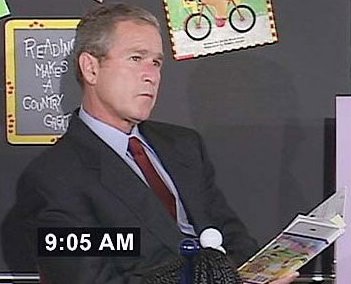
Exhibit A

Exhibit B
Whatever made anyone think that a man who would sit for seven minutes in an elementary school classroom during a terrorist attack was the guy to handle a complex conflict in the Middle East?
Bob Herbert:
Imagine a surgeon who is completely clueless, who has no idea what he or she is doing.
Imagine a pilot who is equally incompetent.
Now imagine a president.
The Middle East is in flames. Iraq has become a charnel house, a crucible of horror with no end to the agony in sight. Lebanon is in danger of going down for the count. And the crazies in Iran, empowered by the actions of their enemies, are salivating like vultures. They can’t wait to feast on the remains of U.S. policies and tactics spawned by a sophomoric neoconservative fantasy — that democracy imposed at gunpoint in Iraq would spread peace and freedom, like the flowers of spring, throughout the Middle East.
If a Democratic president had pursued exactly the same policies, and achieved exactly the same tragic results as George W. Bush, that president would have been the target of a ferocious drive for impeachment by the G.O.P.
Mr. Bush spent a fair amount of time this week with the Iraqi prime minister, Nuri Kamal al-Maliki. There was plenty to talk about, nearly all of it hideous. Over the past couple of months Iraqi civilians have been getting blown away at the stunning rate of four or five an hour. Even Karl Rove had a tough time drawing a smiley face on that picture.
“Obviously the violence in Baghdad is still terrible,” said Mr. Bush, “and therefore there needs to be more troops.”
One did not get the sense, listening to this assessment from the commander in chief, that things would soon be well in hand. There was, instead, a disturbing sense of déjà vu. A sense of the president at a complete loss, not really knowing what to do. I recalled the image of Mr. Bush sitting in a Sarasota, Fla., classroom after being informed of the Sept. 11 attacks. Instead of reacting instantly, commandingly, he just sat there for long wasted moments, with a bewildered look on his face, holding a second-grade story called “The Pet Goat.”
And then there was the famous picture of Mr. Bush, on his way back from a monthlong vacation, looking out the window of Air Force One as it flew low over the destruction wrought by Hurricane Katrina. “It’s devastating,” Mr. Bush was quoted as saying. “It’s got to be doubly devastating on the ground.”
I’ll tell you what’s devastating. The monumental and mind-numbing toll of Mr. Bush’s war in Iraq, which is being documented in a series of important books, the latest being Thomas Ricks’s “Fiasco.” Mr. Ricks gives us more disturbing details about the administration’s “flawed plan for war” and “worse approach to occupation.”
Near the end of his book, he writes:
“In January 2005, the C.I.A.’s internal think tank, the National Intelligence Council, concluded that Iraq had replaced Afghanistan as the training ground for a new generation of jihadist terrorists. The country had become ‘a magnet for international terrorist activity,’ said the council’s chairman, Robert Hutchings.”
Saddled with one failure after another, the administration seems paralyzed, completely unable to shape the big issues facing the U.S. and the world today. Condoleezza Rice is in charge of the diplomatic effort regarding Lebanon. She’s been about as effective at that as the president was in his response to Katrina.
This is what happens when you elect someone you'd like as a beer buddy as president. Barney Gumble may be a funny character on The Simpsons, but that doesn't mean I want him to be president.
Well, America, what the hell did you THINK you were voting for?
Maybe when you voted for George W. Bush in 2000, you were tired of the Clinton scandals and just wanted something new. Maybe you had doubts about George the Son, but figured it'd be OK because the old man would really be running things. Maybe you didn't even vote because you believed all the media crap about Al Gore being a pussy and a liar -- and you figured OK, it'll be bad, but we survived the Reagan years, how bad can this be?
You'd be irresponsible if you thought any of those things, but OK. But when you voted to keep this assclown in office in 2004, America, you should have known enough to realize that what little was left of your country and your future after four years would be destroyed at an ever-accelerating rate by this bunch.
And now you're waking up:
So what do you think when you tuck your kids in at night, America? Do you think about the dirty air they're going to breathe, the water full of heavy metals they're going to drink, the menial jobs they're going to be working because all the high-paying jobs have been offshored to low-cost countries? Do you look around at the McMansion in which you live -- the one with the media room and the private bathroom for every child and more SUVs in the garage than you have drivers -- and wonder how they're going to adjust to a world in which they can't even afford a modest house? Do you look back on the time you went to the Caribbean and went snorkeling on a coral reef and marvelled at the huge diversity of life on that reef -- and think about how your children will never be able to see that diversity of live because that reef will be gone? Do you think about how you can hop in the car and drive wherever you want to, and your kids won't be able to do that because even if gasoline is readily available, it will be prohibitively expensive -- and we will still be dependent on gasoline because of Republican refusal to fund research into alternative fuels, instead plowing money into war and tax cuts for CEOs?
Is the reality of what you voted for in 2000 and 2004 finally hitting you, America?
Your wall of denial is finally starting to crumble, despite your best efforts to hang onto the myth that George W. Bush is a good man, an honest man, who has the best interests of the country at heart. It's crumbling despite your best efforts to believe that Republicans really, really want to welcome you into their rich-guys club, that if you just keep them in office, someday you too will be that rich CEO with the $6000 shower curtain. It's crumbling despite your deep-seated need to believe that a president would never gin up a fake reason to send Americans to war; your understandable need to believe that he is trying to keep your kids safe from terrorists instead of the reality that he's making the world a MORE dangerous place. You're beginning to realize that he WANTS you to be afraid, because he and the men around him don't want a free nation, they WANT one in which a frightened population accepts constant government surveillance of their every move so they can "feel safe." You're beginning to realize that this country's foreign policy has been taken over by religious nuts who WANT a worldwide conflagration, because they think they're going to be sitting on the sofa with Jesus and a big bowl of popcorn watching the heathen get their come-uppance.
Look at your children. Do you want them to die because of a president's religious delusions? Do YOU believe in the Rapture? Even if you do, look at your children again and ask yourself if you want to take that chance rather than giving them the long and happy life that you should want for them?
It's so tempting to smack you in the head with a frying pan, America, because I knew all these things about this bunch six years ago, and all it would have taken would have been just a TINY amount of curiosity, a TINY amount of reading, for you to realize who we were dealing with here. But OK, I understand, you were too busy taking the kids to soccer practice, and keeping them fed, and going to work every day, and fielding the calls from your mom whose health gets worse every day. But you were also too busy watching Oprah talk about Brad and Jennifer's divorce, and voting on American Idol to get the information that would have allowed you to make an intelligent decision in a voting booth in 2004 -- one that would have mattered a hell of a lot more to your children than which mediocre pop singer won a recording contract.
It's tempting, but I'm putting down the frying pan now. I'm not going to smack you. Because you still have a chance, however small it may be, given the craven nature of the entrenched Democrats in Washington, to stop the Bush Administration's relentless march towards a kind of fascistic monarchy; to stop their lust for endless war; to put a stop once and for all to George W. Bush's demented notion that he is God's Anointed Instrument of the End Times. Step up to the plate, America. Stop this the madness of this Admininstration, and demand that the opposition act like one. Because if you don't step up now, it'll be too late to save the futures of your children.
You'd be irresponsible if you thought any of those things, but OK. But when you voted to keep this assclown in office in 2004, America, you should have known enough to realize that what little was left of your country and your future after four years would be destroyed at an ever-accelerating rate by this bunch.
And now you're waking up:
With congressional midterm elections less than four months away, the latest NBC News/Wall Street Journal poll finds that candidates will be facing a public that has grown increasingly pessimistic, as nearly two-thirds don't believe life for their children's generation will be better than it has been for them, and nearly 60 percent are doubtful the Iraq war will come to a successful conclusion.
And there's more pessimism: Among those who believe the nation is headed on the wrong track, more than 80 percent say it's part of a longer-term decline.
According to the poll, 65 percent say they feel less confident that life for their children's generation will be better than it was for them. In December 2001, the last time this question was asked, respondents — by a 49-42 percent margin — said they were confident life would be better for their children.
In addition, only 27 percent think the country is headed in the right direction, while 58 percent say they are less confident the Iraq war will come to a successful conclusion.
And among those who believe that the nation is headed on the wrong track, a whopping 81 percent believe it's part of a longer-term decline and that things won't get better for some time. Just 12 percent think the problems are short-term blips.
So what do you think when you tuck your kids in at night, America? Do you think about the dirty air they're going to breathe, the water full of heavy metals they're going to drink, the menial jobs they're going to be working because all the high-paying jobs have been offshored to low-cost countries? Do you look around at the McMansion in which you live -- the one with the media room and the private bathroom for every child and more SUVs in the garage than you have drivers -- and wonder how they're going to adjust to a world in which they can't even afford a modest house? Do you look back on the time you went to the Caribbean and went snorkeling on a coral reef and marvelled at the huge diversity of life on that reef -- and think about how your children will never be able to see that diversity of live because that reef will be gone? Do you think about how you can hop in the car and drive wherever you want to, and your kids won't be able to do that because even if gasoline is readily available, it will be prohibitively expensive -- and we will still be dependent on gasoline because of Republican refusal to fund research into alternative fuels, instead plowing money into war and tax cuts for CEOs?
Is the reality of what you voted for in 2000 and 2004 finally hitting you, America?
Your wall of denial is finally starting to crumble, despite your best efforts to hang onto the myth that George W. Bush is a good man, an honest man, who has the best interests of the country at heart. It's crumbling despite your best efforts to believe that Republicans really, really want to welcome you into their rich-guys club, that if you just keep them in office, someday you too will be that rich CEO with the $6000 shower curtain. It's crumbling despite your deep-seated need to believe that a president would never gin up a fake reason to send Americans to war; your understandable need to believe that he is trying to keep your kids safe from terrorists instead of the reality that he's making the world a MORE dangerous place. You're beginning to realize that he WANTS you to be afraid, because he and the men around him don't want a free nation, they WANT one in which a frightened population accepts constant government surveillance of their every move so they can "feel safe." You're beginning to realize that this country's foreign policy has been taken over by religious nuts who WANT a worldwide conflagration, because they think they're going to be sitting on the sofa with Jesus and a big bowl of popcorn watching the heathen get their come-uppance.
Look at your children. Do you want them to die because of a president's religious delusions? Do YOU believe in the Rapture? Even if you do, look at your children again and ask yourself if you want to take that chance rather than giving them the long and happy life that you should want for them?
It's so tempting to smack you in the head with a frying pan, America, because I knew all these things about this bunch six years ago, and all it would have taken would have been just a TINY amount of curiosity, a TINY amount of reading, for you to realize who we were dealing with here. But OK, I understand, you were too busy taking the kids to soccer practice, and keeping them fed, and going to work every day, and fielding the calls from your mom whose health gets worse every day. But you were also too busy watching Oprah talk about Brad and Jennifer's divorce, and voting on American Idol to get the information that would have allowed you to make an intelligent decision in a voting booth in 2004 -- one that would have mattered a hell of a lot more to your children than which mediocre pop singer won a recording contract.
It's tempting, but I'm putting down the frying pan now. I'm not going to smack you. Because you still have a chance, however small it may be, given the craven nature of the entrenched Democrats in Washington, to stop the Bush Administration's relentless march towards a kind of fascistic monarchy; to stop their lust for endless war; to put a stop once and for all to George W. Bush's demented notion that he is God's Anointed Instrument of the End Times. Step up to the plate, America. Stop this the madness of this Admininstration, and demand that the opposition act like one. Because if you don't step up now, it'll be too late to save the futures of your children.
Wednesday, July 26, 2006
Wingnut sex perverts
Now that I have your attention:
Here is what the marriage and homosexuality expert (sic) Ann Coulter has to say about the Clinton marriage:
Uh....maybe because your obsession with Bill Clinton makes us think you wish it had been YOU under Clinton's desk, Ann? Hmmmmmmm???????
I wonder what Ann thinks about THIS good, Republican, Christian man:
Oh. He has "a problem with addiction." That all makes it OK then. Next he'll say that he knows Jesus has forgiven him, and that Satan got extra points playing skee-ball with God down at the Seaside Heights boardwalk by targeting good Christians. That's always how they weasel out of it.
Isn't it funny how wingnuts who aren't getting laid are so obsessed with the sex lives of others? Remember when Ann Coulter said on Bill Maher's show that "liberals have joyless sex"? And how would she know that, given that she is neither a liberal, nor does anyone want to have sex with her?
Coulter is obsessed with Bill Clinton. She's obsessed with his sex life. She's obsessed with homosexuals. All this says a lot more about Ann Coulter than it does about Bill Clinton OR about homosexuals.
These wingnuts who want to judge others; who want 13-year-olds to bear their father's babies, who think pregnancy is just punishment for evil women who won't keep their legs closed, are the same ones who download photos of naked children late at night after getting home from the church supper, who go online looking for prepubescent girls to have instant message sex. If you have a normal, healthy attitude about sex, that it is normal, natural, and is to be enjoyed in a responsible manner, rather than to be engaged in furtively with a big heaping dollop of guilt, you don't have to do these things. They are so rigid in their attitudes that they can't possibly live up to the kind of so-called "perfection" they demand of others. And every time they fall, the self-loathing increases, and so the need to control others increases.
The more you hear wingnuts talk about the sex lives of others, the more you know they're telling you something about themselves.
Here is what the marriage and homosexuality expert (sic) Ann Coulter has to say about the Clinton marriage:
DEUTSCH: Before we’re off the air, you were talking about Bill Clinton. Is there anything you want to say about Clinton? No?
Ms. ANN COULTER: No.
DEUTSCH: OK. All right. Did you find him attractive? Was that what it was?
Ms. COULTER: No!
DEUTSCH: You don’t find him attractive?
Ms. COULTER: No. OK, fine, I’ll say it on air.
DEUTSCH: Most women find him attractive.
Ms. COULTER: No.
DEUTSCH: OK, say it on air.
Ms. COULTER: I think that sort of rampant promiscuity does show some level of latent homosexuality.
DEUTSCH: OK, I think you need to say that again. That Bill Clinton, you think on some level, has — is a latent homosexual, is that what you’re saying?
Ms. COULTER: Yeah. I mean, not sort of just completely anonymous — I don’t know if you read the Starr report, the rest of us were glued to it, I have many passages memorized. No, there was more plot and dialogue in a porno movie.
DEUTSCH: I’m not paying any attention. I’m still stuck on Bill Clinton. Don’t — now, isn’t that an example of mean-spirted? Isn’t that just a mean-spirited low blow? No pun intended.
Ms. COULTER: No. Which part of what I said?
DEUTSCH: I think this…
Ms. COULTER: Well, you can read high crimes and misdemeanors if he wants some low blows.
DEUTSCH: OK. No, no. Here’s a — here’s a president of the United States…
Ms. COULTER: There’s merely a comment.
DEUTSCH: …a former president of the United States, and just saying, `You know what? I think he has latent homosexual tendencies.’
Ms. COULTER: No. I think anyone with that level of promiscuity where, you know, you — I mean, he didn’t know Monica’s name until their sixth sexual encounter. There is something that is — that is of the bathhouse about that.
DEUTSCH: But what is the homosexual — that’s — you could say somebody who maybe doesn’t celebrate women the way he should or just is that he’s a hound dog?
Ms. COULTER: No. It’s just random, is this obsession with his…
DEUTSCH: But where’s the — but where’s the homosexual part of that? I’m — once again, I’m speechless here.
Ms. COULTER: It’s reminiscent of a bathhouse. It’s just this obsession with your own — with your own essence.
DEUTSCH: But why is that homosexual? You could say narcissistic.
Ms. COULTER: Right.
DEUTSCH: You could say nymphomaniac.
Ms. COULTER: Well, there is something narcissistic about homosexuality. Right? Because you’re in love with someone who looks like you. I’m not breaking new territory here, why are you looking at me like that?
Uh....maybe because your obsession with Bill Clinton makes us think you wish it had been YOU under Clinton's desk, Ann? Hmmmmmmm???????
I wonder what Ann thinks about THIS good, Republican, Christian man:
Thomas Adams, longtime Green Oaks mayor and former chairman of the Lake County REPUBLICAN Central Committee, was charged Monday with possession and distribution of CHILD PORNOGRAPHY.
Adams, 67, faces 11 counts of disseminating CHILD PORNOGRAPHY and two counts of possession. Lake County Judge Victoria Rossetti set his bond at $100,000.
Prosecutor Patricia Fix said sheriff's and state's attorney's investigators first received tips on Adams' alleged illegal activities in March 2005. Adams allegedly sent CHILD PORNOGRAPHY, via attachments to e-mail, to undercover police in Clearwater, Fla.
The alleged PORNOGRAPHY includes both still images and at least one explicit movie of a boy MASTURBATING, Fix said.
Several phony names were used in his alleged PORNOGRAPHY trading, she said, but all were tracked back to Adams' home in the 800 block of Anderson Drive in Green Oaks.
After being taken into custody, Adams ACKNOWLEDGED that all of the screen names were his and that no one else used his computer, Fix said, adding that Adams admitted he had "a problem with addiction."
Oh. He has "a problem with addiction." That all makes it OK then. Next he'll say that he knows Jesus has forgiven him, and that Satan got extra points playing skee-ball with God down at the Seaside Heights boardwalk by targeting good Christians. That's always how they weasel out of it.
Isn't it funny how wingnuts who aren't getting laid are so obsessed with the sex lives of others? Remember when Ann Coulter said on Bill Maher's show that "liberals have joyless sex"? And how would she know that, given that she is neither a liberal, nor does anyone want to have sex with her?
Coulter is obsessed with Bill Clinton. She's obsessed with his sex life. She's obsessed with homosexuals. All this says a lot more about Ann Coulter than it does about Bill Clinton OR about homosexuals.
These wingnuts who want to judge others; who want 13-year-olds to bear their father's babies, who think pregnancy is just punishment for evil women who won't keep their legs closed, are the same ones who download photos of naked children late at night after getting home from the church supper, who go online looking for prepubescent girls to have instant message sex. If you have a normal, healthy attitude about sex, that it is normal, natural, and is to be enjoyed in a responsible manner, rather than to be engaged in furtively with a big heaping dollop of guilt, you don't have to do these things. They are so rigid in their attitudes that they can't possibly live up to the kind of so-called "perfection" they demand of others. And every time they fall, the self-loathing increases, and so the need to control others increases.
The more you hear wingnuts talk about the sex lives of others, the more you know they're telling you something about themselves.
Because the world needs more babies from 13-year-olds impregnated by older men
The Republican Congress, once again focusing like a laser beam on a problem that is not a problem:
Yes, folks, the Christofascist Zombie Brigade are willing to see Pastor Smith and Grandma put in prison if they dare to help out a desperate girl who's pregnant by her father, or by Uncle Bob, or by the creepy guy down at the swim club.
Doesn't it just warm your heart to know that the Republican Party is so concerned abou the health of your daughters? Not enough to ensure that they have health insurance, but enough to try to ensure their re-election, which is what this is REALLY about:
Meanwhile, these same pro-life Republicans persist in supporting a war that has killed over 5800 Iraqis in just two months.
I am really tired of women's bodies being the playing field for election-year politicking. Unwanted pregnancy is a very real trauma for young women, and this bunch is trying to ensure that it becomes a lifetime trauma -- not out of any kind of strongly-held belief, but because of election-year politics. It's high time the Democrats found their guts and called this for what it is.
I'll be waiting.
The Senate passed legislation Tuesday that would make it a federal crime to help an under-age girl escape parental notification laws by crossing state lines to obtain an abortion.
The bill was approved on a 65-to-34 vote, with 14 Democrats joining 51 Republicans in favor.
A similar measure passed the House last year, and President Bush said he would sign the legislation if the two chambers could work out their differences and send a final bill to him.
In a statement, Mr. Bush said that “transporting minors across state lines to bypass parental consent laws regarding abortion undermines state law and jeopardizes the lives of young women.”
Critics questioned the necessity of the measure, saying it would apply to only a small number of cases and could result in criminal charges against close relatives or clergy members who interceded to help in a time of personal crisis.
Yes, folks, the Christofascist Zombie Brigade are willing to see Pastor Smith and Grandma put in prison if they dare to help out a desperate girl who's pregnant by her father, or by Uncle Bob, or by the creepy guy down at the swim club.
Doesn't it just warm your heart to know that the Republican Party is so concerned abou the health of your daughters? Not enough to ensure that they have health insurance, but enough to try to ensure their re-election, which is what this is REALLY about:
The measure also provided Republicans another opportunity to reassure their social conservative base that its concerns were being addressed in an election year. And it gave them a chance to force Democrats to take a position on an issue some would prefer to avoid out of concern over alienating abortion-rights advocates on one hand or Democratic centrists on the other.
Meanwhile, these same pro-life Republicans persist in supporting a war that has killed over 5800 Iraqis in just two months.
I am really tired of women's bodies being the playing field for election-year politicking. Unwanted pregnancy is a very real trauma for young women, and this bunch is trying to ensure that it becomes a lifetime trauma -- not out of any kind of strongly-held belief, but because of election-year politics. It's high time the Democrats found their guts and called this for what it is.
I'll be waiting.
So much for "Condi for President"
The neocons are in revolt:
The neocons are crazy, of course, with their lust for region-wide war in the Middle East. And they are right that Rice is incompetent, though for different reasons from the ones they cite. But when the Republican Party's right flank is calling the Administration's favorite twofer token incompetent, there's a sea change going on.
Claiming that President Bush's foreign policy agenda has been "hijacked," some prominent conservatives want the "incompetent" Secretary of State Condoleezza Rice transferred to an advisory role, according to an article in a conservative magazine, RAW STORY has found.
"Conservative national security allies of President Bush are in revolt against Secretary of State Condoleezza Rice, saying that she is incompetent and has reversed the administration’s national security and foreign policy agenda," reports Insight Magazine.
Excerpts from the article:
#
The conservatives, who include Newt Gingrich, Richard Perle and leading current and former members of the Pentagon and National Security Council, have urged the president to transfer Miss Rice out of the State Department and to an advisory role. They said Miss Rice, stemming from her lack of understanding of the Middle East, has misled the president on Iran and the Arab-Israeli conflict.
"The president has yet to understand that people make policy and not the other way around," a senior national security policy analyst said. "Unlike [former Secretary of State Colin] Powell, Condi is loyal to the president. She is just incompetent on most foreign policy issues."
The criticism of Miss Rice has been intense and comes from a range of Republican loyalists, including current and former aides in the Defense Department and the office of Vice President Dick Cheney. They have warned that Iran has been exploiting Miss Rice's inexperience and incompetence to accelerate its nuclear weapons program. They expect a collapse of her policy over the next few months
The neocons are crazy, of course, with their lust for region-wide war in the Middle East. And they are right that Rice is incompetent, though for different reasons from the ones they cite. But when the Republican Party's right flank is calling the Administration's favorite twofer token incompetent, there's a sea change going on.
Tuesday, July 25, 2006
Everyone's a little bit Hitler....sometimes...
Doesn't mean we go around committing....hate crimes.
Via ShakesSis, here's proof that Hitler has had some of the best posthumous marketing this side of Elvis.
Via ShakesSis, here's proof that Hitler has had some of the best posthumous marketing this side of Elvis.
When are we going to wake up to the voting problems in this country?
At least in Mexico, people get up and protest dishonest elections. Here we deny that they can exist. But after two questionable presidential elections and at least one questionable midterm election, it's high time people woke the hell up, because the problem with voting machines is real.
Most news stories about the problem talk about machines being "vulnerable to hackers." It is time to stop framing the problem this way. "Vulnerable to hackers" makes it sound like the only risk is from a bored teenager with too much computer knowledge. It's time to call the problem what it is: "vulnerability to rigging by corrupt politicians for whom winning, not democracy, is the only value."
Now why, other than for election-rigging, would Diebold include such a "back door"? It's one thing if you are selling software for a business purpose, such as an accounting package, and you have a feature that allows your customers' programmers to customize the software to their particular needs. But voting machines do one thing: tally and count votes. There's NO need for the software to be customized, certainly not by just about anyone without any kind of security built in.
And that's going to deter people like Kenneth Blackwell and Katherine Harris? I hardly think so.
OK, I'll give you a minute here to wipe the coffee and spit off your monitor. That was pretty much my reaction here.
There's no problem with allowing some kind of password-based access so that bug fixes and such can be applied to software should they become necessary. However, Diebold's access is a door open to just about anyone, done with the assumption that evil elections people don't exist.
I work on data entry systems for clinical trials data. In order to access the system, which contains NO names or other identifying information about trial subjects, you have to have a user ID and password. If I make a change to the software, I have to have someone at a higher level apply the change to the production server even though I am a project manager, because access to production software is very strictly controlled. Yet Diebold believes that anyone ought to be able to muck around with the software in the machines that determine who leads this country. Our systems have to be FDA compliant, but the machines that people vote on are open to anyone? You don't have to be an IT professional to understand just how lame that is.
There's only one reason to leave that kind of security hole big enough to drive a truck through, and that is to make it easy to rig the machine to produce a desired result.
This statement leaves out one very important step in the voter-verification process -- the depositing of the paper record into a locked box that is only opened in the event the machine-tallied and counted vote is challenged.
A locked box doesn't address the problems of corrupt voting officials throwing away these boxes or hiding them if they're counted, but at the very least it doesn't make the entire voting system dependent on software that wouldn't pass muster in a first-semester undergraduate computer science class.
This November, watch the returns very carefully. In your local and state races, try to get your hands on late polling data from the day before or the day of the election. If there are exit polls, monitor the results. Then watch the returns. If you see things like, say, the Democratic candidate with an early lead at around 8:00 PM of five or six points, and that candidate ends up LOSING by six points after the "delayed returns from the Republican's home district" come in HOURS after the polls close, you'll know the fix is in.
For example: In 2002, the state of Georgia was a beta test site for Diebold voting machines. The two key races were those between Democrat Roy Barnes vs. Republican Sonny Perdue for governor, and Democratic incumbent Max Cleland vs. Republican Saxby Chambliss for senate. In 2003, a former Diebold employee revealed that prior to the election, an software patch that was never certified by independent testing authorities or cleared by Georgia election officials was applied to the voting machines. In addition, because of problems with training poll workers, that election was run by Diebold technicians.
In that election, Saxby Chambliss defeated Max Cleland, who had been running a comfortable lead, with an Atlanta Journal-Constitution poll on November 3 showing Cleland with a 49%/44% race going into election day -- well within the polls' margin of error. However, when the dust cleared, Chambliss won with 53% of the vote to Cleland's 46% -- a last minute swing of five full points to Chambless in just three days -- possible, but unlikely. A more questionable result occurred in the gubernatorial race, where Roy Barnes gained the same 46% as Cleland, to Sonny Perdue's61%51% -- a 9-12 point swing in just three days.
Conventional wisdom attributes these upsets to the Angry White Male vote being motivated at the last minute (as if they only became angry in the three days before the election) -- despite the fact that the percentage of whites in Georgia is decreasing:
But what ABOUT those last-minute "patches" anyway -- the ones of which no one knows the content?
Do YOU trust the results of an election in which the state's demographic trends are entirely at odds with the conventional wisdom explanation of the vote -- especially when uncertified software is installed at the last minute before the election?
Republicans may be happy that such shenanigans are working in their favor, because after all, winning is the ONLY thing. But if the votes aren't counted the way they are cast, or if they are swapped in the machine, there are always going to be questions about the legitimacy of their rule and the way they have come to office over the last six years. For it seems to be only Republicans who are unconcerned about black-box voting and mysterious software patches.
Most news stories about the problem talk about machines being "vulnerable to hackers." It is time to stop framing the problem this way. "Vulnerable to hackers" makes it sound like the only risk is from a bored teenager with too much computer knowledge. It's time to call the problem what it is: "vulnerability to rigging by corrupt politicians for whom winning, not democracy, is the only value."
Recently, computer security expert Harri Hursti revealed serious
security vulnerabilities in Diebold's software. According to Michael
Shamos, a computer scientist and voting system examiner in
Pennsylvania, "It's the most severe security flaw ever discovered in a
voting system."
Even more shockingly, we learned recently that Diebold and the State of
Maryland had been aware of these vulnerabilities for at least two
years. They were documented in analysis, commissioned by Maryland and
conducted by RABA Technologies, published in January 2004. For over
two years, Diebold has chosen not to fix the security holes, and
Maryland has chosen not to alert other states or national officials
about these problems.
Basically, Diebold included a "back door" in its software, allowing
anyone to change or modify the software. There are no technical
safeguards in place to ensure that only authorized people can make
changes.
Now why, other than for election-rigging, would Diebold include such a "back door"? It's one thing if you are selling software for a business purpose, such as an accounting package, and you have a feature that allows your customers' programmers to customize the software to their particular needs. But voting machines do one thing: tally and count votes. There's NO need for the software to be customized, certainly not by just about anyone without any kind of security built in.
A malicious individual with access to a voting machine could rig the
software without being detected. Worse yet, if the attacker rigged the
machine used to compute the totals for some precinct, he or she could
alter the results of that precinct. The only fix the RABA authors
suggested was to warn people that manipulating an election is against
the law.
And that's going to deter people like Kenneth Blackwell and Katherine Harris? I hardly think so.
Typically, modern voting machines are delivered several days before an
election and stored in people's homes or in insecure polling stations.
A wide variety of poll workers, shippers, technicians, and others who
have access to these voting machines could rig the software. Such
software alterations could be difficult to impossible to detect.
Diebold spokesman David Bear admitted to the New York Times that the
back door was inserted intentionally so that election officials would
be able to update their systems easily. Bear justified Diebold's
actions by saying, "For there to be a problem here, you're basically
assuming a premise where you have some evil and nefarious election
officials who would sneak in and introduce a piece of software... I
don't believe these evil elections people exist."
OK, I'll give you a minute here to wipe the coffee and spit off your monitor. That was pretty much my reaction here.
There's no problem with allowing some kind of password-based access so that bug fixes and such can be applied to software should they become necessary. However, Diebold's access is a door open to just about anyone, done with the assumption that evil elections people don't exist.
I work on data entry systems for clinical trials data. In order to access the system, which contains NO names or other identifying information about trial subjects, you have to have a user ID and password. If I make a change to the software, I have to have someone at a higher level apply the change to the production server even though I am a project manager, because access to production software is very strictly controlled. Yet Diebold believes that anyone ought to be able to muck around with the software in the machines that determine who leads this country. Our systems have to be FDA compliant, but the machines that people vote on are open to anyone? You don't have to be an IT professional to understand just how lame that is.
There's only one reason to leave that kind of security hole big enough to drive a truck through, and that is to make it easy to rig the machine to produce a desired result.
There have been many significant problems - some resulting in lost
votes - involving paperless voting machines produced by other vendors.
Recognizing the intrinsic risks of paperless voting machines, the
Association for Computing Machinery issued a statement saying that each
voter should be able "to inspect a physical (e.g., paper) record to
verify that his or her vote has been accurately cast and to serve as an
independent check on the result." Without voter-verified paper records
of all the votes, and without routine spot audits of these records, no
currently available voting system can be trusted. With such records,
even when machines do not function correctly, each voter can make sure
that his or her vote has been correctly recorded on paper.
This statement leaves out one very important step in the voter-verification process -- the depositing of the paper record into a locked box that is only opened in the event the machine-tallied and counted vote is challenged.
A locked box doesn't address the problems of corrupt voting officials throwing away these boxes or hiding them if they're counted, but at the very least it doesn't make the entire voting system dependent on software that wouldn't pass muster in a first-semester undergraduate computer science class.
This November, watch the returns very carefully. In your local and state races, try to get your hands on late polling data from the day before or the day of the election. If there are exit polls, monitor the results. Then watch the returns. If you see things like, say, the Democratic candidate with an early lead at around 8:00 PM of five or six points, and that candidate ends up LOSING by six points after the "delayed returns from the Republican's home district" come in HOURS after the polls close, you'll know the fix is in.
For example: In 2002, the state of Georgia was a beta test site for Diebold voting machines. The two key races were those between Democrat Roy Barnes vs. Republican Sonny Perdue for governor, and Democratic incumbent Max Cleland vs. Republican Saxby Chambliss for senate. In 2003, a former Diebold employee revealed that prior to the election, an software patch that was never certified by independent testing authorities or cleared by Georgia election officials was applied to the voting machines. In addition, because of problems with training poll workers, that election was run by Diebold technicians.
In that election, Saxby Chambliss defeated Max Cleland, who had been running a comfortable lead, with an Atlanta Journal-Constitution poll on November 3 showing Cleland with a 49%/44% race going into election day -- well within the polls' margin of error. However, when the dust cleared, Chambliss won with 53% of the vote to Cleland's 46% -- a last minute swing of five full points to Chambless in just three days -- possible, but unlikely. A more questionable result occurred in the gubernatorial race, where Roy Barnes gained the same 46% as Cleland, to Sonny Perdue's
Conventional wisdom attributes these upsets to the Angry White Male vote being motivated at the last minute (as if they only became angry in the three days before the election) -- despite the fact that the percentage of whites in Georgia is decreasing:
The U.S. Census Bureau’s "American Community Survey Change Profile 2001-2002" revealed that, compared to African Americans and the Hispanic population of Georgia, the population of whites is significantly decreasing (estimated at 1%) compared to a significant increase of African Americans (estimated at .3%) and Latinos (estimated at .6%). The population growth in the state by people of color is likely to result in a further decrease in white representation.
But what ABOUT those last-minute "patches" anyway -- the ones of which no one knows the content?
Do YOU trust the results of an election in which the state's demographic trends are entirely at odds with the conventional wisdom explanation of the vote -- especially when uncertified software is installed at the last minute before the election?
Republicans may be happy that such shenanigans are working in their favor, because after all, winning is the ONLY thing. But if the votes aren't counted the way they are cast, or if they are swapped in the machine, there are always going to be questions about the legitimacy of their rule and the way they have come to office over the last six years. For it seems to be only Republicans who are unconcerned about black-box voting and mysterious software patches.
Monday, July 24, 2006
No. Just No. No. No....Absolutely not. No.
Maybe THIS is why they hate us (and if so, who could blame them?):
And ours, too.
More than a year after first teasing that reality viewers hadn't yet seen the last of them, former Survivor and The Amazing Race couple Rob Mariano and the former Amber Brkich have signed a deal to star in their own Newlyweds-like reality series.
Tentatively dubbed The Rob and Amber Project and scheduled to premiere in January 2007, the ten-episode series will air on the Fox Reality network, Fox's recently launched "all reality, all the time" channel that is currently available in about 20 million digital cable and satellite TV households.
According to Fox Reality, the show will follow the couple (whose April 2005 marriage was televised via CBS's May 2005 Rob and Amber Get Married special) as they embark on "the most challenging phase of their young marriage" -- Rob's plan to move to Las Vegas and become a professional gambler.
Deciding to shun more conventional investment options, Survivor's former "Robfather" has decided risk the couple's (and for the record, mostly Amber's) reality winnings in his efforts to become a professional poker player. Along the way, Amber -- who has doubts about the soundness of Rob's idea to parlay her their winnings into "millions more" -- will do her best to supportive of the risky venture.
"We've grown up with Rob and Amber. We've seen their first kiss on Survivor and watched their wedding. They're likeable and competitive," Fox Reality General Manager David Lyle told Daily Variety. "What Rob's trying to do now, it's probably every guy's dream and every girl's nightmare."
And ours, too.
Other Brilliant Bloggers
DriftglassCorrente
Hullabaloo
Hoffmania
Orcinus
Scoobie Davis
Talking Points Memo
World O'Crap
Fact-esque
Liberal Oasis
Oliver Willis
Talk Left
This Modern World
Philip Barron
Rising Hegemon
AMERICABlog
James Wolcott
Skippy the Bush Kangaroo
Dependable Renegade
The Political Carnival
Astrological Musings
Firedoglake
Spiiderweb
Words of Power
RIPCoco
Kung Fu Monkey
Empire Burlesque
WTF is it Now
Down With Tyranny
Welcome Back to Pottersvillle
Spocko's Brain
The Sideshow
The Ostroy Report
Fallenmonk
Three Wise Men
NewsHoggers
Blue Gal
Blah3
Shadow of the Hegemon
Slacktivist
ShortWoman
Echidne of the Snakes
Jesus' General
My Left Wing
Arthur Silber
Republic of T
Bitch Ph.D
The American Street
Comments from Left Field
Balloon Juice
I Can't Believe It's Not a Democracy
Scholars and Rogues
On My Mind
PhysioProf
The Vulgar Curmudgeon
Monkeyfister
Sasha Undercover
ThePoliticalCat
Fables of the Reconstruction
Talk2Action
D-Day
State of the Day
Just an Earth-Bound Misfit
Bradblog
They Gave Us a Republic
Vagabond Scholar
Seeing the Forest
The Reaction
Orcinus
SteveAudio
Princess Sparkle Pony
Paul Levinson
Politics After 50
The Jed Report
One Utah
Sam Seder
Alternet
The Political Carnival
County Fair
Mudflats
A Feather Adrift
That's Why
Disciples of Joe
No Longer Quivering
Margaret and Helen
Stand With Dr. Dean
All the Good Names Were Taken
Badtux the Snarky Penguin
My Mental Dumping Ground
Legal Schnauzer
Alicublog
Bouphonia
Konagod
The Reverse Spin
City of Angels
The Gospel According to Hate
Menopausal Stoners
Stinque
The New York Crank
BP Oil Slick
Pen-Elayne
Inside-Out the Beltway
Reclusive Leftist
Southern Beale
The Moderate Voice
The Rant
Help the 99ers
Brendan Calling
Matt Taibbi
I Was Told There Would Be Bacon
We Don't Agree, But...
ShortWoman
of mule dung and ash
Cookies in Heaven
The Hunting of the Snark
The Policy Page (Rick Ungar)
Ramona's Voices
Sardonicky
Dagblog
The Titanic Sails At Dawn
Cheese Food Nation
Donkey Mountain
Thump and Whip
Under the Lobsterscope
Addicting Info
Wifely Person
Disaffected and it Feels So Good
Reality Chex
Burnt Orange Report
Salmon Alley
The Politics Blog w/Charles Pierce
Elizabitchez
We Are The 99 Percent.
Republic of Gilead
amigoingsomeplace
Fukushima Diary
The Polygon
Degringolade
Onyx Lynx
Parsley's Pics
Mainmati
Brandflakes for Breakfast
The Economic Populist
Liberal Dan
Ex-Amish Atheist
The Poor Man's Huffington Post
Constant Commoner
Channel Surfing
Big Bad Bald Bastard
Panic in Funland (Tbogg!!!)
Weird Wally's Worldview
Brilliant Furriners
Because we all may have to live somewhere else someday.The Galloping Beaver (Canada)
Cathie from Canada
How This Old Brit Sees It ...
Stunner's Afflictions (Jamaica)
Jamaican Lifestyle
Heathers
Pulling up the ladderbehind them
Daily Kos
Atrios
Open Left


CeleBloggers
Roger EbertDispatches from the Island &
Further Dispatches
(Jorge Garcia)
Baseball Nerd
(Keith Olbermann)
FOK News Channel (ditto)
Brilliant at Tweeting
(We won't do it, but we'll follow them)Marc Maron
Sam Seder
Brendan McDonald
Johnny Weir
Melina
Lynn
Keith Olbermann
In Memoriam
(yes, we're getting tired of having to do this)

Break Room Live archives
Morning Sedition 3/04-12/05
A Brilliant Radio Show -
Morning Seditionists
Camp Butch (all the
Sedition you can eat)
Jim Earl and his
Big Page of Crap
Morning Remembrance
Steve Gilliard 1966-2007:
A Brilliant Blogger
The News Blog archive
NetSlaves article archive
Friends of Steve:
The Group News Blog
"Jon Swift" (Al Weisel) 1963-2010
Bats Left Throws Right (Doghouse Riley)
Brilliant at Disappearing
Maybe they've been raptured?Altercation
The All-Spin Zone
Baghdad Burning
Carrie's Nation
Little Country Lost
Cynical Nation
Pam's House Blend
photos1.blogger.com/blogger/397/497/320/bb_banner.1.jpg]^23004A00]coral]navy],](](]]]black],]3]8]20]1]2]3]3]1]2]3]1]1],](](]^235E3D00])])]^3Cimg^20src^3D^22)photos1.blogger.com/blogger/397/497/320/bb_banner.1.jpg^22]^22...you^20have^20a^20choice^3A^20be^20a^20fighting^20liberal^20or^20sit^20quietly.^20I^20know^20what^20I^20am^2C^20what^20are^20you^3F^22^20--^20^3Ca^20href^3D^22)stevegilliard.blogspot.com/2003/12/im-fighting-liberal-you-know-ive.html^22^20STYLE^3D^22color^3Awhite^3B^22^3ESteve^20Gilliard^2C^201966^20-^202007^3C/a^3E^3CBR^3E^22For^20straight^20up^20monster-stomping^20goodness^2C^20nothing^20makes^20smoke^20shoot^20out^20my^20ears^20like^20Brilliant@Breakfast^22^20--^20^3Ca^20href^3D^22)www.poorimpulsecontrol.net/blog^22^20STYLE^3D^22color^3Awhite^3B^22^3ETata^3C/a^3E],](],](](]black](](](]^23FDF2D7](](](]^23333](](](],]50]20],](](]^23FFF8DD])])]black]1.5]15],](](]^2398A45C])])]black]^23FFF8DD])])]^23666]30]^235E3E1A]^23622121],](](]^235E3E1A](],](]^235E3E1A]^23039]^2306C],](](]^23FFF8DD])])],](](]^23FFF8DD])])],](](]^23FFF8DD])])],](]^235E3E1A]^23666]15]3]25]20]^23808C43],](](],](],](](],](]black](](](],](](](],]^235C3E11](](](],](](]^23211104](](](](](],]^2336F]^23211104](],](]Posted^20by^20^24AUTH^20^7C^20^24TIME]20],](](]^23FFF8DD])])]^23FFF8DD])])]^23666]30]^235E3E1A]^23622121],](](]^235E3E1A](],](]^23333]^23039]^2306C]Contact]]]Home]^24HOME]First^20Page]Email^3A^3CBR^3Ebrilliantatbreakfast^20at^20gmail^20dot^20com]]]RSS]^24RSS]RSS^20Feed]Your^20Servers]]]Jill]rilliantatbreakfast.blogspot.com]]Melina])www.ripcoco.com]RIPCoco]Carrie])carriesnation.blogspot.com]Carrie^27s^20Nation]And^20occasionally...]]]jurassicpork])welcome-to-pottersville.blogspot.com]Welcome^20to^20Pottersville]Bob])bobrixon.blogspot.com]The^20Rix^20Mix]Tata])www.poorimpulsecontrol.net/blog]Poor^20Impulse^20Control]Spiiderweb])spiiderweb.blogspot.com]Spiiderweb]Other^20Brilliant^20Bloggers]]]Modern^20Fabulousity])modernfabulousity.blogspot.com]Modern^20Fabulousity]Pandagon])www.pandagon.net]Pandagon]Altercation])www.mediamatters.org/altercation]Altercation]Corrente])www.correntewire.com/]Corrente]Hullabaloo])digbysblog.blogspot.com]Hullabaloo]Hoffmania])www.hoffmania.com]Hoffmania]Orcinus])dneiwert.blogspot.com]Orcinus]Scoobie^20Davis])scoobiedavis.blogspot.com]Scoobie^20Davis]Talking^20Points^20Memo])talkingpointsmemo.com]Talking^20Points^20Memo]World^20O^27Crap])world-o-crap.com/blog]World^20O^27Crap]Fact-esque])casadelogo.typepad.com/factesque/]Fact-esque]Liberal^20Oasis])www.liberaloasis.com/]Liberal^20Oasis]Oliver^20Willis])www.oliverwillis.com/]Oliver^20Willis]Talk^20Left])www.talkleft.com/]Talk^20Left]The^20Talent^20Show])www.thetalentshow.org/]The^20Talent^20Show]Waveflux])www.waveflux.net]Waveflux]Rising^20Hegemon])rising-hegemon.blogspot.com/]Rising^20Hegemon]The^20Poor^20Man])www.thepoorman.net/]The^20Poor^20Man]AMERICABlog])www.americablog.org/]AMERICABlog]Needlenose])www.needlenose.com/]Needlenose]Brilliant^20NJ^20bloggers]]]^24ARCHIVE]^20]]Friends]]]Horm])blog.horm.org]Hallucinations^20Of^20Reabsorbed^20Mind]Phorm])p.horm.org]Another^20Phormation]Etc]]]^3Cimg^20src^3D^22)psyc.horm.org/barimg/bar_psycho.png^22^20width^3D^2280^22^20height^3D^2215^22^20alt^3D^22PsycHo^3A^20Free^20Template^20Generator^22^20style^3D^22border^3A^200px^20solid^20black^22^20/^3E]^24PSYCHO]PsycHo^3A^20Free^20Template^20Generator]^3Cimg^20src^3D^22)psyc.horm.org/barimg/bar_firefox.png^22^20width^3D^2280^22^20height^3D^2215^22^20alt^3D^22Get^20FireFox^21^22^20style^3D^22border^3A^200px^20solid^20black^22^20/^3E])www.mozilla.org/products/firefox/]Get^20Firefox^21]^3Cimg^20src^3D^22)psyc.horm.org/barimg/bar_xhtml.png^22^20width^3D^2280^22^20height^3D^2215^22^20alt^3D^22XHTML^20Validator^22^20style^3D^22border^3A^200px^20solid^20black^22^20/^3E])validator.w3.org/check/referer]XHTML^20Validator]]]]Home]^24HOME]First^20Page]Email]^24EMAIL]Mail^20me^21]RSS]^24RSS]RSS^20Feed]Archive]]]^24ARCHIVE]^20]]Friends]]]Horm])blog.horm.org]Hallucinations^20Of^20Reabsorbed^20Mind]Phorm])p.horm.org]Another^20Phormation]Etc]]]^3Cimg^20src^3D^22)psyc.horm.org/barimg/bar_psycho.png^22^20width^3D^2280^22^20height^3D^2215^22^20alt^3D^22PsycHo^3A^20Free^20Template^20Generator^22^20style^3D^22border^3A^200px^20solid^20black^22^20/^3E]^24PSYCHO]PsycHo^3A^20Free^20Template^20Generator]^3Cimg^20src^3D^22)psyc.horm.org/barimg/bar_firefox.png^22^20width^3D^2280^22^20height^3D^2215^22^20alt^3D^22Get^20FireFox^21^22^20style^3D^22border^3A^200px^20solid^20black^22^20/^3E])www.mozilla.org/products/firefox/]Get^20Firefox^21]^3Cimg^20src^3D^22)psyc.horm.org/barimg/bar_xhtml.png^22^20width^3D^2280^22^20height^3D^2215^22^20alt^3D^22XHTML^20Validator^22^20style^3D^22border^3A^200px^20solid^20black^22^20/^3E])validator.w3.org/check/referer]XHTML^20Validator^26^2361470^3BPsycHo})


