| "Only dull people are brilliant at breakfast" -Oscar Wilde |
 |
"The liberal soul shall be made fat, and he that watereth, shall be watered also himself." -- Proverbs 11:25 |
"...you have a choice: be a fighting liberal or sit quietly. I know what I am, what are you?" -- Steve Gilliard, 1964 - 2007
"For straight up monster-stomping goodness, nothing makes smoke shoot out my ears like Brilliant@Breakfast" -- Tata
"...the best bleacher bum since Pete Axthelm" -- Randy K.
"I came here to chew bubblegum and kick ass. And I'm all out of bubblegum." -- "Rowdy" Roddy Piper (1954-2015), They Live
"For straight up monster-stomping goodness, nothing makes smoke shoot out my ears like Brilliant@Breakfast" -- Tata
"...the best bleacher bum since Pete Axthelm" -- Randy K.
"I came here to chew bubblegum and kick ass. And I'm all out of bubblegum." -- "Rowdy" Roddy Piper (1954-2015), They Live


Brilliant Recent Posts
There's nothing new under the sunAu revoir, y'all....
So Long and Thanks for All the Gefilte Fish
Like White on Rice
Why Did Hillary Clinton Hire a Monsanto Lobbyist t...
Virtual Book Sale
The Man Who Poisoned America
We are privileged to be alive today
The Prodigal Blogger Stops By
Good Times at Pottersville, 3/14/15
Brilliant at Searching
Brilliant Stuff to Buy
What's on my mind:
Brilliant Archives
Brilliant at Begging
Like what you read?Please consider supporting B@B with a donation: There is no gift like the present.
But gifts are nice too:


Feed Me!





Stuff You Must Read
Saturday, January 13, 2007
You may be the Bush Administration's enemy
Who the hell knows what a madman will decide makes you his enemy. Jesus H. Christ, this is starting to make me nostalgic for a good, sane man like Nixon:
The fact remains that the government is still compiling all of your records and tracking your comings and goings -- all in the name of "keeping you safe."
You know, I don't want to hear any more of this "If you haven't done anything wrong, you have nothing to worry about" bullshit. This is an Administration that regards everyone who isn't 100% loyal to George W. Bush and Dick Cheney, who doesn't march entirely in lockstep with everything they do, as "with the terrorists." They are paranoid, power-mad, and extremely dangerous. This has NOTHING to do with 9/11, or national security, or anything. Oh, yes, indeedy, there ARE terrorists living in this country and they are trying to destroy our way of life. But they are not Scary Brown Men in Turbans. They are the Executive Branch of the United States Government.
(UPDATE: Digby has more.)
The Pentagon has been using a little-known power to obtain banking and credit records of hundreds of Americans and others suspected of terrorism or espionage inside the United States, part of an aggressive expansion by the military into domestic intelligence gathering.
The C.I.A. has also been issuing what are known as national security letters to gain access to financial records from American companies, though it has done so only rarely, intelligence officials say.
Banks, credit card companies and other financial institutions receiving the letters usually have turned over documents voluntarily, allowing investigators to examine the financial assets and transactions of American military personnel and civilians, officials say.
The F.B.I., the lead agency on domestic counterterrorism and espionage, has issued thousands of national security letters since the attacks of Sept. 11, 2001, provoking criticism and court challenges from civil liberties advocates who see them as unjustified intrusions into Americans’ private lives.
But it was not previously known, even to some senior counterterrorism officials, that the Pentagon and the Central Intelligence Agency have been using their own “noncompulsory” versions of the letters. Congress has rejected several attempts by the two agencies since 2001 for authority to issue mandatory letters, in part because of concerns about the dangers of expanding their role in domestic spying.
The military and the C.I.A. have long been restricted in their domestic intelligence operations, and both are barred from conducting traditional domestic law enforcement work. The C.I.A.’s role within the United States has been largely limited to recruiting people to spy on foreign countries.
Carl Kropf, a spokesman for the director of national intelligence, said intelligence agencies like the C.I.A. used the letters on only a “limited basis.”
Pentagon officials defended the letters as valuable tools and said they were part of a broader strategy since the Sept. 11 attacks to use more aggressive intelligence-gathering tactics — a priority of former Defense Secretary Donald H. Rumsfeld. The letters “provide tremendous leads to follow and often with which to corroborate other evidence in the context of counterespionage and counterterrorism,” said Maj. Patrick Ryder, a Pentagon spokesman.
Government lawyers say the legal authority for the Pentagon and the C.I.A. to use national security letters in gathering domestic records dates back nearly three decades and, by their reading, was strengthened by the antiterrorism law known as the USA Patriot Act.
Pentagon officials said they used the letters to follow up on a variety of intelligence tips or leads. While they would not provide details about specific cases, military intelligence officials with knowledge of them said the military had issued the letters to collect financial records regarding a government contractor with unexplained wealth, for example, and a chaplain at Guantánamo Bay erroneously suspected of aiding prisoners at the facility.
Usually, the financial documents collected through the letters do not establish any links to espionage or terrorism and have seldom led to criminal charges, military officials say. Instead, the letters often help eliminate suspects.
[snip]
But even when the initial suspicions are unproven, the documents have intelligence value, military officials say. In the next year, they plan to incorporate the records into a database at the Counterintelligence Field Activity office at the Pentagon to track possible threats against the military, Pentagon officials said. Like others interviewed, they would speak only on the condition of anonymity.
The fact remains that the government is still compiling all of your records and tracking your comings and goings -- all in the name of "keeping you safe."
You know, I don't want to hear any more of this "If you haven't done anything wrong, you have nothing to worry about" bullshit. This is an Administration that regards everyone who isn't 100% loyal to George W. Bush and Dick Cheney, who doesn't march entirely in lockstep with everything they do, as "with the terrorists." They are paranoid, power-mad, and extremely dangerous. This has NOTHING to do with 9/11, or national security, or anything. Oh, yes, indeedy, there ARE terrorists living in this country and they are trying to destroy our way of life. But they are not Scary Brown Men in Turbans. They are the Executive Branch of the United States Government.
(UPDATE: Digby has more.)

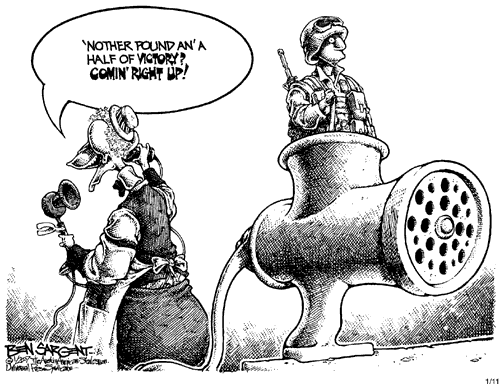
Rod Dreher has a Come to Jesus Moment
This is really extraordinary. Rod Dreher is as staunch a Christian Conservative as you can get. But even he has decided to join the reality-based community. Glenn Greenwald transcribes an oral essay he gave on NPR last Thursday:
I'm so torn about guys like this. On the one hand, I think it's important that those of us who know that what the Bush Administration was dishing out was evil-smelling, dangerous crap from day one be gentle with those coming to their senses so late. It can't be easy to have everything you ever believed dashed into a million pieces, and some kindness is in order. God knows David Brock has spent the last six years trying mightily to atone for his huge role in trying to bring down Bill Clinton.
Yet on the other hand, it's hard to have sympathy for them. WE knew about Bush. WE knew what he was. WE knew the war was based on lies and bullshit. How come guys like this couldn't come around to what was as plain as day? What is it about them that made them trust long after it was crystal clear that what they were trusting was a lie? Sure, I think Media Matters does a terrific job, and I'm glad it's there. But I haven't forgotten that article by David Brock in Esquire. I haven't forgotten his hit job on Anita Hill.
I don't want to keep a Scrapbook of Old Grudges around, because I think when you hold onto old resentments, they don't hurt the person with whom you're angry but they poison you from the inside out. So ultimately, I'm inclined to welcome these repentants into the fold and offer them a drink, and say "Don't worry, big fella....it's hard, but you'll be OK here. You'll see that we're not the demons you thought we were."
As President Bush marched the country to war with Iraq, even some voices on the Right warned that this was a fool's errand. I dismissed them angrily. I thought them unpatriotic.
But almost four years later, I see that I was the fool.
In Iraq, this Republican President for whom I voted twice has shamed our country with weakness and incompetence, and the consequences of his failure will be far, far worse than anything Carter did.
The fraud, the mendacity, the utter haplessness of our government's conduct of the Iraq war have been shattering to me.
It wasn't supposed to turn out like this. Not under a Republican President.
I turn 40 next month -- middle aged at last -- a time of discovering limits, finitude. I expected that. But what I did not expect was to see the limits of finitude of American power revealed so painfully.
I did not expect Vietnam.
As I sat in my office last night watching President Bush deliver his big speech, I seethed over the waste, the folly, the stupidity of this war.
I had a heretical thought for a conservative - that I have got to teach my kids that they must never, ever take Presidents and Generals at their word - that their government will send them to kill and die for noble-sounding rot - that they have to question authority.
On the walk to the parking garage, it hit me.
Will my children, too small now to understand Iraq, take me seriously when I tell them one day what powerful men, whom their father once believed in, did to this country? Heavy thoughts for someone who is still a conservative despite it all. It was a long drive home
I'm so torn about guys like this. On the one hand, I think it's important that those of us who know that what the Bush Administration was dishing out was evil-smelling, dangerous crap from day one be gentle with those coming to their senses so late. It can't be easy to have everything you ever believed dashed into a million pieces, and some kindness is in order. God knows David Brock has spent the last six years trying mightily to atone for his huge role in trying to bring down Bill Clinton.
Yet on the other hand, it's hard to have sympathy for them. WE knew about Bush. WE knew what he was. WE knew the war was based on lies and bullshit. How come guys like this couldn't come around to what was as plain as day? What is it about them that made them trust long after it was crystal clear that what they were trusting was a lie? Sure, I think Media Matters does a terrific job, and I'm glad it's there. But I haven't forgotten that article by David Brock in Esquire. I haven't forgotten his hit job on Anita Hill.
I don't want to keep a Scrapbook of Old Grudges around, because I think when you hold onto old resentments, they don't hurt the person with whom you're angry but they poison you from the inside out. So ultimately, I'm inclined to welcome these repentants into the fold and offer them a drink, and say "Don't worry, big fella....it's hard, but you'll be OK here. You'll see that we're not the demons you thought we were."
When politics makes strange bedfellows
Richard Viguerie is hardly the sort of person on whose e-mail list I would expect to find myself. But find myself on it I did, when I was greeted this morning with this e-mail:
Heh. "Dear Conservative Leader". If I'm a "Conservative Leader", then the right has a lot to worry about.
But every now and then, the libertarian right and the personal freedom left find themselves on the same side, so I did a search on this amendment, and found that ONLY right-wing groups: The John Birch Society, the Freepers -- really hard-right groups were having canniptions about this. I know that there's been some talk of late of making bloggers responsible for what people write in their comments and such, so I figured I'd take a look at the legislation. Based on my reading, what the Republicans (who didn't care at all about protecting people who criticized Congress when THEY were in charge) are all up in arms about is that section 220 seems to seek to curb "astroturfing" -- corporations, or companies that represent corporations, setting up front groups that look to be grassroots organizations. An example of this is "Hands Off the Internet", an organization funded by the telecommunication companies and headed by Clintonista Mike McCurry.
It was early in the morning, and I couldn't make heads nor tails of the legalese therein, so I called upon B@B's Official Resident Expert on All Things Constitutional, Camille Abate of CAJA Institute, who replied as follows:
Because I am not a Constitutional scholar, I'm inclined toward disclosure of such financial arrangements. It's funny how the right made such a ruckus about Daily Kos founder Markos Moulitsas' alleged paid affiliations with Howard Dean's campaign -- an affiliation about which he was quite forthcoming, by the way. But when it comes to trying to have some kind of "truth in advertising" about just whom is behind groups that claim to be "grassroots", then they scream "free speech". In other words, it's OK to be funded by the right, but not OK to be funded by the left.
Well, count me in favor of disclosure. I want to know that a group called "Hands off the Internet" is actually a front group for Big Telecom, because it helps me frame their arguments in context as I evaluate them. I don't think that in any way inhibits free speech, nor does it inhibit their right to create these "astroturf" groups -- it just means that we know whom we're reading.
And by the way, by way of disclosure about who's behind CAJA Institute -- it's right now about fifteen or so highly dedicated people who care deeply about the erosion of our freedoms in the United States under George W. Bush. No giant corporation with an agenda, nor George Soros, nor any other favorite boogeyman of the right, is behind it.
Dear Conservative Leader,
As you may know, Section 220 of S1, the lobby reform bill, would effectively silence many grassroots organizations by subjecting them to onerous registration and reporting requirements which actually exceed what is required of the big lobbyists in Washington, D.C.
Now, Senators Robert Bennett (R-UT), John Cornyn (R-TX), Jon Kyl (R-AZ), and Mitch McConnell (R-KY) have co-sponsored Amendment 20 to S 1, which would remove Section 220 from the bill.
Please call both of your United States senators and tell them to support Amendment 20 to S 1, to delete the regulations on grassroots communications from the lobbying reform bill. Here’s what you can say when you call:
I oppose efforts to regulate my First Amendment rights and to silence critics of Congress.
Please vote for Amendment 20 sponsored by Senator Bennett and others to remove Section 220 from S. 1, the lobbying reform bill.
As NewsMax.com reports on this crucial matter, time is running out.
http://www.newsmax.com/archives/articles/2007/1/11/220628.shtml?s=lh
I’ve created a website, GrassrootsFreedom.com, to help citizens fight efforts to silence us.
After you have called your two senators, I urge you to go to sign our petition at
http://www.grassrootsfreedom.com/gw3/petition/petition.php?PetitionID=25
Also, certain big Washington-based special interest groups are spreading lies about this legislation to misinform the public.
Here’s a letter, written by a lawyer with great technical knowledge of this issue. It’s written with some “legalese,” but it decimates the lies being told to hurt the grassroots.
http://www.grassrootsfreedom.com/gw3/articles-news/articles.php?action=view&CMSArticleID=485&CMSCategoryID=23
So call both of your senators, then visit GrassrootsFreedom.com
Also, please forward this message to your friends, relatives, neighbors, and coworkers.
Cordially,
Richard A. Viguerie
9625 Surveyor Court, Suite 400
Manassas, Virginia 20110
Heh. "Dear Conservative Leader". If I'm a "Conservative Leader", then the right has a lot to worry about.
But every now and then, the libertarian right and the personal freedom left find themselves on the same side, so I did a search on this amendment, and found that ONLY right-wing groups: The John Birch Society, the Freepers -- really hard-right groups were having canniptions about this. I know that there's been some talk of late of making bloggers responsible for what people write in their comments and such, so I figured I'd take a look at the legislation. Based on my reading, what the Republicans (who didn't care at all about protecting people who criticized Congress when THEY were in charge) are all up in arms about is that section 220 seems to seek to curb "astroturfing" -- corporations, or companies that represent corporations, setting up front groups that look to be grassroots organizations. An example of this is "Hands Off the Internet", an organization funded by the telecommunication companies and headed by Clintonista Mike McCurry.
It was early in the morning, and I couldn't make heads nor tails of the legalese therein, so I called upon B@B's Official Resident Expert on All Things Constitutional, Camille Abate of CAJA Institute, who replied as follows:
I just read section 220 of Senate Bill 1. I'm going to copy the critical part here, and then I'll comment on it.
The important part:
(18) PAID EFFORTS TO STIMULATE GRASSROOTS LOBBYING-
`(A) IN GENERAL- The term `paid efforts to stimulate grassroots lobbying' means any paid attempt in support of lobbying contacts on behalf of a client to influence the general public or segments thereof to contact one or more covered legislative or executive branch officials (or Congress as a whole) to urge such officials (or Congress) to take specific action with respect to a matter described in section 3(8)(A), except that such term does not include any communications by an entity directed to its members, employees, officers, or shareholders.
`(B) PAID ATTEMPT TO INFLUENCE THE GENERAL PUBLIC OR SEGMENTS THEREOF- The term `paid attempt to influence the general public or segments thereof' does not include an attempt to influence directed at less than 500 members of the general public.
`(C) REGISTRANT- For purposes of this paragraph, a person or entity is a member of a registrant if the person or entity--
`(i) pays dues or makes a contribution of more than a nominal amount to the entity;
`(ii) makes a contribution of more than a nominal amount of time to the entity;
`(iii) is entitled to participate in the governance of the entity;
`(iv) is 1 of a limited number of honorary or life members of the entity; or
`(v) is an employee, officer, director or member of the entity.
`(19) GRASSROOTS LOBBYING FIRM- The term `grassroots lobbying firm' means a person or entity that--
`(A) is retained by 1 or more clients to engage in paid efforts to stimulate grassroots lobbying on behalf of such clients; and
`(B) receives income of, or spends or agrees to spend, an aggregate of $25,000 or more for such efforts in any quarterly period.'
...okay, here's the easiest way to explain it. Unlike moveon.org, DFA, or the ACLU, the targeted groups have clients who pay them. More like an advertising agency... Colgate Palmolive goes to its ad agency and asks them to advertise a product. They give the ad agency money, and the ad agency does its research, targets the audience, and tries to reach them and persuade them to buy the product.
Well, here, the "grassroots lobbying firm" is like a political advertising aency...it has a client -- let's say it's AT&T who wants to get rid of net neutrality. AT&T pays its political ad agency $1.5 million to reach ordinary Americans and get them to either sign a petition to their legislatures, write postcards to their legislatures, organize a protest march, whatever. The "grassroots lobbying firm" takes the money, and then does what moveon.org does or DFA does -- only they don't need to go to the pool for contributions because they have the money already, they just need their targeted Americans to do whatAmericans usually do for a cause -- petition the
government.
The argument for section 220 is, it's not an attack on the First Amendment's right to petition the government for a redress of grievances, it's a way of making sure
that AT&T and whatever grassroots lobbying firm is working for AT&T come clean and make clear that the money for the effort came from a corporation, and this is no real grassroots action.
HOWEVER, the argument against section 220 is -- and it's a good argument, in my opinion -- that whatever money AT&T or whoever gave to the lobbying firm
doesn't matter...because the end result is ordinary Americans, whether you like their politics or point of view or not, exercise their right to petition the
government for a redress of grievances under the First Amendment. And why shouldn't they get the information to enable them to do that, whether it's paid for by
AT&T or not? We get hit with advertising all the time, it doesn't force us to go to the store and buy the product. Why aren't they entitled, if they're on some kind of listserv that they want to be on, to be reached by the grassroots lobbying firm? Is Section 220's reporting requirements an attempt to chill the right to give information to people?
On the other hand (I could go on and on here), these ordinary Americans could scout out this information for themselves, instead of relying on paid AT&T grassroots lobbyists who will possibly twist the facts and provide false information. That's one of the real dangers.
However, as Jefferson said, in a marketplace of ideas, if you let all ideas float, the quality ones will float to the top.
ON THE OTHER HAND, these grassroots lobbying firms have an advantage over those who are really grassroots and have no money to get their message out easily, and
should they be allowed to have such easy access without reporting the source of the money that gives them such easy access -- and which also might make those ordinary Amerians on the right angry to know that they are really being manipulated by AT&T?
Okay, so there's a part of both sides, I'm sure if you think about it you can come up with more arguments for each side! It's not so clear cut as it seems in terms
of the Constitution...and, as I always say, it's another example of how things get sloppy and could damage our system when you rush legislation through.
Because I am not a Constitutional scholar, I'm inclined toward disclosure of such financial arrangements. It's funny how the right made such a ruckus about Daily Kos founder Markos Moulitsas' alleged paid affiliations with Howard Dean's campaign -- an affiliation about which he was quite forthcoming, by the way. But when it comes to trying to have some kind of "truth in advertising" about just whom is behind groups that claim to be "grassroots", then they scream "free speech". In other words, it's OK to be funded by the right, but not OK to be funded by the left.
Well, count me in favor of disclosure. I want to know that a group called "Hands off the Internet" is actually a front group for Big Telecom, because it helps me frame their arguments in context as I evaluate them. I don't think that in any way inhibits free speech, nor does it inhibit their right to create these "astroturf" groups -- it just means that we know whom we're reading.
And by the way, by way of disclosure about who's behind CAJA Institute -- it's right now about fifteen or so highly dedicated people who care deeply about the erosion of our freedoms in the United States under George W. Bush. No giant corporation with an agenda, nor George Soros, nor any other favorite boogeyman of the right, is behind it.
Mission Almost Accomplished
Looks like God's Anointed Architect of the Rapture is a bit closer to realizing his dream of singlehandedly hastening the return of his messiah:
Gee, if Crawford Caligula keeps it up, maybe Jesus will come riding in on his Big White Horse brandishing his Big White Phallic Sword before the year is out. Or more likely, we'll just have global nuclear war, and as Bush is sitting in his bunker in D.C., with no Jesus in sight, he'll say "But Billy Graham told me it was all true!"
(h/t: C&L)
The keepers of the "Doomsday Clock" plan to move its hands forward next Wednesday to reflect what they call worsening nuclear and climate threats to the world.
The symbolic clock, maintained by the Bulletin of Atomic Scientists, currently is set at seven minutes to midnight, with midnight marking global catastrophe.
The group did not say in which direction the hands would move. But in a news release previewing an event next Wednesday, they said the change was based on "worsening nuclear, climate threats" to the world.
"The major new step reflects growing concerns about a 'Second Nuclear Age' marked by grave threats, including: nuclear ambitions in Iran and North Korea, unsecured nuclear materials in Russia and elsewhere, the continuing 'launch-ready' status of 2,000 of the 25,000 nuclear weapons held by the U.S. and Russia, escalating terrorism, and new pressure from climate change for expanded civilian nuclear power that could increase proliferation risks," the release reads.
The clock was last pushed forward by two minutes to seven minutes to midnight in 2002 amid concerns about the proliferation of nuclear, biological and other weapons and the threat of terrorism.
Gee, if Crawford Caligula keeps it up, maybe Jesus will come riding in on his Big White Horse brandishing his Big White Phallic Sword before the year is out. Or more likely, we'll just have global nuclear war, and as Bush is sitting in his bunker in D.C., with no Jesus in sight, he'll say "But Billy Graham told me it was all true!"
(h/t: C&L)
This is why the fact that Republican are breaking with the Bush Administration over Iraq is so extraordinary
Because usually when you dare to cross the Bush Reich, this is what happens:
Obviously there's supposed to be a quid pro quo that if you are a prosecutor appointed by a Republican, you are supposed to look the other way when presented with Republican misdeeds.
The Bush administration has quietly asked San Diego U.S. Attorney Carol Lam, best known for her high-profile prosecutions of politicians and corporate executives, to resign her post, a law enforcement official said.
Lam, a Bush appointee who took the helm in 2002, was targeted because of job performance issues – in particular that she failed to make smuggling and gun cases a top priority, said the official, who declined to be identified because Lam has yet to step down.
Lam has had high-profile successes during her tenure, such as the Randy “Duke” Cunningham bribery case – but she alienated herself from bosses at the Justice Department because she is outspoken and independent, said local lawyers familiar with her policies.
When she took over, Lam made it clear that she planned to focus less on low-level smuggling cases in favor of public corruption and white collar crime, which would mean fewer but more significant prosecutions.
Lam declined to comment yesterday.
Several prosecutors in Lam's office and many defense lawyers said yesterday that they were unaware of her impending dismissal, and were universally shocked by it.
“It's virtually unprecedented to fire a U.S. Attorney absent some misconduct in office,” said criminal defense attorney Michael Attanasio, a former federal prosecutor.
“This office has clearly made a priority of investigating and prosecuting white collar offenses and has had occasional success doing so,” he said. “One would think that would be valued by any administration, even if it meant fewer resources were devoted to routine and repetitive border crimes.”
Lam, 47, has been criticized by members of the Border Patrol agents union and by members of Congress, including Vista Republican Darrell Issa, who accused her office of “an appalling record of refusal to prosecute even the worst criminal alien offenders.”
But even some of Lam's legal opponents said the supposed reasons she is being forced out are perplexing.
“What do they want her to do, lock up Mexico?” said Mario Conte, former chief of Federal Defenders of San Diego Inc. Conte, now a professor at California Western School of Law in downtown San Diego, said every prosecutor walks a tightrope.
“I'm sure that Carol, in her role, is simply not able to accommodate everybody's desires of what they think the U.S. Attorney should be doing in this district.”
Her most prominent case involved Cunningham. The former Rancho Santa Fe congressman is in federal prison, and indictments of others connected to the case may be forthcoming.
Obviously there's supposed to be a quid pro quo that if you are a prosecutor appointed by a Republican, you are supposed to look the other way when presented with Republican misdeeds.
Friday, January 12, 2007
Leap of faith
To all you Blogspotters: They want me to convert to "New Blogger". Have you done it yet?

Is it safe?

Is it safe?
Now this is funny
I'm old enough to remember what it was like to live in a world where you couldn't possibly have access to all the funny stuff that there is to read. Now we do. Go check out George W. Bush's Iraq speech from the other night, with rebuttal commentary by Homer Simpson.
Republicans who freak out when you get too close to the truth
John Aravosis made an interesting observation today about the wingnuts having the vapors and fanning themselves on a chaise longue over Barbara Boxer pointing out that neither she nor Condoleeza Rice has a personal stake in the escalation of the Iraq War.
Here is what Boxer said:
Now, that's just a fact. Neither one of these women has a loved one who's going to die in this war. What's the problem?
Apparently there is one, because today the New York Post was up in arms:
Now would someone please tell me how pointing out a FACT is an "attack"? I know that this is how Republicans work, that Democrats doing their oversight job is "partisanship" and pointing out differences in viewpoints from the Bush Party Line is "attacking", but for a bunch of people who like to rattle their sabers and talk tough, these people sure are a bunch of whiny-ass titty babies.
I'm a childless woman, and I'm the first one who'll tell you that I don't have a personal stake in this war. So what's the problem with pointing out that a woman without children doesn't have children? The only time I ever felt "attacked" because I don't have children was when a friend's daughter passed away suddenly last year and other women said "You can't possibly understand what it's like, because you don't have children." Whereupon I responded by saying, "And neither can you, because you are going to go home tonight and tuck BOTH of YOUR healthy, alive kids into bed."
Funny, the Post didn't have a problem when Laura Bush said the following about Dear Condi last December:
So just who's attacking here? And why so defensive?
John thinks he knows why:
And before the wingnuts get all up in arms that I am somehow "attacking" Condoleeza Rice because of her sexual orientation (thereby conceding that she's gay), let me make one thing clear: I don't give a damn what her sexual orientation is or that of anyone else. I happen to think she's fucking the President, which would make it hard for her to be a butch lesbian, now, wouldn't it? And frankly, I really don't care if she's fucking the President, except to the extent that it affects her ability to do her job (if indeed she has any ability to do her job, which given her performance at yesterday's hearing and at the 9/11 Commission hearings, is highly doubtful).
But there's something about this wingnut defensiveness that is right out of the same playbook that has them honing in on their opponents' strengths and turning them into weaknesses; it's a race to build a fence around things they think are off-limits in their own, even if they are fair game in others.
And of course that kind of defensiveness is commonly found in homophobes, who are usually people with doubts about their own sexuality. Marc Maron explained this phenomenon about 2 minutes and 20 seconds into his January 6, 2006 appearance on Conan O'Brien's show in the context of straight mens' reaction to people asking if they've seen Brokeback Mountain:
Here is what Boxer said:
"Who pays the price [for Bush's incompetence in Iraq]? I'm not going to pay a personal price. My kids are too old and my grandchild is too young. You're not going to pay a particular price, as I understand it, with an immediate family. So who pays the price? The American military and their families."
Now, that's just a fact. Neither one of these women has a loved one who's going to die in this war. What's the problem?
Apparently there is one, because today the New York Post was up in arms:
Democratic Sen. Barbara Boxer, an appalling scold from California, wasted no time yesterday in dragging the debate over Iraq about as low as it can go - attacking Secretary of State Condoleezza Rice for being a childless woman.
Now would someone please tell me how pointing out a FACT is an "attack"? I know that this is how Republicans work, that Democrats doing their oversight job is "partisanship" and pointing out differences in viewpoints from the Bush Party Line is "attacking", but for a bunch of people who like to rattle their sabers and talk tough, these people sure are a bunch of whiny-ass titty babies.
I'm a childless woman, and I'm the first one who'll tell you that I don't have a personal stake in this war. So what's the problem with pointing out that a woman without children doesn't have children? The only time I ever felt "attacked" because I don't have children was when a friend's daughter passed away suddenly last year and other women said "You can't possibly understand what it's like, because you don't have children." Whereupon I responded by saying, "And neither can you, because you are going to go home tonight and tuck BOTH of YOUR healthy, alive kids into bed."
Funny, the Post didn't have a problem when Laura Bush said the following about Dear Condi last December:
"Dr. Rice, who I think would be a really good candidate (for President), is not interested. Probably because she is single, her parents are no longer living, she's an only child. You need a very supportive family and supportive friends to have this job."
So just who's attacking here? And why so defensive?
John thinks he knows why:
I think they freaked out because for years there have been rumors - unsubstantiated from what I know - about Condi's true sexual orientation. She doesn't appear to date men. She's around 52 years old and has never been married. Her life's dream is to become the commissioner of the National Football League. And she had a very strange exchange on FOX News a few years back in which one of the FOX hosts seemed to be trying to set Condi up on a date with a female anchor at FOX (true story).
None of this proves that Condi is a lesbian. But it explains why there are rumors about Condi, rumors about which the White House is most certainly aware.
Which brings us back to our original question: Why are the White House and conservatives so freaked out about this innocuous quote from Barbara Boxer?
One thing I've learned is that conservatives flip out the most when they think you've found their weak spot. For example, when people questioned Bush's intelligence at the beginning of his term (pre-9/11), the conservatives flipped out (remember when the Canadian press secretary mentioned that Bush was a bit of a dodo?). The conservatives didn't flip out because they thought the charge was wrong or rude or inappropriate - but rather, they flipped out because they knew the charge to be true, and incredibly damaging to the president. After all, imagine how history might have come out differently had the American people known in 2000 what an arrogant dimwit our president-to-be really was? The pattern is repeated often in conservative circles. The moment an enemy hits close to home, conservatives flip out in order to ensure the enemy never dares go there again.
What that suggests in the case of the Condi uproar is that, I think, the White House and conservative activists like FOX News are deathly afraid of Condi's unmarried status and what it might suggest about her sexual orientation. Condi is a potential future Republican presidential, or VP, candidate. She is a rising star (or at least was until the Iraq fiasco) in a party that has few stars left. And if Condi were to turn out to be a bit light in the Manolos, it wouldn't go over too well with the family values crowd that controls the Republican party.
That is the only reason I can think of as to why the White House and conservative activists are freaking out over a nothing-quote from Barbara Boxer. The quote is unintentionally based on the underlying truth that this 52-year-old, single, football-loving lady doesn't seem to have much of an interest in men. And while I tended to be agnostic on the Condi-is-gay rumors up until this point, the bizzarely vicious reaction of the White House and FOX News and Matt Drudge to this episode is starting to make me wonder if they know something I don't.
And before the wingnuts get all up in arms that I am somehow "attacking" Condoleeza Rice because of her sexual orientation (thereby conceding that she's gay), let me make one thing clear: I don't give a damn what her sexual orientation is or that of anyone else. I happen to think she's fucking the President, which would make it hard for her to be a butch lesbian, now, wouldn't it? And frankly, I really don't care if she's fucking the President, except to the extent that it affects her ability to do her job (if indeed she has any ability to do her job, which given her performance at yesterday's hearing and at the 9/11 Commission hearings, is highly doubtful).
But there's something about this wingnut defensiveness that is right out of the same playbook that has them honing in on their opponents' strengths and turning them into weaknesses; it's a race to build a fence around things they think are off-limits in their own, even if they are fair game in others.
And of course that kind of defensiveness is commonly found in homophobes, who are usually people with doubts about their own sexuality. Marc Maron explained this phenomenon about 2 minutes and 20 seconds into his January 6, 2006 appearance on Conan O'Brien's show in the context of straight mens' reaction to people asking if they've seen Brokeback Mountain:
Potent Military Victories To Make Benefit Glorious Image of the Crawford Caligula
Here are some more shining examples of the kind of glorious military victories we've seen under this so-called "war president" who wants us to believe only he can keep us safe, and that God Himself has anointed him to protect us:
So here's my question: If these "al-Qaida affiliates" were not killed, then who the heck are the eight to ten corpses? Just wonderin', is all.
So let's make a scorecard, shall we?
After the 9/11 attacks, we went into Afghanistan and ousted the Taliban, but before we could stabilize that country and the Karzai government, Bush pulled troops from Afghanistan for his war in Iraq. Now the Taliban, who gave safe haven to Osama Bin Laden, are resurgent in Afghanistan, so what is Bush going to do? Pull even MORE troops from Afghanistan to fuel his escalation of the very war in Iraq that Bush's own intelligence officials concede has not stopped, or even eased, but instead fueled Islamic radicalism across the Middle East:
Meanwhile, Bin Laden himself is somewhere in the mountains of our good old ally Pakistan. And Bush is "really not all that concerned about him."
Now would one of the lunatics who finds his/her way here from Lesser Wingnuttia please explain to me how, given this record, you can still believe that "Bush has made us safer"? Would you please explain this record on terrorism and explain to me why, given this record, we should let this guy touch another country, including our own?
In 2002, Time Magazine ran an article "Inside the Mind of the CEO President," continuing the meme that this president, unlike the messy and chaotic wonkery of the Clinton years, would "run this country like a business." Yes, Bush has been the CEO president all right, but the CEO he's been has been ex-Home Depot CEO William Nardelli.
Somalia air strike failed to kill top al-Qaida targets, says US
Xan Rice in Nairobi
Friday January 12, 2007
The Guardian
The US air strike on Somalia failed to kill any of the three top al-Qaida members accused of terror attacks in east Africa.
A senior US official said yesterday that Sunday night's attack had killed between eight and 10 "al-Qaida affiliates" near the southern tip of Somalia.
But he said that Fazul Abdullah Mohammed, Abu Taha al-Sudan and Saleh Ali Saleh Nabhan, all linked to the 1998 US embassy bombings in Kenya and Tanzania and the 2002 Mombasa hotel attack, were still on the run. "Fazul is not dead," said the official, contradicting earlier reports. "The three high-value targets are still of interest to us."
So here's my question: If these "al-Qaida affiliates" were not killed, then who the heck are the eight to ten corpses? Just wonderin', is all.
In a Senate Intelligence Committee hearing, Mr. Negroponte also testified that Al Qaeda’s “resilient” senior leadership continues to play a central planning role from remote hideouts in Pakistan. This conclusion about Al Qaeda reflects a shift in thinking among intelligence officials, who as recently as last summer had assessed that terrorist leaders like Osama bin Laden and Ayman al-Zawahri had become largely isolated from their network of supporters, reducing their role to being more inspirational than operational.
As have previous years’ assessments, Mr. Negroponte said Al Qaeda remained the organization most capable of carrying out another devastating attack on American soil. But Thursday’s testimony from Mr. Negroponte and other top intelligence officials showed a mounting concern about the threat of militant Shiite groups.
[snip]
The other intelligence officials who testified at the hearing were Lt. Gen. Michael D. Maples of the Defense Intelligence Agency, Robert S. Mueller III of the Federal Bureau of Investigation and Randall M. Fort, who leads the Bureau of Intelligence and Research at the State Department.
The officials agreed that the Iraq war had helped fuel Islamic radicalism around the globe and had most likely bolstered the recruiting efforts of Al Qaeda.
[snip]
Mr. Negroponte said Thursday that governments across the region were concerned that the violence in Iraq could spill across the country’s borders and embolden ethnic minorities to carry out attacks against majority sects.
He also warned of the successes that a resurgent Taliban is having in Afghanistan in its attempts to destabilize the government of President Hamid Karzai.
So let's make a scorecard, shall we?
After the 9/11 attacks, we went into Afghanistan and ousted the Taliban, but before we could stabilize that country and the Karzai government, Bush pulled troops from Afghanistan for his war in Iraq. Now the Taliban, who gave safe haven to Osama Bin Laden, are resurgent in Afghanistan, so what is Bush going to do? Pull even MORE troops from Afghanistan to fuel his escalation of the very war in Iraq that Bush's own intelligence officials concede has not stopped, or even eased, but instead fueled Islamic radicalism across the Middle East:
As a last-ditch effort, President Bush is expected to announce this week the dispatch of thousands of additional troops to Iraq as a stopgap measure, an order that Pentagon officials say would strain the Army and Marine Corps as they struggle to man both wars.
Already, a U.S. Army infantry battalion fighting in a critical area of eastern Afghanistan is due to be withdrawn within weeks in order to deploy to Iraq.
According to Army Brig. Gen. Anthony J. Tata and other senior U.S. commanders here, that will happen just as the Taliban is expected to unleash a major campaign to cut the vital road between Kabul and Kandahar. The official said the Taliban intend to seize Kandahar, Afghanistan's second-largest city and the place where the group was organized in the 1990s.
"We anticipate significant events there next spring," said Tata.
Meanwhile, Bin Laden himself is somewhere in the mountains of our good old ally Pakistan. And Bush is "really not all that concerned about him."
Now would one of the lunatics who finds his/her way here from Lesser Wingnuttia please explain to me how, given this record, you can still believe that "Bush has made us safer"? Would you please explain this record on terrorism and explain to me why, given this record, we should let this guy touch another country, including our own?
In 2002, Time Magazine ran an article "Inside the Mind of the CEO President," continuing the meme that this president, unlike the messy and chaotic wonkery of the Clinton years, would "run this country like a business." Yes, Bush has been the CEO president all right, but the CEO he's been has been ex-Home Depot CEO William Nardelli.
The 50% of Connecticut voters who sent Joe Lieberman back to Washington should be ashamed of themselves
As if it weren't bad enough that Lieberman is supporting George W. Bush sending another 20,000 young Americans to their deaths, now he's giving his best bud a free pass on the latter's failures on our own soil. Yes, thanks to Holy Joe Lieberman, George "Heckuva Job Brownie" Bush will face no investigation about how his administration failed the people of the Gulf Coast after Hurricane Katrina:
This is absolutely breathtaking. Lieberman exploited Bush's Katrina failures during the election campaign to position himself as a candidate of "change" -- and the minute he gets sent back to Washington, he's got Bush's back on everything.
This notion of "Let's not dwell in the past", which has been used so successfully by this Administration to avoid any accountability for its many, myriad, spectacular fuckups, which have come one right after another for the past six years, has to stop. When Bill Clinton was president, "accountability" was the watchword on every Republican's lips -- and Joe Lieberman's. Clinton had to be held accountable for a land deal gone bad. He had to be held accountable for the Paula Jones "incident." He had to be held accountable for the Lewinsky affair. He had to be held accountable for the Somalia fiasco (more about BUSH's Somalia fiasco in another post). But THIS guy, who allowed an American city to disappear, who allowed the man who masterminded the attacks on America to go free, who has gutted the U.S. Constitution, who invaded a country that did nothing to us -- THIS GUY is somehow entitled to a free pass?
It's ironic that one of the biggest moral scolds in the Senate is refusing to show this president that actions have consequences, and it says something hideous about Joe Lieberman as a man and as a leader that a president's sexual behavior, however tawdry, immoral, and repulsive it may have been, earned his outrage; but when a sitting president allows Americans to die and an American city to disappear, then bestows government largesse on his campaign contributors for "reconstruction", with little to no oversight, that doesn't trigger Lieberman's sense of right and wrong.
Here is what he said about Bill Clinton during the impeachment hearing:
That Lieberman ended up voting "not guilty" is immaterial; he made a point during his remarks of talking about "false and misleading statements to the American people" and "betraying the public trust." He was perfectly fine with bitchslapping Clinton in front of the entire nation for allegedly lying about a tawdry sexual affair, but when it comes to a president who neglects an entire city in a country over which he presides, we should just "move along, nothing to see here."
Joe Lieberman is in this for Joe Lieberman. He's not looking out for the interests of Americans, or the people of Connecticut, or anyone but Joe Lieberman's career. He is a selfish, venal, greedy man -- as selfish, greedy, and venal as the president with whom he loves to hobnob. And like that president, he likes to wrap himself up in the cloak of religion, but he shames that religion with every move he makes. He is truly a shandeh far di goyim, and makes me ashamed to be even the marginal Jew that I am.
Sen. Joe Lieberman, the only Democrat to endorse President Bush’s new plan for Iraq, has quietly backed away from his pre-election demands that the White House turn over potentially embarrassing documents relating to its handling of the Hurricane Katrina disaster in New Orleans.
Lieberman’s reversal underscores the new role that he is seeking to play in the Senate as the leading apostle of bipartisanship, especially on national-security issues. On Wednesday night, Bush conspicuously cited Lieberman’s advice as being the inspiration for creating a new “bipartisan working group” on Capitol Hill that he said will “help us come together across party lines to win the war on terror.”
But the decision by Lieberman, the new chairman of the Senate Homeland Security and Governmental Affairs Committee, to back away from the committee's Katrina probe is already dismaying public-interest groups and others who hoped the Democratic victory in November would lead to more aggressive investigations of one of the White House’s most spectacular foul-ups.
Last year, when he was running for re-election in Connecticut, Lieberman was a vocal critic of the administration’s handling of Katrina. He was especially dismayed by its failure to turn over key records that could have shed light on internal White House deliberations about the hurricane, including those involving President Bush.
Asserting that there were “too many important questions that cannot be answered,” Lieberman and other committee Democrats complained in a statement last year that the panel “did not receive information or documents showing what actually was going on in the White House.”
[snip]
But now that he chairs the homeland panel—and is in a position to subpoena the records—Lieberman has decided not to pursue the material, according to Leslie Phillips, the senator’s chief committee spokeswoman. “The senator now intends to focus his attention on the future security of the American people and other matters and does not expect to revisit the White House’s role in Katrina,” she told NEWSWEEK.
This is absolutely breathtaking. Lieberman exploited Bush's Katrina failures during the election campaign to position himself as a candidate of "change" -- and the minute he gets sent back to Washington, he's got Bush's back on everything.
This notion of "Let's not dwell in the past", which has been used so successfully by this Administration to avoid any accountability for its many, myriad, spectacular fuckups, which have come one right after another for the past six years, has to stop. When Bill Clinton was president, "accountability" was the watchword on every Republican's lips -- and Joe Lieberman's. Clinton had to be held accountable for a land deal gone bad. He had to be held accountable for the Paula Jones "incident." He had to be held accountable for the Lewinsky affair. He had to be held accountable for the Somalia fiasco (more about BUSH's Somalia fiasco in another post). But THIS guy, who allowed an American city to disappear, who allowed the man who masterminded the attacks on America to go free, who has gutted the U.S. Constitution, who invaded a country that did nothing to us -- THIS GUY is somehow entitled to a free pass?
It's ironic that one of the biggest moral scolds in the Senate is refusing to show this president that actions have consequences, and it says something hideous about Joe Lieberman as a man and as a leader that a president's sexual behavior, however tawdry, immoral, and repulsive it may have been, earned his outrage; but when a sitting president allows Americans to die and an American city to disappear, then bestows government largesse on his campaign contributors for "reconstruction", with little to no oversight, that doesn't trigger Lieberman's sense of right and wrong.
Here is what he said about Bill Clinton during the impeachment hearing:
I have been deeply disappointed and angered by this President's conduct--that which is covered in the Articles, and the more personal misbehavior that is not--and like all of us here, I have struggled uncomfortably for more than a year with how to respond to it. President Clinton engaged in an extramarital sexual relationship with a young White House employee in the Oval Office, which, though consensual, was irresponsible and immoral, and thus raised serious questions about his judgment and his respect for the high office he holds. He then made false or misleading statements about that relationship to the American people, to a Federal district court judge in a civil deposition, and to a Federal grand jury; in so doing, he betrayed not only his family but the public's trust, and undermined his moral authority and public credibility.
That Lieberman ended up voting "not guilty" is immaterial; he made a point during his remarks of talking about "false and misleading statements to the American people" and "betraying the public trust." He was perfectly fine with bitchslapping Clinton in front of the entire nation for allegedly lying about a tawdry sexual affair, but when it comes to a president who neglects an entire city in a country over which he presides, we should just "move along, nothing to see here."
Joe Lieberman is in this for Joe Lieberman. He's not looking out for the interests of Americans, or the people of Connecticut, or anyone but Joe Lieberman's career. He is a selfish, venal, greedy man -- as selfish, greedy, and venal as the president with whom he loves to hobnob. And like that president, he likes to wrap himself up in the cloak of religion, but he shames that religion with every move he makes. He is truly a shandeh far di goyim, and makes me ashamed to be even the marginal Jew that I am.
Because even political geeks have to get their silly and trivial on now and then
Now that I'm not steeped in movies anymore, the awards season kind of sneaks up on me. But here we are, the holidays are aver, the Jets and Giants are done, and so it's time to start thinking about the NEXT benchmark on the way to Opening Day: The Golden Globe Awards. Why just sit in your house alone with a bowl of popcorn and a Diet Coke, when you could attend the liveliest, dishiest awards show party around -- and you don't even have to put on makeup! That's the ModFab/Film Experience Golden Globes Web Chat, starting at 7:45. Just to go the Modern Fabulousity home page and follow instructions there.
We now return you to the Parade of Horrors that is Life in America in the Seventh Year of the Bush Administration.
We now return you to the Parade of Horrors that is Life in America in the Seventh Year of the Bush Administration.
Thursday, January 11, 2007
Can we please have an end to the "Condi for President" talk now?
Christ, this woman is a fucking idiot. Or she's fucking an idiot -- the idiot in the White House. Ha ha. NOT.
Remember when she was asked by Richard Ben-Veniste about the now-infamous August 6, 2001 PDB, and she blithely said, "I think it said....'Bin Laden determined to strike in U.S." -- as if she were talking about the latest Philippa Gregory novel.
Well, she did it again today. It's not an escalation, it's an "augmentation that allows the Iraqis to deal with this very serious problem that they have in Baghdad."
And she said it with a straight face.
Crooks and Liars has the video. Go watch it; it's extraordinary. She's just as twisted and delusional as her boss/bed partner.
Far be it for me to give Novakula any credence, but if for once in his life he's right, this bitch has done as good a job at fucking up the State Department as her lover has been fucking up the rest of the world:
These people must be stopped. It's time to put impeachment back on the table and throw Cheney into the mix as well. Let Nancy Pelosi recuse herself from the process to avoid a conflict of interest, and let the House introduce articles of impeachment now. Meanwhile, Harry Reid should close himself up with Norm Coleman, Chuck Hagel, and that nutball Sam Brownback and tell them: If you don't come on board, you won't have a party, because you won't have a world. This lunatic is going to take you, your party, and the entire country down the tubes unless you put your country ahead of blind party loyalty and come on board. Help us get rid of this bunch of criminals and then we can start talking bipartisanship. This is no longer about Democrats and Republicans, it's about doing what's right for the country and the rest of the world.
Remember when she was asked by Richard Ben-Veniste about the now-infamous August 6, 2001 PDB, and she blithely said, "I think it said....'Bin Laden determined to strike in U.S." -- as if she were talking about the latest Philippa Gregory novel.
Well, she did it again today. It's not an escalation, it's an "augmentation that allows the Iraqis to deal with this very serious problem that they have in Baghdad."
And she said it with a straight face.
In a heated exchange with Hagel, a potential presidential candidate in 2008, Rice disputed his characterization of Bush’s buildup as an “escalation.”
“Putting in 22,000 more troops is not an escalation?” Hagel, a Vietnam veteran and longtime critic of Bush’s Iraq policy, asked. “Would you call it a decrease?”
“I would call it, senator, an augmentation that allows the Iraqis to deal with this very serious problem that they have in Baghdad,” she said.
Hagel told Rice, “Madame secretary, Iraqis are killing Iraqis. We are in a civil war. This is sectarian violence out of control.”
She disputed that Iraq was in the throes of a civil war. To that, Hagel said, “To sit there and say that, that’s just not true.”
Crooks and Liars has the video. Go watch it; it's extraordinary. She's just as twisted and delusional as her boss/bed partner.
Far be it for me to give Novakula any credence, but if for once in his life he's right, this bitch has done as good a job at fucking up the State Department as her lover has been fucking up the rest of the world:
Republicans in Congress who do not want to be quoted tell me that the State Department under Condoleezza Rice is a mess. This comes at a time when the U.S. global position is precarious. While attention is focused on Iraq, American diplomacy is being tested worldwide -- in Afghanistan, Iran, Israel, Korea and Sudan. The judgment by thoughtful Republicans is that Rice has failed to manage that endeavor.
These people must be stopped. It's time to put impeachment back on the table and throw Cheney into the mix as well. Let Nancy Pelosi recuse herself from the process to avoid a conflict of interest, and let the House introduce articles of impeachment now. Meanwhile, Harry Reid should close himself up with Norm Coleman, Chuck Hagel, and that nutball Sam Brownback and tell them: If you don't come on board, you won't have a party, because you won't have a world. This lunatic is going to take you, your party, and the entire country down the tubes unless you put your country ahead of blind party loyalty and come on board. Help us get rid of this bunch of criminals and then we can start talking bipartisanship. This is no longer about Democrats and Republicans, it's about doing what's right for the country and the rest of the world.
"You call that an admission?"
Looks like I'm not the only one who thought that Bush's statement "Where mistakes have been made, the responsibility rests with me" was not the acknowledgement of personal mistakes that the mainstream media so desperately wanted to believe it was.
Dan Froomkin:
It all goes back to our old friend Narcissistic Personality Disorder, doesn't it:
This president is TEXTBOOK.
Here's what therapists say about life with narcissists:
Dan Froomkin:
You Call That an Admission?
Bush is getting a lot of ink today for reportedly having admitted that he made mistakes. It wasn't much of an admission. What Bush said, specifically, was: "Where mistakes have been made, the responsibility rests with me."
That's a step. But the restoration of Bush's credibility on Iraq requires that he admit that he himself made mistakes, and explain what he's learned from them.
Instead, what he was saying last night was, basically: People who worked for me screwed up, and I'm jumping on the grenade. That sort of "admission" casts himself as heroic, rather than repentant.
There was no acknowledgment that he himself had ever done anything wrong. There was no contrition, no remorse, no apology, no sense that he had learned anything from the experience, no reason to hope that he'll make better decisions next time around.
It all goes back to our old friend Narcissistic Personality Disorder, doesn't it:
Five (or more) of the following criteria must be met (all quotes are from Dr. Sam Vaknin’s Malignant Self Love: Narcissism Revisited):
1. Feels grandiose and self-importance (e.g., exaggerates achievements and talents to the point of lying, demands to be recognized as superior without commensurate achievements);
“The narcissist is prone to magical thinking. He thinks about himself in terms of ‘being chosen’ or of ‘having a destiny’. …He believes that his life is of such momentous importance, that it is micro-managed by God. …In short, narcissism and religion go well together, because religion allows the narcissist to feel unique.”
“God is everything the narcissist ever wants to be: omniscient, omnipresent, admired, much discussed, and awe inspiring. God is the narcissist’s wet dream, his ultimate grandiose fantasy.”
2. Is obsessed with fantasies of unlimited success, fame, fearsome power or omnipotence, unequalled brilliance (the cerebral narcissist), bodily beauty or sexual performance (the somatic narcissist), or ideal, everlasting, all-conquering love or passion;
“The narcissist is haunted by the feeling that he is possessed of a mission, of a destiny, that he is a part of fate, of history. He is convinced that his uniqueness is purposeful, that he is meant to lead, chart new ways, to innovate to modernize, to reform, to set precedents, to create. Every act is significant, every writing of momentous consequences, every thought of revolutionary calibre. He feels part of a grand design, a world plan and the frame of affiliation, the group, of which he is a member, must be commensurately grand.”
3. Firmly convinced that he or she is unique and, being special, can only be understood by, should only be treated by, or associate with, other special or unique, or high-status people (or institutions);
“The narcissist despises the very people who sustain his Ego boundaries and functions. He cannot respect people so expressly and clearly inferior to him, yet he can never associate with evidently on his level or superior to him, the risk of narcissistic injury in such associations being too great.”
4. Requires excessive admiration, adulation, attention and affirmation – or, failing that, wishes to be feared and to be notorious (Narcissistic Supply);
“A common error is to think that ‘narcissistic supply’ consists only of admiration, adulation and positive feedback. Actually, being feared, or derided is also supply. The main element is ATTENTION.”
“He feeds of other people, who hurl back at him an image that he projects to them. This is their sole function in his world: to reflect, to admire, to admire, to applaud, to detest – in a word, to assure him that he exists.”
“In short: the group must magnify the narcissist, echo and amplify his life, his views, his knowledge, his history…”
5. Feels entitled. Expects unreasonable or special and favorable priority treatment. Demands automatic and full compliance with his or her expectations;
“He considers his very existence as sufficiently nourishing and sustaining (of others). He feels entitled to the best others can offer without investing in maintaining relationships or in catering to the well-being of his ‘suppliers’.”
6. Is “interpersonally exploitative”, i.e., uses others to achieve his or her own ends;
“He will not hesitate to put people’s lives or fortunes at risk. He will preserve his sense of infallibility in the face of his mistakes and misjudgments by distorting the facts, by evoking mitigating or attenuating circumstances, by repressing the memories, or simply lying.”
7. Devoid of empathy. Is unable or unwilling to identify with or acknowledge the feelings and needs of others;
“But the narcissist does not care. Unable to empathize, he does not fully experience the outcomes of his deeds and decision. For him, humans are dispensable, rechargeable, reusable. They are there to fulfill a function: to supply him with Narcissistic Supply (adoration, admiration, approval, affirmation, etc.). They do not have an existence apart from the carrying out of their duty.”
8. Constantly envious of others or believes that they feel the same about him or her;
“First there is pathological envy. The narcissist is constantly envious of other people: their successes, their property, their character, their education, their children, their ideas, the fact that they can feel, their good mood, their past, their present, their spouses, their mistresses or lovers, their location.”
9. Arrogant, haughty behaviors or attitudes coupled with rage when frustrated, contradicted, or confronted.
“That which has cosmic implications calls for cosmic reactions. A person with an inflated sense of self-import, reacts in an exaggerated manner to threats, greatly inflated by his imagination and by the application of his personal myth.”
“Narcissists live in a state of constant rage, repressed aggression, envy and hatred. They firmly believe that everyone is like them. As a result, they are paranoid, suspicious, scared and erratic.”
This president is TEXTBOOK.
Here's what therapists say about life with narcissists:
“Sooner, or later, everyone around the narcissist is bound to become his victim. People are sucked, voluntarily or involuntarily, into the turbulence that constitutes his life, into the black hole that is his personality, into the whirlwind which makes up his interpersonal relationships. Different people are hurt by different aspects of the narcissist’s life and psychological make-up. Some trust him and rely on him, only to be bitterly disappointed. Others love him and discover that he cannot reciprocate. Yet others are forced to live vicariously, through him.”
So, yes, it's possible to get along with narcissists, but it's probably not worth bothering with. If family members are narcissists, you have my deep sympathy. If people you work with are narcissists, you will be wise to keep an eye on them, if just for your own protection, because they don't think very well, no matter what their IQs, they feel that the rules (of anything) don't apply to them, and they will always cut corners and cheat wherever they think they can get away with it, not to mention alienating co-workers, clients, and customers by their arrogance, lies, malice, and off-the-wall griping. Narcissists are threatened and enraged by trivial disagreements, mistakes, and misunderstandings, plus they have evil mouths and will say ANYTHING, so if you continue to live or work with narcissists, expect to have to clean up after them, expect to lose friends over them, expect big trouble sooner or later.
The Bush Report Card
Keith Olbermann has it, and it's a devastating indictment of this disaster of a president and his disaster of a war:
(hat tip: C&L)
Not even Chris Matthews, a guy who gushed with manlove when Bush landed on the aircraft carrier with socks stuffed into his costume's crotch:
...is disputing what Olbermann says anymore.
(hat tip: C&L)
Not even Chris Matthews, a guy who gushed with manlove when Bush landed on the aircraft carrier with socks stuffed into his costume's crotch:
We're proud of our president. Americans love having a guy as president, a guy who has a little swagger, who's physical, who's not a complicated guy like [former President Bill] Clinton or even like [former Democratic presidential candidates Michael] Dukakis or [Walter] Mondale, all those guys, [George] McGovern. They want a guy who's president. Women like a guy who's president. Check it out. The women like this war. I think we like having a hero as our president.
...is disputing what Olbermann says anymore.
Hey, would you two get a room already?
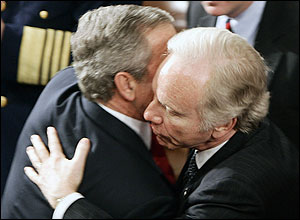
When even Norm Coleman is skeptical about George Bush's plan for Iraq, one senator can always be relied upon to play Drusilla to Bush's Gaius Caligula, soothing his feverish brow with cool cloths and tasty sweets; a senator so beloved by the president that he was the ONLY legislator mentioned during last night's speech.
That senator is Mr. Bush's greatest ally in Congress, greater than anyone even in his own party: one Joseph Lieberman:
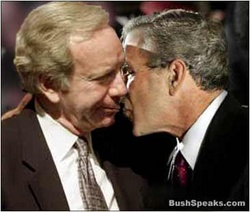
How lucky Mr. Bush is to have such a reliable toady, especially one without "R" after his name, at a time when even his own party is deserting him because they recognize his utter incompetence. But even when the chips are down, there's always Faithful Joe, waiting with a smile....
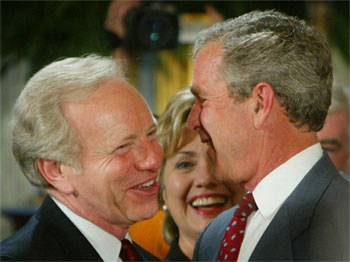
....a hug:

...and a kiss:
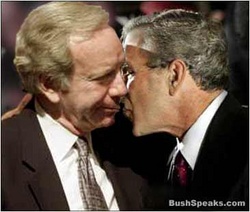
That senator is Mr. Bush's greatest ally in Congress, greater than anyone even in his own party: one Joseph Lieberman:
“I applaud the President for rejecting the fatalism of failure and pursuing a new course to achieve success in Iraq. There is no more difficult decision that a President can make than to send our nation’s bravest soldiers and patriots into harm’s way. Yet, no objective is more worthy in defending America’s vital national security interests than aiding a struggling democracy and supporting brave moderates who are in a life and death struggle against totalitarian extremists supported by Al Qaeda and Iran.
Our troops have sacrificed much and now more will be asked of them to defend our nation. They fight in a just, noble and moral cause against the forces of terrorism, and their sacrifices will make America and the world more secure. I want our troops to return home as soon as possible – after we allow, enable and support them in accomplishing their mission in Iraq in finishing this fight.
I know there are deep differences of opinion about what the President has proposed tonight. In the coming days and weeks, we should undertake respectful debate and deliberation over this new plan. But, let us also remember that excessive partisan division and rancor at home only weakens our will to prevail in this war. I am particularly pleased that the President has taken the important and necessary step of creating a bi-partisan Consultative Group consisting of representatives and leaders of the Executive and Legislative branches to address issues related to the war against global terrorism.
At the moment, we and our Iraqi allies are not winning in Iraq and the American people are understandably frustrated by the miscalculations, the lack of progress, and the daily scenes of violence and casualties. But, make no mistake - defeat in Iraq would result in a moral and strategic setback in our global struggle against Islamist extremists who seek to strike our interests and our homeland.
Success is attainable in Iraq, and tonight the President has offered a comprehensive program to chart a new course in both winning the military struggle to establish order and in achieving the political and economic objectives to build a more promising future for Iraqis. However, no progress is possible unless we restore order, particularly in Baghdad.
Tonight, the President did not take the easy path, but he took the correct and courageous course. We are engaged in a world-wide struggle against Islamist extremism, and Iraq is now the central front. It is a dangerous illusion to believe that we can depart Iraq and the inevitable killing fields and terrorist violence will not follow us in retreat - even to our own shores. That is why it is right and imperative that we recommit ourselves to success in Iraq. Weakness only emboldens our enemy, but united resolution will make our nation safer for generations to come.”
How lucky Mr. Bush is to have such a reliable toady, especially one without "R" after his name, at a time when even his own party is deserting him because they recognize his utter incompetence. But even when the chips are down, there's always Faithful Joe, waiting with a smile....
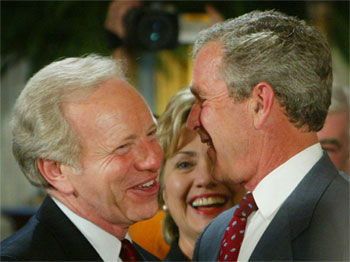
....a hug:
...and a kiss:
The likely scenario
Here is what military officials believe to be the likely scenario as a result of George W. Bush's latest attempt to salvage something of his hopelessly FUBAR legacy:
The only question is why, given this president's history of screwing up everything he touches, anyone ever believed this would turn out any differently.
President Bush's plan to send tens of thousands of U.S. and Iraqi reinforcements to Baghdad to jointly confront Sunni insurgents and Shiite militias is likely to touch off a more dangerous phase of the war, featuring months of fighting in the streets of the Iraqi capital, current and former military officials warned.
"The terrorists and insurgents in Iraq are without conscience, and they will make the year ahead bloody and violent," the president said last night in explaining his revised approach. "Even if our new strategy works exactly as planned, deadly acts of violence will continue -- and we must expect more Iraqi and American casualties."
The prospect of a more intense battle in the Iraqi capital could put U.S. military commanders in exactly the sort of tough urban fight that war planners strove to avoid during the spring 2003 invasion of the country. The plan to partner U.S. and Iraqi units may compel American soldiers to rely on questionable Iraqi army and police forces as never before. And while the president insisted there is no timetable associated with the troop increase, military officials said sustaining it for more than a few months would place a major new strain on U.S. forces that already are feeling burdened by an unexpectedly long and difficult war.
Most of all, the White House's insistence on confronting all insurgents and militias, both Sunni and Shiite, may mean that the U.S. military will wind up fighting the Mahdi Army of radical cleric Moqtada al-Sadr. That militia is estimated by some U.S. intelligence officials to have grown over the past year to about 60,000 fighters, and some in the Pentagon consider it more militarily effective than the Iraqi army. Fighting it could resemble on a citywide scale the sharp combat that took place this week along central Baghdad's Haifa Street, in which U.S. jets and attack helicopters conducted airstrikes just north of the U.S. Embassy in the protected Green Zone.
"There will be more violence than usual because of the surge, and a surge with more casualties plays up on the international stage," said a senior Army official. Sadr "is going to have to make a choice, and if he decides on a confrontation, it will be pretty significant," added a senior Pentagon official.
Sadr is one of the most powerful figures in the Iraqi government, and he has forced it and the U.S. military to back down in the past. Yet if the Mahdi Army is not confronted, the entire offensive may falter and the sectarian conflict may intensify, because Sunnis will feel it is just one more way of attacking them while letting Shiite death squads go free, military experts said. "If our troops do not enter Sadr City, they belittle the notion of a surge because they would leave a leading militia unscathed," said Patrick Cronin of the International Institute for Strategic Studies, a defense think tank.
The last time the U.S. military fought both Sunni and Shiite elements in Iraq was the spring of 2004, which became one of the most difficult times in the war. U.S. commanders were stunned to face a two-front conflict against Sunni insurgents in Anbar province and Shiites in Baghdad and across a broad swath of south-central Iraq. Troops from the Army's 1st Cavalry Division fighting in Sadr's stronghold of about 2 million Shiites in eastern Baghdad became enmeshed in a series of clashes resembling the movie "Black Hawk Down." Sadr's militias besieged isolated U.S. patrols and took over police stations, schools and municipal buildings.
An Army officer who recently commanded a battalion in Baghdad predicted last night that the plan would fail because Iraqi Prime Minister Nouri al-Maliki and his government "will do things to maintain protection" of Sadr's forces. He also dismissed as "happy talk" the president's notion that the predominantly Shiite Iraqi army and police could reassure pro-insurgent Sunni neighborhoods by conducting foot patrols through them.
Bush said it is now clear that there have not been sufficient troops in Baghdad, and that part of the difference in this approach is that the plan will be adequately resourced. Yet the total number of U.S. troops in Iraq after the planned increase will be about 153,000, less than the peak of about 165,000 in December 2005. Military experts last night wondered, as one said, how a "thin green line" of 17,500 additional soldiers in Baghdad could affect the security situation in a city where many of the 5 million residents are hostile to the U.S. presence. "Too little, too late -- way too late," said retired Col. Jerry Durrant, who has worked as a trainer of Iraqi forces.
The only question is why, given this president's history of screwing up everything he touches, anyone ever believed this would turn out any differently.
Because he did such a great job in Iraq, Bush declared war on Iran and Syria last night too
It was almost an "if you blinked, you missed it" moment during Crawford Caligula's speech last night; a moment when you said, "Did he really just say that?"
Did he really declare war on Iran and Syria last night? And if so, is there any more convincing evidence that rather than being chastened by the Baker/Hamilton Iraq Study Group, this lunatic has decided to once again say "Fuck you!" to his father by doing the exact OPPOSITE of what the ISG recommended for dealing with Iran and Syria? Bill Arkin of the Washington Post seems to think so:
Think about what a spoiled child does with toys. If he breaks one, he throws a tantrum, which can be stopped by dangling a shiny new toy in front of him. Then the broken one is forgotten. If Iraq cannot be salvaged, and it increasingly looks like it can't, this president will move on to another shiny new toy.
And who will stop him?
Succeeding in Iraq also requires defending its territorial integrity and stabilizing the region in the face of extremist challenges. This begins with addressing Iran and Syria. These two regimes are allowing terrorists and insurgents to use their territory to move in and out of Iraq. Iran is providing material support for attacks on American troops. We will disrupt the attacks on our forces. We'll interrupt the flow of support from Iran and Syria. And we will seek out and destroy the networks providing advanced weaponry and training to our enemies in Iraq.
Did he really declare war on Iran and Syria last night? And if so, is there any more convincing evidence that rather than being chastened by the Baker/Hamilton Iraq Study Group, this lunatic has decided to once again say "Fuck you!" to his father by doing the exact OPPOSITE of what the ISG recommended for dealing with Iran and Syria? Bill Arkin of the Washington Post seems to think so:
If there's anything in the President Bush's remarks tonight that we didn't already know or didn't anticipate him saying militarily about Iraq, it is his evident willingness to go to war with Syria and Iran to seek peace.
Speaking about the two countries tonight, the president said that the United States wiill "seek out and destroy" those who are providing material support to our enemies.
It is only a threat. But it is a far cry from the diplomatic proposals floated just last month for making Syria and Iran part of the solution. Can the president really be saying that we are willing to risk war with the two countries, and even attack elements inside them, to achieve peace in Iraq?
Think about what a spoiled child does with toys. If he breaks one, he throws a tantrum, which can be stopped by dangling a shiny new toy in front of him. Then the broken one is forgotten. If Iraq cannot be salvaged, and it increasingly looks like it can't, this president will move on to another shiny new toy.
And who will stop him?
Meanwhile, back in Iraq
...we have a country that doesn't even WANT the additional American troops that the Crawford Caligula is sending over there to be target practice for the Mahdi Army:
Now, let me see if I have this straight: The Bush Administration is clinging to its little fantasy of a unity government in which Sunni, Shiite, and Kurd sit together and sing Kumbaya together, while he send additional troops to prop up a Shiite prime minister who is allied with and dependent on the very Shiite religious leader who also heads the militias that American troops are fighting. In other words, Nouri al-Maliki is Moqtada al-Sadr's bitch -- and we are sending MORE troops to fight al-Sadr's guys. Is that about the sum of it? Jesus H. Christ, Bush might as well just take 20,000 more troops and line them up and shoot them himself; at least it would be faster.
Steve Gilliard weighs in:
Anyone who is tempted to think that this represents a genuinely workable plan, a sea change in Bush Administration thinking, should remember that a year ago, Bush announced what he called a "Strategy for Victory in Iraq:
And Juan Cole is just as scathing:
This plan is the same One Percent Doctrine that Dick Cheney and the neocons used to justify this war in the first place -- that if something, in this case the presence of weapons of mass destruction in Iraq, has a one percent chance of being true, you proceed as if it were 100% true and verified -- in other words, if it has "truthiness"®, you run with it. In this case, if escalating our presence in this sectarian civil war has a one percent chance of being successful, you proceed, because not doing anything, or complete withdrawal, has a zero percent chance of being successful, and then the country collapses when we leave. The problem is that the country is going to collapse whether we leave today or we leave tomorrow.
Now, if you want to talk about instituting a military draft, rescinding the tax cuts, rationing gasoline and sending an additional 150,000 troops, then maybe we can talk about making a last push to salvage something about the biggest fuckup in George W. Bush's lifetime of fuckups. But sending another 20,000 troops like the soldier Mike Lupica mentioned yesterday who are already exhausted from previous tours, not only cannot be effective, but arguably constitutes a commander-in-chief committing genocide against his own military.
The Shiite-led government of Prime Minister Nuri Kamal al-Maliki has not publicly opposed the American troop increase, but aides to Mr. Maliki have been saying for weeks that the government is wary of the proposal. They fear that an increased American troop presence, particularly in Baghdad, will be accompanied by a more assertive American role that will conflict with the Shiite government’s haste to cut back on American authority and run the war the way it wants. American troops, Shiite leaders say, should stay out of Shiite neighborhoods and focus on fighting Sunni insurgents.
“The government believes there is no need for extra troops from the American side,” Haidar al-Abadi, a Parliament member and close associate of Mr. Maliki, said Wednesday. “The existing troops can do the job.”
It is an opinion that is broadly held among a Shiite political elite that is increasingly impatient, after nearly two years heading the government here, to exercise power without the constraining supervision of the United States. As a long-oppressed majority, the Shiites have a deep-seated fear that the power they won at the polls, after centuries of subjugation by the Sunni minority, will be progressively whittled away as the Americans seek deals with the Sunnis that will help bring American troops home.
These misgivings are broadly shared by Shiite leaders in the government, including some whom Mr. Bush has courted recently in a United States effort to form a bloc of politicians from the Shiite, Sunni and Kurdish communities that can break Mr. Maliki’s political dependence on the radical Shiite cleric Moktada al-Sadr. He leads the Mahdi Army, the most powerful of the Shiite militias that are at the heart of sectarian violence in Iraq.
Now, let me see if I have this straight: The Bush Administration is clinging to its little fantasy of a unity government in which Sunni, Shiite, and Kurd sit together and sing Kumbaya together, while he send additional troops to prop up a Shiite prime minister who is allied with and dependent on the very Shiite religious leader who also heads the militias that American troops are fighting. In other words, Nouri al-Maliki is Moqtada al-Sadr's bitch -- and we are sending MORE troops to fight al-Sadr's guys. Is that about the sum of it? Jesus H. Christ, Bush might as well just take 20,000 more troops and line them up and shoot them himself; at least it would be faster.
Steve Gilliard weighs in:
Bush's plan is a fantasy, a dangerous one which also provokes Iran to no good purpose.
1) While the Iraqis made a lot of promises and big talk, remember ONE thing. Moqtada Sadr hung Saddam Hussein. Not the government, and they had to go along. So any threat from Maliki should be taken as a threat from Kerensky to tell Lenin that Trotsky needs to control the Bolsheviks
2) Sadr has already manuvered his way past Washington's coup and had brutally demonstrated his power
3) There is no effective Iraqi government to impliment any program. No matter how much money you give to them, they will either steal it or not use it.
4) While Maliki talks unity government, his plan for securing Baghdad basically means attacking Sunni neighborhoods.
5) Sadr fully expects a surge. Fully. According to NPR, he's handing out grenades to every home and drafting every swinging dick between 15 and 45.
People think Bush can flatten Sadr City with airstrikes like they did Fallujah, but that is impossible. People fled Fallujah and turned it into a battleground. So you had minimal risks of killing whole blocks of people. The US could also surround Fallujah.
Sadr City is a whole different story.
Sadr can not only tie down US forces in Sadr City, his supporters and their criminal allies can cut the supply lines to Baghdad. US air power is extremely limited and could be counter productive. The people of Sadr City have no place to go. They will defend their homes. If you turn some of them into rubble, you repeat the mistake the Israelis made last year.
The constant talk of the Iraqi Army joining in this may be the winter's most brutal surprise. If they don't defect, they may not show up. This is a plan of bailing wire and duct tape. Bush gave a speech which should have scared the crap out of people, and I think did. The pundits, unarmed, treat this plan seriously, and mention increased casualities.
What they aren't telling you is that if the US gets sucked into urban combat with both the Shia and Sunni, we will have a disaster on our hands. Not only more dead and wounded, but US forces hampered by the supply line attacks and the desertion of the Iraqi Army.
Odierno and Petraeus take the Iraqis at their word. They are fools.
We will not get the Iraqi support promised. And Americans will die because of that.
Anyone who is tempted to think that this represents a genuinely workable plan, a sea change in Bush Administration thinking, should remember that a year ago, Bush announced what he called a "Strategy for Victory in Iraq:
Speaking to the midshipmen at the Naval Academy in late November 2005, the president declared in a confident tone, "Coalition and Iraqi security forces are on the offensive against the enemy, cleaning out areas controlled by the terrorists and Saddam loyalists, leaving Iraqi forces to hold territory taken from the enemy, and following up with targeted reconstruction to help Iraqis rebuild their lives."
As a portrait of reality, that ranks up there with "Brownie, you're doing a heck of a job." Suffice it to say that a limited number -- a very limited number -- of Iraqis have been able to rebuild their lives. Bush himself said Wednesday night with uncharacteristic albeit belated honesty, "The violence in Iraq, particularly in Baghdad, overwhelmed the political gains the Iraqis had made."
And Juan Cole is just as scathing:
To listen to Bush's speech on Wednesday, you would imagine that al-Qaeda has occupied large swathes of Iraq with the help of Syria and Iran and is brandishing missiles at the US mainland. That the president of the United States can come out after nearly four years of such lies and try to put this fantasy over on the American people is shameful.
The answer to "al-Qaeda's" occupation of neighborhoods in Baghdad and the cities of al-Anbar is then, Bush says, to send in more US troops to "clear and hold" these neighborhoods.
But is that really the big problem in Iraq? Bush is thinking in terms of a conventional war, where armies fight to hold territory. But if a nimble guerrilla group can come out at night and set off a bomb at the base of a large tenement building in a Shiite neighborhood, they can keep the sectarian civil war going. They work by provoking reprisals. They like to hold territory if they can. But as we saw with Fallujah and Tal Afar, if they cannot they just scatter and blow things up elsewhere.
And the main problem is not "al-Qaeda," which is small and probably not that important, and anyway is not really Bin Laden's al-Qaeda. They are just Salafi jihadis who appropriated the name. When their leader, Abu Musab al-Zarqawi, was killed, it didn't cause the insurgency to miss a beat. Conclusion: "al-Qaeda" is not central to the struggle. Izzat Ibrahim Duri and the Baath Party are probably the center of gravity of the resistance.
Bush admitted that the Sunni guerrilla destruction of the Askariyah (Golden Dome) shrine at Samarra set off an orgy of sectarian reprisals. But he does not seem to have actually absorbed the lesson here. The guerrillas did not have to hold territory in order to carry out that bombing. They just had to be able to sneak into a poorly guarded old building that Bush did not even know about and blow it up. The symbolic and psychic damage that they did to the Shiites was profound. Blowing up hundreds of worshippers on Ashura had not had nearly this impact, since the damaged shrine was dedicated to the hidden Twelfth Imam or Mahdi, the Shiite promised one. Many religious Shiites in Iraq are now millenarians, desperately waiting for the Promised One to reveal himself and restore the world to justice. The guerrillas hit the symbol of that hope.
[snip]
Bush could not help taking swipes at Iran and Syria. But the geography of his deployments gives the lie to his singling them out as mischief makers. Why send 4,000 extra troops to al-Anbar province? Why ignore Diyala Province near Iran, which is in flames, or Babel Province southwest of Baghdad? Diyala borders Iran, so isn't that the threat? But wait. Where is al-Anbar? Between Jordan and Baghdad. In other words, al-Anbar opens out into the vast Sunni Arab hinterland that supports the guerrilla movement with money and volunteers, coming in from Jordan. If Syria was the big problem, you would put the extra 4,000 troops up north along the border. If Iran was the big problem, you'd occupy Diyala. But little Jordan is an ally of the US, and Bush would not want to insult it by admitting that it is a major infiltration root for jihadis heading to Iraq.
[snip]
This strategy may have some successes here and there. It won't win the day, and I'd be surprised if it did not collapse by the end of the summer.
This plan is the same One Percent Doctrine that Dick Cheney and the neocons used to justify this war in the first place -- that if something, in this case the presence of weapons of mass destruction in Iraq, has a one percent chance of being true, you proceed as if it were 100% true and verified -- in other words, if it has "truthiness"®, you run with it. In this case, if escalating our presence in this sectarian civil war has a one percent chance of being successful, you proceed, because not doing anything, or complete withdrawal, has a zero percent chance of being successful, and then the country collapses when we leave. The problem is that the country is going to collapse whether we leave today or we leave tomorrow.
Now, if you want to talk about instituting a military draft, rescinding the tax cuts, rationing gasoline and sending an additional 150,000 troops, then maybe we can talk about making a last push to salvage something about the biggest fuckup in George W. Bush's lifetime of fuckups. But sending another 20,000 troops like the soldier Mike Lupica mentioned yesterday who are already exhausted from previous tours, not only cannot be effective, but arguably constitutes a commander-in-chief committing genocide against his own military.
Awaiting President Bush's speech tonight on Iraq, members of Congress from Montana and Wyoming said they want specific details from him in order to evaluate whether to support sending in additional U.S. troops.
It has been widely reported that Bush plans to send 20,000 more troops to help stabilize Baghdad. In his prime-time televised speech, he may also call for political benchmarks for the Iraqi government to meet and an expensive economic development program.
Sen. Jon Tester, D-Mont., said he would reserve judgment until he heard Bush's speech. "But we'll see, we'll see what's in the package and once we understand that, we can make our analysis and determine whether we like it or not, whether it is the same-old, same-old stuff or whether it really is a different direction," the newly elected senator said.
Note to Mr. Tester: It's same-old, same old. George W. Bush has a 45% approval rating in your state. Despite what Dana Bash said on CNN today, that hardly constitutes a "very, very popular" president.
You weren't elected so that you could continue to tiptoe around, or crawl into a fetal position in the corner, waiting to see what the political implications of what this president said would be. You were elected to take a stand and work towards a concrete end to our involvement in Iraq. You know, the way Jim Webb did in his introductory speech before the Senate Foreign Relations Committee:
The series of hearings that we begin today provide a critical opportunity to forge a new strategic direction for Iraq and the entire region—one that is long overdue and one I hope all Americans will eventually be able to rally behind. I would like to express my appreciation to our panel’s witnesses for their appearance today. I look forward to hearing their assessments, especially as they relate to the regional implications of the situation in Iraq today.
We went to war in Iraq recklessly; we must move forward responsibly. The war’s costs to our nation have been staggering. These costs encompass what we hold to be most precious—the blood of our citizens. They also extend to the many thousands more Iraqi people killed and wounded as their country slides into the chaos of sectarian violence and civil war. We have incurred extraordinary financial costs—expenses totaling more than $380 billion and now estimated at $8 billion a month.
The war also has diverted our nation’s focus fighting international terrorism and deflected our attention to the many additional threats to our national security abroad and national greatness at home—costs difficult to measure, perhaps, but very real all the same.
The Iraqi government and the Iraqi people must understand that the United States does not intend to maintain its current presence in their country for the long term. They must make the difficult but essential decisions to end today’s sectarian violence and to provide for their own security. The American people are not alone in seeking that day; indeed, the overwhelming majority of Iraqi citizens also does not want our forces present in their country for any longer than is absolutely necessary.
The key question of the moment is how long the United States should be expected to keep our forces in Iraq as its government seeks to assume these burdens? How and when do we begin to draw down our combat presence and conclude our mission in a way that does not leave even greater chaos behind? What is the administration’s strategic vision and, as it relates to our presence in Iraq, its eventual end point?
The answers to these questions are not to be found in Iraq alone. Achieving our goals in this war requires a coherent strategy encompassing the entire region. The National Strategy for Victory in Iraq, published by the National Security Council in November 2005, principally emphasized how the United States would help the Iraqi people defeat terrorists and build an inclusive democratic state. This strategy identified an initiative to increase international support for Iraq. It did not, however, affirm the need for an overarching diplomatic solution that is now, more than ever, an imperative if we are to end the war.
I have said for many months that the United States does not require a military solution to end the war in Iraq. We must seek a diplomatic solution immediately—one that engages all nations in the region with historic and cultural ties to Iraq. Because they are part of today’s problem, Syria and Iran also must be party to tomorrow’s solution. This overarching diplomatic solution, one supportive of a coherent strategy, will lead to four outcomes. First, it will enable us to withdraw our combat troops from Iraq over time. Second, it will lead to progressively greater regional stability. Third, it will allow us to fight international terrorism more effectively. Lastly, it will enable us to address our broad strategic interests around the world with renewed vigor.
During an earlier era in our nation’s history, we were faced with an unpopular war that had gone on too long. The then-recently retired General Dwight David Eisenhower spoke out against the conduct of the Korean War in the summer of 1952. "Where do we go from here," he asked; "when comes the end?"
Today, the members of this committee—indeed all Americans—await answers to these same questions: Where do we go from here? When comes the end?
Show some guts, man!
Why do sports guys do the best commentary?
We all know about Keith Olbermann's special comments. But check out Mike Lupica's column today, written BEFORE the Crawford Caligula's speech, in which he not only didn't admit that he'd made mistakes (contrary to the spin), but waved his dick at Iran and Syria as well.
Excerpts:
Go read the whole thing. It's worth your time.
Meanwhile, Tim Russert tries to spin this as some kind of bold bet, going "double or nothing" that sending 20,000 more troops to be sitting ducks will somehow work. Yes, it's double or nothing, but it's not chips Bush is putting on the table, it's the lives of 20,000 more American kids, and not one of those kids he's sending into harm's way is named "Jenna Bush", "Barbara Bush", "Noelle Bush", "George P. Bush", or "John Ellis Bush III"
Now let's revisit what he said about mistakes, a sentence being touted as extraordinary by Chris Matthews and Joe Scarborough. Here's what he said:
Does that sound like an admission that George W. Bush has made mistakes? Hardly. "Where mistakes were made" isn't much different than "If mistakes were made" or "To the extent mistakes were made" -- implying doubt that there WERE mistakes. And let's not even get INTO his use of the passive voice. This is the same bullshit he fed us after Hurricane Katrina. It was crap then and it's crap now.
When I was around five years old, I stole a blown-glass duck from a friend. I thought it was pretty and I took it. I showed it to my mother by pulling it out of my pocket and saying "Look what I found!" She knew I didn't own anything like that, she made me confess that I'd taken it, and I had to go over and return it. I still remember how I felt that day. I wasn't all that sorry I'd stolen something, but I hated, hated, hated having to admit right to the person I'd stolen it from -- and his parents -- that I'd done it. That's what George W. Bush looked and sounded like tonight. The difference is that I was a five year old child. This president is sixty years old, and every move of his lips as he uttered that sentence was as if the words were pulled out by force by a stern parent with a boot planted firmly in his ass.
Nothing has changed as a result of this speech. He doesn't believe he's done anything wrong; he uttered a very carefully-crafted sentence because he was told to, just the way I had to return a glass duck when I was five. I knew I'd done something wrong because I am not a sociopath. And I never did anything like that again. George W. Bush IS a sociopath, and the words that came out of his mouth tonight are just that -- empty words.
Not so empty that he isn't going to send 20,000 troops to Baghdad and aircraft carriers to the Persian Gulf by week's end, but empty just the same. Empty of empathy. Empty of remorse. Empty of knowledge. Empty of a soul or of a heart. And empty of any indication that he's laarned anything at all.
Excerpts:
He comes out of upstate New York and put himself through college with ROTC, and found himself with the 1st Armored Division in Baghdad in the summer of 2003 fighting George W. Bush's war. He spent 15 months in Iraq and now they want to send him back in the spring, make him part of this great surge that we will hear about from the White House tonight, one that is less about saving what is left of Iraq than it is saving what is left of this President's reputation.
This President has moved all these top managers around, made John Negroponte a deputy secretary of state and replaced Gen. George Casey in Iraq with Lt. Gen. David Petraeus and made Adm. William Fallon his new head of the Central Command. This is the way sports owners do it with bad teams, as a way of showing some kind of movement to the fans when there is none in the standings.
[snip]
"We had a chance to do something that first summer," the soldier says. "But we dropped the ball. It wasn't the soldiers' fault. It was the fault of our leadership. That's what hurts the most now, that we did what was asked of us and weren't given the help, support or guidance we needed. And before long we weren't fighting foreign fighters and Saddam [Hussein] loyalists, we were fighting regular Iraqis."
He pauses and says, "And now they want to send us back, and keep sending us back, and for what? I see now that Bush wants to send 20,000 more troops, which is supposed to include me, and I want to know why? What's the strategy? If I go back and die in Iraq, is my mother really going to understand why for one day of the rest of her life?"
This is not the story about this war that Bush will tell us tonight, a war that makes Vietnam look as clearly defined as World War II in comparison. This is a soldier's story, and not just his story, but one so many come back telling, one that so many soldiers and National Guardsmen and reservists come back telling. In Iraq, the best and bravest kids are both shocked and awed over how badly their superiors bungled this thing, almost from the start.
"I don't know what I'm going to do," the soldier from upstate New York says. "You want to put me back in uniform and march me back into Baghdad, then you've got to do better than our President has in telling me why, telling me what this month's plan is, what our goals really are. Because those have never been defined, not for the people on the ground, and for that I don't believe I can continue to support this lunacy."
This isn't some politician talking, one like Cheney, who set world records for draft deferments during Vietnam and now wants to fight the whole world. This isn't some war-loving television or radio yahoo who has never served a day of active duty in his life. This is an American soldier who believed the men who sent him there but no longer believes enough in those same people to let them send him back.
Go read the whole thing. It's worth your time.
Meanwhile, Tim Russert tries to spin this as some kind of bold bet, going "double or nothing" that sending 20,000 more troops to be sitting ducks will somehow work. Yes, it's double or nothing, but it's not chips Bush is putting on the table, it's the lives of 20,000 more American kids, and not one of those kids he's sending into harm's way is named "Jenna Bush", "Barbara Bush", "Noelle Bush", "George P. Bush", or "John Ellis Bush III"
Now let's revisit what he said about mistakes, a sentence being touted as extraordinary by Chris Matthews and Joe Scarborough. Here's what he said:
Where mistakes were made, the responsibility lies with me.
Does that sound like an admission that George W. Bush has made mistakes? Hardly. "Where mistakes were made" isn't much different than "If mistakes were made" or "To the extent mistakes were made" -- implying doubt that there WERE mistakes. And let's not even get INTO his use of the passive voice. This is the same bullshit he fed us after Hurricane Katrina. It was crap then and it's crap now.
When I was around five years old, I stole a blown-glass duck from a friend. I thought it was pretty and I took it. I showed it to my mother by pulling it out of my pocket and saying "Look what I found!" She knew I didn't own anything like that, she made me confess that I'd taken it, and I had to go over and return it. I still remember how I felt that day. I wasn't all that sorry I'd stolen something, but I hated, hated, hated having to admit right to the person I'd stolen it from -- and his parents -- that I'd done it. That's what George W. Bush looked and sounded like tonight. The difference is that I was a five year old child. This president is sixty years old, and every move of his lips as he uttered that sentence was as if the words were pulled out by force by a stern parent with a boot planted firmly in his ass.
Nothing has changed as a result of this speech. He doesn't believe he's done anything wrong; he uttered a very carefully-crafted sentence because he was told to, just the way I had to return a glass duck when I was five. I knew I'd done something wrong because I am not a sociopath. And I never did anything like that again. George W. Bush IS a sociopath, and the words that came out of his mouth tonight are just that -- empty words.
Not so empty that he isn't going to send 20,000 troops to Baghdad and aircraft carriers to the Persian Gulf by week's end, but empty just the same. Empty of empathy. Empty of remorse. Empty of knowledge. Empty of a soul or of a heart. And empty of any indication that he's laarned anything at all.
Then he'll change water into wine, walk on water, and wash the feet of the poor. OK, well, not that last part...
Thanks to Glenn Greenwald for showing us that there are still people in this country who have this messianic view of George W. Bush, no matter how many times he screws up.
But this is no stereotypical backwoods bumpkin, this is the Boston Herald city editor, Jules Crittenden:
Uh, Julesey? Just a few things: First of all, the Authorization for the Use of Military Force against Iraq was predicated on:
Second of all, if your Fearless Leader is to be worshipped because he's going to send 20,000 more troops into Iraq, then why isn't he sending the 32,000 that Jack Keane said he needs? Could it be, perhaps, that HE JUST DOESN'T HAVE THEM?
As for the Authorization for Use of Force, 1, 2, 3, 4, 5, and 8 were based on the assumption of a country led by Saddam Hussein, so those no longer apply. Items 6 and 7 could be a consideration, but that's only because Bush's war has created such a power vacuum that it has allowed terrorists INTO Iraq. That leaves #9, except that it remains to be seen whether this war has been effective in fighting anti-United States terrorism.
Of course, as Glenn notes, Crittenden comes from the same bloodline as Danielle Crittenden, who is married to "Axis of Evil" penner David Frum, and who is known for decrying the sluttification of the American Woman, as Amanda points out here. So his wingnut bloodline is pretty impeccable.
How many American corpses is it going to take before these people realize that they are worshipping a false messiah?
But this is no stereotypical backwoods bumpkin, this is the Boston Herald city editor, Jules Crittenden:
George Bush will address us tonight, and show us the way forward. The general outline has been floated: Up to 20,000 more troops, ready to move in by the end of the month. Hammer time for Baghdad and Anbar, already underway with 80 insurgents killed on Haifa Street since Saturday.
[snip]
U.S. Rep Martin Meehan, D-Mass., has his own resolution. I knew Marty 16 years ago in Lowell, long before he was a congressman. He was a political animal, but I liked him, found him principled, and as this war progressed, respected his earnest and measured positions eve when I didn't agree with them. That respect is at an end with his cheap, copycat ploy, a House resolution calling on the president of the United States, in time of war, to ask the permission of Congress before he deploys any more troops into battle.
Tonight, our president is expected, once again, to defy the logic of polls and popularity, and dole out the bitter medicine. What must be done. What should have been done a long time ago. I remain confident in our future and the future of Iraq, because for now, we have a president who will do this.
Uh, Julesey? Just a few things: First of all, the Authorization for the Use of Military Force against Iraq was predicated on:
- Iraq's noncompliance with the conditions of the 1991 cease fire, including interference with weapons inspectors
- Iraq's alleged weapons of mass destruction, and programs to develop such weapons, posed a "threat to the national security of the United States and international peace and security in the Persian Gulf region"
- Iraq's "brutal repression of its civilian population"
- Iraq's "capability and willingness to use weapons of mass destruction against other nations and its own people"
- Iraq's hostility towards the United States as demonstrated by the 1993 assassination attempt of former President George H. W. Bush, and firing on coalition aircraft enforcing the no-fly zones following the 1991 Gulf War
- Members of al-Qaida were "known to be in Iraq"
- Iraq's "continu[ing] to aid and harbor other international terrorist organizations," including anti-United States terrorist organizations
- Fear that Iraq would provide weapons of mass destruction to terrorists for use against the United States
- The efforts by the Congress and the President to fight the 9/11 terrorists and those who aided or harbored them
- The authorization by the Constitution and the Congress for the President to fight anti-United States terrorism
Second of all, if your Fearless Leader is to be worshipped because he's going to send 20,000 more troops into Iraq, then why isn't he sending the 32,000 that Jack Keane said he needs? Could it be, perhaps, that HE JUST DOESN'T HAVE THEM?
As for the Authorization for Use of Force, 1, 2, 3, 4, 5, and 8 were based on the assumption of a country led by Saddam Hussein, so those no longer apply. Items 6 and 7 could be a consideration, but that's only because Bush's war has created such a power vacuum that it has allowed terrorists INTO Iraq. That leaves #9, except that it remains to be seen whether this war has been effective in fighting anti-United States terrorism.
Of course, as Glenn notes, Crittenden comes from the same bloodline as Danielle Crittenden, who is married to "Axis of Evil" penner David Frum, and who is known for decrying the sluttification of the American Woman, as Amanda points out here. So his wingnut bloodline is pretty impeccable.
How many American corpses is it going to take before these people realize that they are worshipping a false messiah?
Other Brilliant Bloggers
DriftglassCorrente
Hullabaloo
Hoffmania
Orcinus
Scoobie Davis
Talking Points Memo
World O'Crap
Fact-esque
Liberal Oasis
Oliver Willis
Talk Left
This Modern World
Philip Barron
Rising Hegemon
AMERICABlog
James Wolcott
Skippy the Bush Kangaroo
Dependable Renegade
The Political Carnival
Astrological Musings
Firedoglake
Spiiderweb
Words of Power
RIPCoco
Kung Fu Monkey
Empire Burlesque
WTF is it Now
Down With Tyranny
Welcome Back to Pottersvillle
Spocko's Brain
The Sideshow
The Ostroy Report
Fallenmonk
Three Wise Men
NewsHoggers
Blue Gal
Blah3
Shadow of the Hegemon
Slacktivist
ShortWoman
Echidne of the Snakes
Jesus' General
My Left Wing
Arthur Silber
Republic of T
Bitch Ph.D
The American Street
Comments from Left Field
Balloon Juice
I Can't Believe It's Not a Democracy
Scholars and Rogues
On My Mind
PhysioProf
The Vulgar Curmudgeon
Monkeyfister
Sasha Undercover
ThePoliticalCat
Fables of the Reconstruction
Talk2Action
D-Day
State of the Day
Just an Earth-Bound Misfit
Bradblog
They Gave Us a Republic
Vagabond Scholar
Seeing the Forest
The Reaction
Orcinus
SteveAudio
Princess Sparkle Pony
Paul Levinson
Politics After 50
The Jed Report
One Utah
Sam Seder
Alternet
The Political Carnival
County Fair
Mudflats
A Feather Adrift
That's Why
Disciples of Joe
No Longer Quivering
Margaret and Helen
Stand With Dr. Dean
All the Good Names Were Taken
Badtux the Snarky Penguin
My Mental Dumping Ground
Legal Schnauzer
Alicublog
Bouphonia
Konagod
The Reverse Spin
City of Angels
The Gospel According to Hate
Menopausal Stoners
Stinque
The New York Crank
BP Oil Slick
Pen-Elayne
Inside-Out the Beltway
Reclusive Leftist
Southern Beale
The Moderate Voice
The Rant
Help the 99ers
Brendan Calling
Matt Taibbi
I Was Told There Would Be Bacon
We Don't Agree, But...
ShortWoman
of mule dung and ash
Cookies in Heaven
The Hunting of the Snark
The Policy Page (Rick Ungar)
Ramona's Voices
Sardonicky
Dagblog
The Titanic Sails At Dawn
Cheese Food Nation
Donkey Mountain
Thump and Whip
Under the Lobsterscope
Addicting Info
Wifely Person
Disaffected and it Feels So Good
Reality Chex
Burnt Orange Report
Salmon Alley
The Politics Blog w/Charles Pierce
Elizabitchez
We Are The 99 Percent.
Republic of Gilead
amigoingsomeplace
Fukushima Diary
The Polygon
Degringolade
Onyx Lynx
Parsley's Pics
Mainmati
Brandflakes for Breakfast
The Economic Populist
Liberal Dan
Ex-Amish Atheist
The Poor Man's Huffington Post
Constant Commoner
Channel Surfing
Big Bad Bald Bastard
Panic in Funland (Tbogg!!!)
Weird Wally's Worldview
Brilliant Furriners
Because we all may have to live somewhere else someday.The Galloping Beaver (Canada)
Cathie from Canada
How This Old Brit Sees It ...
Stunner's Afflictions (Jamaica)
Jamaican Lifestyle
Heathers
Pulling up the ladderbehind them
Daily Kos
Atrios
Open Left


CeleBloggers
Roger EbertDispatches from the Island &
Further Dispatches
(Jorge Garcia)
Baseball Nerd
(Keith Olbermann)
FOK News Channel (ditto)
Brilliant at Tweeting
(We won't do it, but we'll follow them)Marc Maron
Sam Seder
Brendan McDonald
Johnny Weir
Melina
Lynn
Keith Olbermann
In Memoriam
(yes, we're getting tired of having to do this)

Break Room Live archives
Morning Sedition 3/04-12/05
A Brilliant Radio Show -
Morning Seditionists
Camp Butch (all the
Sedition you can eat)
Jim Earl and his
Big Page of Crap
Morning Remembrance
Steve Gilliard 1966-2007:
A Brilliant Blogger
The News Blog archive
NetSlaves article archive
Friends of Steve:
The Group News Blog
"Jon Swift" (Al Weisel) 1963-2010
Bats Left Throws Right (Doghouse Riley)
Brilliant at Disappearing
Maybe they've been raptured?Altercation
The All-Spin Zone
Baghdad Burning
Carrie's Nation
Little Country Lost
Cynical Nation
Pam's House Blend
photos1.blogger.com/blogger/397/497/320/bb_banner.1.jpg]^23004A00]coral]navy],](](]]]black],]3]8]20]1]2]3]3]1]2]3]1]1],](](]^235E3D00])])]^3Cimg^20src^3D^22)photos1.blogger.com/blogger/397/497/320/bb_banner.1.jpg^22]^22...you^20have^20a^20choice^3A^20be^20a^20fighting^20liberal^20or^20sit^20quietly.^20I^20know^20what^20I^20am^2C^20what^20are^20you^3F^22^20--^20^3Ca^20href^3D^22)stevegilliard.blogspot.com/2003/12/im-fighting-liberal-you-know-ive.html^22^20STYLE^3D^22color^3Awhite^3B^22^3ESteve^20Gilliard^2C^201966^20-^202007^3C/a^3E^3CBR^3E^22For^20straight^20up^20monster-stomping^20goodness^2C^20nothing^20makes^20smoke^20shoot^20out^20my^20ears^20like^20Brilliant@Breakfast^22^20--^20^3Ca^20href^3D^22)www.poorimpulsecontrol.net/blog^22^20STYLE^3D^22color^3Awhite^3B^22^3ETata^3C/a^3E],](],](](]black](](](]^23FDF2D7](](](]^23333](](](],]50]20],](](]^23FFF8DD])])]black]1.5]15],](](]^2398A45C])])]black]^23FFF8DD])])]^23666]30]^235E3E1A]^23622121],](](]^235E3E1A](],](]^235E3E1A]^23039]^2306C],](](]^23FFF8DD])])],](](]^23FFF8DD])])],](](]^23FFF8DD])])],](]^235E3E1A]^23666]15]3]25]20]^23808C43],](](],](],](](],](]black](](](],](](](],]^235C3E11](](](],](](]^23211104](](](](](],]^2336F]^23211104](],](]Posted^20by^20^24AUTH^20^7C^20^24TIME]20],](](]^23FFF8DD])])]^23FFF8DD])])]^23666]30]^235E3E1A]^23622121],](](]^235E3E1A](],](]^23333]^23039]^2306C]Contact]]]Home]^24HOME]First^20Page]Email^3A^3CBR^3Ebrilliantatbreakfast^20at^20gmail^20dot^20com]]]RSS]^24RSS]RSS^20Feed]Your^20Servers]]]Jill]rilliantatbreakfast.blogspot.com]]Melina])www.ripcoco.com]RIPCoco]Carrie])carriesnation.blogspot.com]Carrie^27s^20Nation]And^20occasionally...]]]jurassicpork])welcome-to-pottersville.blogspot.com]Welcome^20to^20Pottersville]Bob])bobrixon.blogspot.com]The^20Rix^20Mix]Tata])www.poorimpulsecontrol.net/blog]Poor^20Impulse^20Control]Spiiderweb])spiiderweb.blogspot.com]Spiiderweb]Other^20Brilliant^20Bloggers]]]Modern^20Fabulousity])modernfabulousity.blogspot.com]Modern^20Fabulousity]Pandagon])www.pandagon.net]Pandagon]Altercation])www.mediamatters.org/altercation]Altercation]Corrente])www.correntewire.com/]Corrente]Hullabaloo])digbysblog.blogspot.com]Hullabaloo]Hoffmania])www.hoffmania.com]Hoffmania]Orcinus])dneiwert.blogspot.com]Orcinus]Scoobie^20Davis])scoobiedavis.blogspot.com]Scoobie^20Davis]Talking^20Points^20Memo])talkingpointsmemo.com]Talking^20Points^20Memo]World^20O^27Crap])world-o-crap.com/blog]World^20O^27Crap]Fact-esque])casadelogo.typepad.com/factesque/]Fact-esque]Liberal^20Oasis])www.liberaloasis.com/]Liberal^20Oasis]Oliver^20Willis])www.oliverwillis.com/]Oliver^20Willis]Talk^20Left])www.talkleft.com/]Talk^20Left]The^20Talent^20Show])www.thetalentshow.org/]The^20Talent^20Show]Waveflux])www.waveflux.net]Waveflux]Rising^20Hegemon])rising-hegemon.blogspot.com/]Rising^20Hegemon]The^20Poor^20Man])www.thepoorman.net/]The^20Poor^20Man]AMERICABlog])www.americablog.org/]AMERICABlog]Needlenose])www.needlenose.com/]Needlenose]Brilliant^20NJ^20bloggers]]]^24ARCHIVE]^20]]Friends]]]Horm])blog.horm.org]Hallucinations^20Of^20Reabsorbed^20Mind]Phorm])p.horm.org]Another^20Phormation]Etc]]]^3Cimg^20src^3D^22)psyc.horm.org/barimg/bar_psycho.png^22^20width^3D^2280^22^20height^3D^2215^22^20alt^3D^22PsycHo^3A^20Free^20Template^20Generator^22^20style^3D^22border^3A^200px^20solid^20black^22^20/^3E]^24PSYCHO]PsycHo^3A^20Free^20Template^20Generator]^3Cimg^20src^3D^22)psyc.horm.org/barimg/bar_firefox.png^22^20width^3D^2280^22^20height^3D^2215^22^20alt^3D^22Get^20FireFox^21^22^20style^3D^22border^3A^200px^20solid^20black^22^20/^3E])www.mozilla.org/products/firefox/]Get^20Firefox^21]^3Cimg^20src^3D^22)psyc.horm.org/barimg/bar_xhtml.png^22^20width^3D^2280^22^20height^3D^2215^22^20alt^3D^22XHTML^20Validator^22^20style^3D^22border^3A^200px^20solid^20black^22^20/^3E])validator.w3.org/check/referer]XHTML^20Validator]]]]Home]^24HOME]First^20Page]Email]^24EMAIL]Mail^20me^21]RSS]^24RSS]RSS^20Feed]Archive]]]^24ARCHIVE]^20]]Friends]]]Horm])blog.horm.org]Hallucinations^20Of^20Reabsorbed^20Mind]Phorm])p.horm.org]Another^20Phormation]Etc]]]^3Cimg^20src^3D^22)psyc.horm.org/barimg/bar_psycho.png^22^20width^3D^2280^22^20height^3D^2215^22^20alt^3D^22PsycHo^3A^20Free^20Template^20Generator^22^20style^3D^22border^3A^200px^20solid^20black^22^20/^3E]^24PSYCHO]PsycHo^3A^20Free^20Template^20Generator]^3Cimg^20src^3D^22)psyc.horm.org/barimg/bar_firefox.png^22^20width^3D^2280^22^20height^3D^2215^22^20alt^3D^22Get^20FireFox^21^22^20style^3D^22border^3A^200px^20solid^20black^22^20/^3E])www.mozilla.org/products/firefox/]Get^20Firefox^21]^3Cimg^20src^3D^22)psyc.horm.org/barimg/bar_xhtml.png^22^20width^3D^2280^22^20height^3D^2215^22^20alt^3D^22XHTML^20Validator^22^20style^3D^22border^3A^200px^20solid^20black^22^20/^3E])validator.w3.org/check/referer]XHTML^20Validator^26^2361470^3BPsycHo})


