| "Only dull people are brilliant at breakfast" -Oscar Wilde |
 |
"The liberal soul shall be made fat, and he that watereth, shall be watered also himself." -- Proverbs 11:25 |
"...you have a choice: be a fighting liberal or sit quietly. I know what I am, what are you?" -- Steve Gilliard, 1964 - 2007
"For straight up monster-stomping goodness, nothing makes smoke shoot out my ears like Brilliant@Breakfast" -- Tata
"...the best bleacher bum since Pete Axthelm" -- Randy K.
"I came here to chew bubblegum and kick ass. And I'm all out of bubblegum." -- "Rowdy" Roddy Piper (1954-2015), They Live
"For straight up monster-stomping goodness, nothing makes smoke shoot out my ears like Brilliant@Breakfast" -- Tata
"...the best bleacher bum since Pete Axthelm" -- Randy K.
"I came here to chew bubblegum and kick ass. And I'm all out of bubblegum." -- "Rowdy" Roddy Piper (1954-2015), They Live


Brilliant Recent Posts
There's nothing new under the sunAu revoir, y'all....
So Long and Thanks for All the Gefilte Fish
Like White on Rice
Why Did Hillary Clinton Hire a Monsanto Lobbyist t...
Virtual Book Sale
The Man Who Poisoned America
We are privileged to be alive today
The Prodigal Blogger Stops By
Good Times at Pottersville, 3/14/15
Brilliant at Searching
Brilliant Stuff to Buy
What's on my mind:
Brilliant Archives
Brilliant at Begging
Like what you read?Please consider supporting B@B with a donation: There is no gift like the present.
But gifts are nice too:


Feed Me!





Stuff You Must Read
Saturday, April 29, 2006
OK, my head really did explode this time
Yes, my head just exploded into tiny little pieces, and I have to clean them up off the floor. But first, let me show you what did it:
NYT:
Here's what has been done to these guys by our government -- the very same people expressing this "concern" now:
WaPo, December 21, 2004:
One would think I'd be immune to this sort of blatant bullshit being spewed out of the mouths of Bush Administration officials by now.
NYT:
U.S. Says It Fears Detainee Abuse in Repatriation
A long-running effort by the Bush administration to send home many of the terror suspects held at Guantánamo Bay, Cuba, has been stymied in part because of concern among United States officials that the prisoners may not be treated humanely by their own governments, officials said.
Administration officials have said they hope eventually to transfer or release many of the roughly 490 suspects now held at Guantánamo. As of February, military officials said, the Pentagon was ready to repatriate more than 150 of the detainees once arrangements could be made with their home countries.
But those arrangements have been more difficult to broker than officials in Washington anticipated or have previously acknowledged, raising questions about how quickly the administration can meet its goal of scaling back detention operations at Guantánamo.
"The Pentagon has no plans to release any detainees in the immediate future," said a Defense Department spokesman, Lt. Cmdr. Jeffrey Gordon of the Navy. He said the negotiations with foreign governments "have proven to be a complex, time-consuming and difficult process."
The military has so far sent home 267 detainees from Guantánamo after finding that they had no further intelligence value and either posed no long-term security threat or would reliably be imprisoned or monitored by their own governments. Most of those who remain are considered more dangerous militants; many also come from nations with poor human rights records and ineffective justice systems.
Here's what has been done to these guys by our government -- the very same people expressing this "concern" now:
WaPo, December 21, 2004:
Detainees at the U.S. military prison at Guantanamo Bay, Cuba, were shackled to the floor in fetal positions for more than 24 hours at a time, left without food and water, and allowed to defecate on themselves, an FBI agent who said he witnessed such abuse reported in a memo to supervisors, according to documents released yesterday.
In memos over a two-year period that ended in August, FBI agents and officials also said that they witnessed the use of growling dogs at Guantanamo Bay to intimidate detainees -- contrary to previous statements by senior Defense Department officials -- and that one detainee was wrapped in an Israeli flag and bombarded with loud music in an apparent attempt to soften his resistance to interrogation.
In addition, several agents contended that military interrogators impersonated FBI agents, suggesting that the ruse was aimed in part at avoiding blame for any subsequent public allegations of abuse, according to memos between FBI officials.
[snip]
Some of the FBI memos were written this year after a request from agency headquarters for firsthand accounts of abuse of detainees, officials said.
An overall theme of the documents is a chasm between the interrogation techniques followed by the FBI and the more aggressive tactics used by some military interrogators. "We know what's permissible for FBI agents but are less sure what is permissible for military interrogators," one FBI official said in a lengthy e-mail on May 22, 2004.
In another e-mail, dated Dec. 5, 2003, an agent complained about military tactics, including the alleged use of FBI impersonators. "These tactics have produced no intelligence of a threat neutralization nature to date and . . . have destroyed any chance of prosecuting this detainee," the agent wrote. "If this detainee is ever released or his story made public in any way, DOD interrogators will be not be held accountable because these torture techniques were done [by] the 'FBI' interrogators."
In another e-mail, an unidentified FBI agent describes at least three incidents involving Guantanamo detainees being chained to the floor for extended periods of time and being subjected to extreme heat, extreme cold or "extremely loud rap music."
"On a couple of occasions, I entered interview rooms to find a detainee chained hand and foot in a fetal position to the floor, with no chair, food or water," the FBI agent wrote on Aug. 2, 2004. "Most times they had urinated or defecated on themselves, and had been left there for 18 to 24 hours or more."
In one case, the agent continued, "the detainee was almost unconscious on the floor, with a pile of hair next to him. He had apparently been literally pulling his own hair out throughout the night."
One would think I'd be immune to this sort of blatant bullshit being spewed out of the mouths of Bush Administration officials by now.

More like twentythirty-five tens of thousands
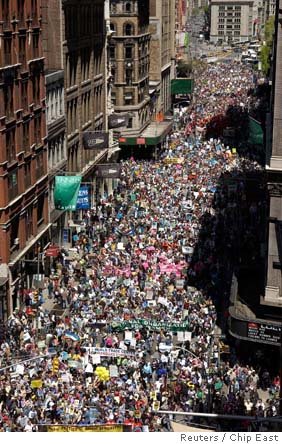
Here is what Reuters and AP calls "tens of thousands" in New York City today to protest the war:

Channel 5 Cincinnati calls this "thousands".
By Monday, the mainstream media will call this "a few dozen."
UPDATE: The organizers are estimating over 350,000 participants. Take a look at this photo that Juan Melli took at the march. Then YOU decide.
Channel 5 Cincinnati calls this "thousands".
By Monday, the mainstream media will call this "a few dozen."
UPDATE: The organizers are estimating over 350,000 participants. Take a look at this photo that Juan Melli took at the march. Then YOU decide.
The decider speaks on the role of government agencies
The Decider-in-Chief, actual quote from yesterday's Rose Garden press conference:
"...it's the role of the Federal Trade Commission to assure me that my inclination and instinct is right."
Friday, April 28, 2006
Yup, those Republicans sure know how to protect the sanctity of marriage
W00t! Maybe if it's a SEX scandal, Americans will wake the hell up.
WSJ:
Oh, and it gets better. Ken Silverstein at Harper's is reporting that
And as Justin Rood notes at TPM Muckraker, the one person who fits that description is CIA chief Porter Goss -- the same guy who now wants to crack down on Democrats at the CIA. Perhaps now we know why.
A REPUBLICAN sex scandal involving hookers and pay-to-play legislation? I'll tell you, it doesn't GET much better than this. It's almost enough to make me decide I like popcorn.
WSJ:
Federal prosecutors are investigating whether two contractors implicated in the bribery of former Rep. Randall "Duke" Cunningham supplied him with prostitutes and free use of a limousine and hotel suites, pursuing evidence that could broaden their long-running inquiry.
Besides scrutinizing the prostitution scheme for evidence that might implicate contractor Brent Wilkes, investigators are focusing on whether any other members of Congress, or their staffs, may also have used the same free services, though it isn't clear whether investigators have turned up anything to implicate others.
In recent weeks, Federal Bureau of Investigation agents have fanned out across Washington, interviewing women from escort services, potential witnesses and others who may have been involved in the arrangement. In an interview, the assistant general manager of the Watergate Hotel confirmed that federal investigators had requested, and been given, records relating to the investigation and rooms in the hotel. But he declined to disclose what the records show. A spokeswoman for Starwood Inc., Westin's parent company, said she wasn't immediately able to get information on whether the Westin Grand had been contacted by investigators.
[snip]
If investigators find that any other members of Congress or their staffs received services at so-called hospitality suites, that could help make a case that they had illegally taken action to benefit Mr. Wilkes in return for favors from him. Mr. Wilkes, his family members and his employees were heavy campaign contributors to several members of Congress. But prosecutors so far apparently haven't found any evidence that other members of Congress had been bribed.
Mr. Wade told investigators that he had knowledge only of the service being provided to Mr. Cunningham, not anyone else, and has said he doesn't know whether Mr. Wilkes may have provided prostitutes or other free entertainment to anyone besides Mr. Cunningham.
K. Lee Blalack II, Mr. Cunningham's lawyer, said, "I have no comment on that" when asked about his client's alleged use of prostitutes. Mr. Cunningham, 64 years old, currently is undergoing a routine medical evaluation at the Butner Federal Correctional Complex in North Carolina.
People close to the case said prosecutors had hoped that Mr. Wilkes, like Mr. Wade, would plead guilty and turn over information relevant to the investigation. Now that he has indicated he won't do so, prosecutors are hunting for evidence to bolster any potential case against him.
Meanwhile, prosecutors are looking at whether they can make corruption cases against other lawmakers based on Mr. Wilkes's campaign contributions to them. But lawyers expert in campaign-finance and criminal law say such cases are far more difficult to prove than those involving outright bribery. The government must show a direct "quid pro quo" that a lawmaker has taken action on a particular bill solely because of a campaign contribution.
Oh, and it gets better. Ken Silverstein at Harper's is reporting that
...those under intense scrutiny by the FBI are current and former lawmakers on Defense and Intelligence comittees—including one person who now holds a powerful intelligence post.
And as Justin Rood notes at TPM Muckraker, the one person who fits that description is CIA chief Porter Goss -- the same guy who now wants to crack down on Democrats at the CIA. Perhaps now we know why.
A REPUBLICAN sex scandal involving hookers and pay-to-play legislation? I'll tell you, it doesn't GET much better than this. It's almost enough to make me decide I like popcorn.
The Erasure of Mark Bingham
Today is the day of the collective wingnut wargasm, as they line up in droves to see United 93, a film designed to help them get their hate on with renewed vigor.
I'm still not planning to see it, for all that the reviews have been quite good. But one wingnut in particular, a female Ann Coulter wannabe, a member of the 101st Fighting Keyboarders' Ladies Auxilliary named Debbie Schlussel, seems to think we need this film to remind us of our government's response:
Actually, I agree. And here is how our government responded while 3000 innocent Americans were murdered by Islamic terrorists:
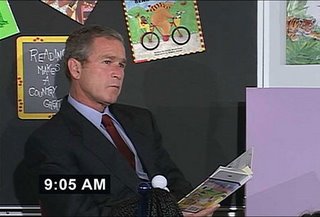
In the lore surrounding that doomed flight, there used to be FOUR names etched into the public consciousness as the ringleaders of the attempt to re-take control of the plane: Jeremy Glick, Todd Beamer, Tom Burnett, and Mark Bingham.
Take a look at the "heroes of flight 93" that Schlussel has chosen to show in her blog entry on United 93.
Notice anyone missing?
Mark Bingham is nowhere to be found.
Why do YOU think Mark Bingham is omitted from the Wingnut History of 9/11?
Go read about him. Then do the math.
I'm still not planning to see it, for all that the reviews have been quite good. But one wingnut in particular, a female Ann Coulter wannabe, a member of the 101st Fighting Keyboarders' Ladies Auxilliary named Debbie Schlussel, seems to think we need this film to remind us of our government's response:
has been almost five years since the terrorist attacks of 9/11, and most Americans have fallen back to sleep. They've forgotten who our enemy is: extremist Islam. They've forgotten why the Patriot Act was enacted. They've forgotten why it was necessary for the NSA to listen in on phone calls of Muslims in America to their friends overseas. They've forgotten why it is necessary that many Islamic charities allegedly funding hospitals and orphanages must be shut down (because as on 9/11, they fund acts and groups that continue to put people in hospitals and orphanages).
That's why "United 93" should be required movie viewing for all Americans who love freedom . . . while we still have it. This movie is the wake-up call that needs to be visited upon anyone who questions why our government responded the way it did when nearly 3,000 innocent Americans were murdered by Islamic terrorists.
Actually, I agree. And here is how our government responded while 3000 innocent Americans were murdered by Islamic terrorists:

In the lore surrounding that doomed flight, there used to be FOUR names etched into the public consciousness as the ringleaders of the attempt to re-take control of the plane: Jeremy Glick, Todd Beamer, Tom Burnett, and Mark Bingham.
Take a look at the "heroes of flight 93" that Schlussel has chosen to show in her blog entry on United 93.
Notice anyone missing?
Mark Bingham is nowhere to be found.
Why do YOU think Mark Bingham is omitted from the Wingnut History of 9/11?
Go read about him. Then do the math.
GOP to Americans: Here's a bribe of two tanks of gas. Now shut the hell up.
The Greedy Old Party doesn't have a patent on lameass proposals for dealing with skyrocketing gas prices in an election year, it just seems that way:
These guys have had a boner for ANWR for years, and the fact that it's going to take ten years to get anything out of there and even then there's only at best six months' supply seems not to occur to these guys, who like alcoholics, are looking to do something....anything....to get gasoline prices down.
But as I said, it isn't just Republicans who are being silly. Democrats aren't a whole lot better. Here in New Jersey, Gov. Corzine is channeling wingnut state Sen. Gerald Cardinale, who has been trumpeting the virtues of self-serve gasoline for years:
Now I have no beef against self-serve gas. In fact, I often pump my own even at my local corner station; mostly because the very nice man who owns it and who does the mechanical work on my Civic, is perennially short-handed at his very busy station. He knows I used to work weekends at a gas station in my 20's, he knows I live in the neighborhood and won't pump and run, and he knows I know what I'm doing. But I recently drove to North Carolina, and at every station I stopped at along the way, and also IN North Carolina, I paid more for gasoline than I pay here. So the idea that distributors are going to drop gas prices if self-serve is initiated, is preposterous.
As for the GOP proposal to hand off small bribes to offset the price of gas, well, that's perhaps the most ridiculous notion of all.
The real problem, which no one wants to address, is that oil is a finite resource and there is increasing worldwide demand for it. Back in the 1970's, we had a chance to really start weaning ourselves from oil; and indeed, the now-reviled president at the time, Jimmy Carter, recognized this need and tried to start addressing it via research into alternative energy sources and reduced consumption. As soon as Ronald Reagan took office in 1981, it was Party Like It's 1999 time, and that was the end of energy conservation. When this bunch took over in 2001, you had a vice president who insinuated that conservation was for pussies, and that real men guzzle as much gasoline as possible. After 9/11, people got the idea that the best way to thumb their noses at Osama Bin Laden was to buy the biggest, baddest, most gas-guzzling SUV possible, slap a yellow ribbon magnet on it, and proceed to dump as much cash as possible into the pockets of the Saudi oil sheikhs.
I don't like paying $3.00 for gas either; and I do think that a windfall profits tax is in order. But if $3.00 gas is what it takes to make thickheaded American Idiots™ realize that the party's over and we can either act now to make the hangover less painful or else be in for some very hard times, I'm all for it.
Senate Republicans tried on Thursday to get the upper hand in the escalating political battle over high gasoline prices by proposing a $100 rebate for taxpayers and by suggesting that they might increase taxes on oil-industry profits.
The Republican proposal also called for opening the Arctic National Wildlife Refuge to oil production, a provision sure to draw opposition from many Democrats and even some Republicans.
"The American consumer is the one that needs the break today, and we need to be taking steps to make sure that they aren't emptying their wallet every time they fill their tank," said Senator John Thune, Republican of South Dakota, as the leadership unveiled its legislative response to an issue quickly taking over the Congressional agenda.
These guys have had a boner for ANWR for years, and the fact that it's going to take ten years to get anything out of there and even then there's only at best six months' supply seems not to occur to these guys, who like alcoholics, are looking to do something....anything....to get gasoline prices down.
But as I said, it isn't just Republicans who are being silly. Democrats aren't a whole lot better. Here in New Jersey, Gov. Corzine is channeling wingnut state Sen. Gerald Cardinale, who has been trumpeting the virtues of self-serve gasoline for years:
Gov. Jon Corzine said he may consider lifting a 57-year-old law that makes the state only one of two where people can't pump their own gas.
A repeal of the ban against self-service gas stations may save consumers as much as 5 cents a gallon, said state Sen. Gerald Cardinale. Lower prices would soften the impact of a gas- tax increase, which Corzine hasn't ruled out as a way to fund road and bridge work.
''It's worthy of a debate," Corzine, a Democrat who took office in January, said last week in response to questions about eliminating the self-serve ban. ''It's certainly one of those things that one might want to pair with" a gas tax increase.
Now I have no beef against self-serve gas. In fact, I often pump my own even at my local corner station; mostly because the very nice man who owns it and who does the mechanical work on my Civic, is perennially short-handed at his very busy station. He knows I used to work weekends at a gas station in my 20's, he knows I live in the neighborhood and won't pump and run, and he knows I know what I'm doing. But I recently drove to North Carolina, and at every station I stopped at along the way, and also IN North Carolina, I paid more for gasoline than I pay here. So the idea that distributors are going to drop gas prices if self-serve is initiated, is preposterous.
As for the GOP proposal to hand off small bribes to offset the price of gas, well, that's perhaps the most ridiculous notion of all.
The real problem, which no one wants to address, is that oil is a finite resource and there is increasing worldwide demand for it. Back in the 1970's, we had a chance to really start weaning ourselves from oil; and indeed, the now-reviled president at the time, Jimmy Carter, recognized this need and tried to start addressing it via research into alternative energy sources and reduced consumption. As soon as Ronald Reagan took office in 1981, it was Party Like It's 1999 time, and that was the end of energy conservation. When this bunch took over in 2001, you had a vice president who insinuated that conservation was for pussies, and that real men guzzle as much gasoline as possible. After 9/11, people got the idea that the best way to thumb their noses at Osama Bin Laden was to buy the biggest, baddest, most gas-guzzling SUV possible, slap a yellow ribbon magnet on it, and proceed to dump as much cash as possible into the pockets of the Saudi oil sheikhs.
I don't like paying $3.00 for gas either; and I do think that a windfall profits tax is in order. But if $3.00 gas is what it takes to make thickheaded American Idiots™ realize that the party's over and we can either act now to make the hangover less painful or else be in for some very hard times, I'm all for it.
Thursday, April 27, 2006
The Madness of King George
L'état, c'est lui.
C-Plus Caligula's CIA lackey, Porter Goss, has tightened restrictions on what CIA employees, both current and retired, are allowed to say about the Lunatic-in-Chief, as long as they are contracting with the agency.
National Journal:
There was a time when respect for law and the good of the American people were supposed to be the primary concern of American presidents and their administrations. Under King George, or Der Führer, or Kommandant, or whatever you want to call the Lunatic-in-Chief, if the entire nation must be sacrified to prop him up, so be it.
We had a nice country once; one we could be proud of. And that was only a few short years ago....
C-Plus Caligula's CIA lackey, Porter Goss, has tightened restrictions on what CIA employees, both current and retired, are allowed to say about the Lunatic-in-Chief, as long as they are contracting with the agency.
National Journal:
The CIA has imposed new and tighter restrictions on the books, articles, and opinion pieces published by former employees who are still contractors with the intelligence agency. According to several former CIA officials affected by the new policy, the rules are intended to suppress criticism of the Bush administration and of the CIA. The officials say the restrictions amount to an unprecedented political "appropriateness" test at odds with earlier CIA policies on outside publishing.
The move is a significant departure from the CIA's longtime practice of allowing ex-employees to take critical or contrary positions in public, particularly when they are contractors paid to advise the CIA on important topics and to publish their assessments.
All current and former CIA employees have long been required to submit manuscripts for books, opinion pieces, and even speeches to the agency's Publications Review Board, which ensures that the works don't reveal classified information or intelligence sources and methods. The board has not generally factored political opinions into its decision-making, former CIA officials say. But in recent years, former employees have written memoirs and opinion pieces challenging the CIA and the Bush administration, particularly for its use of prewar intelligence to justify the war in Iraq. The board did not find that any of those pieces revealed secrets, a fact that makes the CIA's new review standards troubling, former officials and intelligence-community analysts said.
Many of those experts believe that public criticism provides an important source of alternative analysis -- something the CIA needs to understand terrorism, global disease, and other emerging threats. But the White House and CIA Director Porter Goss view spies-turned-authors as political liabilities who embarrass an already battered administration, former officials said.
There was a time when respect for law and the good of the American people were supposed to be the primary concern of American presidents and their administrations. Under King George, or Der Führer, or Kommandant, or whatever you want to call the Lunatic-in-Chief, if the entire nation must be sacrified to prop him up, so be it.
We had a nice country once; one we could be proud of. And that was only a few short years ago....
Blogs I wish I'd written
The problem with wishing you had more time to write better-thought-out blog entries is that nagging feeling that your wish might come true -- in the form of involuntary unemployment. With the months ticking away on my current employer's contracts and the spectre of being a 50-year-old web developer lurking in my future, Oscar Wilde's aphorism that "There are two tragedies in life: one is not getting what you want; the other is getting it" seems more true every day.
But putting the general, gnawing anxiety that chomps away at my guts every day these days aside for a few minutes, here's Glenn Greenwald, talking about the delusions that Bush supporters seem to need in order to get through their day:
That quote from the Administration about creating their own reality? They weren't kidding. The trigger for Glenn's blog entry is the insistence by Matt Drudge that Crashing the Gate, the book by Kos and Jerome Armstrong, has only sold some 3600-odd copies, despite the fact that this is a book by bloggers and not only does that number not include online sales, but Great Aunt Mary in Davenport, Iowa is unlikely to be rushing out to get the latest book by any blogger, however alpha-dog he may be in Blogistan.
The right does this with Air America Radio too, poring over Arbitron numbers like bookies at the track, trying to draw parallels between a 10,000 watt station like WLIB, whose signal goes in and out on a block-by-block basis with the 50,000 watt WABC and taking numbers out of context to "prove" that AAR is going to be dead by next week -- a claim they've been making for 2-1/2 years.
I haven't seen such silliness since the winter of 1997-1998, when all the Star Wars geeks were all up in arms because Titanic was making money hand over fist and nudging the Star Wars films down in the box office rankings -- as if any of these people were going to see a penny of the proceeds. And is there any difference between "My movie can kick your movie's ass" and "My blogger's book can kick your blogger's book's ass?"
This is probably the worst aspect to the right-wing "tell a lie often enough and loudly enough and it becomes truth" squad -- that it forces intelligent people like Glenn to devote time and energy debunking these myths about things that are relatively trivial in the larger sphere of things.
Why should it matter to Matt Drudge how many books Markos sells? For that matter, why should it matter to him how many books Glenn Greenwald sells? If facts don't matter if they don't fit into Drudge's, or another wingnuts's worldview, let them live in their little world of delusion and shut the hell up.
UPDATE: As if trying to prove Glenn right about the Bush cultists, Pat at Brainster is on a crusade to debunk Kos' claims about Crashing the Gate. And perhaps he's right, though Nielsen Bookscan doesn't say anything about online retailers on its web site.
However, let's take that 3600 and some-odd copies in context, shall we?
Two percent. That's not a whole hell of a lot of books being sold by most authors now, is it? 98% of all titles published in 2004 sold 5000 copies or less. Even if Markos and Jerome didn't sell another copy of CTG this year, they'd still be in the company of the authors of 98% of the books published through mainstream outlets every year. That hardly qualifies as "a flop", and Drudge is still full of horsepuckey.
But still -- this is the kind of head we're dealing with on the right. You can flog Air America/WLIB's 1.5 share until the cows come home but when you look at that share in context and you look at specific shows, you'll see things like Randi Rhodes beating Sean Hannity among men aged 25-54 in New York, that paints a somewhat different picture.
But I reiterate: Who the hell cares? Obviously Markos and Jerome care, but why should the rest of us care any more than we should have cared that Titanic knocked the top-grossing film crown off of Star Wars' head? The bottom line is this: the little house of cards that the Bush cultists have built around their own vestigial sanity is crumbling further every day. And they can spin all they want to -- their guy is damaged goods. He's not up to the job, he never has been, and they've been worshipping an empty suit with a codpiece for the last five years. There's help available for this kind of delusion. I suggest that all those whose sanity depends on Bush worship seek some immediately.
But putting the general, gnawing anxiety that chomps away at my guts every day these days aside for a few minutes, here's Glenn Greenwald, talking about the delusions that Bush supporters seem to need in order to get through their day:
As much as anything else, Bush defenders are characterized by an increasingly absolutist refusal to recognize any facts which conflict with their political desires, and conversely, by a borderline-religious embrace of any assertions which bolster those desires. It's a world-view which conflates desire with reality, disregards all facts and evidence that conflict with the decreed beliefs, and faithfully embraces any assertions and fantasies, no matter how baseless and flagrantly false, provided that they bolster the mythology.
Thus, things are going really great in Iraq - just as we predicted they would. When we invaded, Saddam had WMD's and he was funding Al Qaeda. Oil revenues will pay for the whole thing, we will be welcomed as liberators, the whole war will be won quickly and easily. A large military presence is unnecessary because there is no insurgency. Bush is a popular and beloved President. All but a handful of radical fringe subversives in America support the war and believe terrorism is the overarching problem. Americans want to militarily confront Iran, want illegal warrantless eavesdropping, and are happy with how the country is being governed.
It never matters how much evidence arises demonstrating the falsity of these beliefs. They are not susceptible to challenge or reconsideration because they are the by-product of faith and desire and not a critical or rational assessment. They believe these things because they want to believe them, they have to believe them, because the whole world-view on which their identity and purpose has come to be based -- the brave, heroic President leading the great conservative nation in glorious, epic war-triumph over the evil Muslim enemy -- depends upon believing these myths. No facts can shake these beliefs because they aren't grounded in facts and aren't the by-product of rationality.
[snip]
Soon after 9/11, the Bush movement became driven by much more than a set of political beliefs. It provides its adherents with much more than just a vehicle for political activism. It gives them purpose and a feeling of strength and power that they otherwise lack. In that sense, it is not dissimilar to a religion, and it is therefore unsurprising -- but nontheless ugly and destructive -- that their beliefs and convictions are not grounded in facts and reality but in a resolute faith that cannot be shaken by facts. Every event is interpreted so as to bolster the faith, facts are disregarded which undermine the faith and fact-free assertions are embraced which confirm the faith.
That quote from the Administration about creating their own reality? They weren't kidding. The trigger for Glenn's blog entry is the insistence by Matt Drudge that Crashing the Gate, the book by Kos and Jerome Armstrong, has only sold some 3600-odd copies, despite the fact that this is a book by bloggers and not only does that number not include online sales, but Great Aunt Mary in Davenport, Iowa is unlikely to be rushing out to get the latest book by any blogger, however alpha-dog he may be in Blogistan.
The right does this with Air America Radio too, poring over Arbitron numbers like bookies at the track, trying to draw parallels between a 10,000 watt station like WLIB, whose signal goes in and out on a block-by-block basis with the 50,000 watt WABC and taking numbers out of context to "prove" that AAR is going to be dead by next week -- a claim they've been making for 2-1/2 years.
I haven't seen such silliness since the winter of 1997-1998, when all the Star Wars geeks were all up in arms because Titanic was making money hand over fist and nudging the Star Wars films down in the box office rankings -- as if any of these people were going to see a penny of the proceeds. And is there any difference between "My movie can kick your movie's ass" and "My blogger's book can kick your blogger's book's ass?"
This is probably the worst aspect to the right-wing "tell a lie often enough and loudly enough and it becomes truth" squad -- that it forces intelligent people like Glenn to devote time and energy debunking these myths about things that are relatively trivial in the larger sphere of things.
Why should it matter to Matt Drudge how many books Markos sells? For that matter, why should it matter to him how many books Glenn Greenwald sells? If facts don't matter if they don't fit into Drudge's, or another wingnuts's worldview, let them live in their little world of delusion and shut the hell up.
UPDATE: As if trying to prove Glenn right about the Bush cultists, Pat at Brainster is on a crusade to debunk Kos' claims about Crashing the Gate. And perhaps he's right, though Nielsen Bookscan doesn't say anything about online retailers on its web site.
However, let's take that 3600 and some-odd copies in context, shall we?
AUTHORS struggle, mostly in vain, against their fated obscurity. According to Nielsen Bookscan, which tracks sales from major booksellers, only 2 percent of the 1.2 million unique titles sold in 2004 had sales of more than 5,000 copies.
Two percent. That's not a whole hell of a lot of books being sold by most authors now, is it? 98% of all titles published in 2004 sold 5000 copies or less. Even if Markos and Jerome didn't sell another copy of CTG this year, they'd still be in the company of the authors of 98% of the books published through mainstream outlets every year. That hardly qualifies as "a flop", and Drudge is still full of horsepuckey.
But still -- this is the kind of head we're dealing with on the right. You can flog Air America/WLIB's 1.5 share until the cows come home but when you look at that share in context and you look at specific shows, you'll see things like Randi Rhodes beating Sean Hannity among men aged 25-54 in New York, that paints a somewhat different picture.
But I reiterate: Who the hell cares? Obviously Markos and Jerome care, but why should the rest of us care any more than we should have cared that Titanic knocked the top-grossing film crown off of Star Wars' head? The bottom line is this: the little house of cards that the Bush cultists have built around their own vestigial sanity is crumbling further every day. And they can spin all they want to -- their guy is damaged goods. He's not up to the job, he never has been, and they've been worshipping an empty suit with a codpiece for the last five years. There's help available for this kind of delusion. I suggest that all those whose sanity depends on Bush worship seek some immediately.
Obsession with teen sex at the FDA
The Bush Administration has managed to politicize every single agency of the United States Government, remaking them into the image of the medieval Christofascist Zombies with whom he claims to identify.
The Food and Drug Administration's Mission Statement:
The FDA's mission is NOT to ensure female chastity. And yet that seems to be the basis on which the agency has made its decision to not allow emergency contraception to be made available over the counter:
"Sex-based cults." Urban legends. And this is what George W. Bush's FDA regards as science?
There's no doubt in my mind that these wingnuts are closet cases and pedophiles. Every last one of them. Their relentless obsession with gay sex, their equally relentless obsession with teen sex, their gleefully graphic depictions of the sex practices they attribute to others -- are all far more a reflection on what's going on in their own sick minds than on the actual practices of the people they fear and loathe so much.
The Food and Drug Administration's Mission Statement:
The FDA is responsible for protecting the public health by assuring the safety, efficacy, and security of human and veterinary drugs, biological products, medical devices, our nation’s food supply, cosmetics, and products that emit radiation. The FDA is also responsible for advancing the public health by helping to speed innovations that make medicines and foods more effective, safer, and more affordable; and helping the public get the accurate, science-based information they need to use medicines and foods to improve their health.
The FDA's mission is NOT to ensure female chastity. And yet that seems to be the basis on which the agency has made its decision to not allow emergency contraception to be made available over the counter:
Former FDA Commissioner Lester Crawford, Dr. Janet Woodcock, deputy operations commissioner, and Dr. Steven Galson, director of the FDA's drug evaluation center, are to testify in court-ordered depositions to be taken by attorneys for the Manhattan-based Center for Reproductive Rights on April 26, 27 and 28 in Washington, D.C. and Rockville, Md.
The women's group seeks to force approval of over-the-counter sales of Plan B, which can prevent pregnancy if taken within 72 hours after unprotected intercourse.
Simon Heller, one of the attorneys, plans to quiz Woodcock about a March 23, 2004, staff memo suggesting she was concerned Plan B might lead to teenage promiscuity.
The FDA is only supposed to consider the safety and efficacy of drugs.
In the memo released by the FDA during the discovery process, Dr. Curtis Rosebraugh, an agency medical officer, wrote: "As an example, she stated that we could not anticipate, or prevent extreme promiscuous behaviors such as the medication taking on an 'urban legend' status that would lead adolescents to form sex-based cults centered around the use of Plan B."
Rosebraugh indicated he found no reason to bar nonprescription sales of Plan B.
"This was the level of scientific discourse, so to speak," Heller said in a phone interview, referring to concerns attributed to Woodcock. "I find it very odd that these people who are supposed to be responsible scientists and doctors are making up wacky reasons."
"Sex-based cults." Urban legends. And this is what George W. Bush's FDA regards as science?
There's no doubt in my mind that these wingnuts are closet cases and pedophiles. Every last one of them. Their relentless obsession with gay sex, their equally relentless obsession with teen sex, their gleefully graphic depictions of the sex practices they attribute to others -- are all far more a reflection on what's going on in their own sick minds than on the actual practices of the people they fear and loathe so much.
Democrats take note
I hate to sound like a broken record, but the one thing that's made me angrier than Republicans during the last five years has been the complete unwillingness of Washington Democrats to stand up for what they believe in. From Hillary Clinton thinking she can get the anti-sex Christofascist zombies to vote for her because she has referred to abortion as "a tragedy" to John Kerry's prevarication on the Iraq war, Democrats are still laboring under the delusion that George W. Bush is some kind of colussus bestride the world.
Bob Herbert goes down the litany of Bush incompetence and Bush failures today, and exhorts Congress to finally step up to the plate and do its job:
And yet, while Republicans are trying to distance themselves from this worst president of MY lifetime (with the exception of John McCain, who in his zeal for the 2008 nomination, is doing everything short of donning a blue dress and fellating the Chimp-in-Chief in the Oval Office), Democrats are still cowering in the corner, lest Karl Rove say mean things about them.
While the increasingly marginalized Howard Dean is still quietly trying to implement a 50-state strategy and compete for every seat, Barbara Boxer, whom I usually respect, is playing to the Bob Shrum/DLC wussy-ass playbook of only fighting for the seats that she feels are "winnable", instead of believing that any seat is "winnable" with the right candidate and the right message.
What Democrats have forgotten is that many of the aspects of American life they hold dear are the product of Democrats. Public schools, worker safety rules, Social Security, environmental protection laws -- all the product of Democratic ideas. In recent years, Democrats have allowed Republicans to paint them as the party of men kissing each other and abortion (as if we were trying to make it mandatory), and have never once pointed out that while the Republicans are saying to their Bible Belt constituents, "Look! Over there! Two men are kissing!" -- they've been pulling the wallets from their constituents' pockets and giving the few pennies in there to giant corporations.
Democratic values ARE American values -- and it's about damn time that the Democrats realized that and stopped settling for the scraps from the Republican corporate groaning board. They owe it to us, the people, do start representing us. Because when they don't, and they worship at the altar of corporate cash, presidents like George W. Bush and House Majority Leaders like Tom DeLay are the result.
Bob Herbert goes down the litany of Bush incompetence and Bush failures today, and exhorts Congress to finally step up to the plate and do its job:
The nation seems, very belatedly, to be catching on to the tragic failures and monumental ineptitude of its president. Mr. Bush's poll numbers are abysmal. Republicans up for re-election are running from him as if he were the bogyman.
[snip]
In the current issue of Rolling Stone, Sean Wilentz, a distinguished historian and the director of the American Studies program at Princeton University, takes a serious look at the possibility that Mr. Bush may be the worst president in the nation's history.
What in the world took so long? Some of us have known since the moment he hopped behind the wheel that this reckless president was driving the nation headlong toward a cliff.
The worst thing he did, of course, was to employ a massive campaign of deceit to lead the nation into a catastrophic war in Iraq — a war with no end in sight that has already claimed tens of thousands of lives and inflicted scores of thousands of crippling injuries.
When he was a young man, Mr. Bush used the Air National Guard to hide out from the draft in a time of war. Then, as president, he's suddenly G. I. George, strutting around in a flight suit, threatening to wage war on all and sundry, and taunting the insurgents in Iraq with a cry of "bring them on."
[snip]
Among the complaints in the Cato study is that the Bush administration has taken the position that despite validly enacted laws to the contrary, the president cannot be restrained "from pursuing any tactic he believes to be effective in the war on terror."
This view has led to activities that I believe have brought great shame to the nation: the warrantless spying on Americans, the abuses at Abu Ghraib, the creation of the C.I.A.'s network of secret prisons, extraordinary rendition and the barbaric encampment at Guantánamo Bay, Cuba, in which detainees are held, without regard to guilt or innocence, in a nightmarish no man's land beyond the reach of any reasonable judicial process.
The sins of the Bush administration are so extensive and so egregious, they could never be adequately addressed in a newspaper column. History will be the final judge. But I've no doubt about the ultimate verdict.
Remember the Clinton budget surplus?
It was the largest in American history. President Bush and his cronies went after it like vultures feasting in a field of carcasses. They didn't invest the surplus. They devoured it.
Remember how most of the world responded with an extraordinary outpouring of sympathy and support for America in the immediate aftermath of Sept. 11?
Mr. Bush had no idea how to seize that golden opportunity to build new alliances and strengthen existing ones. Much of that solidarity with America has morphed into outright hostility.
Remember Katrina?
The major task of Congress and the voters for the remainder of the Bush presidency is to curtail the destructive impulses of this administration, and to learn the lessons that will prevent similar horrors from ever happening again.
And yet, while Republicans are trying to distance themselves from this worst president of MY lifetime (with the exception of John McCain, who in his zeal for the 2008 nomination, is doing everything short of donning a blue dress and fellating the Chimp-in-Chief in the Oval Office), Democrats are still cowering in the corner, lest Karl Rove say mean things about them.
While the increasingly marginalized Howard Dean is still quietly trying to implement a 50-state strategy and compete for every seat, Barbara Boxer, whom I usually respect, is playing to the Bob Shrum/DLC wussy-ass playbook of only fighting for the seats that she feels are "winnable", instead of believing that any seat is "winnable" with the right candidate and the right message.
What Democrats have forgotten is that many of the aspects of American life they hold dear are the product of Democrats. Public schools, worker safety rules, Social Security, environmental protection laws -- all the product of Democratic ideas. In recent years, Democrats have allowed Republicans to paint them as the party of men kissing each other and abortion (as if we were trying to make it mandatory), and have never once pointed out that while the Republicans are saying to their Bible Belt constituents, "Look! Over there! Two men are kissing!" -- they've been pulling the wallets from their constituents' pockets and giving the few pennies in there to giant corporations.
Democratic values ARE American values -- and it's about damn time that the Democrats realized that and stopped settling for the scraps from the Republican corporate groaning board. They owe it to us, the people, do start representing us. Because when they don't, and they worship at the altar of corporate cash, presidents like George W. Bush and House Majority Leaders like Tom DeLay are the result.
Wednesday, April 26, 2006
Mr. Feingold and the Bloggers
Via Glenn Greenwald and Brad Friedman comes this interesting observation at Down with Tyranny that blows the "electable" meme right out of the water:
What the Democrats don't understand is that even when people don't agree with everything a candidate says, they respect a candidate who stands for what he or she believes in. Here in the NJ 5th District, I'm working with the campaign of Camille Abate, a candidate not afraid to take a firm stand, running against a typical wishy-washy, finger-in-the-wind opponent who not only doesn't even live in the district (he's rented an apartment here solely for the purpose of running for Congress) but who seems unable to take a definitive stand on anything. And this is the party's Designated Guy.
Remember Paul Hackett's appearance on The Daily Show, where the post-consultant, de-fanged Hackett says "Some people think the President lied about the reasons for the Iraq War. I think we should look into this"? Well, I wrote Paul Aronsohn asking whether he would support holding George Bush accountable, as Russ Feingold has tried to do with his censure resolution, and his answer was:
Of course he's right about checks and balances, but the translation here is that you don't even TRY to fight any battle you're not likely to win. This certainly serves to get the Democrats off the hook for now, doesn't it? Sure -- let's just turn a blind eye to the lies into war, the domestic spying, the bunker buster test taking place in the Nevada desert in June in preparation for dropping nuclear bombs on Iran, the coziness with the energy industry, the response to Katrina, and on and on ad nauseum -- until we have a majority. Never mind that Bush's approval ratings are hovering close to the 30% line.
And this is the guy the Democrats in my county are pushing -- just more of the same.
I've seen Camille speak in front of groups, and she has the goods. She doesn't have the organization, but she has the goods. People like what she has to say. They hunger for someone to take a stand and believe in it. In my district, we have a two-term far-right Republican Congressman who is going to eat Paul Aronsohn's liver with fava beans and a nice chianti -- and then ask for seconds. And this is the party's Designated Guy.
Russ Feingold has it exactly right -- and so does Howard Dean and so does Camille Abate. And every organization of party hacks who think that the kind of weak-ass kowtowing to the wingnuts we saw out of John Kerry in 2004 is going to take back the House and Senate this fall against Republican incumbents who may find themselves going to jail if they lose the majority, they'd better guess again -- or they'll find themselves with quite a hangover on the day after Election Day.
"This administration," he told us, "doesn't know how to govern the country. But they are brilliant at intimidating Democrats." Obviously, they don't intimidate him at all. He speaks his mind because he believes in his core values and principles. Voters sense that. When Kerry, whose public perception was wishy-washy and someone with a weak value-system, squeaked by to a 10,000 vote victory in Wisconsin, Feingold's far more progressive and outspoken positions garnered him a 300,000 vote victory, despite an avalanche of right-wing money pouring into the unfathomably filthy campaign against him. But it wasn't really about the policy positions per se. It was about the man and how he makes decisions and what he's made of.
What the Democrats don't understand is that even when people don't agree with everything a candidate says, they respect a candidate who stands for what he or she believes in. Here in the NJ 5th District, I'm working with the campaign of Camille Abate, a candidate not afraid to take a firm stand, running against a typical wishy-washy, finger-in-the-wind opponent who not only doesn't even live in the district (he's rented an apartment here solely for the purpose of running for Congress) but who seems unable to take a definitive stand on anything. And this is the party's Designated Guy.
Remember Paul Hackett's appearance on The Daily Show, where the post-consultant, de-fanged Hackett says "Some people think the President lied about the reasons for the Iraq War. I think we should look into this"? Well, I wrote Paul Aronsohn asking whether he would support holding George Bush accountable, as Russ Feingold has tried to do with his censure resolution, and his answer was:
We desperately need accountability in Washington, and to that end, we need to restore a system of checks and balances. The best way to do that is by putting the Democrats in the majority in one or both houses. Then -- and only then -- will we be able to look into the Bush Administration's many transgressions, such as with respect to the war in Iraq, the leaking of classified information, and the use of warrantless wiretaps.
Of course he's right about checks and balances, but the translation here is that you don't even TRY to fight any battle you're not likely to win. This certainly serves to get the Democrats off the hook for now, doesn't it? Sure -- let's just turn a blind eye to the lies into war, the domestic spying, the bunker buster test taking place in the Nevada desert in June in preparation for dropping nuclear bombs on Iran, the coziness with the energy industry, the response to Katrina, and on and on ad nauseum -- until we have a majority. Never mind that Bush's approval ratings are hovering close to the 30% line.
And this is the guy the Democrats in my county are pushing -- just more of the same.
I've seen Camille speak in front of groups, and she has the goods. She doesn't have the organization, but she has the goods. People like what she has to say. They hunger for someone to take a stand and believe in it. In my district, we have a two-term far-right Republican Congressman who is going to eat Paul Aronsohn's liver with fava beans and a nice chianti -- and then ask for seconds. And this is the party's Designated Guy.
Russ Feingold has it exactly right -- and so does Howard Dean and so does Camille Abate. And every organization of party hacks who think that the kind of weak-ass kowtowing to the wingnuts we saw out of John Kerry in 2004 is going to take back the House and Senate this fall against Republican incumbents who may find themselves going to jail if they lose the majority, they'd better guess again -- or they'll find themselves with quite a hangover on the day after Election Day.
United 93 opens Friday. Are you going to see it?
It's movies like United 93 that make me glad I decided to slack off of movie reviews until and unless I feel truly inspired. If I were still dedicated to reviewing all of the Important Openings, I'd feel obligated to see it. But I plan to pass this one by.
For one thing, I'm afraid to fly under the best of circumstances. I still vividly remember one particularly bad landing in 50 mph crosswinds at Newark Airport, while our Air Jamaica pilot (who for my money are some of the best in the business) explained how he was "trying to get a better runway". This flight involved 3 abortive landings before we finally touched down. When Mr. Brilliant is white as a sheet and passengers are actually using the barf bags, you know it's bad. Then there was the time when a flight to Raleigh-Durham got below the fog level before the landing gear was down -- and you could read the numbers on the runway. Usually I rely on the reactions of other passengers -- and that time I saw fear on everyone's face.
It's only been in the last year or so that I can fly without feeling utter, well, terror.
I'm also not one to stop and rubberneck at car accidents either, though I understand most people do. And I think it's that instinct that's going to make people pay money to watch a plane full of doomed people -- people we've come to know via their families and the many news reports that followed the 9/11 attacks -- try in vain to save their own lives.
I'm perfectly willing to see movies that make me think, or that make me feel. But I for one don't feel I need to experience 9/11 all over again, no matter how expertly and tastefully it's handled.
What about you?
For one thing, I'm afraid to fly under the best of circumstances. I still vividly remember one particularly bad landing in 50 mph crosswinds at Newark Airport, while our Air Jamaica pilot (who for my money are some of the best in the business) explained how he was "trying to get a better runway". This flight involved 3 abortive landings before we finally touched down. When Mr. Brilliant is white as a sheet and passengers are actually using the barf bags, you know it's bad. Then there was the time when a flight to Raleigh-Durham got below the fog level before the landing gear was down -- and you could read the numbers on the runway. Usually I rely on the reactions of other passengers -- and that time I saw fear on everyone's face.
It's only been in the last year or so that I can fly without feeling utter, well, terror.
I'm also not one to stop and rubberneck at car accidents either, though I understand most people do. And I think it's that instinct that's going to make people pay money to watch a plane full of doomed people -- people we've come to know via their families and the many news reports that followed the 9/11 attacks -- try in vain to save their own lives.
I'm perfectly willing to see movies that make me think, or that make me feel. But I for one don't feel I need to experience 9/11 all over again, no matter how expertly and tastefully it's handled.
What about you?
Where is Bill Frist now?
Funny how the "Terri [Schiavo] Wants to Live!" crowd is nowhere to be found here:
Now that we know the Schiavo circus didn't have the effect that Congressional Republicans and George Bush wanted, suddenly the "presumption in favor of life" no longer applies.
The countdown has begun on the life of Andrea Clark, a patient at St. Luke's Hospital.
Six days left.
No, she's not terminal, her family says and she's not brain dead. Her sisters say that she wants to live. The Houston hospital is going to unilaterally remove a woman from life support, apparently based on the decision of a lone physician even though her family wants her to continue to receive care.
The central issue in the Andrea Clark case is the same as that in the Terri Schindler Schiavo case, whether the state should be able to sanction the removal of a human being from life support.
What's even more significant in the Clark case is that the Texas bill that allows health care providers to end a human life despite the wishes of the patient and the patient's family was signed into law in 1999 by President George W. Bush as Texas Governor. However, in 2005, he rushed back to the White House from Easter vacation to sign a bill rushed through Congress which was designed to save the life of Terri Schiavo because of his "presumption in favor of life".
The hospital's ethics committee has apparently decided they don't want Andrea Clark to receive care anymore, saying its futile, and has recommended that she be removed from life support despite her family's wishes. If her family can't find another hospital to transfer her to by Sunday, April 30, she will be removed from her respirator and dialysis and die.
Andrea Clark, 54, has been a heart patient at the hospital since November. In January, she underwent open heart surgery and in February, she developed bleeding on the brain.
Now that we know the Schiavo circus didn't have the effect that Congressional Republicans and George Bush wanted, suddenly the "presumption in favor of life" no longer applies.

American Idiot of the Day
And the award goes to.....
This freeper, quoted at Pam's House Blend:
What on earth are they teaching people over at Fox News?
This freeper, quoted at Pam's House Blend:
I can't wait until the Republicans control the Presidency, the House and the Senate. Then they will change the way that the ACLU not only sues to destroy the fabric of our society, but they get paid from the govt coffers for doing it. Just you wait, the things that the libs have done to the system over the years will be returned to balance.
What on earth are they teaching people over at Fox News?
The Revenge of Ozone Man
MoDo:
Uh....actually, no we don't. In fact, if the American diet became a bit less cornified and if they took some of that corn used to make high fructose corn syrup and made ethanol, we might drop fuel prices a bit...were it not for the fact that it takes more energy in the form of fossil fuels to produce ethanol -- or biodiesel from soybean and sunflower plants -- than is generated. But let's continue....
Last night I put 7.6 gallons of gasoline into our 2001 Honda Civic and gave the station attendant two tens, a single, and three quarters. It used to cost me 10 bucks for just over a half-tank of gas. Now, I drive nine miles each way to work, and Mr. Brilliant was laid off recently, we we aren't a high-use household at the moment. And frankly, I have zero sympathy for SUV drivers complaining about high gas prices. It's not unlike the Iraq War argument, If I knew there were no weapons of mass destruction in Iraq, why didn't John Kerry? Anyone with half a brain should have known that if demand for oil is increasing worldwide, and you combine that with a secretive energy panel convened at this Administration's inception and the close ties this Administration has with Big Oil, it's not hard to do the math.
It seems that every time there's a price spike like this, the price then drops to a level above the level we had become used to paying. So if we became accustomed to paying $2.39, and now gas is $3.02, the next time the price drops it'll settle down around $2.45 -- and so on. So little by little, we get used to paying a higher price -- enough so that Ford and GM can continue to lumber along making Excursions and Blazers, and idiotic Americans who insist they need to drive on New Jersey's highways in what are essentially armored vehicles will continue to buy them -- and then scream bloody murder when the price of gasoline goes up. But they will buy them, and they will pay the gas prices, and there will be NO outcry at all for alternative energy sources.
Because Americans have come to believe that cheap (relatively speaking) gasoline is somehow our birthright. And if we have to kill a few hundred thousand or million people in the Middle East, along with a few thousand of our own citizens, they're willing to pay the price. After the 9/11 attacks, Bill Maher published a book called When you Drive Alone, you Ride with Bin Laden. Somehow we've forgotten the connection between our thirst for petroleum and the very regimes in the Middle East we're fighting. It is not "our oil", and yes, it is under "their sand." And if we had a half a brain in our collective heads, we'd demand a Manhattan Project for energy independence -- one which would simultaneously do something about our dependence on oil AND global warming.
It's taken over five years, but George W. Bush finally made a concession speech to Al Gore.
He conceded that America needs to conserve, by buying hybrid vehicles and developing new energy sources.
Trying to calm the yips in his party and the country over exploding gasoline prices, the president sounded a bit like a wild-eyed Ozone Man himself yesterday, extolling the virtues of alternative fuel derived from cooking grease, sugar, grass, wood chips, soybean oil and corn.
But then he got ahold of himself. "You just got to recognize there are limits to how much corn can be used for ethanol," he said, standing in front of a bucolic mural. "After all, we got to eat some."
Uh....actually, no we don't. In fact, if the American diet became a bit less cornified and if they took some of that corn used to make high fructose corn syrup and made ethanol, we might drop fuel prices a bit...were it not for the fact that it takes more energy in the form of fossil fuels to produce ethanol -- or biodiesel from soybean and sunflower plants -- than is generated. But let's continue....
You could run a fleet of S.U.V.'s on the gas that W. was spewing about fuel. Bill Clinton would have been more likely to crack down on fast food than W. and Dick Cheney would be to crack down on Big Oil.
Even the usually supportive Wall Street Journal editorial page chastised Republicans for putting on "Chuck Schumer and Nancy Pelosi fright wigs" to shout about corporate greed and market manipulation.
W.'s big move was to ever so slightly beef up a federal investigation into oil company price manipulation that's been under way since Katrina. "It's a great idea," said the Democratic leader, Senator Harry Reid. "So good that we passed a law last year calling for that."
Price manipulation could explain the marginal — why gas went from, say, $2.70 to $2.90 — but not why gas went from $1.40 to $2.70. That's more about fundamental forces: Chinese and Indian demand, markets spooked by Iran's threats, Nigeria's unrest, Venezuela's talk of nationalizing its oil industry, and the Pentagon's bungling of the restoration of Iraq's infrastructure.
Gasoline prices may be hurting average folks, but the oilers who helped put the Boy King and the Duke of Halliburton in office with lavish donations are enjoying record profits and breathtaking bonuses.
The Oilmen in the Oval, incompetent in so many ways, have brilliantly achieved one of their main objectives: boosting the fortunes of the oil industry and the people who run it.
All those secret meetings the vice president had back in 2001, letting the energy and oil big shots help write our energy policy — one that urged more oil and gas drilling — worked like a charm. In all their years in government, Mr. Cheney and the Bushes have never done anything to hold the oil companies' feet to the fire, or get Americans' feet off the gas pedal.
Last night I put 7.6 gallons of gasoline into our 2001 Honda Civic and gave the station attendant two tens, a single, and three quarters. It used to cost me 10 bucks for just over a half-tank of gas. Now, I drive nine miles each way to work, and Mr. Brilliant was laid off recently, we we aren't a high-use household at the moment. And frankly, I have zero sympathy for SUV drivers complaining about high gas prices. It's not unlike the Iraq War argument, If I knew there were no weapons of mass destruction in Iraq, why didn't John Kerry? Anyone with half a brain should have known that if demand for oil is increasing worldwide, and you combine that with a secretive energy panel convened at this Administration's inception and the close ties this Administration has with Big Oil, it's not hard to do the math.
It seems that every time there's a price spike like this, the price then drops to a level above the level we had become used to paying. So if we became accustomed to paying $2.39, and now gas is $3.02, the next time the price drops it'll settle down around $2.45 -- and so on. So little by little, we get used to paying a higher price -- enough so that Ford and GM can continue to lumber along making Excursions and Blazers, and idiotic Americans who insist they need to drive on New Jersey's highways in what are essentially armored vehicles will continue to buy them -- and then scream bloody murder when the price of gasoline goes up. But they will buy them, and they will pay the gas prices, and there will be NO outcry at all for alternative energy sources.
Because Americans have come to believe that cheap (relatively speaking) gasoline is somehow our birthright. And if we have to kill a few hundred thousand or million people in the Middle East, along with a few thousand of our own citizens, they're willing to pay the price. After the 9/11 attacks, Bill Maher published a book called When you Drive Alone, you Ride with Bin Laden. Somehow we've forgotten the connection between our thirst for petroleum and the very regimes in the Middle East we're fighting. It is not "our oil", and yes, it is under "their sand." And if we had a half a brain in our collective heads, we'd demand a Manhattan Project for energy independence -- one which would simultaneously do something about our dependence on oil AND global warming.
Tuesday, April 25, 2006
Here's why the oil companies are hiking the price of gasoline
Sure, part of it is so that EVERY executive in the industry can be as fat and happy as Lee Raymond....but there's another benefit:
So next time your neighbor complains that his kid had a bad asthma attack last night because the air quality was so bad, point to his Ford Excursion and ask him if being able to play Biggest Dickus with everyone else on the road is really worth it.
President Bush on Tuesday ordered a temporary suspension of environmental rules for gasoline, making it easier for refiners to meet demand and possibly dampen prices at the pump. He also halted for the summer the purchase of crude oil for the government's emergency reserve.
[snip]
Easing the environment rules will allow refiners greater flexibility in providing oil supplies since they will not have to use certain additives such as ethanol to meet clean air standards. The suspension of oil purchases for the federal emergency oil reserve is likely to have only modest impact since relative little extra oil will be involved.
So next time your neighbor complains that his kid had a bad asthma attack last night because the air quality was so bad, point to his Ford Excursion and ask him if being able to play Biggest Dickus with everyone else on the road is really worth it.
Partisan witchhunts at the CIA?
Not only does it appear that CIA agent Mary McCarthy isn't the she-devil solely responsible for Bush's 32% approval rating that the drooling, slobbering wingnut blogosphere would have you believe, but David Corn has noticed an interesting tidbit pulled from Sunday's Washington Post story on McCarthy's arrest:
I guess being anything other than a good, loyal brownshirt Republican makes you a national security threat in George W. Bush's America.
(cross-posted at Spiiderweb)
Even the agency's employment policies have changed: Applicants are now asked more aggressively whether they have any friends in the news media, several agency employees said. And the hurdles to making public statements persist for those who have left: Former CIA agents report that the agency's process for reviewing what they write about current events has recently become lengthier and more difficult.
The White House also has recently barraged the agency with questions about the political affiliations of some of its senior intelligence officers, according to intelligence officials.
I guess being anything other than a good, loyal brownshirt Republican makes you a national security threat in George W. Bush's America.
(cross-posted at Spiiderweb)
This is the point at which I stop flying
Nothing says comfort like standing for four hours on a plane:
I don't know about you, but I'm not into bondage, and the idea of being strapped to a backboard and held in with a harness is just a bit too Hannibal Lecter for my taste.
Apologies to my far-flung family members, but when it gets to this point, you'll have to live with phone and e-mail, thank you very much.
Snakes on a plane indeed.
The airlines have come up with a new answer to an old question: How many passengers can be squeezed into economy class?
A lot more, it turns out, especially if an idea still in the early stage should catch on: standing-room-only "seats."
Airbus has been quietly pitching the standing-room-only option to Asian carriers, though none have agreed to it yet. Passengers in the standing section would be propped against a padded backboard, held in place with a harness, according to experts who have seen a proposal.
I don't know about you, but I'm not into bondage, and the idea of being strapped to a backboard and held in with a harness is just a bit too Hannibal Lecter for my taste.
Apologies to my far-flung family members, but when it gets to this point, you'll have to live with phone and e-mail, thank you very much.
Snakes on a plane indeed.
Libertarian hippies
Now I know that the world is about to come to an end. John Tierney takes a break from musing on how women really want to be subservient to men to actually make sense about the FDA's ridiculous positions on marijuana and pseudoephedrine:
I'm not sure why marijuana is so frightening to politicians. It has been so as long as I've been alive. Now, lest the DEA decide that it's time to do a "sneak and peek" in my house, let me advise them that they'd be wasting their time; there's absolutely no reefer, pot, gage, or jive in my house, nor has there been for years. But one does not have to be an active partaker to realize that the government's position on marijuana is completely untenable.
Here's an administration that in June 2004 announced a plan to screen the entire U.S. population for mental illness ("mental illness" presumably defined as "Disagreeing With Anything We Want To Do To Screw You Over") and put everyone diagnosed with anything on the DSM-IV list on medication:
Except that TMAP was founded in 1995 as an alliance of individuals from the pharmaceutical industry, the University of Texas, and the mental health and corrections systems of Texas and was funded by a Robert Wood Johnson grant and by drug companies.
And therein lies the problem: Marijuana can be grown just about anywhere, and if legal, could be free. And that flies in the face of an entire industry. And corporations must be protected at all costs.
So there's your motivation for the DEA insisting for the last 40 years that marijuana has no legitimate use.
The Sudafeds of Mass Destruction issue is even more ridiculous. I use Benadryl for hayfever. The active ingredient is diphenhydramine, which is not even RELATED to pseudoephedrine. Diphenhydramine is an antihistamine. Psuedoephedrine is a decongestant. And yet, I can't seem to find the 100-capsule bottles of Benadryl anymore. I guess here in NJ, anything with "ine" at the end of its name is regarded as "it's all the same to me."
If you have a cold and go to your local Eckerd or any other pharmacy, you're now greeted with an ominous-looking sign which tells you that by order of the Department of Homeland Security, you now have to go to the pharmacy counter and wait in line behind 27 people before you can get a box of 24 Sudafed tablets. And you may only buy them one at a time.
Are there people who use Sudafed to make meth? Certainly. How many of them are there, vs. the number of people who just need to get to work even though they have head colds? I understand the Doctrine of The Assholes Ruin It For Everyone, but this is ridiculous.
Washington's latest prescription for patients in pain is the statement issued last week by the Food and Drug Administration on the supposed evils of medical marijuana. The F.D.A. is being lambasted, rightly, by scientists for ignoring some evidence that marijuana can help severely ill patients. But it's the kind of statement given by a hostage trying to please his captors, who in this case are a coalition of Republican narcs on Capitol Hill, in the White House and at the Drug Enforcement Administration.
They've been engaged in a long-running war to get the F.D.A. to abandon some of its quaint principles, like the notion that it's not fair to deny a useful drug to patients just because a few criminals might abuse it. The agency has also dared to suggest that there should be a division of labor when it comes to drugs: scientists and doctors should figure out which ones work for patients, and narcotics agents should catch people who break drug laws.
The drug cops want everyone to share their mission. They think that doctors and pharmacists should catch patients who abuse painkillers — and that if the doctors or pharmacists aren't good enough detectives, they should go to jail for their naïveté.
This month, pharmacists across the country are being forced to lock up another menace to society: cold medicine. Allergy and cold remedies containing pseudoephedrine, a chemical that can illegally be used to make meth, must now be locked behind the counter under a provision in the new Patriot Act.
Don't ask what meth has to do with the war on terror. Not even the most ardent drug warriors have been able to establish an Osama-Sudafed link.
The F.D.A. opposed these restrictions for pharmacies because they'll drive up health care costs and effectively prevent medicine from reaching huge numbers of people (Americans suffer a billion colds per year). These costs are undeniable, but it's unclear that there are any net benefits.
In states that previously enacted their own restrictions, the police report that meth users simply switched from making their own to buying imported drugs that were stronger — and more expensive, so meth users commit more crimes to pay for their habit.
The Sudafed law gives you a preview of what's in store if Representative Frank Wolf, a Virginia Republican, succeeds in giving the D.E.A. a role in deciding which new drugs get approved. So far, despite a temporary success last year, he hasn't been able to impose this policy, but the F.D.A.'s biggest fear is that Congress will let the drug police veto new medications. In that case, who would ever develop a better painkiller? The benefits to patients would never outweigh the potential inconvenience to the police.
Officially, the D.E.A. says it wants patients to get the best medicine. But look at what it's done to scientists trying to study medical marijuana. They've gotten approval for their experiments from the F.D.A., but they can't get the high-quality marijuana they need because the D.E.A. won't allow it to be grown. The F.D.A. actually wants to know if the drug works, but the D.E.A. is following the just-say-know-nothing strategy: as long as researchers can't study marijuana, they can't come up with evidence that it's effective.
And as long as there's no conclusive evidence that medical marijuana works, the D.E.A. and its allies on Capitol Hill can go on blindly fighting it.
I'm not sure why marijuana is so frightening to politicians. It has been so as long as I've been alive. Now, lest the DEA decide that it's time to do a "sneak and peek" in my house, let me advise them that they'd be wasting their time; there's absolutely no reefer, pot, gage, or jive in my house, nor has there been for years. But one does not have to be an active partaker to realize that the government's position on marijuana is completely untenable.
Here's an administration that in June 2004 announced a plan to screen the entire U.S. population for mental illness ("mental illness" presumably defined as "Disagreeing With Anything We Want To Do To Screw You Over") and put everyone diagnosed with anything on the DSM-IV list on medication:
Bush established the New Freedom Commission on Mental Health in April 2002 to conduct a "comprehensive study of the United States mental health service delivery system." The commission issued its recommendations in July 2003. Bush instructed more than 25 federal agencies to develop an implementation plan based on those recommendations.
The president's commission found that "despite their prevalence, mental disorders often go undiagnosed" and recommended comprehensive mental health screening for "consumers of all ages," including preschool children. According to the commission, "Each year, young children are expelled from preschools and childcare facilities for severely disruptive behaviours and emotional disorders." Schools, wrote the commission, are in a "key position" to screen the 52 million students and 6 million adults who work at the schools.
The commission also recommended "Linkage [of screening] with treatment and supports" including "state-of-the-art treatments" using "specific medications for specific conditions." The commission commended the Texas Medication Algorithm Project (TMAP) as a "model" medication treatment plan that "illustrates an evidence-based practice that results in better consumer outcomes."
Dr Darrel Regier, director of research at the American Psychiatric Association (APA), lauded the president's initiative and the Texas project model saying, "What's nice about TMAP is that this is a logical plan based on efficacy data from clinical trials."
He said the association has called for increased funding for implementation of the overall plan.
Except that TMAP was founded in 1995 as an alliance of individuals from the pharmaceutical industry, the University of Texas, and the mental health and corrections systems of Texas and was funded by a Robert Wood Johnson grant and by drug companies.
And therein lies the problem: Marijuana can be grown just about anywhere, and if legal, could be free. And that flies in the face of an entire industry. And corporations must be protected at all costs.
So there's your motivation for the DEA insisting for the last 40 years that marijuana has no legitimate use.
The Sudafeds of Mass Destruction issue is even more ridiculous. I use Benadryl for hayfever. The active ingredient is diphenhydramine, which is not even RELATED to pseudoephedrine. Diphenhydramine is an antihistamine. Psuedoephedrine is a decongestant. And yet, I can't seem to find the 100-capsule bottles of Benadryl anymore. I guess here in NJ, anything with "ine" at the end of its name is regarded as "it's all the same to me."
If you have a cold and go to your local Eckerd or any other pharmacy, you're now greeted with an ominous-looking sign which tells you that by order of the Department of Homeland Security, you now have to go to the pharmacy counter and wait in line behind 27 people before you can get a box of 24 Sudafed tablets. And you may only buy them one at a time.
Are there people who use Sudafed to make meth? Certainly. How many of them are there, vs. the number of people who just need to get to work even though they have head colds? I understand the Doctrine of The Assholes Ruin It For Everyone, but this is ridiculous.
Monday, April 24, 2006
&#$&%(*&#% Blogger!!
Blogger was completely verkockteh for most of the day....hence the late postings with the early timestamps.
I'll be cross-posting at Spiiderweb for the next few days too, so give Spiidey some love while you're there.
I'll be cross-posting at Spiiderweb for the next few days too, so give Spiidey some love while you're there.
What do YOU think?
If there is another terrorist attack on the U.S. in advance of the November elections, what do you think the reaction of the majority of Americans will be? Will they rally behind the President, or has he lost too much credibility? Will they blame him for the failure of his so-called war on terror? Will they accept or even DEMAND more of a police state under the guise of "keeping us safe"? And what will be the effect on the November election....will there even be one?
What do YOU think?
What do YOU think?
So what if he's seen Kenneth Branagh as Henry V too many times?
This is still the kind of stuff of which God knows the Bush twins are NOT made:
There may be valid reasons to want to keep him away from the front lines, but that "the spare" doesn't regard himself as being exempt or special just because he's third in line to the British throne is something the booze-swilling Bush girls could learn from.
Prince Harry has threatened to quit the Army if commanders refuse to send him to the front line.
He told senior officers before recently passing out of Sandhurst as a Second Lieutenant: "If I am not allowed to join my unit in a war zone, I will hand in my uniform."
Harry, 21, and third in line to the throne, has previously talked of his desire to see action with his comrades and the prospect of him walking out on the Army if he is not allowed on to the front line has turned a theoretical problem into a nightmare for the Palace and Ministry of Defence.
The embarrassment for the Army caused by him quitting would be matched by uproar at the notion that while ordinary citizens are allowed to that their main problem is not whether Harry can take the pressure of coming under fire in action – but whether the lives of the men fighting alongside him will be more at risk because he is regarded as a ‘trophy target’ by insurgents.
One experienced commander said: "Second Lt Wales will, as far as is possible, be treated like any other officer but there has to be a line drawn as to whether the men he leads might experience extra danger due to his presence. Decisions will be taken by commanding officers based on an accurate risk assessment at the time."
In talks between the MoD and Clarence House, it has been suggested that if Harry is deployed to the front line he should be given a safe role, acting as a liaison officer at a military HQ well away from the action.
But sources close to Harry said last night: "He will go bananas if he is given special treatment. He doesn’t want to let the rest of the lads and lasses down by opting out. He was always the first to volunteer on exercises."
There may be valid reasons to want to keep him away from the front lines, but that "the spare" doesn't regard himself as being exempt or special just because he's third in line to the British throne is something the booze-swilling Bush girls could learn from.
A weather warning from Down Under
The second Category 5 tropical cyclone in a month is about to hit Australia:
Now imagine what is going to happen if the Gulf Coast, or Florida's Atlantic coast, gets hit by two Cat. 5 storms this year......
A severe tropical cyclone headed for the northern Australian city of Darwin, wiped out in a direct hit by a storm in 1974, but weather officials believe it will weaken as it crosses land on Monday or Tuesday.
Cyclone Monica, a slow-moving maximum category-five tropical storm, buffeted Aboriginal communities on the western shores of the Gulf of Carpentaria on Sunday night and halted production at an alumina refinery.
Monica, with winds gusting at 350 kph (220 mph), was about 520 km (320 miles) northeast of the tropical city of Darwin on Monday, the Bureau of Meteorology said.
It said the storm was expected to cross the coast later on Monday and reach the Darwin area by Tuesday afternoon.
"The cyclone is then expected to weaken slightly as it passes over the Cobourg Peninsula ... but will still be a severe tropical cyclone," said the bureau.
[snip]
Cyclone Monica is of similar intensity to Cyclone Larry, which caused at least A$250 million ($185 million) in damage when it hit the Queensland coast around Innisfail last month, smashing houses and destroying banana crops.
Now imagine what is going to happen if the Gulf Coast, or Florida's Atlantic coast, gets hit by two Cat. 5 storms this year......
I am not interested in what John Kerry has to say
I am really sick and tired of Democrats who say all the right things -- when it doesn't matter.
I'm not climbing aboard the Al Gore in 2008 bandwagon because I don't trust him to be as passionate about global warming once the consultants and pollsters get hold of him. And I certainly am not interested in what John Kerry has to say about the war in Iraq -- not after he gave an impassioned speech about being careful about going to war -- and then voted for the Iraq War resolution anyway. John Kerry of all people should have known what the deal was -- and instead he stuck his finger in the air and decided to take the easy way out by voting to give a numbskull like George W. Bush the authority to go to war in Iraq for no damn good reason at all.
But talk he is, as Bob Herbert reports, presumably because he seems to think we're going to give him another chance in 2008:
Remember, folks....this is a guy who took his $14 million in leftover campaign cash and went home even as his running mate was insisting that every vote in Ohio should be counted. John Kerry has lost his credibility forever. He voted for this war. He voted for this war WHEN HE KNEW BETTER. And he has a lot of nerve asking us, 2500 American bodies later, to take him seriously on this issue.
I'm not climbing aboard the Al Gore in 2008 bandwagon because I don't trust him to be as passionate about global warming once the consultants and pollsters get hold of him. And I certainly am not interested in what John Kerry has to say about the war in Iraq -- not after he gave an impassioned speech about being careful about going to war -- and then voted for the Iraq War resolution anyway. John Kerry of all people should have known what the deal was -- and instead he stuck his finger in the air and decided to take the easy way out by voting to give a numbskull like George W. Bush the authority to go to war in Iraq for no damn good reason at all.
But talk he is, as Bob Herbert reports, presumably because he seems to think we're going to give him another chance in 2008:
Saturday was the 35th anniversary of John Kerry's appearance as a young Vietnam veteran before the Senate Foreign Relations Committee. During his testimony, Mr. Kerry called for an end to the war in Vietnam and famously inquired: "How do you ask a man to be the last man to die for a mistake?"
He marked the occasion Saturday with an important and moving speech before an audience crammed into historic Faneuil Hall. The speech took on even more poignancy as it became known over the weekend that at least eight more American G.I.'s had been killed in Iraq.
I've felt all along that Democratic politicians, including Senator Kerry, have hurt themselves with their muddled messages on Iraq. Most elected Democrats have been petrified almost to the point of paralysis by their fear of being seen as soft on national security. So they've acquiesced to one degree or another in a war that in their heads and in their hearts they knew was wrong.
In his speech on Saturday, Senator Kerry, who voted to authorize the use of force in Iraq, gave the impression of a man who had found a voice he'd been seeking through trial and error for a long time, perhaps since that springtime day in Richard Nixon's Washington in 1971.
"I believed then," he said, "just as I believe now, that the best way to support the troops is to oppose a course that squanders their lives, dishonors their sacrifice and disserves our people and our principles."
He repeated his call for a complete withdrawal of American combat troops from Iraq by the end of this year, and offered an uncompromising defense of the right of all Americans — including retired generals — to engage in "untrammeled debate and open dissent" on the war.
"I come here today," he said, "to affirm that it is both a right and an obligation for Americans to disagree with a president who is wrong, a policy that is wrong and a war in Iraq that weakens the nation."
He described the war as "rooted in deceit and justified by continuing deception." And in a comparison with Vietnam, he said it is time now to get past "the blindness and cynicism" of political leaders who would continue to send "brave young Americans to be killed or maimed" in a war that the country had come to realize was a mistake.
By the time he testified in 1971, he said, "it was clear to me that hundreds of thousands of soldiers, sailors, marines and airmen — disproportionately poor and minority Americans — were being sent into the valley of the shadow of death for an illusion privately abandoned by the very men who kept sending them there."
(In a private discussion, Mr. Kerry and I talked about the many thousands of American G.I.'s who were killed in Vietnam after it had become widely known that victory would not be achieved. Barry Zorthian, the public information officer for U.S. forces in Vietnam in the mid-1960's, has noted that American losses nearly doubled between 1969 and the end of the war. He was never convinced, he said, that "those last 25,000 casualties were justified.")
Mr. Kerry also warned against allowing the war and the fear of terror to change the character of the United States. He received a standing ovation when he said, "The most dangerous defeatists, the most dispiriting pessimists, are those who invoke September 11th to argue that our traditional values are a luxury we can no longer afford."
In an interview after the speech, I asked Mr. Kerry about the secret prisons being run by the C.I.A. and the practice of extraordinary rendition, in which terror suspects are abducted by the U.S. and sent off to regimes skilled in the art of torture.
He said he believed these policies were violations of the Geneva Conventions, then added: "But the more important thing is that they are violations of our values, violations of our principles. Who are we to run around the world saying protect the Falun Gong or somebody else's right to speak out, and then we're willing to take people without knowledge of [guilt or] innocence and throw them into torture situations. I think that's reprehensible."
Remember, folks....this is a guy who took his $14 million in leftover campaign cash and went home even as his running mate was insisting that every vote in Ohio should be counted. John Kerry has lost his credibility forever. He voted for this war. He voted for this war WHEN HE KNEW BETTER. And he has a lot of nerve asking us, 2500 American bodies later, to take him seriously on this issue.
There is no tipping point
For the last three years, people on the left have looked at every Bush scandal and said, "This is the one. This one will be the tipping point. This is the one that will make the whole house of cards come tumbling down." And it never happens. I think the reason for this is sheer volume -- when you have an Administration that is as evil, and as corrupt as the Bush Junta, they go beyond the average American's ability to suspend disbelief. Americans want to believe that while their leaders make mistakes, they are basically good, well-meaning people. To believe that your government is evil by design is to have to do something about it. And most Americans are more concerned with who will win American Idol this week -- it's just much easier.
And that is why the revelations by retired CIA officer Tyler Drumheller on 60 Minutes last night won't mean a thing, for all that they were damning:
This is pretty damning stuff, because it shows that the LACK of WMD made going to war that much safer -- and rather than calming the warflogging in the Administration, it made the Bushistas even MORE determined to go to war -- just the way a bully picks on the weakest kid on the playground.
So why isn't this confirmation of the fact that the Bush Administration was determined to go to war no matter what the facts were a tipping point? As Josh Marshall explains, it's because this "explosive" revelation should never have been explosive -- if the Congressional committees who are supposed to provide oversight had been doing their job instead of covering for the Administration:
It isn't just the Administration. What we have is a massive deception and cover-up not just by the President, but by both houses of Congress and the press. To that extent, the Bush Administration aide cited in Ron Suskind's 2004 New York Times article said,
...he was right. They have created their own reality. It's a reality in which they can do whatever they want, and no one -- not Congress, not the Democrats, not the press, not the American people -- will hold them accountable for their actions.
And that is why the revelations by retired CIA officer Tyler Drumheller on 60 Minutes last night won't mean a thing, for all that they were damning:
Meanwhile, the CIA had made a major intelligence breakthrough on Iraq’s nuclear program. Naji Sabri, Iraq’s foreign minister, had made a deal to reveal Iraq’s military secrets to the CIA. Drumheller was in charge of the operation.
"This was a very high inner circle of Saddam Hussein. Someone who would know what he was talking about," Drumheller says.
"You knew you could trust this guy?" Bradley asked.
"We continued to validate him the whole way through," Drumheller replied.
According to Drumheller, CIA Director George Tenet delivered the news about the Iraqi foreign minister at a high-level meeting at the White House, including the president, the vice president and Secretary of State Rice.
At that meeting, Drumheller says, "They were enthusiastic because they said, they were excited that we had a high-level penetration of Iraqis."
What did this high-level source tell him?
"He told us that they had no active weapons of mass destruction program," says Drumheller.
"So in the fall of 2002, before going to war, we had it on good authority from a source within Saddam's inner circle that he didn't have an active program for weapons of mass destruction?" Bradley asked.
"Yes," Drumheller replied. He says there was doubt in his mind at all.
"It directly contradicts, though, what the president and his staff were telling us," Bradley remarked.
"The policy was set," Drumheller says. "The war in Iraq was coming. And they were looking for intelligence to fit into the policy, to justify the policy."
Drumheller expected the White House to ask for more information from the Iraqi foreign minister.
But he says he was taken aback by what happened. "The group that was dealing with preparation for the Iraq war came back and said they're no longer interested," Drumheller recalls. "And we said, 'Well, what about the intel?' And they said, 'Well, this isn't about intel anymore. This is about regime change.'"
"And if I understand you correctly, when the White House learned that you had this source from the inner circle of Saddam Hussein, they were thrilled with that," Bradley asked.
"The first we heard, they were. Yes," Drumheller replied.
Once they learned what it was the source had to say — that Saddam Hussein did not have the capability to wage nuclear war or have an active WMD program, Drumheller says, "They stopped being interested in the intelligence."
This is pretty damning stuff, because it shows that the LACK of WMD made going to war that much safer -- and rather than calming the warflogging in the Administration, it made the Bushistas even MORE determined to go to war -- just the way a bully picks on the weakest kid on the playground.
So why isn't this confirmation of the fact that the Bush Administration was determined to go to war no matter what the facts were a tipping point? As Josh Marshall explains, it's because this "explosive" revelation should never have been explosive -- if the Congressional committees who are supposed to provide oversight had been doing their job instead of covering for the Administration:
Drumheller's account is pretty probative evidence on the question of whether the White House politicized and cherry-picked the Iraq intelligence.
So why didn't we hear about any of this in the reports of those Iraq intel commissions that have given the White House a clean bill of health on distorting the intel and misleading the country about what we knew about Iraq's alleged WMD programs?
Think about it. It's devastating evidence against their credibility on a slew of levels.
Did you read in any of those reports -- even in a way that would protect sources and methods -- that the CIA had turned a key member of the Iraqi regime, that that guy had said there weren't any active weapons programs, and that the White House lost interest in what he was saying as soon as they realized it didn't help the case for war? What about what he said about the Niger story?
Did the Robb-Silbermann Commission not hear about what Drumheller had to say? What about the Roberts Committee?
I asked Drumheller just those questions when I spoke to him early this evening. He was quite clear. He was interviewed by the Robb-Silbermann Commission. Three times apparently.
Did he tell them everything he revealed on tonight's 60 Minutes segment. Absolutely.
Drumheller was also interviewed twice by the Senate Select Committee on Intelligence (the Roberts Committee) but apparently only after they released their summer 2004 report.
Now, quite a few of us have been arguing for almost two years now that those reports were fundamentally dishonest in the story they told about why we were so badly misled in the lead up to war. The fact that none of Drumheller's story managed to find its way into those reports, I think, speaks volumes about the agenda that the writers of those reports were pursuing.
"I was stunned," Drumheller told me, when so little of the stuff he had told the commission's and the committee's investigators ended up in their reports. His colleagues, he said, were equally "in shock" that so little of what they related ended up in the reports either.
What Drumheller has to say adds quite a lot to our knowledge of what happened in the lead up to war. But what it shows even more clearly is that none of this stuff has yet been investigated by anyone whose principal goal is not covering for the White House.
It isn't just the Administration. What we have is a massive deception and cover-up not just by the President, but by both houses of Congress and the press. To that extent, the Bush Administration aide cited in Ron Suskind's 2004 New York Times article said,
"...when we act, we create our own reality. And while you're studying that reality - judiciously, as you will - we'll act again, creating other new realities, which you can study too, and that's how things will sort out. We're history's actors . . . and you, all of you, will be left to just study what we do."
...he was right. They have created their own reality. It's a reality in which they can do whatever they want, and no one -- not Congress, not the Democrats, not the press, not the American people -- will hold them accountable for their actions.
Sunday, April 23, 2006
The ultimate in cat blogging
Jazz Shaw has an entry in the AmEx/Tribeca Film Festival short film contest, featuring his Katrina-Kat, Tom. Check it out. It's a highly effective 15-second film.
Then and Now
George W. Bush, September 17, 2001:
George W. Bush, March 13, 2002:
Osama Bin Laden, today:
It has been 1685 days since the 9/11 attacks. We have invaded and destroyed a country that had nothing to do with those attacks, and the man this administration told us was responsible for those attacks released another tape today.
Mr. Bush, we're still waiting.
"I want justice...And there's an old poster out West… I recall, that said, 'Wanted, Dead or Alive.'"
George W. Bush, March 13, 2002:
Terror is bigger than one person. And he's just -- he's a person who's now been marginalized. His network, his host government has been destroyed. He's the ultimate parasite who found weakness, exploited it, and met his match. He is -- as I mentioned in my speech, I do mention the fact that this is a fellow who is willing to commit youngsters to their death and he, himself, tries to hide -- if, in fact, he's hiding at all.
So I don't know where he is. You know, I just don't spend that much time on him, Kelly, to be honest with you.
Osama Bin Laden, today:
"I call on mujahedeen and their supporters, especially in Sudan and the Arab peninsula, to prepare for long war again the crusader plunderers in Western Sudan. Our goal is not defending the Khartoum government but to defend Islam, its land and its people,"
It has been 1685 days since the 9/11 attacks. We have invaded and destroyed a country that had nothing to do with those attacks, and the man this administration told us was responsible for those attacks released another tape today.
Mr. Bush, we're still waiting.
"Are you frightened?" "Yes." "Not nearly frightened enough."
And the "Everything I Know I Learned from The Lord of the Rings" Express continues.
Via Spiiderweb comes this hair-raising account of the various scenarios that are possible as the Bush Administration acts on the PNAC agenda of attempting to produce a 21st century American Empire:
The American people and Congress allowed George W. Bush to play the Big Swinging Dicks game in Iraq, because the former were still traumatized by the 9/11 attacks, and Congressional Democrats were too craven and too frightened to put up a rational fight. Now, Bush has decided that he is "the decider", and that he and only he gets to decide whether to use nuclear weapons in what is now nearly a foregone conclusion to attack Iran. Is Iran simply a proxy for China at this point? And will this war escalate?
The fact is that the most dangerous, despotic madman in the world isn't any of the leaders that are presented on the evening news as Very Scary People Heading Up Countries Where They Aren't Like Us. The most dangerous man in the world is sitting in the White House -- and he has absolutely no qualms about blowing the entire world to kingdom come, because as a believer in his own role as God's own anointed architect of the Rapture, he has his escape hatch all ready to go.
Via Spiiderweb comes this hair-raising account of the various scenarios that are possible as the Bush Administration acts on the PNAC agenda of attempting to produce a 21st century American Empire:
An important consideration in any US-China conflict is the geopolitical reality that the US and its allies will be operating on exterior lines, while China will operate on interior lines. This gives China a huge advantage in a major war in Asia against US and allied forces.
Consider the long sea lanes of communication (10,000 kilometers) that the US alliance would be forced to cross each time its forces had to resupply and you get an idea of the huge logistics problem that the US would face in a confrontation with China.
Such lengthy sea lanes of communication (SLOC) are highly vulnerable to a gauntlet of Chinese and Russian submarines lying in ambush along the route laden with underwater sea mines. This will make transporting personnel and equipment by the US over the Pacific or the Atlantic extremely dangerous and expensive.
Compare this US handicap with troop movement by Chinese troops using heavy-lift aircraft, railways and highways within the China mainland. China's interior lines of communication are shorter and protected, with little chance for enemy interdiction. Chinese troops can concentrate numerically superior forces rapidly at any given point to defeat invading US forces one by one with much shorter and less vulnerable lines of communication.
And in the event that the US forces and their allies are lucky enough to land on the Chinese mainland, they will be faced not only with a conventional People's Liberation Army of more than 2 million, but also with a people's militia conducting asymmetric warfare and a people's war in its teeming millions. US forces and their allies will be like a raging bull charging and goring a hive of killer bees. US forces may be able to set foot in China, but it is highly doubtful if they could come out alive.
Grimmer scenarios
There is a scenario grimmer than described above, however, and that is if strategic planners belonging to that elite group called the Project for the New American Century decide to launch a nuclear "first strike" against China and Russia and risk a mutually-assured destruction: 1)In defense of Taiwan ... or 2) In launching a "preventive war" to stop China from catching up economically and militarily. Or, if China decides to start an offensive against Taiwan with a one-megaton nuclear burst 40 kilometers above the center of the island. Or, if China and Russia decide to arm a number of their short and medium-range ballistic missiles and supersonic cruise missiles with tactical nuclear warheads in defending themselves against US and UK aircraft carrier battle groups.
Land-attack versions of these supersonic cruise missiles armed with nuclear warheads carried by stealthy Chinese and Russian submarines can also put American coastal cities at great risk to nuclear devastation. Strategic planners must also consider these worst-case possibilities.
[snip]
American crossroad
As the sole superpower, the US stands at a critical crossroad. One road leads to world domination. Using its pre-eminent military war machine without equal, it can strike at any perceived threat, change foreign sovereign regimes at will, grab precious mineral resources anywhere in the world and control local economies with its host of transnational corporations. It can also sabotage the economy of up-coming rivals, or launch preventive wars to preempt prospective competitors and try to defeat them militarily while they are still weak compared to America.
Such a course of action is very tempting, especially to leaders with global ambitions of becoming "Lords of the Earth". But such a road is full of risks and what is planned on paper, as what was done in Iraq, may not turn out as hoped. And such a path will necessarily ignite the outrage of most right-thinking people. America will earn for itself the enmity and hatred of people all over the world.
The American people and Congress allowed George W. Bush to play the Big Swinging Dicks game in Iraq, because the former were still traumatized by the 9/11 attacks, and Congressional Democrats were too craven and too frightened to put up a rational fight. Now, Bush has decided that he is "the decider", and that he and only he gets to decide whether to use nuclear weapons in what is now nearly a foregone conclusion to attack Iran. Is Iran simply a proxy for China at this point? And will this war escalate?
The fact is that the most dangerous, despotic madman in the world isn't any of the leaders that are presented on the evening news as Very Scary People Heading Up Countries Where They Aren't Like Us. The most dangerous man in the world is sitting in the White House -- and he has absolutely no qualms about blowing the entire world to kingdom come, because as a believer in his own role as God's own anointed architect of the Rapture, he has his escape hatch all ready to go.
The difference between Democrats and Republicans on ethics
When Democrats have ethics problems in their midst, they address them immediately:
The Democrats' hurry to get Mollohan out of the way is no doubt motivated by the November elections and the party's desire to paint the Republicans as corrupt, as it is by a sense of what's right. It still differs from Republicans who hung onto Tom DeLay long after it was clear that he was a sleaze of nearly unparallelled proportions, shrieking that his ethical problems were the result of some kind of conspiracy by those who have no power.
Rep. Alan B. Mollohan (W.Va.) stepped down temporarily from his post as ranking Democrat on the House ethics committee, amid accusations that he used his congressional position to funnel money to his own home-state foundations, possibly enriching himself in the process.
As recently as Thursday, Mollohan, a 12-term lawmaker, had said he would not step aside, but he bowed to pressure yesterday from House Democratic leaders eager to pursue their campaign against what they call a "culture of corruption" in the Republican Party.
It has become clear that the unprecedented campaign that has been launched against me will continue to be at least as relentless as it has been to date," he said in a letter to House Minority Leader Nancy Pelosi (Calif.), maintaining his innocence. "I do not want these baseless allegations to divert attention from the important work that the House Ethics Committee must undertake in the remainder of this Congress."
In a 500-page complaint filed with a U.S. attorney in February, the conservative National Legal and Policy Center in Falls Church challenged the accuracy of Mollohan's financial disclosure forms and detailed a remarkable change in the lawmaker's personal fortune.
Mollohan's real estate holdings and other assets jumped in value from $562,000 in 2000 to at least $6.3 million in 2004, said Ken Boehm, chairman of the legal center.
During the same period, Mollohan used his position on the House Appropriations Committee to secure more than $150 million in appropriations for five nonprofit entities that he helped establish in his congressional district. One of the groups is headed by a former appropriations aide, Laura Kurtz Kuhns, with whom Mollohan bought $2 million worth of property on Bald Head Island, N.C.
The Democrats' hurry to get Mollohan out of the way is no doubt motivated by the November elections and the party's desire to paint the Republicans as corrupt, as it is by a sense of what's right. It still differs from Republicans who hung onto Tom DeLay long after it was clear that he was a sleaze of nearly unparallelled proportions, shrieking that his ethical problems were the result of some kind of conspiracy by those who have no power.
A day late and a dollar short
I've long said that the biggest mistake the Democrats make is to always assume that the American people are "too smart" to fall for the lies and swiftboating that are an integral part of Republican campaign tactics. They aren't. They fall for it every time.
And now they have buyer's remorse:
I'm not one to defend John Kerry. He ran an awful campaign, he refused to articulate any kind of concrete ideas, he phumphered questions on his Iraq war vote -- and still came within a hair's breadth (and some voter suppression in Ohio and Florida) of winning.
But for people to decide NOW that he would have been a better choice than Bush is more than a little disingenuous. After all, all the ineptitude, all the arrogance, all the dictatorial "my way or the highway" petulance that Bush exhibits today was on open display in 2004 for anyone who actually looked. Those who regret voting for Bush now? Tough luck. I have no sympathy for them. And I have no confidence that when they go to the polls this November, they won't be carrying in their heads the now-proven lie that only Republicans can keep them safe, and only Republicans care about their concerns.
And now they have buyer's remorse:
The outcome of the 2004 United States presidential election would be different if a new ballot took place this year, according to a poll by Bloomberg and the Los Angeles Times. 47 per cent of respondents would vote for Democrat John Kerry, while 40 per cent would support Republican George W. Bush.
In American elections, candidates require 270 votes in the U.S. Electoral College to win the White House. In November 2004, Bush earned a second term after securing 286 electoral votes from 31 states. Kerry received 252 electoral votes from 19 states and the District of Columbia. As far as the popular vote is concerned, Bush garnered 51.03 per cent of all cast ballots, with Kerry getting 48.04 per cent.
I'm not one to defend John Kerry. He ran an awful campaign, he refused to articulate any kind of concrete ideas, he phumphered questions on his Iraq war vote -- and still came within a hair's breadth (and some voter suppression in Ohio and Florida) of winning.
But for people to decide NOW that he would have been a better choice than Bush is more than a little disingenuous. After all, all the ineptitude, all the arrogance, all the dictatorial "my way or the highway" petulance that Bush exhibits today was on open display in 2004 for anyone who actually looked. Those who regret voting for Bush now? Tough luck. I have no sympathy for them. And I have no confidence that when they go to the polls this November, they won't be carrying in their heads the now-proven lie that only Republicans can keep them safe, and only Republicans care about their concerns.
Other Brilliant Bloggers
DriftglassCorrente
Hullabaloo
Hoffmania
Orcinus
Scoobie Davis
Talking Points Memo
World O'Crap
Fact-esque
Liberal Oasis
Oliver Willis
Talk Left
This Modern World
Philip Barron
Rising Hegemon
AMERICABlog
James Wolcott
Skippy the Bush Kangaroo
Dependable Renegade
The Political Carnival
Astrological Musings
Firedoglake
Spiiderweb
Words of Power
RIPCoco
Kung Fu Monkey
Empire Burlesque
WTF is it Now
Down With Tyranny
Welcome Back to Pottersvillle
Spocko's Brain
The Sideshow
The Ostroy Report
Fallenmonk
Three Wise Men
NewsHoggers
Blue Gal
Blah3
Shadow of the Hegemon
Slacktivist
ShortWoman
Echidne of the Snakes
Jesus' General
My Left Wing
Arthur Silber
Republic of T
Bitch Ph.D
The American Street
Comments from Left Field
Balloon Juice
I Can't Believe It's Not a Democracy
Scholars and Rogues
On My Mind
PhysioProf
The Vulgar Curmudgeon
Monkeyfister
Sasha Undercover
ThePoliticalCat
Fables of the Reconstruction
Talk2Action
D-Day
State of the Day
Just an Earth-Bound Misfit
Bradblog
They Gave Us a Republic
Vagabond Scholar
Seeing the Forest
The Reaction
Orcinus
SteveAudio
Princess Sparkle Pony
Paul Levinson
Politics After 50
The Jed Report
One Utah
Sam Seder
Alternet
The Political Carnival
County Fair
Mudflats
A Feather Adrift
That's Why
Disciples of Joe
No Longer Quivering
Margaret and Helen
Stand With Dr. Dean
All the Good Names Were Taken
Badtux the Snarky Penguin
My Mental Dumping Ground
Legal Schnauzer
Alicublog
Bouphonia
Konagod
The Reverse Spin
City of Angels
The Gospel According to Hate
Menopausal Stoners
Stinque
The New York Crank
BP Oil Slick
Pen-Elayne
Inside-Out the Beltway
Reclusive Leftist
Southern Beale
The Moderate Voice
The Rant
Help the 99ers
Brendan Calling
Matt Taibbi
I Was Told There Would Be Bacon
We Don't Agree, But...
ShortWoman
of mule dung and ash
Cookies in Heaven
The Hunting of the Snark
The Policy Page (Rick Ungar)
Ramona's Voices
Sardonicky
Dagblog
The Titanic Sails At Dawn
Cheese Food Nation
Donkey Mountain
Thump and Whip
Under the Lobsterscope
Addicting Info
Wifely Person
Disaffected and it Feels So Good
Reality Chex
Burnt Orange Report
Salmon Alley
The Politics Blog w/Charles Pierce
Elizabitchez
We Are The 99 Percent.
Republic of Gilead
amigoingsomeplace
Fukushima Diary
The Polygon
Degringolade
Onyx Lynx
Parsley's Pics
Mainmati
Brandflakes for Breakfast
The Economic Populist
Liberal Dan
Ex-Amish Atheist
The Poor Man's Huffington Post
Constant Commoner
Channel Surfing
Big Bad Bald Bastard
Panic in Funland (Tbogg!!!)
Weird Wally's Worldview
Brilliant Furriners
Because we all may have to live somewhere else someday.The Galloping Beaver (Canada)
Cathie from Canada
How This Old Brit Sees It ...
Stunner's Afflictions (Jamaica)
Jamaican Lifestyle
Heathers
Pulling up the ladderbehind them
Daily Kos
Atrios
Open Left


CeleBloggers
Roger EbertDispatches from the Island &
Further Dispatches
(Jorge Garcia)
Baseball Nerd
(Keith Olbermann)
FOK News Channel (ditto)
Brilliant at Tweeting
(We won't do it, but we'll follow them)Marc Maron
Sam Seder
Brendan McDonald
Johnny Weir
Melina
Lynn
Keith Olbermann
In Memoriam
(yes, we're getting tired of having to do this)

Break Room Live archives
Morning Sedition 3/04-12/05
A Brilliant Radio Show -
Morning Seditionists
Camp Butch (all the
Sedition you can eat)
Jim Earl and his
Big Page of Crap
Morning Remembrance
Steve Gilliard 1966-2007:
A Brilliant Blogger
The News Blog archive
NetSlaves article archive
Friends of Steve:
The Group News Blog
"Jon Swift" (Al Weisel) 1963-2010
Bats Left Throws Right (Doghouse Riley)
Brilliant at Disappearing
Maybe they've been raptured?Altercation
The All-Spin Zone
Baghdad Burning
Carrie's Nation
Little Country Lost
Cynical Nation
Pam's House Blend
photos1.blogger.com/blogger/397/497/320/bb_banner.1.jpg]^23004A00]coral]navy],](](]]]black],]3]8]20]1]2]3]3]1]2]3]1]1],](](]^235E3D00])])]^3Cimg^20src^3D^22)photos1.blogger.com/blogger/397/497/320/bb_banner.1.jpg^22]^22...you^20have^20a^20choice^3A^20be^20a^20fighting^20liberal^20or^20sit^20quietly.^20I^20know^20what^20I^20am^2C^20what^20are^20you^3F^22^20--^20^3Ca^20href^3D^22)stevegilliard.blogspot.com/2003/12/im-fighting-liberal-you-know-ive.html^22^20STYLE^3D^22color^3Awhite^3B^22^3ESteve^20Gilliard^2C^201966^20-^202007^3C/a^3E^3CBR^3E^22For^20straight^20up^20monster-stomping^20goodness^2C^20nothing^20makes^20smoke^20shoot^20out^20my^20ears^20like^20Brilliant@Breakfast^22^20--^20^3Ca^20href^3D^22)www.poorimpulsecontrol.net/blog^22^20STYLE^3D^22color^3Awhite^3B^22^3ETata^3C/a^3E],](],](](]black](](](]^23FDF2D7](](](]^23333](](](],]50]20],](](]^23FFF8DD])])]black]1.5]15],](](]^2398A45C])])]black]^23FFF8DD])])]^23666]30]^235E3E1A]^23622121],](](]^235E3E1A](],](]^235E3E1A]^23039]^2306C],](](]^23FFF8DD])])],](](]^23FFF8DD])])],](](]^23FFF8DD])])],](]^235E3E1A]^23666]15]3]25]20]^23808C43],](](],](],](](],](]black](](](],](](](],]^235C3E11](](](],](](]^23211104](](](](](],]^2336F]^23211104](],](]Posted^20by^20^24AUTH^20^7C^20^24TIME]20],](](]^23FFF8DD])])]^23FFF8DD])])]^23666]30]^235E3E1A]^23622121],](](]^235E3E1A](],](]^23333]^23039]^2306C]Contact]]]Home]^24HOME]First^20Page]Email^3A^3CBR^3Ebrilliantatbreakfast^20at^20gmail^20dot^20com]]]RSS]^24RSS]RSS^20Feed]Your^20Servers]]]Jill]rilliantatbreakfast.blogspot.com]]Melina])www.ripcoco.com]RIPCoco]Carrie])carriesnation.blogspot.com]Carrie^27s^20Nation]And^20occasionally...]]]jurassicpork])welcome-to-pottersville.blogspot.com]Welcome^20to^20Pottersville]Bob])bobrixon.blogspot.com]The^20Rix^20Mix]Tata])www.poorimpulsecontrol.net/blog]Poor^20Impulse^20Control]Spiiderweb])spiiderweb.blogspot.com]Spiiderweb]Other^20Brilliant^20Bloggers]]]Modern^20Fabulousity])modernfabulousity.blogspot.com]Modern^20Fabulousity]Pandagon])www.pandagon.net]Pandagon]Altercation])www.mediamatters.org/altercation]Altercation]Corrente])www.correntewire.com/]Corrente]Hullabaloo])digbysblog.blogspot.com]Hullabaloo]Hoffmania])www.hoffmania.com]Hoffmania]Orcinus])dneiwert.blogspot.com]Orcinus]Scoobie^20Davis])scoobiedavis.blogspot.com]Scoobie^20Davis]Talking^20Points^20Memo])talkingpointsmemo.com]Talking^20Points^20Memo]World^20O^27Crap])world-o-crap.com/blog]World^20O^27Crap]Fact-esque])casadelogo.typepad.com/factesque/]Fact-esque]Liberal^20Oasis])www.liberaloasis.com/]Liberal^20Oasis]Oliver^20Willis])www.oliverwillis.com/]Oliver^20Willis]Talk^20Left])www.talkleft.com/]Talk^20Left]The^20Talent^20Show])www.thetalentshow.org/]The^20Talent^20Show]Waveflux])www.waveflux.net]Waveflux]Rising^20Hegemon])rising-hegemon.blogspot.com/]Rising^20Hegemon]The^20Poor^20Man])www.thepoorman.net/]The^20Poor^20Man]AMERICABlog])www.americablog.org/]AMERICABlog]Needlenose])www.needlenose.com/]Needlenose]Brilliant^20NJ^20bloggers]]]^24ARCHIVE]^20]]Friends]]]Horm])blog.horm.org]Hallucinations^20Of^20Reabsorbed^20Mind]Phorm])p.horm.org]Another^20Phormation]Etc]]]^3Cimg^20src^3D^22)psyc.horm.org/barimg/bar_psycho.png^22^20width^3D^2280^22^20height^3D^2215^22^20alt^3D^22PsycHo^3A^20Free^20Template^20Generator^22^20style^3D^22border^3A^200px^20solid^20black^22^20/^3E]^24PSYCHO]PsycHo^3A^20Free^20Template^20Generator]^3Cimg^20src^3D^22)psyc.horm.org/barimg/bar_firefox.png^22^20width^3D^2280^22^20height^3D^2215^22^20alt^3D^22Get^20FireFox^21^22^20style^3D^22border^3A^200px^20solid^20black^22^20/^3E])www.mozilla.org/products/firefox/]Get^20Firefox^21]^3Cimg^20src^3D^22)psyc.horm.org/barimg/bar_xhtml.png^22^20width^3D^2280^22^20height^3D^2215^22^20alt^3D^22XHTML^20Validator^22^20style^3D^22border^3A^200px^20solid^20black^22^20/^3E])validator.w3.org/check/referer]XHTML^20Validator]]]]Home]^24HOME]First^20Page]Email]^24EMAIL]Mail^20me^21]RSS]^24RSS]RSS^20Feed]Archive]]]^24ARCHIVE]^20]]Friends]]]Horm])blog.horm.org]Hallucinations^20Of^20Reabsorbed^20Mind]Phorm])p.horm.org]Another^20Phormation]Etc]]]^3Cimg^20src^3D^22)psyc.horm.org/barimg/bar_psycho.png^22^20width^3D^2280^22^20height^3D^2215^22^20alt^3D^22PsycHo^3A^20Free^20Template^20Generator^22^20style^3D^22border^3A^200px^20solid^20black^22^20/^3E]^24PSYCHO]PsycHo^3A^20Free^20Template^20Generator]^3Cimg^20src^3D^22)psyc.horm.org/barimg/bar_firefox.png^22^20width^3D^2280^22^20height^3D^2215^22^20alt^3D^22Get^20FireFox^21^22^20style^3D^22border^3A^200px^20solid^20black^22^20/^3E])www.mozilla.org/products/firefox/]Get^20Firefox^21]^3Cimg^20src^3D^22)psyc.horm.org/barimg/bar_xhtml.png^22^20width^3D^2280^22^20height^3D^2215^22^20alt^3D^22XHTML^20Validator^22^20style^3D^22border^3A^200px^20solid^20black^22^20/^3E])validator.w3.org/check/referer]XHTML^20Validator^26^2361470^3BPsycHo})


