| "Only dull people are brilliant at breakfast" -Oscar Wilde |
 |
"The liberal soul shall be made fat, and he that watereth, shall be watered also himself." -- Proverbs 11:25 |
"...you have a choice: be a fighting liberal or sit quietly. I know what I am, what are you?" -- Steve Gilliard, 1964 - 2007
"For straight up monster-stomping goodness, nothing makes smoke shoot out my ears like Brilliant@Breakfast" -- Tata
"...the best bleacher bum since Pete Axthelm" -- Randy K.
"I came here to chew bubblegum and kick ass. And I'm all out of bubblegum." -- "Rowdy" Roddy Piper (1954-2015), They Live
"For straight up monster-stomping goodness, nothing makes smoke shoot out my ears like Brilliant@Breakfast" -- Tata
"...the best bleacher bum since Pete Axthelm" -- Randy K.
"I came here to chew bubblegum and kick ass. And I'm all out of bubblegum." -- "Rowdy" Roddy Piper (1954-2015), They Live


Brilliant Recent Posts
There's nothing new under the sunAu revoir, y'all....
So Long and Thanks for All the Gefilte Fish
Like White on Rice
Why Did Hillary Clinton Hire a Monsanto Lobbyist t...
Virtual Book Sale
The Man Who Poisoned America
We are privileged to be alive today
The Prodigal Blogger Stops By
Good Times at Pottersville, 3/14/15
Brilliant at Searching
Brilliant Stuff to Buy
What's on my mind:
Brilliant Archives
Brilliant at Begging
Like what you read?Please consider supporting B@B with a donation: There is no gift like the present.
But gifts are nice too:


Feed Me!





Stuff You Must Read
Tuesday, January 29, 2008
A taste of what politics used to be....
...before Lee Atwater came on the scene and turned presidential races into a contest as to just how dead the corpse of the opposition would be after you finished with him; and his spawn Karl Rove turned a brain-damaged idiot into a president.
There used to be Republicans and Democrats who may have disagreed about the best way to get there, but whose goals weren't really all that dissimilar. Yes, there were always the kind of right-wing elitists who seemed to think the Gilded Age was the optimal American society and that the existence of a middle class had caused the Haves nothing but trouble. But at one time, legislation could be hammered out in a way other than one side capitulating to the other.
As Bob Herbert reports today, Sens. Chuck Hagel and Chris Dodd are working on legislation that would form a kind of WPA for rebuilding this country's crumbling infrastructure:
Last night in his State of the Union address, George Bush mentioned his record on job creation, never once acknowledging that the number of jobs created during his years in office has never been sufficient to offset new entrants into the workforce, let alone those who have been put out of work by offshoring and corporate mismanagement. What Dodd and Hagel offer is a real opportunity to create jobs for the displaced and at least stop our crumbling infrastructure from turning us into the next superpower to crumble into irrelevance.
There used to be Republicans and Democrats who may have disagreed about the best way to get there, but whose goals weren't really all that dissimilar. Yes, there were always the kind of right-wing elitists who seemed to think the Gilded Age was the optimal American society and that the existence of a middle class had caused the Haves nothing but trouble. But at one time, legislation could be hammered out in a way other than one side capitulating to the other.
As Bob Herbert reports today, Sens. Chuck Hagel and Chris Dodd are working on legislation that would form a kind of WPA for rebuilding this country's crumbling infrastructure:
The country could do itself a favor by paying more attention to the efforts of Senator Dodd, a Connecticut Democrat who is chairman of the Banking Committee, and Senator Hagel, a Nebraska Republican. They have co-sponsored legislation that would create a national infrastructure bank to promote and help finance large-scale projects across the nation.
Part of their mission is to generate a sense of urgency. In an interview yesterday, Senator Dodd told me: “At a time when we’re worried about rising unemployment rates and declining confidence in this country, infrastructure projects have the dual effect of putting people to work — and usually at pretty good salaries and wages — while also creating a sense of optimism, of investing in the future.”
The country has been hit hard by lost jobs in manufacturing and construction. As government and political leaders are scrambling for ways to stimulate the economy in the current downturn, infrastructure improvements would seem to be a natural component of any effective recovery plan.
“In terms of stimulating the economy, there is nothing better than a job,” said Senator Dodd.
The need for investment on a large scale — and for the long term — is undeniable. According to the American Society of Civil Engineers, in a study that should have gotten much more attention when it was released in 2005, it would take more than a trillion and a half dollars over a five-year period to bring the U.S. infrastructure into reasonably decent shape.
Will we wait until another New Orleans-style disaster occurs, or another heavily traveled bridge plunges into a river?
As things stand now, the American infrastructure is incapable of meeting the competitive demands of the globalized 21st-century economy. Senator Hagel noted that ports are overwhelmed by the ever-expanding volume of international trade. Rail lines are overloaded. Highways are clogged.
“The basic infrastructure of a country will determine that country’s future,” he said, “and we are far behind.”
We appear to have forgotten the lessons of history. Time and again an economic boom has followed periods of sustained infrastructure improvement. It’s impossible to calculate all of the benefits from (to mention just a few) the Erie Canal, which connected the Great Lakes to the Atlantic Ocean and helped make New York America’s premier city; the rural electrification program and other capital improvements of the New Deal; the interstate highway program of the Eisenhower administration.
The tremendous costs and vast reach of today’s infrastructure requirements means that the federal government has to take a leadership role. It’s inevitable. The only question is when.
The financier Felix Rohatyn, who served as ambassador to France during the Clinton administration, and former Senator Warren Rudman, a Republican, have been sounding the alarm for a number of years now, urging the government to get over its unwillingness to invest adequately in public transportation systems, water projects, schools, dams, the electric grid, and so on.
I remember Mr. Rohatyn telling me, “A modern economy needs a modern platform, and that’s the infrastructure.”
The current concern over the economy should be taken by the government as a signal to finally move ahead on this critically important issue.
Last night in his State of the Union address, George Bush mentioned his record on job creation, never once acknowledging that the number of jobs created during his years in office has never been sufficient to offset new entrants into the workforce, let alone those who have been put out of work by offshoring and corporate mismanagement. What Dodd and Hagel offer is a real opportunity to create jobs for the displaced and at least stop our crumbling infrastructure from turning us into the next superpower to crumble into irrelevance.
Labels: Chris Dodd, Chuck Hagel, real bipartisanship

Wednesday, March 28, 2007
Spreading freedom and democracy, Bush Administration-style
This is what Americans are dying for:
Props to Chuck Hagel for finally finding his balls and voting to start putting an end to this madness. And as for Joe Lieberman, who co-sponsored Thad Cochran's defeated amendment to strip the withdrawal date of March 31, 2008 out of the bill, well, he said the bill would "snatch defeat from the jaws of progress in Iraq."
Got to love that lowering of the goal posts for his one true love, George W. Bush:

Hey Connecticut voters (except Melina and AHA): Are you happy now?
Off-duty Shiite policemen enraged by massive bombings in the northern town of Tal Afar went on a revenge spree against Sunni residents there on Wednesday, killing at least 45 men execution-style, police and hospital officials said.
The policemen began roaming the town's Sunni neighborhoods on foot early in the morning, shooting at Sunni residents and homes.
A senior hospital official in Tal Afar said at least 45 men between the ages of 15 and 60 were killed with a shot to the back of the head and four others were wounded. He spoke on condition of anonymity due to security concerns.
Police said dozens of Sunnis were killed or wounded, but they had no precise figures. The shooting continued for more than two hours, the officials said.
Army troops later moved into the Sunni areas to stop the violence and a curfew was slapped on the entire town, according to Wathiq al-Hamdani, the provincial police chief and his head of operations, Brig. Abdul-Karim al-Jibouri.
Props to Chuck Hagel for finally finding his balls and voting to start putting an end to this madness. And as for Joe Lieberman, who co-sponsored Thad Cochran's defeated amendment to strip the withdrawal date of March 31, 2008 out of the bill, well, he said the bill would "snatch defeat from the jaws of progress in Iraq."
Got to love that lowering of the goal posts for his one true love, George W. Bush:
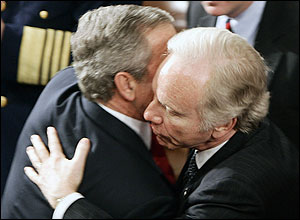
Hey Connecticut voters (except Melina and AHA): Are you happy now?
Labels: Chuck Hagel, Iraq, Joe Lieberman
Sunday, January 28, 2007
Just in case you're thinking you might vote for Chuck Hagel over, say, Hillary Clinton
Because I've been thinking I might quite possibly do that.
But here are some things you need to know about Chuck Hagel's record before deciding:
I don't have a problem with banning human cloning, but the rest of it is troublesome.
This is not a great record.
It isn't just pro-business, it's anti-worker and anti-consumer. Hagel is clearly in the pocket of the corporations.
Again -- not great. It sounds like he's not interested in funding public education at the federal level.
This is a TERRIBLE record on issues related to global warming and the environment, as well as indicating a very friendly-to-the-energy-industry pattern -- something that we don't know if it has changed as a result of his growing opposition to the Iraq war.
Again -- awful on government-for-sale and government corruption issues. Let us also not forget Hagel's connection to ES&S -- the manufacturer of the voting machines used in Nebraska in both elections he won:
But there's more:
More here.
As appealing as Chuck Hagel is looking right now because of his principled stand against escalating the Iraq war, let's not forget, before we fall in love, that this is a very right-wing guy on everything else. I'm not saying don't consider voting for him, just know what you're getting when you do.
But here are some things you need to know about Chuck Hagel's record before deciding:
Chuck Hagel on Abortion
- Voted NO on $100M to reduce teen pregnancy by education & contraceptives. (Mar 2005)
- Voted YES on criminal penalty for harming unborn fetus during other crime. (Mar 2004)
- Voted YES on banning partial birth abortions except for maternal life. (Mar 2003)
- Voted YES on maintaining ban on Military Base Abortions. (Jun 2000)
- Voted YES on banning partial birth abortions. (Oct 1999)
- Voted YES on banning human cloning. (Feb 1998)
- Rated 0% by NARAL, indicating a pro-life voting record. (Dec 2003)
I don't have a problem with banning human cloning, but the rest of it is troublesome.
Chuck Hagel on Civil Rights
- Voted YES on recommending Constitutional ban on flag desecration. (Jun 2006)
- Voted NO on adding sexual orientation to definition of hate crimes. (Jun 2002)
- Voted YES on loosening restrictions on cell phone wiretapping. (Oct 2001)
- Voted NO on expanding hate crimes to include sexual orientation. (Jun 2000)
- Voted NO on setting aside 10% of highway funds for minorities & women. (Mar 1998)
- Voted YES on ending special funding for minority & women-owned business. (Oct 1997)
- Supports anti-flag desecration amendment. (Mar 2001)
- Rated 60% by the ACLU, indicating a mixed civil rights voting record. (Dec 2002)
This is not a great record.
Chuck Hagel on Corporations
- Voted NO on repealing tax subsidy for companies which move US jobs offshore. (Mar 2005)
- Voted YES on reforming bankruptcy to include means-testing & restrictions. (Mar 2005)
- Voted YES on restricting rules on personal bankruptcy. (Jul 2001)
- Rated 87% by the US COC, indicating a pro-business voting record. (Dec 2003)
It isn't just pro-business, it's anti-worker and anti-consumer. Hagel is clearly in the pocket of the corporations.
Chuck Hagel on Education
- Voted NO on $52M for "21st century community learning centers". (Oct 2005)
- Voted NO on $5B for grants to local educational agencies. (Oct 2005)
- Voted NO on shifting $11B from corporate tax loopholes to education. (Mar 2005)
- Voted NO on funding smaller classes instead of private tutors. (May 2001)
- Voted NO on funding student testing instead of private tutors. (May 2001)
- Voted NO on spending $448B of tax cut on education & debt reduction. (Apr 2001)
- Voted YES on Educational Savings Accounts. (Mar 2000)
- Voted YES on allowing more flexibility in federal school rules. (Mar 1999)
- Voted YES on education savings accounts. (Jun 1998)
- Voted YES on school vouchers in DC. (Sep 1997)
- Rated 36% by the NEA, indicating a mixed record on public education. (Dec 2003)
Again -- not great. It sounds like he's not interested in funding public education at the federal level.
Chuck Hagel on Energy & Oil/Environment
- Voted NO on disallowing an oil leasing program in Alaska's AMWR. (Nov 2005)
- Voted NO on $3.1B for emergency oil assistance for hurricane-hit areas. (Oct 2005)
- Voted NO on reducing oil usage by 40% by 2025 (instead of 5%). (Jun 2005)
- Voted NO on banning drilling in the Arctic National Wildlife Refuge. (Mar 2005)
- Voted YES on Bush Administration Energy Policy. (Jul 2003)
- Voted NO on targeting 100,000 hydrogen-powered vehicles by 2010. (Jun 2003)
- Voted NO on removing consideration of drilling ANWR from budget bill. (Mar 2003)
- Voted YES on drilling ANWR on national security grounds. (Apr 2002)
- Voted YES on terminating CAFE standards within 15 months. (Mar 2002)
- Voted YES on preserving budget for ANWR oil drilling. (Apr 2000)
- Voted NO on ending discussion of CAFE fuel efficiency standards. (Sep 1999)
- Voted NO on defunding renewable and solar energy. (Jun 1999)
- Voted YES on approving a nuclear waste repository. (Apr 1997)
- Voted NO on including oil & gas smokestacks in mercury regulations. (Sep 2005)
- Voted YES on confirming Gale Norton as Secretary of Interior. (Jan 2001)
- Voted YES on more funding for forest roads and fish habitat. (Sep 1999)
- Voted YES on transportation demo projects. (Mar 1998)
- Voted NO on reducing funds for road-building in National Forests. (Sep 1997)
- Rated 0% by the LCV, indicating anti-environment votes. (Dec 2003)
This is a TERRIBLE record on issues related to global warming and the environment, as well as indicating a very friendly-to-the-energy-industry pattern -- something that we don't know if it has changed as a result of his growing opposition to the Iraq war.
Chuck Hagel on Government Reform
- Voted YES on allowing some lobbyist gifts to Congress. (Mar 2006)
- Voted NO on establishing the Senate Office of Public Integrity. (Mar 2006)
- Voted NO on banning "soft money" contributions and restricting issue ads. (Mar 2002)
- Voted YES on require photo ID (not just signature) for voter registration. (Feb 2002)
- Voted NO on banning campaign donations from unions & corporations. (Apr 2001)
- Voted NO on funding for National Endowment for the Arts. (Aug 1999)
- Voted NO on favoring 1997 McCain-Feingold overhaul of campaign finance. (Oct 1997)
Again -- awful on government-for-sale and government corruption issues. Let us also not forget Hagel's connection to ES&S -- the manufacturer of the voting machines used in Nebraska in both elections he won:
Chuck Hagel first ran for the U.S. Senate in Nebraska in 1996. Electronic voting machines owned by Election Systems & Software (ES&S) reported that he had won both the primaries and the general election in unprecedented victories. His 1996 victory was considered one of the biggest upsets of that election. He was the first Republican to win a Nebraska senatorial campaign in 24 years and won virtually every demographic group, including many largely black communities that had never before voted Republican.
Six years later Hagel ran again against Democrat Charlie Matulka in 2002, and won in a landslide. He was re-elected to his second term with 83% of the vote: the biggest political victory in the history of Nebraska. Again, the votes were counted by ES&S, now the largest voting machine company in America.
While these victories could be dismissed simply as a Republican upset, a January 2003 article in the independent Washington paper The Hill revealed interesting details about Hagel's business investments and casts a different light on his election successes. Chuck Hagel was CEO of ES&S (then AIS) until 1995 and he is still a major stockholder of the parent company of ES&S, McCarthy & Company. Hagel resigned as CEO of ES&S to run for the Senate and resigned as president of the parent company McCarthy & Company following his election (where he remains a major investor).
Today, the McCarthy Group is run by Michael McCarthy, who happens to be Chuck Hagel's treasurer. Hagel's financials still list the McCarthy Group as an asset, with his investment valued at $1-$5 million. Campaign finance reports show that Michael McCarthy also served as treasurer for Hagel until December of 2002.
But there's more:
Chuck Hagel on Health Care
- Voted YES on limiting medical liability lawsuits to $250,000. (May 2006)
- Voted NO on expanding enrollment period for Medicare Part D. (Feb 2006)
- Voted NO on increasing Medicaid rebate for producing generics. (Nov 2005)
- Voted NO on negotiating bulk purchases for Medicare prescription drug. (Mar 2005)
- Voted YES on $40 billion per year for limited Medicare prescription drug benefit. (Jun 2003)
- Voted NO on allowing reimportation of Rx drugs from Canada. (Jul 2002)
- Voted NO on allowing patients to sue HMOs & collect punitive damages. (Jun 2001)
- Voted YES on funding GOP version of Medicare prescription drug benefit. (Apr 2001)
- Voted NO on including prescription drugs under Medicare. (Jun 2000)
- Voted YES on limiting self-employment health deduction. (Jul 1999)
- Voted NO on increasing tobacco restrictions. (Jun 1998)
- Voted YES on Medicare means-testing. (Jun 1997)
- Invest funds to alleviate the nursing shortage. (Apr 2001)
- Rated 12% by APHA, indicating a anti-public health voting record. (Dec 2003)
More here.
As appealing as Chuck Hagel is looking right now because of his principled stand against escalating the Iraq war, let's not forget, before we fall in love, that this is a very right-wing guy on everything else. I'm not saying don't consider voting for him, just know what you're getting when you do.
Labels: 2008, Chuck Hagel
Other Brilliant Bloggers
DriftglassCorrente
Hullabaloo
Hoffmania
Orcinus
Scoobie Davis
Talking Points Memo
World O'Crap
Fact-esque
Liberal Oasis
Oliver Willis
Talk Left
This Modern World
Philip Barron
Rising Hegemon
AMERICABlog
James Wolcott
Skippy the Bush Kangaroo
Dependable Renegade
The Political Carnival
Astrological Musings
Firedoglake
Spiiderweb
Words of Power
RIPCoco
Kung Fu Monkey
Empire Burlesque
WTF is it Now
Down With Tyranny
Welcome Back to Pottersvillle
Spocko's Brain
The Sideshow
The Ostroy Report
Fallenmonk
Three Wise Men
NewsHoggers
Blue Gal
Blah3
Shadow of the Hegemon
Slacktivist
ShortWoman
Echidne of the Snakes
Jesus' General
My Left Wing
Arthur Silber
Republic of T
Bitch Ph.D
The American Street
Comments from Left Field
Balloon Juice
I Can't Believe It's Not a Democracy
Scholars and Rogues
On My Mind
PhysioProf
The Vulgar Curmudgeon
Monkeyfister
Sasha Undercover
ThePoliticalCat
Fables of the Reconstruction
Talk2Action
D-Day
State of the Day
Just an Earth-Bound Misfit
Bradblog
They Gave Us a Republic
Vagabond Scholar
Seeing the Forest
The Reaction
Orcinus
SteveAudio
Princess Sparkle Pony
Paul Levinson
Politics After 50
The Jed Report
One Utah
Sam Seder
Alternet
The Political Carnival
County Fair
Mudflats
A Feather Adrift
That's Why
Disciples of Joe
No Longer Quivering
Margaret and Helen
Stand With Dr. Dean
All the Good Names Were Taken
Badtux the Snarky Penguin
My Mental Dumping Ground
Legal Schnauzer
Alicublog
Bouphonia
Konagod
The Reverse Spin
City of Angels
The Gospel According to Hate
Menopausal Stoners
Stinque
The New York Crank
BP Oil Slick
Pen-Elayne
Inside-Out the Beltway
Reclusive Leftist
Southern Beale
The Moderate Voice
The Rant
Help the 99ers
Brendan Calling
Matt Taibbi
I Was Told There Would Be Bacon
We Don't Agree, But...
ShortWoman
of mule dung and ash
Cookies in Heaven
The Hunting of the Snark
The Policy Page (Rick Ungar)
Ramona's Voices
Sardonicky
Dagblog
The Titanic Sails At Dawn
Cheese Food Nation
Donkey Mountain
Thump and Whip
Under the Lobsterscope
Addicting Info
Wifely Person
Disaffected and it Feels So Good
Reality Chex
Burnt Orange Report
Salmon Alley
The Politics Blog w/Charles Pierce
Elizabitchez
We Are The 99 Percent.
Republic of Gilead
amigoingsomeplace
Fukushima Diary
The Polygon
Degringolade
Onyx Lynx
Parsley's Pics
Mainmati
Brandflakes for Breakfast
The Economic Populist
Liberal Dan
Ex-Amish Atheist
The Poor Man's Huffington Post
Constant Commoner
Channel Surfing
Big Bad Bald Bastard
Panic in Funland (Tbogg!!!)
Weird Wally's Worldview
Brilliant Furriners
Because we all may have to live somewhere else someday.The Galloping Beaver (Canada)
Cathie from Canada
How This Old Brit Sees It ...
Stunner's Afflictions (Jamaica)
Jamaican Lifestyle
Heathers
Pulling up the ladderbehind them
Daily Kos
Atrios
Open Left


CeleBloggers
Roger EbertDispatches from the Island &
Further Dispatches
(Jorge Garcia)
Baseball Nerd
(Keith Olbermann)
FOK News Channel (ditto)
Brilliant at Tweeting
(We won't do it, but we'll follow them)Marc Maron
Sam Seder
Brendan McDonald
Johnny Weir
Melina
Lynn
Keith Olbermann
In Memoriam
(yes, we're getting tired of having to do this)

Break Room Live archives
Morning Sedition 3/04-12/05
A Brilliant Radio Show -
Morning Seditionists
Camp Butch (all the
Sedition you can eat)
Jim Earl and his
Big Page of Crap
Morning Remembrance
Steve Gilliard 1966-2007:
A Brilliant Blogger
The News Blog archive
NetSlaves article archive
Friends of Steve:
The Group News Blog
"Jon Swift" (Al Weisel) 1963-2010
Bats Left Throws Right (Doghouse Riley)
Brilliant at Disappearing
Maybe they've been raptured?Altercation
The All-Spin Zone
Baghdad Burning
Carrie's Nation
Little Country Lost
Cynical Nation
Pam's House Blend
photos1.blogger.com/blogger/397/497/320/bb_banner.1.jpg]^23004A00]coral]navy],](](]]]black],]3]8]20]1]2]3]3]1]2]3]1]1],](](]^235E3D00])])]^3Cimg^20src^3D^22)photos1.blogger.com/blogger/397/497/320/bb_banner.1.jpg^22]^22...you^20have^20a^20choice^3A^20be^20a^20fighting^20liberal^20or^20sit^20quietly.^20I^20know^20what^20I^20am^2C^20what^20are^20you^3F^22^20--^20^3Ca^20href^3D^22)stevegilliard.blogspot.com/2003/12/im-fighting-liberal-you-know-ive.html^22^20STYLE^3D^22color^3Awhite^3B^22^3ESteve^20Gilliard^2C^201966^20-^202007^3C/a^3E^3CBR^3E^22For^20straight^20up^20monster-stomping^20goodness^2C^20nothing^20makes^20smoke^20shoot^20out^20my^20ears^20like^20Brilliant@Breakfast^22^20--^20^3Ca^20href^3D^22)www.poorimpulsecontrol.net/blog^22^20STYLE^3D^22color^3Awhite^3B^22^3ETata^3C/a^3E],](],](](]black](](](]^23FDF2D7](](](]^23333](](](],]50]20],](](]^23FFF8DD])])]black]1.5]15],](](]^2398A45C])])]black]^23FFF8DD])])]^23666]30]^235E3E1A]^23622121],](](]^235E3E1A](],](]^235E3E1A]^23039]^2306C],](](]^23FFF8DD])])],](](]^23FFF8DD])])],](](]^23FFF8DD])])],](]^235E3E1A]^23666]15]3]25]20]^23808C43],](](],](],](](],](]black](](](],](](](],]^235C3E11](](](],](](]^23211104](](](](](],]^2336F]^23211104](],](]Posted^20by^20^24AUTH^20^7C^20^24TIME]20],](](]^23FFF8DD])])]^23FFF8DD])])]^23666]30]^235E3E1A]^23622121],](](]^235E3E1A](],](]^23333]^23039]^2306C]Contact]]]Home]^24HOME]First^20Page]Email^3A^3CBR^3Ebrilliantatbreakfast^20at^20gmail^20dot^20com]]]RSS]^24RSS]RSS^20Feed]Your^20Servers]]]Jill]rilliantatbreakfast.blogspot.com]]Melina])www.ripcoco.com]RIPCoco]Carrie])carriesnation.blogspot.com]Carrie^27s^20Nation]And^20occasionally...]]]jurassicpork])welcome-to-pottersville.blogspot.com]Welcome^20to^20Pottersville]Bob])bobrixon.blogspot.com]The^20Rix^20Mix]Tata])www.poorimpulsecontrol.net/blog]Poor^20Impulse^20Control]Spiiderweb])spiiderweb.blogspot.com]Spiiderweb]Other^20Brilliant^20Bloggers]]]Modern^20Fabulousity])modernfabulousity.blogspot.com]Modern^20Fabulousity]Pandagon])www.pandagon.net]Pandagon]Altercation])www.mediamatters.org/altercation]Altercation]Corrente])www.correntewire.com/]Corrente]Hullabaloo])digbysblog.blogspot.com]Hullabaloo]Hoffmania])www.hoffmania.com]Hoffmania]Orcinus])dneiwert.blogspot.com]Orcinus]Scoobie^20Davis])scoobiedavis.blogspot.com]Scoobie^20Davis]Talking^20Points^20Memo])talkingpointsmemo.com]Talking^20Points^20Memo]World^20O^27Crap])world-o-crap.com/blog]World^20O^27Crap]Fact-esque])casadelogo.typepad.com/factesque/]Fact-esque]Liberal^20Oasis])www.liberaloasis.com/]Liberal^20Oasis]Oliver^20Willis])www.oliverwillis.com/]Oliver^20Willis]Talk^20Left])www.talkleft.com/]Talk^20Left]The^20Talent^20Show])www.thetalentshow.org/]The^20Talent^20Show]Waveflux])www.waveflux.net]Waveflux]Rising^20Hegemon])rising-hegemon.blogspot.com/]Rising^20Hegemon]The^20Poor^20Man])www.thepoorman.net/]The^20Poor^20Man]AMERICABlog])www.americablog.org/]AMERICABlog]Needlenose])www.needlenose.com/]Needlenose]Brilliant^20NJ^20bloggers]]]^24ARCHIVE]^20]]Friends]]]Horm])blog.horm.org]Hallucinations^20Of^20Reabsorbed^20Mind]Phorm])p.horm.org]Another^20Phormation]Etc]]]^3Cimg^20src^3D^22)psyc.horm.org/barimg/bar_psycho.png^22^20width^3D^2280^22^20height^3D^2215^22^20alt^3D^22PsycHo^3A^20Free^20Template^20Generator^22^20style^3D^22border^3A^200px^20solid^20black^22^20/^3E]^24PSYCHO]PsycHo^3A^20Free^20Template^20Generator]^3Cimg^20src^3D^22)psyc.horm.org/barimg/bar_firefox.png^22^20width^3D^2280^22^20height^3D^2215^22^20alt^3D^22Get^20FireFox^21^22^20style^3D^22border^3A^200px^20solid^20black^22^20/^3E])www.mozilla.org/products/firefox/]Get^20Firefox^21]^3Cimg^20src^3D^22)psyc.horm.org/barimg/bar_xhtml.png^22^20width^3D^2280^22^20height^3D^2215^22^20alt^3D^22XHTML^20Validator^22^20style^3D^22border^3A^200px^20solid^20black^22^20/^3E])validator.w3.org/check/referer]XHTML^20Validator]]]]Home]^24HOME]First^20Page]Email]^24EMAIL]Mail^20me^21]RSS]^24RSS]RSS^20Feed]Archive]]]^24ARCHIVE]^20]]Friends]]]Horm])blog.horm.org]Hallucinations^20Of^20Reabsorbed^20Mind]Phorm])p.horm.org]Another^20Phormation]Etc]]]^3Cimg^20src^3D^22)psyc.horm.org/barimg/bar_psycho.png^22^20width^3D^2280^22^20height^3D^2215^22^20alt^3D^22PsycHo^3A^20Free^20Template^20Generator^22^20style^3D^22border^3A^200px^20solid^20black^22^20/^3E]^24PSYCHO]PsycHo^3A^20Free^20Template^20Generator]^3Cimg^20src^3D^22)psyc.horm.org/barimg/bar_firefox.png^22^20width^3D^2280^22^20height^3D^2215^22^20alt^3D^22Get^20FireFox^21^22^20style^3D^22border^3A^200px^20solid^20black^22^20/^3E])www.mozilla.org/products/firefox/]Get^20Firefox^21]^3Cimg^20src^3D^22)psyc.horm.org/barimg/bar_xhtml.png^22^20width^3D^2280^22^20height^3D^2215^22^20alt^3D^22XHTML^20Validator^22^20style^3D^22border^3A^200px^20solid^20black^22^20/^3E])validator.w3.org/check/referer]XHTML^20Validator^26^2361470^3BPsycHo})


