| "Only dull people are brilliant at breakfast" -Oscar Wilde |
 |
"The liberal soul shall be made fat, and he that watereth, shall be watered also himself." -- Proverbs 11:25 |
"...you have a choice: be a fighting liberal or sit quietly. I know what I am, what are you?" -- Steve Gilliard, 1964 - 2007
"For straight up monster-stomping goodness, nothing makes smoke shoot out my ears like Brilliant@Breakfast" -- Tata
"...the best bleacher bum since Pete Axthelm" -- Randy K.
"I came here to chew bubblegum and kick ass. And I'm all out of bubblegum." -- "Rowdy" Roddy Piper (1954-2015), They Live
"For straight up monster-stomping goodness, nothing makes smoke shoot out my ears like Brilliant@Breakfast" -- Tata
"...the best bleacher bum since Pete Axthelm" -- Randy K.
"I came here to chew bubblegum and kick ass. And I'm all out of bubblegum." -- "Rowdy" Roddy Piper (1954-2015), They Live


Brilliant Recent Posts
There's nothing new under the sunAu revoir, y'all....
So Long and Thanks for All the Gefilte Fish
Like White on Rice
Why Did Hillary Clinton Hire a Monsanto Lobbyist t...
Virtual Book Sale
The Man Who Poisoned America
We are privileged to be alive today
The Prodigal Blogger Stops By
Good Times at Pottersville, 3/14/15
Brilliant at Searching
Brilliant Stuff to Buy
What's on my mind:
Brilliant Archives
Brilliant at Begging
Like what you read?Please consider supporting B@B with a donation: There is no gift like the present.
But gifts are nice too:


Feed Me!





Stuff You Must Read
Monday, January 28, 2013
Julian Fellowes is not just elitist, but an appallingly retrograde sexist, too.
SPOILER ALERT: If you haven't watched Sunday night's episode of Downton Abbey, wait to read the below until you do.
Really, Julian? I mean really? Seriously?
After I've spent nearly a half-season steeling myself for the moment when Matthew tires of Lord Grantham, who in Season 3 has turned into the biggest asshole in the countryside, hits him over the head with the candlestick in the library with the help of Colonel Mustard and is then murdered in prison by Bates' roommate, thereby freeing Dan Stevens to, I don't know, perhaps take over the role of Elder Price in The Book of Mormon, THIS is what you do? I mean we knew that Dan Stevens had tired of wearing a tuxedo all the time and was moving on after this season, so whether he is killed off or goes off to play a footman in a musical review, it will be anticlimactic anyway.
We'd even heard rumblings that Maggie Smith had had quite enough of the Dowager Countess, though Cousin Violet may be the best role Smith has had in her entire career, and while the costumes are unwieldy, how could anyone give up a role where you get lines like these:
But from what I hear, old Maggie can be a bit cranky, so I just figured that the Dowager Countess would be keeling over any minute.
But Sibyl? The lovely Sibyl, she of the harem pants and the sweet disposition and the adorable mini-baby-bump? Sibyl, the heart and soul of the Grantham family -- the only one of the three Grantham sisters that one might actually want to know in real life?
Julian, how could you? And in CHILDBIRTH no less? Is this what you think well-born ladies who marry below their class deserve? A gruesome death from eclampsia? At least the unfortunate Lavinia Swire got to expire prettily at the end of Series 2 in a mist from a partcularly generous spray bottle with nothing seemingly amiss but a lack of mascara.
I've put up with a lot of hooey from you. No suspension of disbelief is enough to compensate for Matthew's miraculous recovery from his manhood-ending war injury, or of O'Brien's nefarious architecting of miscarriage-by-soap, or Lavinia's father leaving all his money to Matthew because even though he treated old Reg's daughter so shabbily, he's a good chap who deserves to be left a fortune anyway. I've also put up with a lot of how you've treated your women characters, aside from the Great Dowager. Poor Edith. I mean, Edith hasn't always been the nicest person; after all, writing the Turkish Ambassador to regale him with the details of his son's demise from Mary the Ice Princess' obviously-not-icy nether quarters. But to have her jilted at the altar was just plain cruel. To leave the lovely Anna moping around for half a season, playing a kind of downstairs Debra Morgan? Can O'Brien really be that evil? And poor Daisy...can't you give the poor dumb girl a LITTLE happiness? At least you haven't killed off Mrs. Hughes...yet. Mary is a cold bitch, Edith is both pathetic and loathsome, Cora is shallow, and Mrs. Crawley is a right-wing caricature of a bleeding heart liberal.
But through it all, there was Sibyl. Beautiful, kind Sibyl, who was even nice to that awful Thomas, and who, give her fifty years or so, would have marched with him at a gay rights parade. Lovely Sibyl, who followed her heart and married the fiery Irish chauffeur, risking her father's wrath for love. And that's where you fell into loathsomeness, Julian. Because in making the wages of sin death as punishment for Sibyl's refusal to adhere to the mores of her class, you showed yourself to be not just classist, but sexist as hell.
I hope Edith takes up wearing trousers and smoking cigars -- just to piss you off. And don't you DARE start getting ideas that she should marry Branson. She's just gotten some meaning to her life, don't you go getting all Henry VIII on her ass.
Really, Julian? I mean really? Seriously?
After I've spent nearly a half-season steeling myself for the moment when Matthew tires of Lord Grantham, who in Season 3 has turned into the biggest asshole in the countryside, hits him over the head with the candlestick in the library with the help of Colonel Mustard and is then murdered in prison by Bates' roommate, thereby freeing Dan Stevens to, I don't know, perhaps take over the role of Elder Price in The Book of Mormon, THIS is what you do? I mean we knew that Dan Stevens had tired of wearing a tuxedo all the time and was moving on after this season, so whether he is killed off or goes off to play a footman in a musical review, it will be anticlimactic anyway.
We'd even heard rumblings that Maggie Smith had had quite enough of the Dowager Countess, though Cousin Violet may be the best role Smith has had in her entire career, and while the costumes are unwieldy, how could anyone give up a role where you get lines like these:
But from what I hear, old Maggie can be a bit cranky, so I just figured that the Dowager Countess would be keeling over any minute.
But Sibyl? The lovely Sibyl, she of the harem pants and the sweet disposition and the adorable mini-baby-bump? Sibyl, the heart and soul of the Grantham family -- the only one of the three Grantham sisters that one might actually want to know in real life?
Julian, how could you? And in CHILDBIRTH no less? Is this what you think well-born ladies who marry below their class deserve? A gruesome death from eclampsia? At least the unfortunate Lavinia Swire got to expire prettily at the end of Series 2 in a mist from a partcularly generous spray bottle with nothing seemingly amiss but a lack of mascara.
I've put up with a lot of hooey from you. No suspension of disbelief is enough to compensate for Matthew's miraculous recovery from his manhood-ending war injury, or of O'Brien's nefarious architecting of miscarriage-by-soap, or Lavinia's father leaving all his money to Matthew because even though he treated old Reg's daughter so shabbily, he's a good chap who deserves to be left a fortune anyway. I've also put up with a lot of how you've treated your women characters, aside from the Great Dowager. Poor Edith. I mean, Edith hasn't always been the nicest person; after all, writing the Turkish Ambassador to regale him with the details of his son's demise from Mary the Ice Princess' obviously-not-icy nether quarters. But to have her jilted at the altar was just plain cruel. To leave the lovely Anna moping around for half a season, playing a kind of downstairs Debra Morgan? Can O'Brien really be that evil? And poor Daisy...can't you give the poor dumb girl a LITTLE happiness? At least you haven't killed off Mrs. Hughes...yet. Mary is a cold bitch, Edith is both pathetic and loathsome, Cora is shallow, and Mrs. Crawley is a right-wing caricature of a bleeding heart liberal.
But through it all, there was Sibyl. Beautiful, kind Sibyl, who was even nice to that awful Thomas, and who, give her fifty years or so, would have marched with him at a gay rights parade. Lovely Sibyl, who followed her heart and married the fiery Irish chauffeur, risking her father's wrath for love. And that's where you fell into loathsomeness, Julian. Because in making the wages of sin death as punishment for Sibyl's refusal to adhere to the mores of her class, you showed yourself to be not just classist, but sexist as hell.
I hope Edith takes up wearing trousers and smoking cigars -- just to piss you off. And don't you DARE start getting ideas that she should marry Branson. She's just gotten some meaning to her life, don't you go getting all Henry VIII on her ass.
Labels: Downton Abbey, pop culture, sexism, television

Friday, January 18, 2013
What "Vanished Virtues"?

Text of actual letter in the Hackensack, NJ Record, January 15, 2013:
Regarding "Why do we love 'Downton Abbey'?" (Better Living, Page BL-1, Jan. 6):
I was once again engaged and enthralled by the opening broadcast of Season 3 of "Downton Abbey." Why do I enjoy it so much? Isn't it just a glorified soap opera with contrived crises and ensuing deus ex machina resolutions?
Yes, but the magnificent script, the perfect embodiments of the dramatis personae by every member of the cast, the settings and the costumes all combine to cast a magical spell. We are brought into this world of manners, dignity, an uncomplaining assumption of responsibility, a restrained but ever present sense of mutual respect.
Most know and accept their role in the Abbey and in society, yet elements of dissonance in these relationships within and without the Abbey are also skillfully expressed. It is a world of God, king and country, a stiff upper lip, soldiering on in the face of adversity.
In a broader context we know that this society embodied an obsolete and unfair class structure and, for the most part willingly and enthusiastically, participated in the senseless carnage of World War I. This conflict unwittingly rent the very fabric of Downton society in the postwar decades and sowed the seeds for World War II.
Most of the positive values that permeated the world of Downton Abbey have been cast aside. Millions are enslaved by the welfare state at the expense of their dignity and autonomy, the nuclear and extended family is on the decline, our popular culture is increasingly vulgar and anarchic. Is it any wonder that nostalgia for the vanished virtues of Downton touches us to the core?
Yes, most knew and accepted their role in the Abbey. Oh, for the good old days when the nobility had a birthright and the peons knew their place.

Now, I watch Downton Abbey as much as any red-blooded American, but even aside from the series' more ludicrous plot developments, such as the "Is he or isn't he" veteran with no face who may or may not be the supposedly long-lost heir, or the convenient death of Miss Lavinia Swire from the flu, or last week's jilting or the show's resident designated victim, poor Edith, at the altar by an old geezer who was no bargain anyway, at least I understand that Downton, just as Upstairs Downstairs was a generation ago, is FICTION. It no more represents bygone values than Gone With the Wind does the Civil War, or that Hair is a factual portrayal of the late 1960s.
But as today's Republican Party, with far too much acquiescence and active participation by the Democrats, is still trying to return us to those days when Lady Mary could sit around all day doing embroidery and poor Daisy could look forward only to decades of drudgery, and Mrs. Hughes could be touched with gratitude by the assurance by Lady Cora that if she does have cancer, she won't be thrown out in the street, it's worth looking at what real life was like for the Daisys and the Mrs. Patmores and the Mrs. Hugheses and the Carsons.
Alison Maloney, author of Life Below Stairs, cites a list of rules of behavior as put forth in a booklet produced by the Ladies' Sanitary Association in 1901 entitled Rules For the Manners of Servants in Good Families:
Always move quietly about the house, and do not let your voice be heard by the family unless necessary
Never sing or whistle at your work where the family would be likely to hear you
Do not call out from room to room and if you are a housemaid, be careful not only to do your work quietly but to keep out of sight as much as possible
Never begin to talk to the ladies and gentlemen, unless it be to deliver a message or ask a necessary question
Do not talk to your fellow servants or the children of the family in the passages or sitting rooms, or in the presence of ladies and gentlemen
Always answer when you receive an order or a reproof, either: "yes ma'am" or "I am very sorry ma'am" to show you have heard
Should you be required to walk with a lady or gentleman, in order to carry a parcel or otherwise, always keep a few paces behind
Do not smile at droll stories told in your presence or seem in any way to notice, or enter into, the family conversation, or the talk at table, or with visitors
More rules, and a typical day for Edwardian servants, here. In other words, do nothing to allow the ladies and gentlemen to have to acknowledge that you are a human being. Is this the "vanished virtue" of which the letter writer speaks? Shut up and serve your betters? "Know your place" and don't aspire to anything more? That hardly seems like the kind of virtue that an American would hold dear. Here's part of a recollection by one Jean Rennie, who spent sixteen years in service from 1924-1940:
I came to a grandly beautiful Highland castle, with towers and battlements and all, standing high on the hill on the shores of Loch Fyne. I don't remember the exact moment of arrival at the back door, but I do remember walking along a seemingly endless red-tiled corridor. I heard the sound of scrubbing as I went along and I saw a young girl on her knees scrubbing energetically, and seemingly enjoying it. I caught a glimpse of what I afterwards found was the scullery. It was down two steps, and it had the same cheerful redbrick floor. Rounding a corner, I saw the kitchen - a wide, gleaming place, with a long spotless white table down its middle, big windows, barred with railings, like parks, spiked at the top. It looked so clear and clean and friendly. And there was no one in it. I was taken along the passage, right to the end, where I was put into a room with two single beds.Unlike the easy interactions that take place on Downton and that we remember from Upstairs Downstairs, most servants were terrified of their employers. At a time when the alternative was backbreaking farm work, life in a grand house was only a good deal by comparison, and again -- hardly representative of the society we in America have always claimed to want. Or in this age of talk of "makers and takers", perhaps we do, though one has to wonder about the special place of the landed gentry in the Downton era, who seemed to have little required of them beyond reading and a sizable social calendar, while their servants worked eighteen hours a day, six and a half days a week, with only a half-day off once a week -- hardly enough time to be an amateur CSI investigator, as Downton's Anna seems to have.
Jessie and I went to our room and put on our caps and aprons again, and Jessie helped me put my few belongings away. Then I wrote a letter to my mother, and soon it was seven o'clock, the hour when I was to be initiated into the mysteries of being a house-maid.
I don't remember the exact way from our kitchen corridor into the house beyond. I can remember a narrow passage with a baize door at the end which led into the front hall, because it was on a shelf in that corridor where reposed the grog tray, from which the butler had taken the whisky he handed to me at six o'clock one morning to wake me up !
I don't remember how I got to the bedrooms, but here we were, and I followed Margaret meekly. We took a dustpan and brush with us, and a duster, into the bedroom belonging to the eldest daughter of the house. There was the laird and his lady, two daughters and a son, a lady housekeeper, and some visitors.
Margaret showed me how to pick up bits of ash and paper and things from the carpet, to draw the curtains and shut the windows. To shut the windows and draw the curtains on the glorious sunset over the purple hill seemed to me sacrilege, but it seemed that the 'gentry' didn't have time to look at sunsets.
We straightened the room and then Margaret moved to the massive wardrobe. She opened the doors wide, and there were hung dresses and coats and costumes, enough to take my breath away. She dug out a black lace dress and laid it across the bed. Then she looked at the other side of the wardrobe and chose from dozens of pairs of shoes a black satin pair, and put them on the floor beside the dress. She went to a drawer and took out a long black slip and some other black underclothes, and from another drawer full of stockings she selected a pair which she examined very carefully before she laid them, with the foot tucked in, across the bed with the other clothes.
I was full of questions, and some I managed to ask, but mostly I just wanted to touch and look at the lovely dresses in the wardrobe.
Why did she put out that dress? Why not another one? Why couldn't Elspeth - well, Miss Elspeth, then - pick her own dress? Suppose she didn't want that one, suppose she wanted a different colour - she'd have to get out all her own things then?
'You ask too many questions, Jane - we've got to do it - it's our job.'
We lit the fire and made sure it would burn up, and that was that room done. We had several more to do, and we had to hurry apparently. It seemed the dressing-gong would go soon, and we must be out of the bedrooms and be ready to go into the drawing-room and other rooms.
In each room we did the same things. Margaret did unbend sufficiently to tell me that you get used to what the ladies wear, especially when they're alone. When there were visitors, or very important visitors anyway, perhaps they preferred something different, in which case they usually told Margaret during the day. But usually it was the same old black frock . . .
Then I heard the deep reverberating tones of a gong just as we'd got back into the dining-room passage. Margaret and I stood with the butler, who was putting finishing touches to the dining-room table. He went through into the front hall, and after a few minutes he came back and nodded to Margaret.
'They've gone up,' he said.
Margaret gathered me up, dustpan and brush and duster and all, and we went into the drawing-room.
The same performance as the bedrooms - bits gathered up, papers and magazines straightened, cushions plumped up and put in their proper places. Firesides swept up and dusted, and fires made up. There were two fires in the great white drawing-room, both blazing high.
Then we went to the gun-room, but Margaret just looked in and said, 'No, that's all right. Come on, billiard-room.'
The billiard-room was just that, and nothing more. Two large billiard tables filled the whole length of the room, and stacked under the tables till they were almost pushing the tables up, were newspapers - I think every Glasgow Herald and every Scotsman that had ever been printed.
Here, too, there was a huge fireplace, with a blazing fire, and we had to tidy up here as well. The same in the front hall, curtains and windows to shut out the still loveliness of the evening.
We were still scuttling round when the gong rang through the house again, and we had to pick up our brushes and dusters and run quick.
Apparently we mustn't be seen. It was to be assumed, I suppose, that the fairies had been at the rooms.
Perhaps it's about sexual restraint -- but only for women. In most Edwardian houses, fraternizing among the servants was frowned upon, and unlike Daisy's tragic wedding to the unfortunate William on Downton, more often than not both parties would be sacked, and the woman in the relationship blamed. Half of all children born out of wedlock in 1911 were born to women in domestic service, which makes me wonder for how many doing the master's bidding involved more than just polishing the silver.
So what is this "vanished virtue" about which this letter writer is so wistful? I'd like to believe that it's the sense of noblesse oblige that used to accompany great wealth; the understanding that with great wealth came great responsibility, as Andrew Carnegie noted in his 1889 essay The Gospel of Wealth:
What is the proper mode of administering wealth after the laws upon which civilization is founded have thrown it into the hands of the few ? And it is of this great question that I believe I offer the true solution. It will be understood that fortunes are here spoken of, not moderate sums saved by many years of effort, the returns on which are required for the comfortable maintenance and education of families. This is not wealth, but only competence which it should be the aim of all to acquire.
There are but three modes in which surplus wealth can be disposed of. It call be left to the families of the decedents; or it can be bequeathed for public purposes; or, finally, it can be administered during their lives by its possessors. Under the first and second modes most of the wealth of the world that has reached the few has hitherto been applied. Let us in turn consider each of these modes. The first is the most injudicious. In monarchical countries, the estates and the greatest portion of the wealth are left to the first son, that the vanity of the parent may be gratified by the thought that his name and title are to descend to succeeding generations unimpaired. The condition of this class in Europe to-day teaches the futility of such hopes or ambitions.The successors have become impoverished through their follies or from the fall in the value of land. Even in Great Britain the strict law of entail has been found inadequate to maintain the status of an hereditary class. Its soil is rapidly passing into the hands of the stranger. Under republican institutions the division of property among the children is much fairer, but the question which forces itself upon thoughtful men in all lands is: Why should men leave great fortunes to their children? If this is done from affection, is it not misguided affection?
[snip]
The growing disposition to tax more and more heavily large estates left at death is a cheering indication of the growth of a salutary change in public opinion. The State of Pennsylvania now takes--subject to some exceptions--one-tenth of the property left by its citizens. The budget presented in the British Parliament the other day proposes to increase the death-duties ; and,most significant of all, the new tax is to be a graduated one. Of all forms of taxation, this seems the wisest. Men who continue hoarding great sums all their lives, the proper use of which for - public ends would work good to the community, should be made to feel that the community, in the form of the state, cannot thus be deprived of its proper share. By taxing estates heavily at death the state marks its condemnation of the selfish millionaire's unworthy life.
It is desirable ;that nations should go much further in this direction.
Compare this kind of wealthy man with, say, Willard Romney, whose wealth was obtained by driving ever more people into poverty, and whose philanthropy, such as it is, involves contributing to a church that baptizes dead Jews and seeks to block gay people from enjoying the privileges he takes for granted. Or like Donald Trump, who inherited $400 million from his father and has spent the last three decades strutting around like a self-made man. Or any of the various billionaires who have attempted to buy themselves a government that will take what little the lower socioeconomic levels have left and further line their pockets with it.
If that's the kind of "vanished virtue" to which the writer of that letter to the local newspaper was referring, I'm on board. But somehow I don't think it is.
Labels: Downton Abbey, faux piety, history, revisionist history
Sunday, January 08, 2012
Downton! You're gonna be all right now.
When you're alone
And life is making you lonely,
You can always go
Downton!
When you've got worries,
An Edwardian surrey
Seems to help, I know,
Downton!
Just listen to the music
of the wine glasses at dinner
Linger in the countryside
where Mary's still a sinner
How can you lose?
The lights are much softer there
You can forget all your troubles,
forget all your cares and go
Downton!
things'll be great when you're
Downton!
no finer place for sure
Downton!
Escape is waiting for you
(Apologies to Petula Clark and Tony Hatch for the above)
This afternoon at Casa la Brilliant may have belonged to the Giants (YAY!), but after 9 PM, when the football is over and Mr. Brilliant has turned in for the night, it's all going to be about sober-but-still-awesome clothes and fabulous hats and World War I and the denizens of Downton Abbey.
I remember when the original Forsyte Sage played on American TV for the first time, ushering in what would become Masterpiece Theatre. This was a sprawling, 26-episode, utterly faithful rendition of Jon Galsworthy's six novels. It had sex and intrigue and family strife lo unto succeeding generations. The Forsyte Saga was all about the upstairs and not at all about the downstairs. It had great costumes and British accents and rigid manners -- all the things we now take for granted about costume dramas. But in 1967, there had been nothing like it on American television:
Today this version has lost none of its power, though it does play a bit stagey. But at the time, Forsyte was so successful that it begat Upstairs Downstairs (from which co-creator Jean Marsh insists Downton Abbey was shamelessly stolen), Poldark, The First Churchills, The Six Wives of Henry VIII, Elizabeth R, Brideshead Revisited, and the greatest costume drama of all time, I, Claudius. The best of the Masterpiece dramas have two things in common: richly-drawn characters, and superlative production values.
As we are wont to do in our navel-gazing society, there is much hue and cry over why the very same people who support the Occupy movement are already assembling their tea and scones to enjoy over the premiere of season 2 of a drama that's all about inheritance of a huge English mansion -- the family that owns it and the many people whose purpose in life is to serve them. And let's face it, the people who have been screaming about defunding NPR and cheering Mitt Romney's assertion that Sesame Street is going to have to start advertising Froot Loops, are hardly likely to be planted in front of their local public television station tonight, for all that they have the delusion that if things were only just like they were in the pre- (and this season, current) World War I era, with everyone knowing exactly where s/he stands in the scheme of things, life would be a lot better.
But those of us who ARE glued in front of PBS tonight at 9 Eastern Time know what the attraction is. It isn't that we want to be waited on by people who have no lives other than serving the wealthy. It isn't that we want to, as Lady Mary said in Season I, have no life but going to socials and charity functions and wait around to marry. It isn't that we want to, as Maggie Smith's deliciously haughty Dowager Countess said last season, have no opinions until we marry and then our husbands tell us what to think.
No, the attraction is something far less profound.
It's all about the clothes. And the hats:
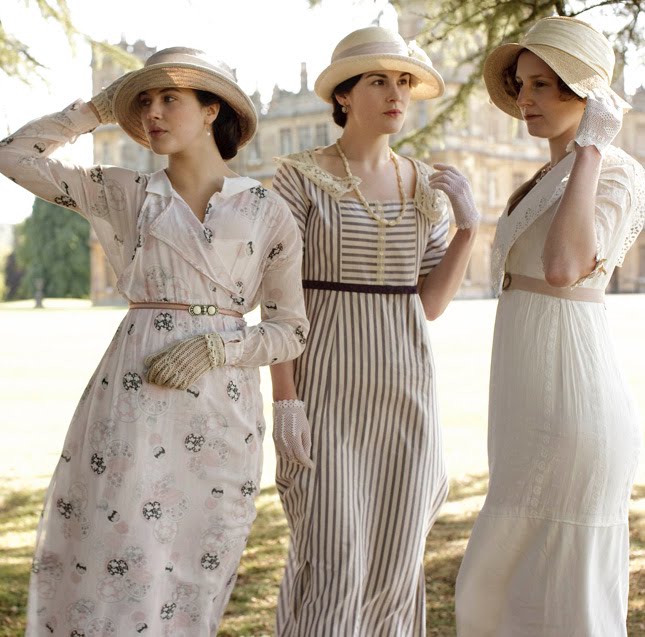
After Titanic came out in 1997, there was a rash of interest in Edwardian clothing -- the lace-up boots, the tea dresses, and yes, the corsets. I myself bought one, and while it would be horrifically uncomfortable to wear all the time, there's something about a corset that makes you carry yourself differently -- taller, straighter, and with a rack you could read Shakespeare from. Even among those of us who refuse to take any vacation where we have to dress up, there's something appealing about watching people wear gorgeous dresses to dinner, and outfits with matching hats to garden parties. Even Boardwalk Empire, with it's Scorsesean gangsters and graphic violence, had some of the most fabulous costuming we've seen in popular culture in recent years.
There's something about wearing the clothing of a particular time that gives us a vague sense of what it was like to be there -- the constriction of corsets and hobble skirts. The pointed toes of lace-up boots. The feel of a summer breeze blowing through the straw of a hat festooned with the better part of an entire florist's inventory
The darted sheath dresses, suits, and fedoras of Mad Men have never quite caught on, perhaps because there are far too many of us alive who still remember them from the first time, or because there is nothing about the lives of ANY of the characters on that show with whom we'd want to change places even for a day, for all that we find them so compelling. Nor would we want to trade places with Lady Mary Crawley either, for that matter, despite her gorgeous dresses, because Michelle Dockery so expertly portrays the despair of a woman born just a few years too early for the changes that will come after Season 2 of Downton Abbey ends.
Yes, Downton Abbey may seem like just another Austen-esque thwarted romance story with a big house. But if you ask a fan to dig down deep and reveal what the appeal is, yes, it's about the house p0rn. But more than anything else it's about this:

and this:

So if you're inclined to shop for clothing inspired by this time period, Victorian Trading Company has some lovely garments and accessories.
Now if you'll excuse me, I have to go dress for dinner. Consider this an open thread for All Things Downton.
Labels: Downton Abbey, pop culture, television
Other Brilliant Bloggers
DriftglassCorrente
Hullabaloo
Hoffmania
Orcinus
Scoobie Davis
Talking Points Memo
World O'Crap
Fact-esque
Liberal Oasis
Oliver Willis
Talk Left
This Modern World
Philip Barron
Rising Hegemon
AMERICABlog
James Wolcott
Skippy the Bush Kangaroo
Dependable Renegade
The Political Carnival
Astrological Musings
Firedoglake
Spiiderweb
Words of Power
RIPCoco
Kung Fu Monkey
Empire Burlesque
WTF is it Now
Down With Tyranny
Welcome Back to Pottersvillle
Spocko's Brain
The Sideshow
The Ostroy Report
Fallenmonk
Three Wise Men
NewsHoggers
Blue Gal
Blah3
Shadow of the Hegemon
Slacktivist
ShortWoman
Echidne of the Snakes
Jesus' General
My Left Wing
Arthur Silber
Republic of T
Bitch Ph.D
The American Street
Comments from Left Field
Balloon Juice
I Can't Believe It's Not a Democracy
Scholars and Rogues
On My Mind
PhysioProf
The Vulgar Curmudgeon
Monkeyfister
Sasha Undercover
ThePoliticalCat
Fables of the Reconstruction
Talk2Action
D-Day
State of the Day
Just an Earth-Bound Misfit
Bradblog
They Gave Us a Republic
Vagabond Scholar
Seeing the Forest
The Reaction
Orcinus
SteveAudio
Princess Sparkle Pony
Paul Levinson
Politics After 50
The Jed Report
One Utah
Sam Seder
Alternet
The Political Carnival
County Fair
Mudflats
A Feather Adrift
That's Why
Disciples of Joe
No Longer Quivering
Margaret and Helen
Stand With Dr. Dean
All the Good Names Were Taken
Badtux the Snarky Penguin
My Mental Dumping Ground
Legal Schnauzer
Alicublog
Bouphonia
Konagod
The Reverse Spin
City of Angels
The Gospel According to Hate
Menopausal Stoners
Stinque
The New York Crank
BP Oil Slick
Pen-Elayne
Inside-Out the Beltway
Reclusive Leftist
Southern Beale
The Moderate Voice
The Rant
Help the 99ers
Brendan Calling
Matt Taibbi
I Was Told There Would Be Bacon
We Don't Agree, But...
ShortWoman
of mule dung and ash
Cookies in Heaven
The Hunting of the Snark
The Policy Page (Rick Ungar)
Ramona's Voices
Sardonicky
Dagblog
The Titanic Sails At Dawn
Cheese Food Nation
Donkey Mountain
Thump and Whip
Under the Lobsterscope
Addicting Info
Wifely Person
Disaffected and it Feels So Good
Reality Chex
Burnt Orange Report
Salmon Alley
The Politics Blog w/Charles Pierce
Elizabitchez
We Are The 99 Percent.
Republic of Gilead
amigoingsomeplace
Fukushima Diary
The Polygon
Degringolade
Onyx Lynx
Parsley's Pics
Mainmati
Brandflakes for Breakfast
The Economic Populist
Liberal Dan
Ex-Amish Atheist
The Poor Man's Huffington Post
Constant Commoner
Channel Surfing
Big Bad Bald Bastard
Panic in Funland (Tbogg!!!)
Weird Wally's Worldview
Brilliant Furriners
Because we all may have to live somewhere else someday.The Galloping Beaver (Canada)
Cathie from Canada
How This Old Brit Sees It ...
Stunner's Afflictions (Jamaica)
Jamaican Lifestyle
Heathers
Pulling up the ladderbehind them
Daily Kos
Atrios
Open Left


CeleBloggers
Roger EbertDispatches from the Island &
Further Dispatches
(Jorge Garcia)
Baseball Nerd
(Keith Olbermann)
FOK News Channel (ditto)
Brilliant at Tweeting
(We won't do it, but we'll follow them)Marc Maron
Sam Seder
Brendan McDonald
Johnny Weir
Melina
Lynn
Keith Olbermann
In Memoriam
(yes, we're getting tired of having to do this)

Break Room Live archives
Morning Sedition 3/04-12/05
A Brilliant Radio Show -
Morning Seditionists
Camp Butch (all the
Sedition you can eat)
Jim Earl and his
Big Page of Crap
Morning Remembrance
Steve Gilliard 1966-2007:
A Brilliant Blogger
The News Blog archive
NetSlaves article archive
Friends of Steve:
The Group News Blog
"Jon Swift" (Al Weisel) 1963-2010
Bats Left Throws Right (Doghouse Riley)
Brilliant at Disappearing
Maybe they've been raptured?Altercation
The All-Spin Zone
Baghdad Burning
Carrie's Nation
Little Country Lost
Cynical Nation
Pam's House Blend
photos1.blogger.com/blogger/397/497/320/bb_banner.1.jpg]^23004A00]coral]navy],](](]]]black],]3]8]20]1]2]3]3]1]2]3]1]1],](](]^235E3D00])])]^3Cimg^20src^3D^22)photos1.blogger.com/blogger/397/497/320/bb_banner.1.jpg^22]^22...you^20have^20a^20choice^3A^20be^20a^20fighting^20liberal^20or^20sit^20quietly.^20I^20know^20what^20I^20am^2C^20what^20are^20you^3F^22^20--^20^3Ca^20href^3D^22)stevegilliard.blogspot.com/2003/12/im-fighting-liberal-you-know-ive.html^22^20STYLE^3D^22color^3Awhite^3B^22^3ESteve^20Gilliard^2C^201966^20-^202007^3C/a^3E^3CBR^3E^22For^20straight^20up^20monster-stomping^20goodness^2C^20nothing^20makes^20smoke^20shoot^20out^20my^20ears^20like^20Brilliant@Breakfast^22^20--^20^3Ca^20href^3D^22)www.poorimpulsecontrol.net/blog^22^20STYLE^3D^22color^3Awhite^3B^22^3ETata^3C/a^3E],](],](](]black](](](]^23FDF2D7](](](]^23333](](](],]50]20],](](]^23FFF8DD])])]black]1.5]15],](](]^2398A45C])])]black]^23FFF8DD])])]^23666]30]^235E3E1A]^23622121],](](]^235E3E1A](],](]^235E3E1A]^23039]^2306C],](](]^23FFF8DD])])],](](]^23FFF8DD])])],](](]^23FFF8DD])])],](]^235E3E1A]^23666]15]3]25]20]^23808C43],](](],](],](](],](]black](](](],](](](],]^235C3E11](](](],](](]^23211104](](](](](],]^2336F]^23211104](],](]Posted^20by^20^24AUTH^20^7C^20^24TIME]20],](](]^23FFF8DD])])]^23FFF8DD])])]^23666]30]^235E3E1A]^23622121],](](]^235E3E1A](],](]^23333]^23039]^2306C]Contact]]]Home]^24HOME]First^20Page]Email^3A^3CBR^3Ebrilliantatbreakfast^20at^20gmail^20dot^20com]]]RSS]^24RSS]RSS^20Feed]Your^20Servers]]]Jill]rilliantatbreakfast.blogspot.com]]Melina])www.ripcoco.com]RIPCoco]Carrie])carriesnation.blogspot.com]Carrie^27s^20Nation]And^20occasionally...]]]jurassicpork])welcome-to-pottersville.blogspot.com]Welcome^20to^20Pottersville]Bob])bobrixon.blogspot.com]The^20Rix^20Mix]Tata])www.poorimpulsecontrol.net/blog]Poor^20Impulse^20Control]Spiiderweb])spiiderweb.blogspot.com]Spiiderweb]Other^20Brilliant^20Bloggers]]]Modern^20Fabulousity])modernfabulousity.blogspot.com]Modern^20Fabulousity]Pandagon])www.pandagon.net]Pandagon]Altercation])www.mediamatters.org/altercation]Altercation]Corrente])www.correntewire.com/]Corrente]Hullabaloo])digbysblog.blogspot.com]Hullabaloo]Hoffmania])www.hoffmania.com]Hoffmania]Orcinus])dneiwert.blogspot.com]Orcinus]Scoobie^20Davis])scoobiedavis.blogspot.com]Scoobie^20Davis]Talking^20Points^20Memo])talkingpointsmemo.com]Talking^20Points^20Memo]World^20O^27Crap])world-o-crap.com/blog]World^20O^27Crap]Fact-esque])casadelogo.typepad.com/factesque/]Fact-esque]Liberal^20Oasis])www.liberaloasis.com/]Liberal^20Oasis]Oliver^20Willis])www.oliverwillis.com/]Oliver^20Willis]Talk^20Left])www.talkleft.com/]Talk^20Left]The^20Talent^20Show])www.thetalentshow.org/]The^20Talent^20Show]Waveflux])www.waveflux.net]Waveflux]Rising^20Hegemon])rising-hegemon.blogspot.com/]Rising^20Hegemon]The^20Poor^20Man])www.thepoorman.net/]The^20Poor^20Man]AMERICABlog])www.americablog.org/]AMERICABlog]Needlenose])www.needlenose.com/]Needlenose]Brilliant^20NJ^20bloggers]]]^24ARCHIVE]^20]]Friends]]]Horm])blog.horm.org]Hallucinations^20Of^20Reabsorbed^20Mind]Phorm])p.horm.org]Another^20Phormation]Etc]]]^3Cimg^20src^3D^22)psyc.horm.org/barimg/bar_psycho.png^22^20width^3D^2280^22^20height^3D^2215^22^20alt^3D^22PsycHo^3A^20Free^20Template^20Generator^22^20style^3D^22border^3A^200px^20solid^20black^22^20/^3E]^24PSYCHO]PsycHo^3A^20Free^20Template^20Generator]^3Cimg^20src^3D^22)psyc.horm.org/barimg/bar_firefox.png^22^20width^3D^2280^22^20height^3D^2215^22^20alt^3D^22Get^20FireFox^21^22^20style^3D^22border^3A^200px^20solid^20black^22^20/^3E])www.mozilla.org/products/firefox/]Get^20Firefox^21]^3Cimg^20src^3D^22)psyc.horm.org/barimg/bar_xhtml.png^22^20width^3D^2280^22^20height^3D^2215^22^20alt^3D^22XHTML^20Validator^22^20style^3D^22border^3A^200px^20solid^20black^22^20/^3E])validator.w3.org/check/referer]XHTML^20Validator]]]]Home]^24HOME]First^20Page]Email]^24EMAIL]Mail^20me^21]RSS]^24RSS]RSS^20Feed]Archive]]]^24ARCHIVE]^20]]Friends]]]Horm])blog.horm.org]Hallucinations^20Of^20Reabsorbed^20Mind]Phorm])p.horm.org]Another^20Phormation]Etc]]]^3Cimg^20src^3D^22)psyc.horm.org/barimg/bar_psycho.png^22^20width^3D^2280^22^20height^3D^2215^22^20alt^3D^22PsycHo^3A^20Free^20Template^20Generator^22^20style^3D^22border^3A^200px^20solid^20black^22^20/^3E]^24PSYCHO]PsycHo^3A^20Free^20Template^20Generator]^3Cimg^20src^3D^22)psyc.horm.org/barimg/bar_firefox.png^22^20width^3D^2280^22^20height^3D^2215^22^20alt^3D^22Get^20FireFox^21^22^20style^3D^22border^3A^200px^20solid^20black^22^20/^3E])www.mozilla.org/products/firefox/]Get^20Firefox^21]^3Cimg^20src^3D^22)psyc.horm.org/barimg/bar_xhtml.png^22^20width^3D^2280^22^20height^3D^2215^22^20alt^3D^22XHTML^20Validator^22^20style^3D^22border^3A^200px^20solid^20black^22^20/^3E])validator.w3.org/check/referer]XHTML^20Validator^26^2361470^3BPsycHo})


